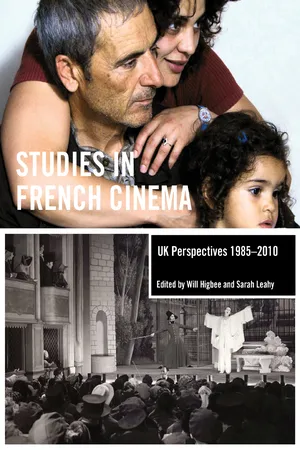
eBook - ePub
Studies in French Cinema
UK perspectives, 19852010
- 398 pages
- English
- ePUB (mobile friendly)
- Available on iOS & Android
eBook - ePub
Information
Chapter 1
Introduction
For more than twenty years, UK-based academics have been making key and distinct contributions to the way French cinema (its history and theory) has been taught and researched in both English-language and French universities. Following on from pioneering work produced by academics in France and the United States during the late 1960s and 1970s, studies focusing on key film-makers and movements such as Godard and 1930s Poetic Realism had begun to emerge in English by the mid-1980s – see, for example, Colin MacCabe’s work on Godard (1980), Roy Armes’ monograph French Cinema (1985) and Keith Reader’s (1981) analysis of French cinema in Cultures on Celluloid. In 1984, French cinema studies gained a certain visibility within the broader field of French studies, as the first-ever panel on French cinema at the Society for French Studies’ conference was convened; as part of this panel, Keith Reader presented a paper on La Règle du jeu/The Rules of the Game (Renoir 1939), Russell Cousins on La Bête humaine/The Human Beast (Renoir 1938) and Jill Forbes on Jean-Louis Baudry and theory.
Perhaps one of the first events where the question of French cinema as a discipline was directly debated was at the pioneering conference on European Cinema convened by Susan Hayward at Aston University in 1982. The proceedings of that conference, published in 1985, contain a short piece by Hayward entitled ‘Film Studies and Modern Languages’, in which she argues for the importance of varying theoretical approaches according to what is made necessary by the ‘filmic language’ (Hayward 1985: 155), indicating a desire to avoid any methodological or epistemological parti pris – a concern that has characterized Hayward’s work. The first PhD thesis on French Cinema was also completed in 1985. Submitted by Ginette Vincendeau to the University of East Anglia, this was entitled ‘Social Text and Context of a Popular Entertainment Medium’ (Vincendeau 1985).1 It is this thesis – as Phil Powrie argues in Part III of this book – that, along with the intervention of academics such as Forbes, Hayward and Reader at the aforementioned conferences of the mid-1980s, marks the start of the UK strand of French cinema studies. Finally, 1985 was a key date in the sense that the end of the year also saw the publication of the first of a series of seminal articles by Ginette Vincendeau in Screen – the academic journal that was then, and remains now, arguably the most important and prestigious forum for academic debate in the discipline of film studies. The article was titled ‘Community, Nostalgia and the Spectacle of Masculinity’ (Vincendeau 1985a); though it was certainly not the first contribution on French cinema to be published in Screen, it was notable for the way that it identified multiple areas of inquiry – popular cinema of the 1930s, French stardom, gender representation – that would emerge as key concerns in UK French film studies. The mid-1980s was therefore a crucial period for the emergence and visibility of a nascent network of UK-based researchers whose contribution is being recognized by this volume, which considers UK perspectives on studies in French cinema from 1985 to the present.
Under the direction of Susan Hayward and Ginette Vincendeau, this early research, collaboration and ongoing intellectual exchange from the 1980s led to arguably two of the most important departures for French screen studies in the English language in the early 1990s. The first of these was the publication of French Film: Texts and Contexts (1990), a collection of new work on French cinema by French, UK and US academics, edited by Hayward and Vincendeau, which ranged from the early silent period to the mid-1980s. The second was Hayward’s groundbreaking French National Cinema (1993), which established the Routledge National Cinemas Series and opened up discussions around the place and significance (ideological, political and economic) of the ‘national’ within a given national cinema or film culture, discussions that have had a broader impact in relation to national cinema studies in the fields of Film Studies and Modern Languages more generally.
What distinguished these two books was the way they considered French ‘national’ cinema in a context that combined research on the established key movements and moments (1920s Avant-garde, 1930s Poetic Realism, The Nouvelle Vague) in French cinema with apparently under-valued or overlooked films and film-makers who were seen as the antithesis of the art-house auteur that so characterized perceptions of French cinema from across the Channel.
Another significant achievement of French Film: Texts and Contexts was that it brought together for the first time leading academics from the United Kingdom, France and the United States who were working on French cinema. In much the same way that French national cinema must be seen in its transnational context – as part of a global network of cinematic relations – we recognize that scholarship is necessarily international in scope and in influence. Even a cursory glance at the bibliographical references in this volume reveals the centrality of international dialogue and exchange to the development of French cinema studies as a discipline. The focus on UK perspectives in this volume, then, is certainly not intended to exclude from the debate pioneering work on French cinema from France, the United States, Oceania, Canada and elsewhere. Rather, it is to take stock, after 25 years, of the evolution of the discipline with the UK university context and the impact of the emergence of French film as an object of study on the French studies curriculum, and to consider where the study of French cinema might be going from here. Inevitably, then, there is groundbreaking work – such as that of Bill Marshall (2009) on the French Atlantic, Mireille Rosello (1997, 2001) on postcolonial French film, Geneviève Sellier (2005) on gender in French cinema, Colin Crisp (1993) and Dudley Andrew (1995) on both the cinematic and cultural history of France, Laurent Creton (2004) on the economy of the French film industry, Michel Marie (1997) on the Nouvelle Vague and Raphaëlle Moine (2005a, 2005b) on genre, to cite just a few examples – which we have not been able to include directly, but whose major contribution to the field should be clear from the way this work has informed the scholarship presented here.
The focus of this volume also precludes the possibility of considering the important contribution of UK-based academics to the emerging field of postcolonial francophone French Studies – in particular, Murphy (2008), Thackway (2003) and Spass (2000), but above all the peerless contribution to studies of francophone North African and Sub-Saharan cinema produced by Roy Armes through numerous publications since the mid-1980s (see, for example, Armes 1987, 2005, 2007). The influence of such scholarship, its concern with colonial, postcolonial, diasporic and third cinema, and the ways in which diasporic film-makers from former French colonies destabilize or redefine our understanding of the boundaries of the nation in French national cinema is nonetheless present in this volume through the work of Carrie Tarr (Chapters 6 and 23) and Will Higbee (Chapter 16). Indeed, as the debates featured on the national and transnational of French cinema demonstrate (see in particular Hayward, Chapter 3 and Vincendeau, Chapter 24), these constantly shifting boundaries are particularly tricky to map.
Since the mid-1980s, then, drawing on a range of methodological approaches – from a focus on historical or textual analysis to cultural studies and feminist film theory – UK-based scholars of French cinema have published pioneering research in relation to French stardom, popular genre cinema, French women directors, representations of gender, French queer cinema and representations of sexuality, as well as postcolonial cinemas in France. These same scholars have also been attuned to developments in the wider field of film studies – in Chapter 7, for example, Vincendeau argues for a need to expand the work on stardom begun in the 1980s, which had been almost exclusively focused on Hollywood to the context of the 1930s French popular cinema and particularly the French star Jean Gabin. The choice here of a male star as the object of analysis also opened up questions of visual pleasure, the gaze and masculinity, thus bringing Vincendeau’s work into dialogue with key figures in film studies such as Laura Mulvey (1975) and Steve Neale (1984). Similarly, Susan Hayward’s seminal piece ‘National Cinemas and the Body Politic’ (republished here as Chapter 3) emanates from her own sustained engagement with questions of national cinema in the French context in order to offer an important contribution to a broader theorizing of the national in film studies. This chapter also prefigures, through Hayward’s application of Grewal and Kaplan’s (1994) concept of ‘scattered hegemonies’, a series of more recent debates around transnational, interstitial cinemas and cinemas of ‘small nations’ – see, for example, Ezra and Rowden (2006), Hjort and Petrie (2007) and Higbee and Lim (2010). Elsewhere, the work of Tarr, Forbes, Hayward, Reader and Powrie (including examples of their work found in this volume) has responded in various ways to what we might describe as the spatial turn that occurs in film studies during the 1990s, following on from the historical turn of the 1980s identified by Alastair Phillips in Chapter 19.
The United Kingdom’s status as a pivotal site for new and original debate in the area of French Screen Studies was further confirmed in 2000 with the founding by Professor Susan Hayward and Professor Phil Powrie of Studies in French Cinema (Intellect), the only international refereed academic journal devoted exclusively to French cinema. Studies in French Cinema has played a key role in the way that its editorial policy, along with the annual conference linked to the journal, has consistently attempted to open up a forum for under-researched areas, moments, movements or histories of French cinema (e.g. French cinema of the 1950s and 1970s, popular genre cinema, French queer cinema). In this respect, the journal has reflected the contribution made by UK-based academics (again, in dialogue with colleagues based in US, French and Oceanic institutions) to an opening out of the multiplicity of voices, histories and trends within French cinema, beyond the established canonical moments and movements of the early silent period, 1930s Poetic Realism and the French New Wave.
What marks much of the scholarship on French cinema that has emerged from the United Kingdom since the mid-1980s is the unique perspective it offers on French cinema that is located both within and outside the culture – a position described by Forbes in Chapter 20 – borrowing from the title of Noël Burch’s (1979) pioneering work on Japanese cinema – as that of the ‘distant observer’:
A ‘distant observer’ usefully describes the position of all those who study foreign cultures both because of the interpretative difficulties that distance throws up, and because of the privileges that distance confers and the capacity for totalization that it appears, perhaps dangerously, to offer to our gaze. The dialectic of closeness and distance, internality and externality, is one of the fascinating paradoxes of cultural studies – above all, perhaps, in the cinema, where the immediacy of perception tends to obscure the necessity for reflection.
Following Forbes’ lead, we would argue that this position of the distant observer is an enriching rather than a limiting one. This is a critical perspective that comes with a considerable knowledge and understanding of the complex historical, social and cultural factors at play within French cinema – or, to borrow Hayward and Vincendeau’s term, the texts and contexts of French cinema. However, it also offers an alternative view that repositions the focus of French cinema as an object of study at the same time as it seeks to shed light on previously obscured areas of French cinema via a plurality of perspectives (theoretical and historical) that challenge the homogenizing teleology of a French ‘national’ cinema. In a similar way, this positioning – which is both within and outside the culture it investigates – can afford productive encounters between French cinema history and theory via theoretical discourses that lie outside the realms/focus of French cinema, most obviously here the analysis of postcolonial and diasporic cinema that the work of Carrie Tarr has done so much to promote in the French context. Such work has been able to shed new light on the representation of France’s postcolonial minorities within the context of a multicultural, postcolonial France by employing a set of critical and theoretical concepts (postcolonial cinema, third cinema) more familiar to Anglo-American than francophone academics. Similar arguments can be made for the application of queer theory, questions around the popular drawn from cultural studies and, of course, gender studies. Indeed, it is to this last area that the work of Keith Reader and Phil Powrie has made a considerable contribution. Both scholars have, in their own ways, interrogated the power relations embedded in gender representation, notably revealing – through analyses of films ranging from René Clair’s Les Deux Timides/Two Timid Souls (1928) to Resnais’ L’Année dernière à Marienbad/Last Year at Marienbad (1961) and Eustache’s La Maman et la putain/The Mother...
Table of contents
- Cover
- Dedication
- Title Page
- Copyright
- Contents
- Acknowledgements
- Contributors
- Chapter 1: Introduction
- Part I
- Part II
- Part III
- Index
Trusted by 375,005 students
Access to over 1.5 million titles for a fair monthly price.
Study more efficiently using our study tools.
Frequently asked questions
Yes, you can cancel anytime from the Subscription tab in your account settings on the Perlego website. Your subscription will stay active until the end of your current billing period. Learn how to cancel your subscription
No, books cannot be downloaded as external files, such as PDFs, for use outside of Perlego. However, you can download books within the Perlego app for offline reading on mobile or tablet. Learn how to download books offline
Perlego offers two plans: Essential and Complete
- Essential is ideal for learners and professionals who enjoy exploring a wide range of subjects. Access the Essential Library with 800,000+ trusted titles and best-sellers across business, personal growth, and the humanities. Includes unlimited reading time and Standard Read Aloud voice.
- Complete: Perfect for advanced learners and researchers needing full, unrestricted access. Unlock 1.5M+ books across hundreds of subjects, including academic and specialized titles. The Complete Plan also includes advanced features like Premium Read Aloud and Research Assistant.
We are an online textbook subscription service, where you can get access to an entire online library for less than the price of a single book per month. With over 1.5 million books across 990+ topics, we’ve got you covered! Learn about our mission
Look out for the read-aloud symbol on your next book to see if you can listen to it. The read-aloud tool reads text aloud for you, highlighting the text as it is being read. You can pause it, speed it up and slow it down. Learn more about Read Aloud
Yes! You can use the Perlego app on both iOS and Android devices to read anytime, anywhere — even offline. Perfect for commutes or when you’re on the go.
Please note we cannot support devices running on iOS 13 and Android 7 or earlier. Learn more about using the app
Please note we cannot support devices running on iOS 13 and Android 7 or earlier. Learn more about using the app
Yes, you can access Studies in French Cinema by Will Higbee, Sarah Leahy, Will Higbee,Sarah Leahy in PDF and/or ePUB format, as well as other popular books in Media & Performing Arts & Film & Video. We have over 1.5 million books available in our catalogue for you to explore.