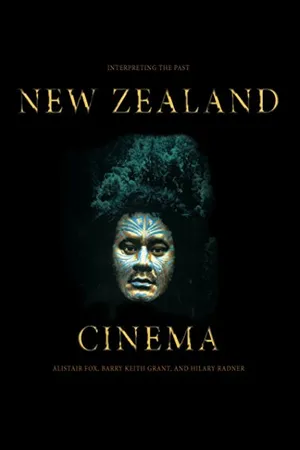
New Zealand has produced one of the world's most vibrant film cultures, a reflection of the country's evolving history and the energy and resourcefulness of its people. From early silent features like The Te Kooti Trail to recent films such as River Queen, this book examines the role of the cinema of New Zealand in building a shared sense of national identity. The works of key directors, including Peter Jackson, Jane Campion, and Vincent Ward, are here introduced in a new light, and select films are given in-depth coverage. Among the most informative accounts of New Zealand's fascinating national cinema, this will be a must for film scholars around the globe.
Rudall Hayward and the Cinema of Maoriland: Genre-mixing and Counter-discourses in Rewi’s Last Stand (1925), The Te Kooti Trail (1927) and Rewi’s Last Stand/The Last Stand (1940)
Alistair Fox
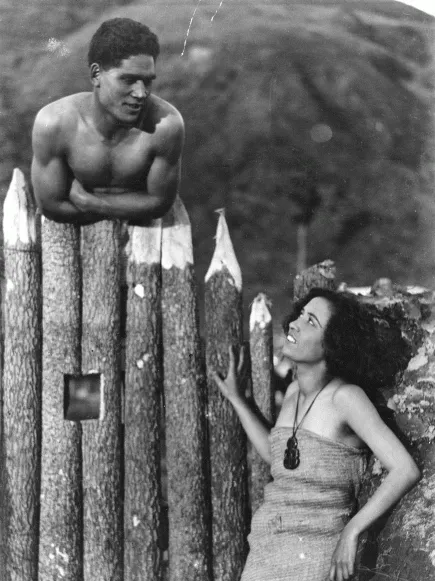
Patiti Warbrick as Taranahi and Tina Hunt as Monika in The Te Kooti Trail, 1927, dir. Rudall Hayward. Image courtesy of the Hayward Collection, New Zealand Film Archive Ng
Kaitiaki O Ng
Taonga Whiti
hua.
Michel Foucault and Hayden White, among others, have taught us to recognise the shaping power of discourses whenever any attempt is made to make sense of the multivariousness and apparent disorder of experience. A discourse, according to Foucault, is determined by the “group of relations established between authorities of emergence, delimitation, and specification” with respect to “objects.” These “discursive relations” are necessary “to speak of this or that object, in order to deal with them, name them, analyse them, classify them, explain them, etc.”1 The problem, however, as White has argued, is that “discourse always tends to slip away from our data towards the structures of consciousness with which we are trying to grasp them.” Correspondingly, “the data always resist the coherency of the image which we are trying to fashion of them.”2 In short, any attempt to assert a particular discourse as the means of interpreting experience inevitably conjures up the possibility of other, alternative ones.
These inseparably linked processes can be seen in the series of historical epics on the New Zealand Wars between M
ori and P
keh
of the 1860s made by Rudall Hayward, considered the father of New Zealand filmmaking. In this chapter, I shall argue that Hayward’s distinctive practice of mixing different genres resulted in films that acknowledge and animate a variety of competing discourses with the aim of correcting the simplicities of any single one. The tropes that constitute a particular genre carry with them an inherent and inherited latent meaning. For this reason, a fictive recreation of historical events that combines elements from a diverse range of genres is potentially capable of achieving a more complex, multifaceted representation than is liable to be constructed through more mono-dimensional representational means. As I shall demonstrate, Hayward’s New Zealand War epics achieve this kind of complexity because of his ability to draw upon the signifying resources of a range of cinematic and literary genres that were popular at the time in order to find a new way of construing the meaning of the past. In doing so, he demonstrated the usefulness of cinema as an instrument for the interpretation of history itself.
Origins of Hayward’s interest in New Zealand history
Hayward’s interest in New Zealand history, as he later recalled, began when, as a schoolboy at Whanganui Collegiate College, he became fascinated by James Cowan’s The Adventures of Kimble Bent: A Story of Wild Life in the New Zealand Bush, published by Whitcombe and Tombs in 1911.3 This narrative, recorded by Cowan from the oral account of Kimble Bent himself, tells how Bent, a British soldier who deserted during the New Zealand Wars of the 1860s, went over to the opposing side, and lived as a P
keh
-M
ori in Taranaki during the campaign of T
tokowaru, war chief of the Ng
ti Ruanui iwi, and the prophet Te Ua Haum
ne, founder of the Pai M
rire movement, against the colonial government.4 The adventures described by Kimble Bent were thrilling indeed, especially in their account of M
ori “primitive war-methods” that were terrifying to the Europeans, such as the revival by Pai M
rire of ancient rites, including the removal of the hearts of enemy soldiers, and cannibalism. Accordingly, his account is replete with “frightful scenes,” as when one of T
tokowaru’s war-parties tomahawks, cuts to pieces, cooks and eats a trooper named Smith, “who had incautiously ventured out to look for his horse beyond rifle-range of the redoubt,” or when the M
ori K
papa (M
ori troops fighting on the government side), “mad with the lust of killing,” decapitate and savagely mutilate the bodies of their Hauhau enemies.5 Cowan’s vivid rendition of these events, Hayward recalls, started him thinking about putting New Zealand history on the screen, because he realised that intercultural wars of the nineteenth century provided material as fascinating as any to be found in the American westerns that had been made popular by D. W. Griffith and his contemporaries.6
Hayward also appreciated that M
ori subject matter, including myths and legends, could exert a powerful appeal at the box office on account of its exoticism and ethnographic interest. From the 1870s onwards, literary works began to appear that combined elevated or lyrical descriptions of New Zealand’s sublime and picturesque landscapes with stories that presented the M
ori as variously noble, ferocious and romantic. Dusky M
ori maidens were depicted as seductive in their beauty and “wantonness,” while M
ori warriors were presented as matchless in their valour and martial pride. This was the literature of “Maoriland,” the alternative name for New Zealand that was popular up until the 1930s.7 It included works such as Alfr...
Table of contents
Cover
Title Page
Copyright
Dedication
Contents
Acknowledgements
Introduction: The Historical Film in New Zealand Cinema
Chapter 1: Rudall Hayward and the Cinema of Maoriland: Genre-mixing and Counter-discourses in Rewi’s Last Stand (1925), The Te Kooti Trail (1927) and Rewi’s Last Stand/The Last Stand (1940)
Chapter 2: Rudall Hayward’s Democratic Cinema and the “Civilising Mission” in the ”Land of the Wrong White Crowd”
Chapter 3: The Western, New Zealand History and Commercial Exploitation: The Te Kooti Trail, Utu and Crooked Earth
Chapter 4: Unsettled Historiography: Postcolonial Anxiety and the Burden of the Past in Pictures
Chapter 5: Cross-currents: River Queen’s National and Trans-national Heritages
Chapter 6: Tracking Titokowaru over Text and Screen: Pakeha Narrate the Warrior, 1906–2005
Chapter 7: Rites of Passage in Post–Second World War New Zealand Cinema: Migrating the Masculine in Journey for Three (1950)
Chapter 8: Cinema and the interpretation of 1950s New Zealand History: John O’Shea and Roger Mirams, Broken Barrier (1952)
Chapter 9: Re-representing Indigeneity: Approaches to History in Some Recent New Zealand and Australian Films
Chapter 10: “The Donations of History”: Mauri and the Transfigured “Maori Gaze”: Towards a Bi-national Cinema in Aotearoa
Chapter 11: History, Hybridity and Indeterminate Space: The Parker-Hulme Murder, Heavenly Creatures and New Zealand Cinema
Chapter 12: Screening Women’s Histories: Jane Campion and the New Zealand Heritage Film, from the Biopic to the Female Gothic
Chapter 13: The Time and the Place: Music and Costume and the “Affect” of History in the New Zealand Films of Jane Campion
Chapter 14: Mining for Forgotten Gold: Leon Narbey’s Illustrious Energy (1987)
Filmography
Bibliography
Contributors
Index
Trusted by 375,005 students
Access to over 1.5 million titles for a fair monthly price.
Study more efficiently using our study tools.
Frequently asked questions
Yes, you can cancel anytime from the Subscription tab in your account settings on the Perlego website. Your subscription will stay active until the end of your current billing period. Learn how to cancel your subscription
No, books cannot be downloaded as external files, such as PDFs, for use outside of Perlego. However, you can download books within the Perlego app for offline reading on mobile or tablet. Learn how to download books offline
Perlego offers two plans: Essential and Complete
Essential is ideal for learners and professionals who enjoy exploring a wide range of subjects. Access the Essential Library with 800,000+ trusted titles and best-sellers across business, personal growth, and the humanities. Includes unlimited reading time and Standard Read Aloud voice.
Complete: Perfect for advanced learners and researchers needing full, unrestricted access. Unlock 1.5M+ books across hundreds of subjects, including academic and specialized titles. The Complete Plan also includes advanced features like Premium Read Aloud and Research Assistant.
Both plans are available with monthly, semester, or annual billing cycles.
We are an online textbook subscription service, where you can get access to an entire online library for less than the price of a single book per month. With over 1.5 million books across 990+ topics, we’ve got you covered! Learn about our mission
Look out for the read-aloud symbol on your next book to see if you can listen to it. The read-aloud tool reads text aloud for you, highlighting the text as it is being read. You can pause it, speed it up and slow it down. Learn more about Read Aloud
Yes! You can use the Perlego app on both iOS and Android devices to read anytime, anywhere — even offline. Perfect for commutes or when you’re on the go. Please note we cannot support devices running on iOS 13 and Android 7 or earlier. Learn more about using the app
Yes, you can access New Zealand Cinema by Alistair Fox, Barry Keith Grant, Hilary Radner, Alistair Fox,Barry Keith Grant,Hilary Radner, Barry Keith, Alistair Fox, Hilary Radner in PDF and/or ePUB format, as well as other popular books in Art & Art General. We have over 1.5 million books available in our catalogue for you to explore.