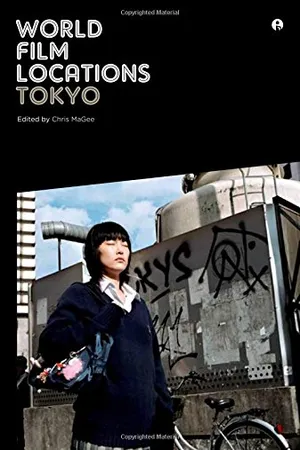
World Film Locations: Tokyo
eBook - ePub
Available until 23 Dec |Learn more

World Film Locations: Tokyo

  1. 128 pages
  2. English
  3. ePUB (mobile friendly)
  4. Available on iOS & Android
eBook - ePub
Available until 23 Dec |Learn more

World Film Locations: Tokyo

About this book

World Film Locations: Tokyo gives readers a kaleidoscopic view of one of the world's most complex and exciting cities through the lens of world cinema. 50 scenes from classic and contemporary films explore how motion pictures have shaped the role of Tokyo in our collective consciousness, as well as how these cinematic moments reveal aspects of the life and culture of a city that are often hidden from view. Complimenting these scenes from such varied films as Tokyo Story, You Only Live Twice, Godzilla and Enter the Void are six spotlight essays that take us from the wooden streets of pre-nineteenth-century Edo to the sprawling 'what-if' megalopolis of science fiction anime.

Illustrated throughout with dynamic screen captures World Film Locations: Tokyo is at once a guided tour of Japan's capital conducted by the likes of Akira Kurosawa, Samuel Fuller, Chris Marker and Sofia Coppola while also being an indispensible record of how Tokyo has fired both the imaginations of individuals working behind the camera and those of us sitting transfixed in movie theatres.

Frequently asked questions

Yes, you can cancel anytime from the Subscription tab in your account settings on the Perlego website. Your subscription will stay active until the end of your current billing period. Learn how to cancel your subscription.
No, books cannot be downloaded as external files, such as PDFs, for use outside of Perlego. However, you can download books within the Perlego app for offline reading on mobile or tablet. Learn more here.
Perlego offers two plans: Essential and Complete
  • Essential is ideal for learners and professionals who enjoy exploring a wide range of subjects. Access the Essential Library with 800,000+ trusted titles and best-sellers across business, personal growth, and the humanities. Includes unlimited reading time and Standard Read Aloud voice.
  • Complete: Perfect for advanced learners and researchers needing full, unrestricted access. Unlock 1.4M+ books across hundreds of subjects, including academic and specialized titles. The Complete Plan also includes advanced features like Premium Read Aloud and Research Assistant.
Both plans are available with monthly, semester, or annual billing cycles.
We are an online textbook subscription service, where you can get access to an entire online library for less than the price of a single book per month. With over 1 million books across 1000+ topics, we’ve got you covered! Learn more here.
Look out for the read-aloud symbol on your next book to see if you can listen to it. The read-aloud tool reads text aloud for you, highlighting the text as it is being read. You can pause it, speed it up and slow it down. Learn more here.
Yes! You can use the Perlego app on both iOS or Android devices to read anytime, anywhere — even offline. Perfect for commutes or when you’re on the go.
Please note we cannot support devices running on iOS 13 and Android 7 or earlier. Learn more about using the app.
Yes, you can access World Film Locations: Tokyo by Chris MaGee in PDF and/or ePUB format, as well as other popular books in Media & Performing Arts & Film & Video. We have over one million books available in our catalogue for you to explore.

Information

TOKYO LOCATIONS

SCENES 1-7

1.
TOKYO MARCH (1929)
Pre-war Asakusa/Shinjuku/Musashino
page 10
2.
STRAY DOG/NORA INU (1949)
4 Ueno, Taito-ku, Ameyokocho
page 12
3.
TOKYO STORY (1953)
Ginza shopping district
page 14
4.
WHERE CHIMNEYS ARE SEEN (1953)
Senju Thermal Power Station, 35 Senju
Sakuragi, Adachi Ward
page 16
5.
GODZILLA/GORIJA (1954)
Wako Department Store, 4-5-11 Ginza, Ch
image
image

page 18
6.
HOUSE OF BAMBOO (1955)
Ginza district of Ch
image
image

page 20
7.
WHEN A WOMAN ASCENDS THE STAIRS (1960)
Ginza 6-chome
page 22

TOKYO MARCH (1929)

LOCATION
The most modernized city of the East
image
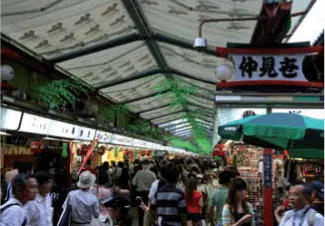
Nakamise shopping street, Sensoji Temple, Asakusa (Photo ©Richard Ryer)
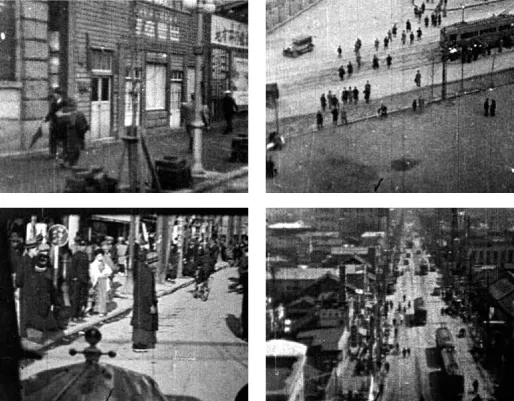
IT’S A MIRACLE THAT WE CAN enjoy films of Tokyo made before 1945. Not only was the actual nitrate-based film stock used before then fragile and highly flammable, but Tokyo itself suffered terribly during the first half of the twentieth century. The Great Kanto Earthquake of 1923 and the US-lead fire bombings of World War II would topple and pummel the Japanese capital. Once the Occupation began in the fall of 1945 many film prints that didn’t burn in the bombing were deemed a threat to Japan’s nascent democracy and ended up burning on the bonfires of US censors. These tragic events make the opening of Kenji Mizoguchi’s Tokyo March that much more miraculous. Only 28 minutes survive of this melodrama about a beautiful geisha named Orie who comes between two friends, Yoshiki and Sakuma, but the first two minutes affords us a rare glimpse of pre-war Tokyo. We see the city through the wind shield of a speeding automobile: commuters run to catch a streetcar, patent leather shoes walk beside traditional geta, housewives, businessmen and bicyclists jockey in the street. Art deco-inspired inter-titles speak of ā€˜the most modernized city of the East’ and the vast metropolis’ various districts āˆ’ the ā€˜chic town of Asakusa’, ā€˜the ever-changing Shinjuku’ and Musashino where the moon ā€˜shines over the rooftop of the shopping mall’. These fleeting, grainy shots of Tokyo are made all the more poignant by the fact that just sixteen years later the city would be almost totally destroyed in the war.
image
Chris MaGee
Directed by Kenji Mizoguchi
Timecode for scene: Pre-war Asakusa/Shinjuku/Musashino Scene duration: 0:01:24 – 0:03:17
image
Images ©1929 Gendai Eigasha; Nikkatsu Uzumasa

STRAY DOG/NORA INU (1949)

LOCATION
4 Ueno, Taito-ku, Ameyokocho
image
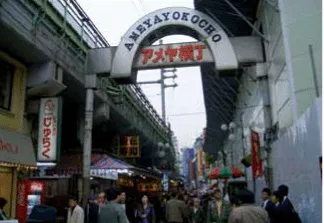
Ameyokocho shopping street
PRESENT DAY AMEYOKOCHO is a major shopping area which literally translates as ā€˜American Alley’ and is famous for the range of goods on offer from both department stores and market stalls. In the late-1940s, however, Ameyokocho was a thriving black market community, known for trading under-the-table American products, hence its significance to the plot of Akira Kurosawa’s classic police procedural Stray Dog. When his gun is stolen while travelling on a crowded bus, disgraced Detective Murakami (Toshiro Mifune) becomes determined to restore his reputation by retrieving the weapon from the clutches of the criminal underworld. Murakami’s self-assigned mission takes him to Ameyokocho where, disguised as an unkempt ex-soldier, he wanders around, attempting to establish the necessary lead. This lengthy sequence was shot by second unit director Ishiro Honda, who hid his handheld camera in a box as a means of capturing footage of Tokyo’s seedy underbelly that would work within Kurosawa’s film noir framework. Starting at Ueno station, Murakami makes his way through bars, brothels, flophouses and street markets, sweating under the sweltering sun, eventually making contact with a bandaged gangster while recuperating by a bombed-out fountain. If the undercover Murakami is looking for redemption, everyone else in Ameyokocho is simply seeking survival; Kurosawa superimposes Murakami’s searching eyes over the crowded environment to show his realization that this is a world driven by desperation and populated by bottom-feeders. Ameyokocho burned down in late 1949, making this sequence a valuable record of the social collapse that constituted Japan’s post-war underground economy.
image
John Berra
Directed by Akira Kurosawa
Scene description: Detective Murakami undercover at the black market Timecode f...

Table of contents

  1. Cover
  2. Title Page
  3. Copyright
  4. Contents
  5. Essays
  6. Maps/Scenes
  7. Tokyo: City of The Imagination
  8. Scenes 1-7
  9. Worst of Times/Best of Times: Post-War Tokyo in Film
  10. Scenes 8-14
  11. Tokyo Must Burn! The End of The World Through Anime Eyes
  12. Scenes 15-21
  13. Tokyo Stories: The Humanistic Cityscape Of Yasujiro Ozu
  14. Scenes 22-28
  15. Strangers Among Us: A Cinematic View of Immigrants In Tokyo
  16. Scenes 29-36
  17. Shinjuku: Dawn is Wet
  18. Scenes 37-45
  19. Edo: Old Tokyo resurrected on film
  20. Resources
  21. Filmography
  22. Contributor Bios