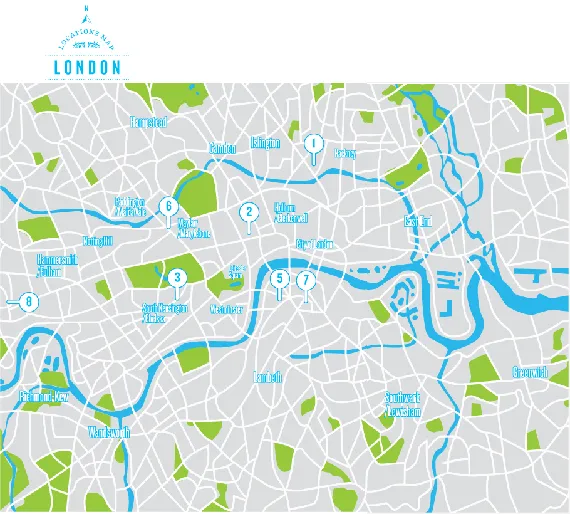
An exciting and visually focused tour of the diverse range of films shot on location in London, World Film Locations: London presents contributions spanning the Victorian era, the swinging '60s and the politically charged atmosphere following the 2005 subway bombings. Essays exploring key directors, themes and historical periods are complemented by reviews of important scenes that offer particular insight into London's relationship to cinema. The book is illustrated throughout with full-colour film stills and photographs of cinematic landmarks as they appear now – as well as city maps to aid those keen to investigate them.
Frequently asked questions
Yes, you can cancel anytime from the Subscription tab in your account settings on the Perlego website. Your subscription will stay active until the end of your current billing period. Learn how to cancel your subscription.
No, books cannot be downloaded as external files, such as PDFs, for use outside of Perlego. However, you can download books within the Perlego app for offline reading on mobile or tablet. Learn more here.
Perlego offers two plans: Essential and Complete
Essential is ideal for learners and professionals who enjoy exploring a wide range of subjects. Access the Essential Library with 800,000+ trusted titles and best-sellers across business, personal growth, and the humanities. Includes unlimited reading time and Standard Read Aloud voice.
Complete: Perfect for advanced learners and researchers needing full, unrestricted access. Unlock 1.4M+ books across hundreds of subjects, including academic and specialized titles. The Complete Plan also includes advanced features like Premium Read Aloud and Research Assistant.
Both plans are available with monthly, semester, or annual billing cycles.
We are an online textbook subscription service, where you can get access to an entire online library for less than the price of a single book per month. With over 1 million books across 1000+ topics, we’ve got you covered! Learn more here.
Look out for the read-aloud symbol on your next book to see if you can listen to it. The read-aloud tool reads text aloud for you, highlighting the text as it is being read. You can pause it, speed it up and slow it down. Learn more here.
Yes! You can use the Perlego app on both iOS or Android devices to read anytime, anywhere — even offline. Perfect for commutes or when you’re on the go. Please note we cannot support devices running on iOS 13 and Android 7 or earlier. Learn more about using the app.
Yes, you can access World Film Locations: London by Neil Mitchell in PDF and/or ePUB format, as well as other popular books in Media & Performing Arts & Film & Video. We have over one million books available in our catalogue for you to explore.
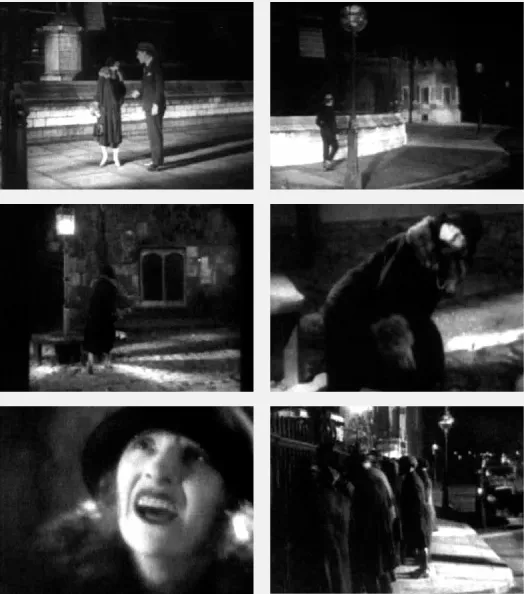
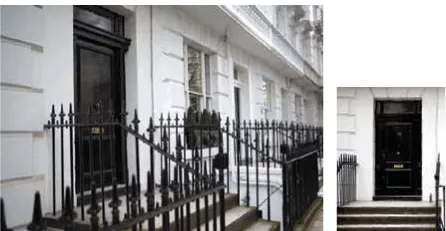
THE 1927 SILENT CLASSICThe Lodger is widely regarded as the first true ‘Hitchcock’ film, not least by the man himself. As such it incorporates two of his most popular themes – the wrongly accused man and the association between sex and murder – and it is also the film where Hitchcock made the first of his trademark cameo appearances. The simple plot sees Ivor Novello’s Jonathan Drew moving into a new flat during a spate of killings by a Jack the Ripper-type serial killer known as ‘The Avenger’. Drew immediately draws suspicion on himself by behaving strangely, leaving the house at odd hours and lusting after the landlady’s daughter. The subtitle to The Lodger identifies it as ‘A Story of the London Fog’ but although there’s plenty of fog there’s very little of late 1920s London in evidence. However, though most of the film was shot at a studio in Islington, there are a couple of recognizable exterior shots, most notably the location of the killer’s second murder, where the riverbank wall is clearly visible as the soon-to-be victim quarrels with her lover. Things could have been very different, however − Hitchcock apparently wanted to show the first victim being dragged out of the Thames with the Hungerford Bridge in the background. He managed to get permission from Scotland Yard on the condition that he filmed the scene in one night, only to discover, post-shooting, that the cameraman had forgotten to put on the lens, rendering the scene unusable.
Matthew Turner
Directed by Alfred Hitchcock
Scene description: The killer commits a second murder Scene duration: 0:30:00 – 0:30:23
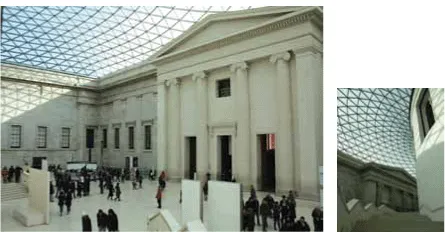
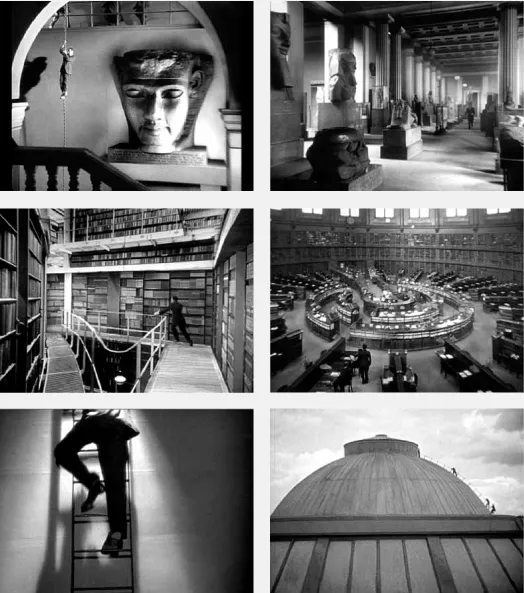
BLACKMAIL IS REGARDED as the first British ‘sound’ movie or ‘talkie’. However, for the climactic pursuit scene through the British Museum, sound is irrelevant as Hitchcock demonstrates how to shoot a tense and dramatic scene within a recognizable and visually stunning location. Hitchcock would refine this type of sequence throughout his remarkable and innovative career. The use of The British Museum for this scene, and within the context of the film, is significant for many reasons. Prior to the chase the film is set in small interior locations − a loft studio, mall shop, and backroom, etc. The penultimate scene sees the villain, blackmailer and suspected murderer ‘Tracy’ being chased by the police, during which Hitchcock exploits the museum’s vast space to great effect. The monolithic columns outside the museum dwarf the fleeing man as he stops beside them. His tiny frame juxtaposed against the overwhelming pillars predicts the futility of his running. In the museum the chase continues through the long corridors, the huge domed Reading Room (now located at the British Library) and the ancient Egypt room. Due to the museum’s low light levels, and to exacerbate the size of the rooms and length of the corridors, Hitchcock used a primitive yet effective technique called ‘The Schufftan Process’ that involved using mirrors placed at specific angles in relation to the camera to create a spatially exaggerated setting on film. This heightened sense of realism, coupled with a keen eye for architectural grandeur, foregrounds the young Hitchcock’s pioneering talents.
Toby King
Directed by Alfred Hitchcock
Scene description: The pursuit of Tracy through the British Museum Timecode for scene: 1:14:10 – 1:18:00
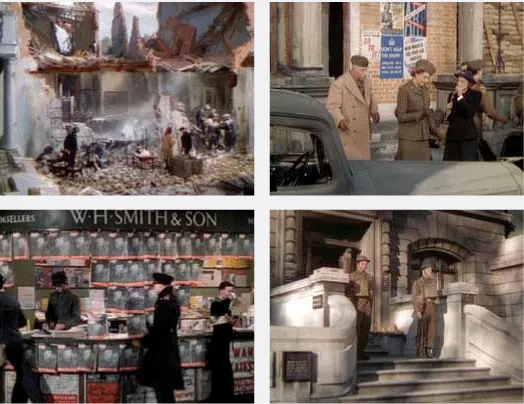
MICHAEL POWELL AND Emeric Pressburger’s wartime London is a cinematic feast of fortified landmarks and bleak streets. And rightly so, as they are the eminent directors of wartime films in Britain. In The Life and Death of Colonel Blimp, the newly retired Colonel Candy (Roger Livesey) receives notice of his ejection from the army amid myriad early war cries, and opts to dine in his stately home with porter Murdoch (John Laurie) and the aptly named Johnny Cannon, played by Deborah Kerr in her third role in the film. Candy’s home, sturdily built, with a military-esque khaki colour scheme and shot in staid 3-person square framing, is indicative of the stiff upper lip that resides beneath Candy’s well-groomed moustache. After firework-like bomb graphics hit the screen, the ensuing air raid announcements pass to reveal Candy’s home in ruins. The white-grey coated interior spreads only as far as the fireplace, where a landscape painting remains − a relic of the blitzed Brits’ only hiding place: the country. Despite the carnage its exterior screams wartime London − blue skies spill through the cracks as a bomber hovers in the background and a tea-drinking clean-up crew jokes lightly about its resident’s need for a bath. Meanwhile, departing from a Piccadilly spa, Candy is flanked by bricks, columns, and sandbags of wartime proportions as he hops into the car. Whipping past Piccadilly to a thoroughly representative WHSmith news-stand, indoor and outdoor London remain upstanding against destructive outside forces, its wartime residents in solidarity for home and country.
Nicola Balkind
Directed by Michael Powell and Emeric Pressburger
Scene description: London during wartime Timecode for scene: 2:29:00 – 2:33:00
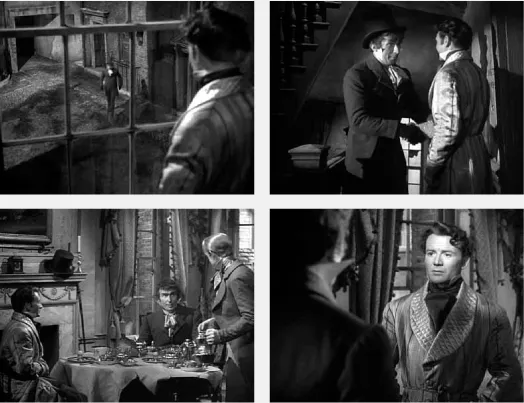
IN DAVID LEAN’S magisterial imagining of Charles Dickens’s rags-to-riches classic of nineteenth century life, the young Pip Pirrip (John Mills) is plucked from his humble rural beginnings by a mysterious benefactor and sent to live in London to become ‘a young gentleman of great expectations’. In a studio shot sequence which best illustrates the change this provokes in him, Pip is visited by his brother-in-law. As the faltering blacksmith Joe Gargery (Bernard Miles) approaches the house, Pip’s elevation at the window emphasizes his feeling of superiority toward the man who raised him. His narration rings with disdain: ‘As I watched Joe that Tuesday morning, dressed grotesquely in a new suit, let me confess that if I could have kept him away by paying money, I certainly would have paid money.’ Joe is merely intimidated by the big city, as Pip himself had been at first, yet Pip’s mortified reaction illustrates the wedge that perceived social superiority can drive between families and the resulting incompatibility of his old and new life. In Great Expectations London represents success and civility and is held in stark contrast to Pip’s coarse provincial upbringing. Once inside, Joe’s clumsy antics with his hat cause agony for Pip, who is short-tempered and rough with him. Sensing Pip’s embarrassment, Joe hastily departs and − as Pip is left to reflect on his behaviour − it is his own words which most fittingly condemn him: ‘In trying to become a gentleman, I had succeeded in becoming a snob.’
Emma Simmonds
Directed by David Lean
Scene description: Joe visits Pip in London Timecode for scene: 0:56:24 – 1:00:00
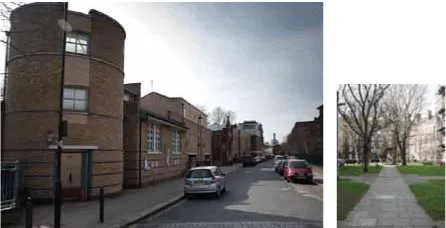
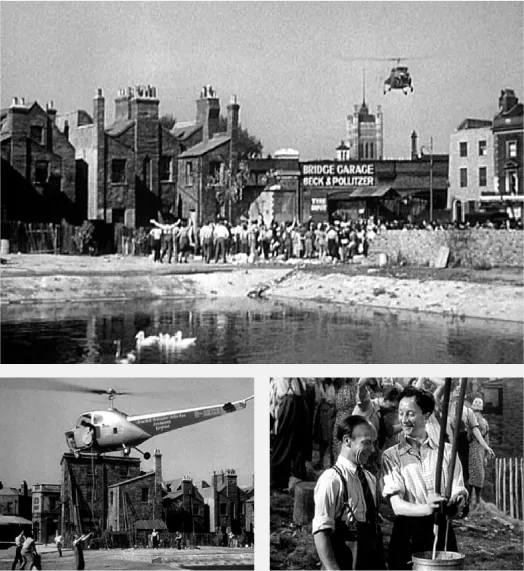
EALING STUDIOS’ sweetly satirical Passport to Pimlico pokes gentle fun at the stifling austerity of post-war London. The detonation of an unexploded bomb in Pimlico’s (fictional) Miramont Place reveals ancient documents proving that the district of Pimlico actually belongs to Burgundy, France. Realizing that as Burgundians they are no longer subject to post-war rationing and other restrictions, the Pimlico locals declare independence and the district is quickly flooded with black marketeers, spivs and entrepreneurs, causing the government to retaliate by erecting a blockade (echoing the Berlin Blockade, a topical theme for 1949 audiences). The film’s climax sees Londoners rally round and throw supplies over the barriers to the starving Burgundians, causing the government to relent and negotiate. The closing scenes feature an impressively staged visual gag where a helicopter hovers over Miramont Place and delivers milk. The pilot shouts ‘Milk-o!’ as milkmen used to do, while down on the ground, Bert (Charles Hawtrey, latterly a regular in the Carry On films) pretends to milk the whirlybird whilst operating the milk hose. Passport to Pimlico wasn’t actually filmed in Pimlico, the Miramont Place set was built about a mile away, on the other side of the river, on a cleared bomb site on the Lambeth Road. Municipal flats were built on the site in the 60s and are now part of the China Walk Estate, but the railway arches shown to good effect in the background of the helicopter scene are clearly visible from the junction of Hercules Road and Lambeth Road.
Matthew Turner
Directed by Henry Cornelius
Scene description: The helicopter milk round Timecode for scene: 1:14:55 – 1:15:32
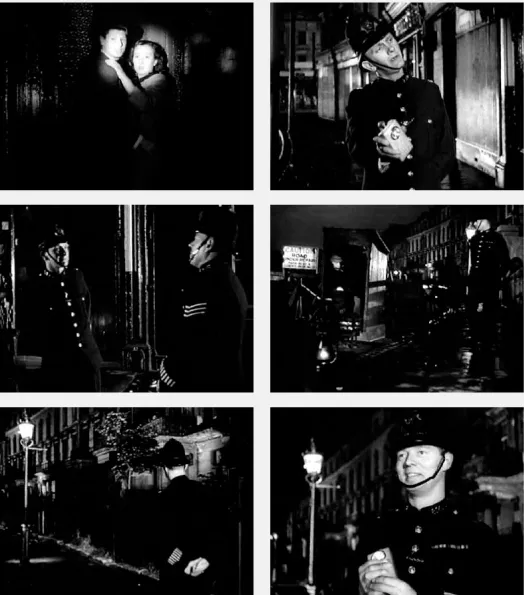
AN EARLY SCENE in Basil Deardon’s now landmark film has rookie cop Andy Mitchell doing his first night shift on the beat out of Paddington Green police station. The noirish filming of the London streets (rain soaked, with low key lighting) suggest the risk of urban crime. However, this is soon negated by the avuncular policemen patrolling the streets – observing the stars, indulgently busting a young couple kissing, and walking quietly so as not to wake sleeping street hawkers. Andy soon falls in with his future mentor, PC George Dixon (Stanley Baxter), who gives him some tips on surviving the London night shift. The trick is to find something to occupy your mind, and Dixon composes amusing songs about the force:
They’ve cracked a safe at number 8 and robbed a local bank.
Kids have smashed the fire alarm just their jolly prank,
You’ve found a headless torso and its foul play you suspect (and here’s the funny bit),
But when the sergeant comes along you must tell him ‘all correct!’
This sequence, and this song in particular, encapsulates the London that Deardon imagines. It oscillates between the noir and the idyllic, between jolly pranks and headless torsos, between an equilibrium represented by the ‘blue lamp’ of the police and the dangerous social elements of postwar London’s underworld of spivs and petty criminals.
Lindsay Steenberg
Directed by Basil Deardon
Scene description: PC Andy Mitchell does his first night shift on the beat Timecode for scene: 0:13:13 − 0:14:20
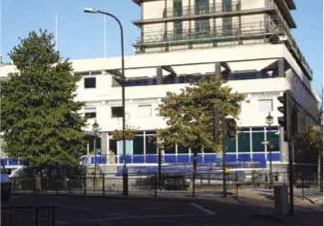
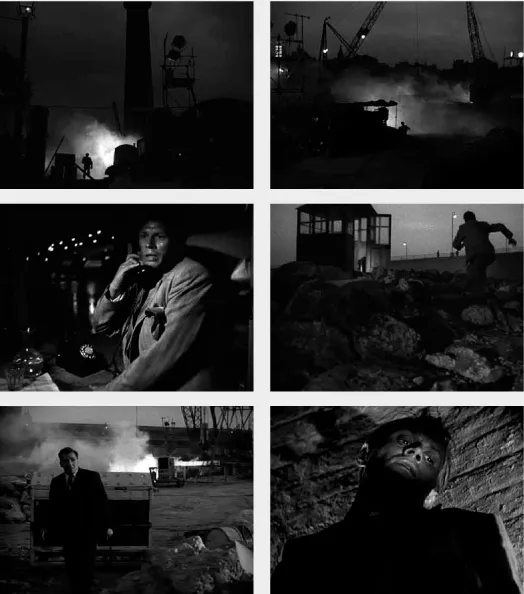
IN JULES DASSIN’S classic 1950 thriller Night and the City, London got its very own slice of film noir. Shot on the streets and sound-stages of the capital, Dassin’s vision of London’s underworld centres on two-bit hustler Harry Fabian (Richard Widmark), whose latest get-rich-quick scheme hinges on taking control of professional wrestling away from vicious underworld boss Kristo (Herbert Lom). However, when his manipulative scheming results in the death of Kristo’s father (in one of the best fight scenes ever committed to celluloid), Harry finds himself on the run with a price on his head and no one to turn to. With dawn about to break and Kristo’s thugs hot on his tail, Harry races across the real-life construction site (itself the site of severe bombing during World War II) for 1951’s Festival of Britain. It later became the Royal Festival Hall and, after further expansion, the Southbank Centre, including what is now the BFI Southbank. Waterloo Bridge is clearly visible in the background as Harry makes a desperate phonecall from the engineer’s shack after having been forced to kill one of his pursuers in self-defence. The scene is brilliantly shot, lit and edited, with Dassin and cameraman Max Green (real name Mutz Greenbaum) getting terrific use out of the various angles and shadows the site provided. Similarly, in order to shoot everything quickly within their allotted twenty minute window of light, Dassin and Green used six different camera set-ups in total – an almost unheard-of occurrence in 1949.
Matthew Turner
Directed by Jules Dassin
Scene description: The chase across the Festival of Britain construction Timecode for scene: 1:14:00 – 1:16:00
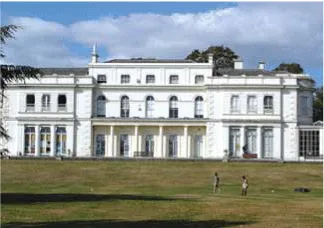
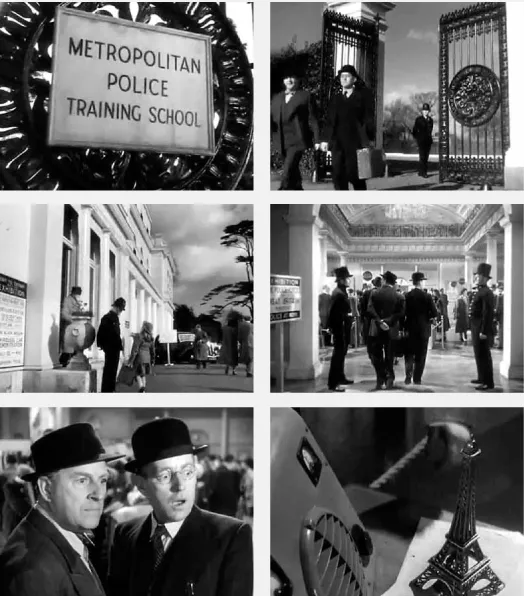
GUNNERSBURY PARK, once the home of the Rothschilds, is one of the most beautiful landmarks in London – and, for fans of The Lavender Hill Mob, it is also one of the most evocative. Charles Crichton’s ageless Ealing comedy reaches its crucial point in a scene filmed at Gunnersbury, here doubling for the ‘Metropolitan Police Training School’ and hosting an exhibition of the force’s anti-crime operations. Alec Guinness’s ‘Dutch’ Holland and Stanley Holloway’s Alfred Pendlebury follow a schoolgirl inside, with the aim of recovering from her a miniature Eiffel Tower they have cast from stolen gold and that she believes to be a cheap souvenir. They are forced to snatch it – and what seems like the entire Metropolitan police force gives chase in an exquisitely English scene. The criminals are dressed in suits and ties, and their escape is conducted as a condescending voice repeatedly intones, ‘The public can assist the police by keeping the gangways clear. Keep calm and avoid crowding…’ There is violence, but none is excessive and only a little (tipping over a guard box with an officer inside, for example) is unsporting. As Holland and Pendlebury dash outside to steal a police car, they remember that Dutch cannot drive and so comically swap positions, before driving off into the next scene: one of cinema’s quaintest car chases. The entire sequence is fuelled by a kind of Britishness that no longer exists, and perhaps did not exist even in 1951, but one that will always amuse.
Scott Jordan Harris
Directed by Charles Crichton
Scene description: ‘Run, Dutch! Run!’/The Police Exhibition Timecode for scene: 1:05:11 – 1:10:22
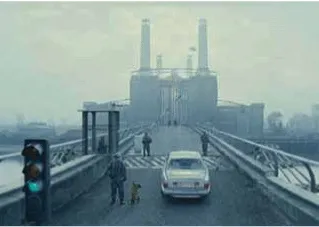
FROM THE BIRTH OF CINEMA onwards, London has been ever present on the big screen in films shot wholly or in part in the city, via Hollywood studio recreations and through other locations posing as England’s capital. London’s geographical collision of tourist attractions, white and blue collar work-spaces, leafy middle class suburbs, parklands, liminal spaces, and economically deprived areas have proved to be fertile cinematic territory. In keeping with film representations of any frequently used major city London’s onscreen identity is as fluid, contradictory and diverse as it is in real life. From Hitchcock’s atmospheric The Lodger: A Story of the London Fog (1929), which uses both the crimes of Jack the Ripper and the historic ‘pea soupers’ that once engulfed the city as its narrative and visual basis, through to Alfonso Caurón’s adaptation of P. D. James’ dystopian novel Children of Men (2006), the city has been host to every conceivable genre of film covering all manner of narratives, historic events, fantasy visions and cultural zeitgeists. Victorian set films (of which there have been nearly two hundred Dickens adaptations alone) along with film visions of Edwardian England, wartime London, the Swinging Sixties, ‘Thatcher’s Britain’ and contemporary multiculturalism as seen in Stephen Frears’ Dirty Pretty Things (2002), have all charted, challenged, re-interpreted and celebrated London and its residents.
Children of Men
As the River Thames winds its way through the city’s landmass so the evolution of the city itself threads its way through the films where London is portrayed. As the ‘face’ of the city has changed, architecturally, demographically and culturally, so have its onscreen representations. Issues surrounding race, class, gender and sexuality have all played out in the private and public spaces of the city throughout the decades. The city signifiers of old London – St. Paul’s Cathedral, Big Ben and The Houses of Parliament, and the contemporary landmarks of The London Eye, The Gherkin and The O2 Arena, coupled with the equally ubiquitous Routemaster buses, black cabs, red telephone boxes and iconic Underground typography, physically locate these movies. When contextually aligned with historical facts, media representations, other artistic visions, and cultural, social and political upheavals (either within Britain or on a global scale) the ‘idea’ of London in a narrative is better grounded and informed. As its iconography is visual shorthand for the city so London is, or at least was for many years, cinematic shorthand for England, and by extension Britain, its powerful allure highlighted both by its regular appearances onscreen and as, annually, either the most visited or second most visited city on the planet. The East End, Camden Town, the more exclusive enclaves of Knightsbridge and Mayfair, the licentious streets of Soho and the South Bank are all distinct physical environments which also exist concurrently as ideas in the imagination of visitors, residents and film audiences alike.
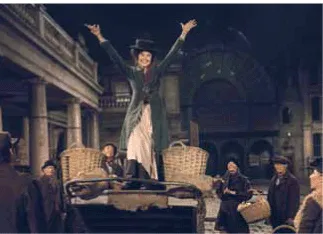
My Fair Lady
As in all collections of films, crime is one of the most enduring and frequently utilized genres, and in many cases London crime films exemplify the social climate of the era in which they are set. Basil Dearden’s The Blue Lamp (1950), John Mackenzie’s The Long Good Friday (1980) and David Cronenberg’s Eastern Promises (2007) for example all portray the city in very different ways. Where Dearden’s film is a ‘localized’ view of post war crime around the streets of Paddington, The Long Good Friday’s East End gangster Harold Shand (Bob Hoskins) is drawn into the wider politicized dealings of the IRA and American business interests at the dawn of Thatcherism. By the time of Cronenberg’s film the globalized twenty-first century London criminal underworld is portrayed as being dominated by Eastern European criminals, who have infiltrated and colonized large parts of the city.
Striking contrasts occur frequently in visions of London. Gary Oldman’s coruscating Nil by Mouth (1997), a tale of dysfunctional working class lives blighted by alcohol and drug abuse in the neglected environment of a South London council estate, is visually and thematically light years away from George Kukor’s family friendly musical My Fair Lady (1964). What they have in common though, is a concern with psycho-geography: the effects of the environment on emotional states. Psycho-geography is an increasingly prevalent concern when dealing with city life onscreen, and given London’s diversified living spaces it has played an intrinsi...
Table of contents
Cover
Title Page
Copyright
Contents
Essays
Maps/Scenes
London: City of the Imagination
Scenes 1-8
Victorian London : A Painterly Vision of the City Divided
Scenes 9-16
Ealing Studios: A Brief History of the Mecca of British film
Scenes 17-24
Swinging London: Their Texts Are Loud But Never Square
Scenes 25-32
Going Underground : Strange Goings On Down Below...