eBook - ePub
Available until 23 Dec |Learn more
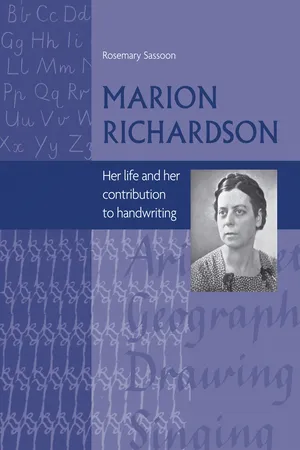
Marion Richardson
Her Life and Her Contribution to Handwriting
This book is available to read until 23rd December, 2025
- 97 pages
- English
- ePUB (mobile friendly)
- Available on iOS & Android
eBook - ePub
Available until 23 Dec |Learn more
About this book
In Marion Richardson: Her Life and Contribution to Handwriting, Rosemary Sassoon looks at Richardson's life and work through the artist and educator's own writings as well as letters and personal recollections from those who knew and worked with her. The driving force behind a momentous shift in the way art is taught to children, Richardson is perhaps best known for her groundbreaking contribution to penmanship, devising two schemes based on her observations of the natural movements of young children's hands. The result of extensive original archival research, this book includes many illustrations that depict Richardson's inventive approach.
Frequently asked questions
Yes, you can cancel anytime from the Subscription tab in your account settings on the Perlego website. Your subscription will stay active until the end of your current billing period. Learn how to cancel your subscription.
No, books cannot be downloaded as external files, such as PDFs, for use outside of Perlego. However, you can download books within the Perlego app for offline reading on mobile or tablet. Learn more here.
Perlego offers two plans: Essential and Complete
- Essential is ideal for learners and professionals who enjoy exploring a wide range of subjects. Access the Essential Library with 800,000+ trusted titles and best-sellers across business, personal growth, and the humanities. Includes unlimited reading time and Standard Read Aloud voice.
- Complete: Perfect for advanced learners and researchers needing full, unrestricted access. Unlock 1.4M+ books across hundreds of subjects, including academic and specialized titles. The Complete Plan also includes advanced features like Premium Read Aloud and Research Assistant.
We are an online textbook subscription service, where you can get access to an entire online library for less than the price of a single book per month. With over 1 million books across 1000+ topics, we’ve got you covered! Learn more here.
Look out for the read-aloud symbol on your next book to see if you can listen to it. The read-aloud tool reads text aloud for you, highlighting the text as it is being read. You can pause it, speed it up and slow it down. Learn more here.
Yes! You can use the Perlego app on both iOS or Android devices to read anytime, anywhere — even offline. Perfect for commutes or when you’re on the go.
Please note we cannot support devices running on iOS 13 and Android 7 or earlier. Learn more about using the app.
Please note we cannot support devices running on iOS 13 and Android 7 or earlier. Learn more about using the app.
Yes, you can access Marion Richardson by Rosemary Sassoon in PDF and/or ePUB format, as well as other popular books in Literature & Art General. We have over one million books available in our catalogue for you to explore.
Information
Part 1
Marion Richardson: her life
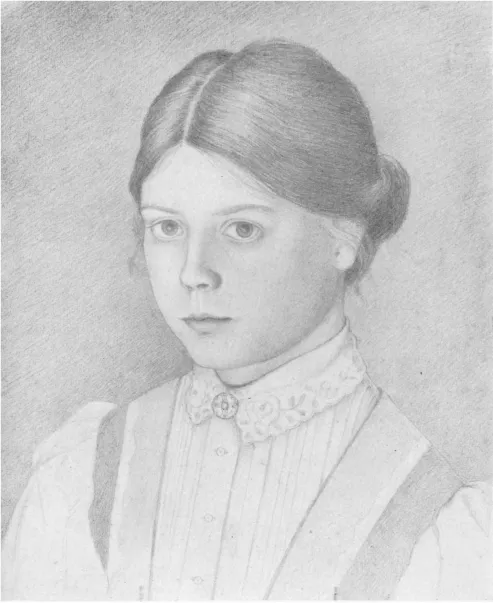
Self portrait by Marion Richardson, aged 17 (reproduced from Art and the Child).
Her life
‘It is not possible to think of anyone in the educational world today who so fully deserves some token of our general esteem’, wrote Herbert Read in the editorial of the 1947 Issue of Athene, the Journal of the Society for Education in Art, dedicated to Marion Elaine Richardson. Her life’s work was in the fields of both child art education and handwriting. In the teaching of art she is remembered for the stimulating of children’s imagination and releasing their natural creativity through her innovative techniques of mind and word picturing. In the teaching of handwriting she eventually broke away from long accepted methods to realise the value of pattern and base her method and letter forms on what she had observed to be the natural movement of young children’s hands.
Childhood
Her work is for the most part well documented, but relatively little is known about the private life of this remarkable woman. However, in order to assess the impact of her attainments, it is first necessary to explore, as far as possible, the influences on her life and character, set in the years leading up to and between the two world wars. She was born on 9 October 1892 at 10 Wellesley Villas, in Ashford, Kent, in the parish of St Mary the Virgin. Her father, Walter Marshall Richardson, was a master brewer and maltster. She came from a large family, in fairly comfortable circumstances. The 1901 census reveals that she had two sisters and three brothers between the age of 2 and 12. This also tells us that the household contained a governess and three domestic servants. Two of her three brothers were killed in the First World War. Only Donald survived.
Her mother, Ellen, related in the same issue of Athene that all through her early childhood her daughter Marion showed great powers of imagination and was fond of making up stories. After early lessons in the schoolroom she attended a small local day school. She enjoyed telling stories and at one time she joined a small pen club, called the Primrose Scribbling Club, according to her mother. She was the youngest member and adopted the nom de plume ‘A mere girl’. She continued her education at a boarding school in St Leonards-on-Sea established by the Church Education Corporation. In 1906 her family had moved from Kent so, at the age of 14, she entered Milham Ford School, Oxford. This was a sister school to the one at St Leonards. The school was ahead of its time in ideas of education and teaching methods and she would have been exposed to stimulating concepts from an early age. It was the art mistress there who recognised her talent and persuaded her to sit for an art teacher’s scholarship at the Birmingham Municipal School of Arts and Crafts.
Marion Richardson’s book Art and the Child was published posthumously in 1948. It was edited by her sister Kathleen. (Kathleen Richardson, also an art teacher, worked for many years at the Dragon School in Oxford.) We do not even know whether Marion Richardson would have written more had she lived longer, or whether anything had been edited out by her sister. Clare Bennison – whose extensive research for her 1982 thesis, Marion Elaine Richardson, Handwriting Pioneer, has been invaluable in the writing of this book – noticed in her search through the archive, that many of the draft pages were in the hand of Miss Plant, Marion’s friend. Did she have any influence? Sian Everitt, curator of the Marion Richardson archive, remarked in the Oxford Dictionary of National Biography on the inaccuracies that occur in the book and its sentimental style, but at least it gives us some insight into her life and thoughts, otherwise we are very dependent on what others wrote about her. Touchingly, the dedication to this book was written and signed MR on 11 November 1946, the day before she died.
Little else about her personal life was revealed by her family. Most of what we can find out about the real person comes from comments by those who knew her (many of whom can no longer confirm or enlarge on their remarks). Therefore, we are dependent to a large extent on the small amount of her own written words to reveal any clues to her real feelings.
There are a few mentions of her early years from the beginning of Art and the Child. ‘When I was a child I possessed a certain skill in drawing’, starts chapter 1 in Art and the Child, ‘and as I belonged to a big family, and we had grown poor, the possibility of my winning a scholarship in art was one we could not afford to overlook’. What can be read into this other than Marion Richardson’s innate modesty? Her self portrait when quite young shows considerable sensitivity and draughtsmanship. What is known of her early home life does not point to poverty. By 1906, however, her father had died and maybe all the family resources had to be directed towards the sons’ education, as was quite usual in those days. She continued that she was only sixteen when she sat for the entrance examination for the Birmingham School of Art. ‘I hoped with all my heart that this best (a drawing of a crab’s claw) would not be good enough to win a scholar’s place. I did not want to leave school and had no interest in learning to draw. But, alas, the crab had caught me. The offer of four years’ training as a teacher could not be refused, and that autumn I became an art student.’ She continued in the same rather melancholy vein: ‘As time went on, however, I grew more or less reconciled to the thought of my career, and indeed found great happiness in some of my work’. Young though the age of 16 may seem today it was not so young in 1908. ‘Many started at Birmingham at 11, although more usually at 13 or 14’, remarked John Swift.
An art student
Those who she came into contact with during those early years were strong characters themselves, in particular the director of the School of Art, Robert Catterson-Smith. ‘He won me over completely as a disciple by teaching us to rely on our visual powers rather than on the skill of hand, and never to begin a drawing until we had a clear image of the subject.’
Sketch of Marion Richardson as a student by H F Warnes (reproduced from Athene 4, Volume 1)
Catterson-Smith introduced Marion Richardson to many of the ideas she used and put into practice in later years with her own pupils. He had been familiar with, and probably himself been influenced by, the work of T R Ablett (1848–1945) on memory and drawing and in 1921 wrote of his own methods in his book Drawing from Memory and Mind Picturing, published by Pitman. Ablett had understood that children’s scribbles were their attempts to express mental images of the world around them. He believed in the principle that children’s drawings should be expressed in their own natural way. Furthermore he proposed that children should be encouraged to enjoy drawing and arranging letters and using them as motifs for design. His book Written Design was published by Chapman and Hall in 1885 (price sixpence). See also pages 66 and 67. It is easy to comprehend how the work of these two men must have had a very real influence on Richardson, although she seldom seemed to have acknowledged this. She kept up with Catterson-Smith and they corresponded for many years after she left art college. Later, after she found strength to formulate her own ideas, he wrote of her: ‘By her own freshness of mind and initiative she has struck out on extremely interesting and in my opinion sound lines’.
David Thistlewood had this to say in an article in the Journal of Art Education, vol 2, 1983: ‘The great achievements of British art educationists in the first half of the twentieth century were to recognise the authentic validity of children’s modes of expression and equally significant to encourage and protract a natural creativity beyond childhood into adolescence’.
Another influence was Edward Johnston’s student, who taught her calligraphy, [see page 49], and later the great scribe himself. Their influence on this young and impressionable girl were reflected in her early work, as is chronicled later on. They epitomised the two sides of her eventual contribution to education. But to fulfil herself she eventually had to break away from those mentors and develop her own ideas – both in the field of child art and in the teaching of handwriting.
During this time she had another fortuitous introduction. She met Margery Fry through some fellow art students who lodged at the Birmingham hostel where she was warden. It was situated in Hagley Road. This introduction led to Marion Richardson also taking up residence in the hostel where the ‘ladies’ were entertained to reading sessions and shared accounts of their dreams. This developed into a friendship that led to her involvement in Margery Fry’s interest in prison education. In the house there were examples of Roger Fry and his friend’s artwork and furnishings from the Omega Workshop, as well as a ‘progressive’ library. Miss Fry, according to Dudley Girls’ High School records, had had some involvement in the school, perhaps as a teacher, before 1912. She was a member of the Staffordshire Education Committee and it is said that she helped Marion to secure her teaching post at Dudley High School. She wrote in the 1947 Athene, under the title of ‘Art and Craft in a Prison’, that Marion Richardson’s work at Dudley Girls’ High School was well known but another aspect of it was less familiar, though perhaps no less important. She referred to her work at Winson Green Prison in Birmingham where Marion and a friend successfully took part in an experiment teaching drawing and craft, not only to women prisoners but also to a group of boys. Margery Fry reported that; ‘To the best of my belief, those classes in Birmingham were the first experiment in what has since been seen to be an important part of the reformative side of prison, the voluntary classes’.
Marion Richardson described her first afternoon classes in embroidery and craftwork in an article entitled ‘Classes in Prison’, in the Women’s Leader in 1922: ‘Only remand cases and hospital cases were allowed to attend – at the time there were only three such women, two of whom were awaiting trial for child murder, and were later found to be insane’. She noted that Dr Hamblin Smith, the prison medical officer, was to be thanked for the success of the classes. By the end of the first year the scope of the prison work was much extended, and later, when working in London, she also taught at Holloway prison.
Ellen Richardson related that her daughter had completed her studies in 1912 and gained her Art Master’s Certificate. However, H F Warnes, a fellow student (who incidentally provided a beautiful sketch of Marion as a student), disputed this: ‘She set out on this course but never completed it. These much criticised certificates were replaced by the new certificate (ATD) in 1912’. Warnes contributed his memories of her as a student in the 1947 issue of Athene. ‘In actual achievement her work attracted no special notice, due in part no doubt, to the presence of students of exceptional ability in the school.’ John Swift remarks that when she was at art school Marion Richardson was aware that she was not the most talented of artists and in a manner typical of art schools (then and arguably now) the fine art students dismissed her as a future teacher. Anyhow, she would have had to earn her living so the career of teaching was inevitable.
Warnes talked of the potent influence on her of Catterson-Smith, who was a: ‘vigorous opponent of the traditional system of teaching (art)’. What is indisputable is that in 1912, just before the end of her course, she was appointed art teacher at Dudley Girls’ High School, where she was to spend the next ten years teaching full time. Her delightful lack of confidence is revealed in her description of her job interview. ‘I was only 19 and I wore a black veil for the interview in the hope of hiding my youth.’
Teaching at Dudley Girls’ High School
In those early years she took a part in many school activities. There are reports of her playing a lead role in a school play, before the other aspects of her work began to take up all her time. Her job included teaching handwriting and embroidery as well as art. Miss Frood reported in Athene: ‘She was the youngest of my staff when I became head mistress in 1914. The first things that impressed me about Marion Richardson were her enthusiasm, freshness, drive and utter sincerity’. She continued by saying that frequently the irresponsible villains of the middle school were sent to the studio when they had been turned out of lessons for bad behaviour but they soon became angels when they had settled down to some creative work with Marion. These were the years when she was developing her pioneering ideas on the teaching of art.
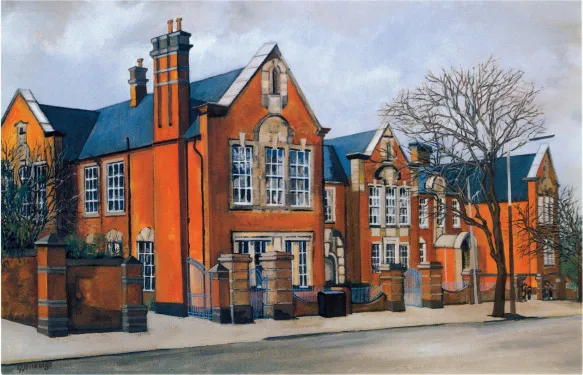
Dudley Girls’ High School, 1914.
In a brief introduction for an exhibition held at the school in 1917 Marion Richardson tried to explain her ideas to a possibly sceptical audience: ‘The drawings in this exhibition are all the work of children who receive no help but the encouragement to draw. Th...
Table of contents
- Cover
- Title Page
- Copyright
- Contents
- Acknowledgements
- Part 1 Marion Richardson: her life
- Part 2 Marion Richardson’s contribution to handwriting
- Bibliography
- Index