World Film Locations: Madrid
eBook - ePub
Available until 23 Dec |Learn more

World Film Locations: Madrid

  1. 128 pages
  2. English
  3. ePUB (mobile friendly)
  4. Available on iOS & Android
eBook - ePub
Available until 23 Dec |Learn more

World Film Locations: Madrid

About this book

World Film Locations: Madrid is a trip through the urban space conceived as film location. The premise is that these locations must have been protagonist of films shot in Madrid since the silent era to the present. Madrid is the film capital of the Hispanic World from the standpoint of production. Being also one of the most visited cities in the world, this book tries to discover its most imaginative side for the visitor who dares to take this journey. But it is a tour that is not covered in the guidebooks. The different suggestions are explained in a series of essays written by experts, which analyses the role that the city plays in the stories filmed in Madrid. This is a city of contrasts where lives high culture (the best universities, the Museo del Prado, etc.), with the most popular and sparkling nightlife that began with La Movida and AlmodĂłvar.

These essays account for this life contrast, addressing from the corralas (popular architecture) in Egdar Neville's films, to the underground cinema of IvĂĄn Zulueta. Madrid's spaces and their films are visually discussed as well through 44 microanalysis of sequences, whose selection criteria has been its importance in the plot and its ability to represent the true spirit of the city, rather than its tourist attractive. Casual visitors or permanent inhabitants, and general lovers of Spanish culture in a broad sense, will find in these pages reasons to wander through Madrid's films and streets.

Frequently asked questions

Yes, you can cancel anytime from the Subscription tab in your account settings on the Perlego website. Your subscription will stay active until the end of your current billing period. Learn how to cancel your subscription.
No, books cannot be downloaded as external files, such as PDFs, for use outside of Perlego. However, you can download books within the Perlego app for offline reading on mobile or tablet. Learn more here.
Perlego offers two plans: Essential and Complete
  • Essential is ideal for learners and professionals who enjoy exploring a wide range of subjects. Access the Essential Library with 800,000+ trusted titles and best-sellers across business, personal growth, and the humanities. Includes unlimited reading time and Standard Read Aloud voice.
  • Complete: Perfect for advanced learners and researchers needing full, unrestricted access. Unlock 1.4M+ books across hundreds of subjects, including academic and specialized titles. The Complete Plan also includes advanced features like Premium Read Aloud and Research Assistant.
Both plans are available with monthly, semester, or annual billing cycles.
We are an online textbook subscription service, where you can get access to an entire online library for less than the price of a single book per month. With over 1 million books across 1000+ topics, we’ve got you covered! Learn more here.
Look out for the read-aloud symbol on your next book to see if you can listen to it. The read-aloud tool reads text aloud for you, highlighting the text as it is being read. You can pause it, speed it up and slow it down. Learn more here.
Yes! You can use the Perlego app on both iOS or Android devices to read anytime, anywhere — even offline. Perfect for commutes or when you’re on the go.
Please note we cannot support devices running on iOS 13 and Android 7 or earlier. Learn more about using the app.
Yes, you can access World Film Locations: Madrid by Lorenzo J Torres Hortelano in PDF and/or ePUB format, as well as other popular books in Technology & Engineering & Power Resources. We have over one million books available in our catalogue for you to explore.
Image
EMBRACING NORMALCY

Madrid’s Gay Cinema at the Turn of the New Millennium
Image
ONE OF THE MOST distinctive features of the cinema of Madrid (and Spain) at the turn of the new millennium is the significant crop of films related to gay themes. In just three decades Spain has experienced a startling change: from being quite a homophobic culture to becoming, in 2005, the third country in the world to legalize gay marriage and the first to do so with full adoption rights. Gay characters and issues went from almost total absence or merciless mockery during the Franco and Transición years to an underground curiosity in the early years of democracy represented by Madrid’s La Movida and Almodóvar, leading to a normal and recurrent presence in current mainstream cinema and in Madrid’s urban culture.
Image
Nothing exemplifies this process of normalization better than the rapid transformation of Chueca. Once a rundown area in the centre of the city until the gay community started moving there, it has quickly become a hip neighborhood and the beating heart of gay Madrid. Spinnin’, a commendable, quirky and whimsical movie set in 1995, epitomizes this change. At that time the gay community still suffered occasional attacks in Chueca, the AIDS scourge was visible and marriage and adoption rights were goals to fight for. A character in Spinnin’ says, ‘The world is already filmed. Now we need to change it.’ But, when the movie was made in 2007, many of those aspirations had already become a reality, and the film served more as a testimony of the change. That year Madrid was the site of Europride, and Chueca had already become a chic residential area, a hot nightlife destination and the foremost film set of gay Madrid.
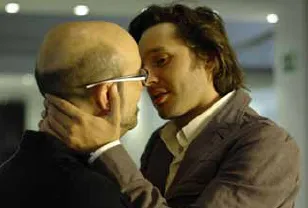
Countless movies have helped define the ethos of this normalization in the last fifteen years. Madrid is shown as the anonymous city where a tormented Alberto in the remarkable Segunda piel/Second Skin (1999) can keep secrets and separate relationships with a gay lover and a wife. However, for the most part, Madrid appears as a big, open, joyful and diverse metropolis where, as Km. 0 (2000) shows, a myriad coupling combinations can happen. Madrid is where Marcos, the leading character in I Love You Baby (2001), comes to explore his homosexuality. When his boyfriend kisses him in broad daylight, he asks surprised ‘¿AquĂ­, en la calle?’ (‘Here, in the street?’); a place where according to Amor de hombre/The Love of a Man (1997) all men, may they be waiters, cab drivers, musicians, doctors, pet store owners, lawyers, or even married, are gay. Some form stable relationships and quarrel about domestic issues, while others just cruise the city in search of easy hook-ups. Madrid is also the city where young male immigrants in Los novios bĂșlgaros/Bulgarian Lovers (2003) become sex toys for promiscuous and liberated, well-off gay professionals who live in modern homes, populate upscale spas, use drugs freely, drink expensive wine and party in Chueca. Finally, in Reinas/Queens (2006), produced in the middle of the debate over the landmark gay marriage law, Madrid is above all the site of the historic event of the first twenty gay weddings.
Opposite Fuera de Carta / Below Cachorro
Image
But this normalization has also gone one step further, leading to questions about typical gay stereotypes in favour of a depiction of characters that happen to be gay and have a different lifestyle, but also share other problems with the rest of society. This change is first evident in Cachorro/Bear Cub (2004), fully addressed in Chuecatown/Boystown (2007), and has gone full circle in Fuera de Carta/Chef’s Special (2008).
In the current cinema of Madrid, society is not only accepting the presence of the gay community, but it is also promoting and embracing their lifestyles.
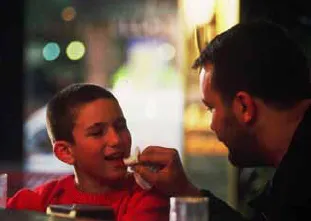
In Bear Cub, Pedro, an HIV-positive gay dentist with an active and promiscuous sexual life, suddenly finds himself as the guardian of his 9-year-old nephew. The movie doesn’t make apologies for his lifestyle and the ones of his friends, a group of mostly middle-aged gay men holding regular jobs and carrying on normal lives. Bear Cub asks us to embrace their normalcy, not yet fully accepted (in fact, the director deleted a couple of scenes that could have been perceived as taking it too far), by showing a community that faces the same emotional insecurities and day-to-day problems as everyone else. In a statement the director added to the DVD, he recognized that his goal is for normalization beyond gay stereotypes, even socially accepted ones, and to try to address real problems. When the grandmother, armed with prevalent and opposing social values, blackmails Pedro by threatening to make his HIV condition public if he doesn’t let her take the boy, it is the child who, in a moving scene, shows her that accepting that normalization is a tough but achievable goal.
In Boystown, VĂ­ctor, a good-looki...

Table of contents

  1. Cover page
  2. Copyright
  3. Title
  4. Contents
  5. Acknowledgements
  6. Introduction
  7. Madrid: City of the Imagination
  8. Madrid in Motion: Squares, Corralas, Markets, Verbenas
  9. Iván Zulueta: Films of Madrid’s Underground
  10. Embracing Normalcy: Madrid Gay Cinema at the Turn of the New Millennium
  11. Madrid: Unexpected Dream Factory
  12. Beyond the Cliché: Madrid in Twenty-first Century American Thrillers
  13. Bright Young Things: Neo-existentialism in Madrid cinema of the 1990’s
  14. Resources
  15. Contributor Bios
  16. Filmography