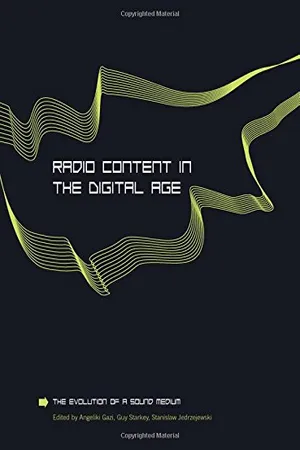
The traditional radio medium has seen significant changes in recent years as part of the current global shift toward multimedia content, with both digital and FM making significant use of new technologies, including mobile communications and the Internet. This book focuses on the important role these new technologies play—and will play as radio continues to evolve. This series of essays by top academics in the field examines new options for radio technology as well as a summary of the opportunities and challenges that characterize academic and professional debates around radio today.
eBook - ePub
Radio Content in the Digital Age
The Evolution of a Sound Medium
- 258 pages
- English
- ePUB (mobile friendly)
- Available on iOS & Android
eBook - ePub
Radio Content in the Digital Age
The Evolution of a Sound Medium
About this book
Information
Part II
Content
Chapter 6
Blurring Fiction with Reality: The Strange Case of Amnésia, an Italian ‘Mockumentary'
This research does not aim to cover the history of media on the basis of a dialectic between fiction and reality. The chapter's main objective is to analyse the case of an Italian radio programme which was very successful during the 2008/09 radio season. We have chosen to analyse the format and language of this programme as we believe that it represents a fitting example of innovation with regard to a traditional radio genre such as fiction. Amnésia, contaminating a traditional genre with the use of new media, is in our opinion a valid answer to the question, ‘What should radio content be like in the digital age?’ Moreover, Amnésia is an interesting case study for another reason: the programme's initial idea (its format) was in itself a further attempt to question the boundary between fiction and reality and had many similarities with the first case in which this boundary was crossed: the War of the Worlds by Orson Welles. However, before we deal with the object of our study we must first return briefly to the history of the radio programme that for the first time breached the thin line that separates fiction and reality.
When fiction crossed over into reality: the War of the Worlds of 1938
“It was the night before Halloween...
the only trouble was that an
impressive number of listeners
forgot what day it was”.1
the only trouble was that an
impressive number of listeners
forgot what day it was”.1
On the night of Sunday, 30 October 1938, at 8pm, CBS broadcast live The War of the Worlds, a radio drama based on a novel by H. G. Wells and directed by a young Orson Welles. The programme was part of the series of radio adaptations Mercury Theatre on Air, which had already been aired for sixteen weeks without being particularly successful. On Sunday night, at the same time, NBC broadcast the more popular Charlie McCarthy Show, and CBS had not yet found a commercial company who would sponsor Orson Welles’ programme. The series was in risk of being cancelled. Welles himself was rather sceptical of the British novel's potential to capture the attention of American listeners. On the Thursday prior to the broadcast, Mercury Theatre's board (which included Welles) met to listen to recordings of the rehearsals. “We have only one way of keeping this program running”, said Houseman, Mercury's co-director, “By playing up the realism as far as possible. We have to make it more real, more believable, using the radio newscast format”.2 The script was changed according to this suggestion and in some parts entirely re-written. It was decided that the story of the Martians landing was to be told as a radio newscast. Even so, Welles was not convinced. Then came the night of the live broadcast. The theme song played. The story's introduction, read by Orson Welles’ slow and deep voice, began: “We know now that in the early years of the 20th century this world was being watched closely by intelligences greater than man's and yet as mortal as his own..”. The Crosley agency calculated that on that night 32 million people were listening to the radio.
Then the anonymous voice of a presenter, followed on after Welles, reading a normal weather report and announcing that programmes would continue with a live broadcast from a ballroom in a New York restaurant. After a couple of minutes of music, there was a sudden interruption: “Ladies and gentlemen, we interrupt our program...”. It was 1938, shortly after the Munich crisis, and the world was on the brink of war. The first news flash of the radio newscast, which stated that strange phenomena had been sighted on planet Mars, was followed by others, until finally it was announced that mysterious flying machines had landed in New Jersey. The voice of an on-the-spot correspondent broke into the houses of Americans: “Good heavens, something's wriggling out of the shadow like a grey snake... the crowd falls back... Well, I'll pull this microphone with me as I talk. I'll have to stop the description until I can take a new position. Hold on, will you please, I'll be right back in a minute”. Then it was the turn of the ‘Secretary of the Interior’ who, speaking in a flat, official tone, said: “Citizens of the nation: I shall not try to conceal the gravity of the situation that confronts the country [...] Placing our faith in God we must continue the performance of our duties each and every one of us, so that we may confront this destructive adversary with a nation united, courageous, and consecrated to the preservation of human supremacy on this earth”. This message contributed significantly towards spreading panic. Thousands of families abandoned their homes and took refuge in the woods. Many National Guard stations were stormed by people trying to obtain gas masks from the army. In some towns in the South the entire population poured onto the streets to pray and sing religious hymns. In the meantime, the broadcast was coming to an end: “I'm speaking from the roof of the Broadcasting Building, New York City... The Martians [are] approach [ing]. Estimated in the last two hours, three million people have moved out along the roads to the north [...] Avoid bridges to Long Island - hopelessly jammed. All communication with Jersey shore closed ten minutes ago. No more defenses. Our army wiped out [...] This maybe the last broadcast. We'll stay here to the end. [...] Martian cylinders are falling all over the country [...] [Everybody is] running towards the East River, thousands of them, dropping in like rats. Now the smoke [...] [has] reached Times Square. [It's] a hundred yards away[...] it's - it's fifty feet [...]”. A sigh, a moan, the muffled sound of a body falling down and of the microphone rolling on the concrete: death of a reporter, live on the radio.
The next day newspaper titles read: ‘Orson Welles's radio war terrorizes the US'. Six weeks after the broadcast people were still found camping in the woods for fear of the Martians. The Hooper Rating Company calculated that on that night the most popular radio programme had been the Charlie McCarthy Show with a share of 34.7%. However, when the show ended, 12% of that audience moved to CBS and Mercury Theatre on Air’s share went from a normal 3.6% to 15% in the first twenty minutes of the broadcast.3 Listeners’ word of mouth and phone calls to friends and family telling them to turn on the radio (something similar to what happened on September 11, 2001 with text messaging) contributed to further increase the number of listeners, taking it to six million.
According to the classic psychological study by Cantril on audience reactions to Welles’ radio drama,4 of those six million about one million and seven hundred thousand believed that Martians were invading the Earth, and of these one million two hundred thousand not only took the broadcast seriously, but experienced feelings of fear and panic. Cantril's study on audience reactions, conducted by analysing letters to the programme and a series of interviews, led him to conclude that the percentage of people who, that Halloween, believed that Martians were landing did so for a number of reasons, which can be summed up as follows:
• The nature of the public's trust in the radio itself. The War of the Worlds was aired at a time when the radio had replaced newspapers as the primary source of information.
• The degree of instability of that period. The United States was emerging from the Great Depression and the crisis of European politics was extremely topical in those days. American society was living in a period of uncertainty. Only one month before (30 September) programmes were interrupted to announce the Munich agreement.5 It was a time of crisis: an economic slump was in full swing, a world war was around the corner and now the Martians were landing. Another external event, explains Cantril, which was beyond the control and comprehension of individuals.
• The listening mode: many tuned in after the show began or “by contagion”, urged to listen to the programme by people they knew and fuelling each other.
• The audience's psychological and social profile: Cantril noted that the personality of some listeners led them to be much more inclined than others to believe unconditionally, unable to exercise their critical judgement. In particular, a lack of critical judgement was especially found, in Cantril's interviews, in those listeners with a lower literacy level and limited cultural consumption.
• The broadcast's high degree of realism: “It didn't sound like a radio drama”, said one of the listeners to the American sociologist.
Why Martians were believable
Cantril's analysis and conclusions are certainly important, as they represent the first and most detailed study on the psychology of radio listening, and they were able to grasp the complexity of the radio audience's reactions.
However, the fact that one out of three American listeners that night believed that the Martians had landed does not depend only on the psychology of listeners and on the USA's specific historical and political context at the time. Another decisive factor, which Cantril's analysis does not really shed light on, was the particular way in which Orson Welles used radio language.6 The choice to translate Wells’ text into a breaking news story contributed significantly to the false event's credibility.
A regular listener of CBS who tuned into Welles’ radio drama from the beginning and listened carefully for the whole time would have had plenty of occasions to realize that he was listening to a radio fiction.7 The programme was interspersed with a host of linguistic and narrative signs that could easily lead the audience to interpret it as fictional: the programme's jingle specifying that Mercury Theatre on Air was presenting The War of the Worlds by H. G. Wells was repeated as many as four times during the broadcast. Moreover, it was rather implausible, with the technical means available at the time, that a radio studio could hook up to a jet pilot and broadcast his voice. In addition, many of the names in the story were changed. The CBS executive Davidson Taylor and the network's team of lawyers forced the authors to modify the script, changing as many as 28 names, fearing that the programme would otherwise be too realistic. However, the new names were quite similar to the original ones, especially when heard and not read. Langley Field became Langham Field. Princeton University Observatory became Princeton Observatory and New Jersey's National Guard became the State Militia.8
Furthermore, listeners doubting the broadcast's truthfulness could have attempted to verify its plausibility by looking for other sources: they could have switched to another radio station to check whether anyone else was talking about the event, or called an acquaintance in New Jersey or in one of the ‘landing’ spots. In fact, the majority of listeners that night came to the conclusion that the landing was actually fictional. Everyone, however, even the ‘non-believers', asked themselves for a second if it was all really happening. And if some people kept believing the story until the end of the programme, it was also due to the fact that Welles had recreated an almost exact copy of a radio newscast of the time. Despite inconsistencies (the pilot connected via radio) and signifiers (the programme's jingle), a few highly plausible elements were sufficient to make the story sound real to listeners. The first realistic element that contributed to question the programme's fictional status was the interruption of the music by the news bulletin. At the time, these interruptions were quite frequent: the European crisis and Nazism's advance were topical news and American networks often interrupted music and soap operas in order to update the audience on new developments. The second element was the use of an expert authority (the astronomer from Princeton Observatory). Another crucial element was the inclusion of the voice of the Minister of the Interior, whose tone and rhythm were perfectly imitated by an actor. Radio at the time was the most important news medium and people habitually used it to gain information. The trustworthiness of news items broadcast by the radio was not usually questioned. All these elements, and more generally the choice of the radio commentary as the linguistic register used to adapt H. G. Wells's novel for the radio, played an important role in convincing listeners that the programme's story was real.
Attention! La radio ment!9
The case of The War of the Worlds is important because for the first time fiction disguised itself as reality. Welles was the first to cross the line between fiction and reality within electronic media, to shatter the sacredness of the real, to show that the emperor was not wearing any clothes. Whether he was conscious of it or not, he demonstrated that the media could lie and showed the whole world how dangerous it was to believe them unconditionally. Welles was also the first to betray the implicit pact between the author of a story and its reader/listener, that is that ‘suspension of disbelief’ that allows those who listen to or read a story to make-believe, to pretend that it is all true in order to derive an aesth...
Table of contents
- Cover
- Dedication
- Half Title
- Title
- Copyrigh
- Contents
- Acknowledgements
- Introduction: Radio and the Digital Age
- Part I: Convergence
- Part II: Content
- Part III: Community
- Contributors to this Volume
Trusted by 375,005 students
Access to over 1.5 million titles for a fair monthly price.
Study more efficiently using our study tools.
Frequently asked questions
Yes, you can cancel anytime from the Subscription tab in your account settings on the Perlego website. Your subscription will stay active until the end of your current billing period. Learn how to cancel your subscription
No, books cannot be downloaded as external files, such as PDFs, for use outside of Perlego. However, you can download books within the Perlego app for offline reading on mobile or tablet. Learn how to download books offline
Perlego offers two plans: Essential and Complete
- Essential is ideal for learners and professionals who enjoy exploring a wide range of subjects. Access the Essential Library with 800,000+ trusted titles and best-sellers across business, personal growth, and the humanities. Includes unlimited reading time and Standard Read Aloud voice.
- Complete: Perfect for advanced learners and researchers needing full, unrestricted access. Unlock 1.5M+ books across hundreds of subjects, including academic and specialized titles. The Complete Plan also includes advanced features like Premium Read Aloud and Research Assistant.
We are an online textbook subscription service, where you can get access to an entire online library for less than the price of a single book per month. With over 1.5 million books across 990+ topics, we’ve got you covered! Learn about our mission
Look out for the read-aloud symbol on your next book to see if you can listen to it. The read-aloud tool reads text aloud for you, highlighting the text as it is being read. You can pause it, speed it up and slow it down. Learn more about Read Aloud
Yes! You can use the Perlego app on both iOS and Android devices to read anytime, anywhere — even offline. Perfect for commutes or when you’re on the go.
Please note we cannot support devices running on iOS 13 and Android 7 or earlier. Learn more about using the app
Please note we cannot support devices running on iOS 13 and Android 7 or earlier. Learn more about using the app
Yes, you can access Radio Content in the Digital Age by Angeliki Gazi, Guy Starkey, Stanislaw Jedrzejewski, Angeliki Gazi,Guy Starkey,Stanislaw Jedrzejewski in PDF and/or ePUB format, as well as other popular books in Social Sciences & Media Studies. We have over 1.5 million books available in our catalogue for you to explore.