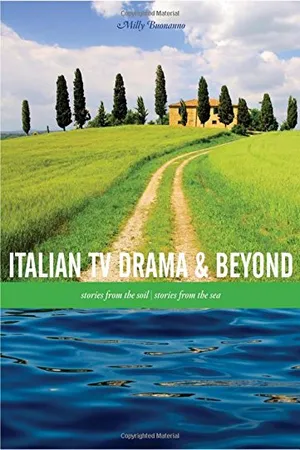
Since its inception in the mid-1950s, the television drama has emerged as the dominant medium of contemporary storytelling in Italian society, with a steadily increasing supply of locally produced domestic dramas offering up competing versions of Italian identity. Informed by the nation's rich historical and cultural heritage—as well as a string of notable foreign imports—the narratives discussed here offer much insight into Italian society and highlight the wide array of television programming available outside of Britain and the United States.
- 274 pages
- English
- ePUB (mobile friendly)
- Available on iOS & Android
eBook - ePub
About this book
Information
Chapter 1
Building the Nation: The Origins of Italian Television Drama
The words to say it
In Italy home-grown television drama is now called ‘fiction’. This was not always so. The use of the English word, which replaced the original Italian word sceneggiato (or teleromanzo), began to gain popularity in professional and academic language, and later in common parlance, some 30 years ago. This coincided with a major change in the Italian televisual system and in culture, brought about by the break-up of public television’s monopoly and the advent of private networks (see Chapter 2).
In one sense this was a standardization with the vocabulary of other Latin countries. As Jerome Bourdon has pointed out, ‘in the field of television, until the 1980s the word fiction was not used; there was a range of different terms, taken from the theatre (“dramatique” in French, “drama” in English, “Fernsehspiel” in German), the radio and the press (“feuilletons”)’ (Bourdon, 2004a: 177).1 During the 1980s a general reformulation of television jargon, mainly under Anglo-American influence, occurred across Europe and well beyond Italy. One consequence was that the previous local variants for ‘television drama’ ended up converging at the same name. Within the Latin countries, the word was ‘fiction’ in French, ‘ficción’ in Spanish and ‘ficção’ in Portuguese. In each of these instances, however, the word used pertains to the vocabulary of the national language, as is testified by both the dictionary and the pronunciation. The Italian case is different: ‘fiction’ is and remains an English (or Anglo-American) word, pronounced (more or less correctly) in the English way.
Therefore in Italy we have recourse to a foreign word to denote just one concept: indigenous televisual storytelling. Thus, a national signified is associated with a transnational signifier, while the familiar domestic drama is made strange by a nonnative word and pronunciation.
Not so long ago, when media-cultural imperialism (Schiller, 1969, 1976 and 1991) still served as ‘the central myth of the study of trans-national communication’ (Miller, 2000: 3), a similar example would be readily advanced to corroborate the belief that the dominance of Anglo-American media culture went so far as to dictate ‘the words to say it’, to quote Marie Cardinal (2000). I do not deny that there is some substance in this argument, since the invasiveness of English, especially in media jargon, is indisputable; but that is not the point I wish to emphasize. Rather than resurrecting the much-debated issues of cultural imposition and dependence (not necessarily outmoded: they just have not got us very far!), I think that it is more useful to take as my starting point this emblematic case of lexical and semantic contamination and attempt to reconstruct the relationship between the national and the non-national, the native and the non-native, in Italian television drama. We are dealing with long-term relationships to be regarded as recurrent factors in the history of indigenous television drama, albeit in different configurations according to the evolutionary phases of the national television system and its environment. These relationships helped shape domestic television drama in forms and contents that have in turn become part and parcel of its own tradition and identity.
In what follows I shall focus on TV drama at the dawn of Italian broadcasting. There was no ‘fiction’ in those early times, but rather its precursor or ancestor, namely the sceneggiato. The sceneggiato – which literally means ‘scripted novel’ – was the privileged and almost exclusive narrative genre of Italian television for two decades, from the mid-1950s to the mid-1970s. It enjoyed immense popularity and still today remains firmly established in the vocabulary and generational memory (Colombo and Aroldi, 2003) of older viewers, and is, in addition, often nostalgically evoked by those complaining about the worthlessness, as they see it, of contemporary fiction.
My intention here is to argue that the sceneggiato has been a crucial component of the strategy of ‘nation building’ that was pursued at the inception of Italian television. Whether it was literary adaptation or historical drama, the sceneggiato re-enacted for the Italians – a culturally diverse and largely uneducated population at that time – the key historical events and the novelistic tradition in which a once fragmented country, that had become one nation in relatively recent times, was encouraged to recognize the roots – and the routes – of a common history and culture. Interestingly enough, however, this effective vehicle for the construction and transmission of national commonalities and national identity, as the sceneggiato proved to be, has from the start entertained apparently contradictory relationships with the cultural heritage of foreign nations. Unfortunately, I do not have sufficiently precise comparative evidence to maintain that this was a feature peculiar to Italy; a history of European television is still in its early stages (Bignell and Fickers, 2008) and the historical macro-overviews that are currently available, valuable though they are, need to be supplemented by focused micro-overviews in the future of European television studies (Jacobs, 2000). Since I am well aware of the temptation (often irresistible to researchers) to proclaim national uniqueness or specificity in the absence of a valid basis for comparison, I shall confine myself to reconstructing the origins of domestic television drama, focusing on the short ‘experimental moment’ (Delavaud and Maréchal, 2011) of the 1950s, which coincides with the first quinquennium (or a little more) of national broadcasting in Italy.
The domestic stage
Italian state television (Rai) came into being in 1954 and was run for more than two decades as a public service monopoly (Buonanno, 2004a). These are the years that some nostalgically consider to be the golden age of Italian television drama, perhaps of television tout court (Colombo and Aroldi, 2003). During these years, Rai’s production and programming policies were essentially inspired by cultural and educational principles. Television was first and foremost conceived as a means of enlightening a mass audience and broadening its horizons. If such a conception was shared at that time by most European public television companies (Bourdon, 2004b), in Italy it reflected not so much the adoption of a model and an ethos of public service as the deep-rooted convictions of the Rai’s board of directors about the unprecedented educational and cultural potential of the new medium. This ruling group was made up of intellectuals and managers who combined a predominant humanist-literary background with a Catholic political orientation, responsive to liberal and modernizing aspirations, in accordance with the left wing of the Christian Democratic Party then governing Italy (Monteleone, 1992). It is well known that the Catholic forces were much more far-sighted and advanced than the political and cultural forces of the Left (who remained entrenched for years in their positions of unshakeable ideological denial) in understanding the importance of television and the strategic role that it could play in the process of modernizing Italian society (Gundle, 2000). It may be useful to add that in the 1950s the Catholic world played a prominent part in the organization of popular entertainment, thanks to a widespread network of both parish cinemas and amateur dramatics.
As regards the humanistic roots of televisual culture (Bettetini, 1985), Sergio Pugliese, a distinguished founding father and powerful Director of Programmes from 1954 to 1965, was for example an esteemed playwright. Under his direction the weekly appointment with theatre on Friday evenings became one of the cornerstones of the programme schedule; and the start of transmissions on 3 January 1954 received a theatrical imprint from the live broadcast of a comedy by Carlo Goldoni (Grasso, 1992). Hence the features of the ‘domestic stage’ that were widely attributed to Italian television at its origins.
Theatre was the favourite pastime of intellectuals and the bourgeois class in Italy. The arrival of television on the scene helped to bring about a remarkable increase in audiences for theatrical drama, which became an established feature of the viewing habits of a broad section of middle-class audiences. The attraction of novelty and the public’s declared thirst for instruction (De Rita, 1964) – the viewers seemed to share a somewhat scholastic conception of the new medium – served to confer a fair degree of success on stage plays broadcast on television. So much so, indeed, that some observers were prompted to state, with some exaggeration, that television ‘had accomplished the miracle of turning Italy into a country of thespian fans’ (Lombezzi, 1980: 51). In fact radio had already gone a long way towards opening the gates of the highbrow citadel of the stage theatre to the people; television followed in its footsteps.
It was, however, not thespian art but novels that turned out to be the main vehicle of widespread diffusion of humanistic and literary culture with respect to the Italian public. Rai’s educational scheme found one of its most congenial and fertile fields of expression in the popularization of the novelistic narrative. An intensive if somewhat artisanal production of TV drama was almost exclusively devoted to the latter. Therefore the sense of an enlightening mission coupled with the highest regard for classic culture gave rise to a genre that soon became the hallmark and pride of Italian television drama: the sceneggiato (or teleromanzo: De Fornari, 1990), a word still used to refer to home-grown television drama by elderly people who are not at ease with the foreignness of the word ‘fiction’.
Literary adaptation
The sceneggiato was in essence a literary adaptation: a story told in instalments and based on an already published work of fiction or, as people preferred to say, ‘from the author’s work’. The division into instalments, six on average, and the literary source of the story being narrated were distinctive characteristics of the Italian sceneggiato, but they were not sufficient to define it. Its specific identity was constructed from an inseparable ensemble of elements which, together with the narrative formula and the literary source, comprised an expressive model and a cultural project.
Shot in interiors using analogue technology and initially broadcast live, the sceneggiato chose the stage, not the cinema, as its reference model. The entire production reflected the deliberate construction of the sceneggiato as a theatrical performance: the studio fitted out like a stage with wings and a backcloth, the screenplay divided into ‘acts’, the actors drawn mainly from the theatre world, the preponderance of dialogues and soliloquies on the action. Particularly in the early days, it was a true ‘theatricalized novel’, completely in tune with the home theatre that television had originally supplied. But even in later years, when it became possible to record on film, eliminate live broadcasting, edit footage and shoot on location, the original ‘theatre in the studio’ formula was never completely abandoned.
Linking television drama to the theatre was a coherent and strategic policy on the part of the Rai, coherent with the basic humanistic inspiration, which was reinforced by the alliance between theatre and novel; and strategic in relation to the purpose of conferring legitimacy on television drama, placing it under the banner of an established and prestigious cultural asset. At the same time the aim was to protect television drama from possible association with, and contamination by, the cinema. Various reasons that cannot be explored here (see Chapter 2) counselled against any reference to filmic models (Sanguineti, 1980), be they the so-called auteur cinéma which in the previous decade had emerged in the famous neo-realism movement, or the lowbrow Italian film industry that had achieved its greatest successes in Italy with social melodrama, comedy and musical genres. Criticism and televisual aesthetics in turn supported the idea of an essential diversity and a necessary separateness of languages and styles between the two media, and constantly deplored those directors who purported to ‘make films on television’ (Lombezzi, 1980: 48).
Italy did not of course have exclusivity in literary adaptation, which was cherished by European public television because of its strategic capacity to combine two of the three fundamental purposes of the public service: to educate and to entertain. ‘The adaptation of classic literature … has been a characteristic of British television almost since television began’ (Caughie, 2000: 207). In particular, the BBC inaugurated its tradition of ‘classic serials’ – replacing the previous one-off adaptations (Kerr, 1982) – in the early 1950s, a few years before the inception of Italian television. And French television drama, for its part, made wide use of literary sources from the 1960s (Chaniac, 1996). Literature, like the theatre (or history) thus came to be ‘mobilized’ in order to provide a cultural legitimacy extrinsic to a medium that was suspected of being ‘not itself good’ (Brundson, 1997: 113), in Italy as elsewhere.
But it was possibly in Italy that literary adaptations achieved – and kept, for some time – a pre-eminent position on the domestic drama scene in terms of production volumes, magnitude of success and reputation for quality. The great flowering of the nineteenth-century novel provided the sources for hundreds of adaptations that were destined to become hugely popular and would generate phenomena of TV personality worship. Up to 1977 there were always literary adaptations, not infrequently more than one title, among the ten most watched programmes of each season (Grasso, 1992). Their repeats have filled up the night-time programming schedules of the terrestrial networks for years, and have become more recently a resource for satellite and terrestrial digital channels, while many titles are being reissued and marketed as DVDs.
The sceneggiati of yesteryear remain established in the Italian collective memory and they remain the most remarkable example of ‘national popular TV drama’ created by Italian television in the first stage of its history.2
Electronic library
Even today, despite a flourishing publishing industry that produces over 60,000 titles per year and a fairly high level of schooling (three out of four Italians have attended school for at least eight years), international comparative research into cultural consumption still brings up the historical ‘problem’ (Forgacs and Gundle, 2007) of reading habits in Italy. It may be excessive to claim irrefutably, as newspapers frequently do, that ‘Italians don’t read’; but it cannot be denied that they read less assiduously than other nationalities. For example, almost 45 per cent of Italians over fourteen are habitual readers (at least three books per year) as against over 60 per cent of Germans and the English (AIE, 2010).
Obviously in the 1950s the situation was even worse. At the beginning of the decade the illiteracy rate in Italy as a whole was nearly 14 per cent, while in the southern regions and generally the agricultural areas it almost exceeded 25 per cent. Fewer than 60 per cent of Italians had any educational qualifications (De Mauro, 1991). The low level of education was in turn an obstacle to the acquisition of a common language: the numerous regional languages and dialects remained predominant in everyday speech, whereas the habitual use of standard Italian was confined to a small minority of the educated class. Only 17.5 per cent of all Italian families comprised at least one member who read books (Peresson, 2008). By contrast, illustrated magazines, photostories and comic strips had achieved a huge circulation among ordinary people by the end of the 1940s. The fact was that their strong graphic component offered less literate people the opportunity for visual reading that relied upon the eloquence of the pictures, without the effort needed to decipher the written text.
Thus the cultural scene in 1950s Italy was characterized not so much by general backwardness – indeed the conditions for the ‘economic miracle’ that was to explode in the 1960s were already developing – as by the wide gap between an élite minority that was able and willing to practise and enjoy reading and the less-educated majority, who were wedded to printed material made more accessible by the predominant presence of ‘pictures’ (‘looking at the pictures’ was the expression used in Italy to mean reading through images). These two unequal components of Italian society had neither reading nor language in common.
The extremely effective role played by television, in advance of universal schooling, in bringing about the linguistic and therefore cultural unification of Italians is well known. In this con...
Table of contents
- Cover Page
- Title Page
- Copyright
- Contents
- Dedication
- Introduction
- 1. Building the Nation: The Origins of Italian TV Drama
- 2. The Cinematic Turn and the Americanization of the Television Landscape
- 3. The Political Career of a Popular Fiction: La Piovra (The Octopus: The Power of the Mafia)
- 4. A Place in the Sun: The First Italian Soap Opera
- 5. Mimetic Heroes and Ironic Leaders: The Genesis and Evolution of Italian Police Drama
- 6. In the Footsteps of La Piovra: Twenty years of Mafia stories in Italian TV drama
- 7. Life Stories: A Heroic Enclave and the Rise of the Religious Biopic
- 8. The Re-enactment of the Past and the Politics of Memory and Identity in Contemporary Drama
- Conclusion
- References
- Index
Trusted by 375,005 students
Access to over 1.5 million titles for a fair monthly price.
Study more efficiently using our study tools.
Frequently asked questions
Yes, you can cancel anytime from the Subscription tab in your account settings on the Perlego website. Your subscription will stay active until the end of your current billing period. Learn how to cancel your subscription
No, books cannot be downloaded as external files, such as PDFs, for use outside of Perlego. However, you can download books within the Perlego app for offline reading on mobile or tablet. Learn how to download books offline
Perlego offers two plans: Essential and Complete
- Essential is ideal for learners and professionals who enjoy exploring a wide range of subjects. Access the Essential Library with 800,000+ trusted titles and best-sellers across business, personal growth, and the humanities. Includes unlimited reading time and Standard Read Aloud voice.
- Complete: Perfect for advanced learners and researchers needing full, unrestricted access. Unlock 1.5M+ books across hundreds of subjects, including academic and specialized titles. The Complete Plan also includes advanced features like Premium Read Aloud and Research Assistant.
We are an online textbook subscription service, where you can get access to an entire online library for less than the price of a single book per month. With over 1.5 million books across 990+ topics, we’ve got you covered! Learn about our mission
Look out for the read-aloud symbol on your next book to see if you can listen to it. The read-aloud tool reads text aloud for you, highlighting the text as it is being read. You can pause it, speed it up and slow it down. Learn more about Read Aloud
Yes! You can use the Perlego app on both iOS and Android devices to read anytime, anywhere — even offline. Perfect for commutes or when you’re on the go.
Please note we cannot support devices running on iOS 13 and Android 7 or earlier. Learn more about using the app
Please note we cannot support devices running on iOS 13 and Android 7 or earlier. Learn more about using the app
Yes, you can access Italian TV Drama and Beyond by Milly Buonanno in PDF and/or ePUB format, as well as other popular books in Scienze sociali & Scienze della comunicazione. We have over 1.5 million books available in our catalogue for you to explore.