- 210 pages
- English
- ePUB (mobile friendly)
- Available on iOS & Android
eBook - ePub
About this book
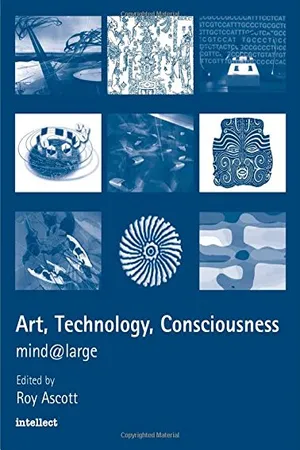
Within a technological context, this volume addresses contemporary theories of consciousness, subjective experience, the creation of meaning and emotion, and relationships between cognition and location. Its focus is both on and beyond the digital culture, seeking to assimilate new ideas emanating from the physical sciences as well as embracing spiritual and artistic aspects of human experience. Developing on the studies published in Roy Ascott's successful Reframing Consciousness, the book documents the very latest work from those connected with the internationally acclaimed CAiiA-STAR centre and its conferences. Their artistic and theoretical research in new media and art includes aspects of:
Information
Towards a Physics of Subjectivity
Stephen Jones
Part I
In my paper in Reframing Consciousness (Jones, 1998), I demonstrated that the information we have of the world must be physically embodied. To recap: what we get in the physical world is the information that is available to us from its sources, which are difference relations among aspects of the ‘objective world’. These difference relations comprise physically embodied order in various material and energetic impacts on our sensory end organs. This physically embodied order only becomes discernable through the myriad of differences between things, i.e. their difference relations.
Difference relations also occur in our brains, where sense data from out there undergo a sequence of transforms spreading news of this sense data throughout the network as physiologically embodied information. Some of these transforms have ‘survival’ value, becoming useful to consciousness thus making up our subjective experience of our external and internal worlds, and to which we attach meaning. They are what philosophers call ‘qualia’ and must consist in physical matter and energy, since information cannot be possible without material embodiement. The brain does not produce non-physical stuff because, being a physical system using energy to maintain itself and process difference relations into information, it is bound by the 2nd Law of Thermodynamics (in essence, ‘there is no such thing as a free lunch’).
Thus the qualia derived from some actual object are what the brain physiology makes of the input stimulus it receives. Qualia are the actual state of our sensory transform subsystems at some moment. They are not information about some subsystem they are the information in that subsystem, i.e., its current state. How is one’s present state, mood or whatever produced from this current state? It is my view that the brain operates as a large- scale complex of cascaded neural nets and that the overall state of this network will tend to pull its subnets into a condition which may be easily re-formed by some event. This is consciousness as context in the present. The overall state of the net includes emotional states, as well as rational states and bodily orientation, etc. It will be strongly formed by our history in the world since we are the accumulated history of our sense data and our reflection upon it. As memory this is recapitulation of our acculturation. Various classes of qualial groups, such as concepts of danger or concepts of physics, will have important weight in this overall net phase-space depending on current context.
Thus qualia are information in those aspects of the network phase-space of neural subnets and complexes which become accessible to consciousness by contributing useful information into our self-regulation in the world. Qualia, as what we are consciously experiencing, are a subset of the phase-spaces of all the transformative systems in the brain. And all of this only requires physically embodied information, or at least such of it as remains available after layers of processing.
So what actually is information? It is not the matter or energy of the universe, rather, it is carried in the difference relations among the particulars of matter and energy and our perception of those relations. Information comes in the difference relations between things which give those particulars their properties. Thus relations are somehow more fundamental than the things between which the relations hold. Further, it is through relations that conglomerates of parts become coherent entities, i.e. relations show how an ensemble of parts can emerge as a whole having properties unpredicted by the separate properties of the parts.
Thus relations must be considered within the fundamental pantheon. Perhaps relations are the fundamental factor since, were it not for the operation of the relations among them, objects would be undetectable and the universe would remain in an unchanging, pre- collapse state of potentia as far as we are concerned. But, of course, we wouldn’t be here to be concerned anyway.
It is the detection of relations which pulls things out of their superposed quantum potentials and into the perceived universe, and their transformation into information allows us to perceive and explain them. It is because we perceive the world through its relations that the physical world we know exists. But this world of relations, being informational, is the world of the rules of procedure for the evolution of objects and particulars in the universe. As it is the world that we know, is it possible that we actually see right into the heart of things? Our subjective experience is of a world of apparently manifest objects and structures. Is it possible that if we can remove our entanglement in, our attachment to, the world of material things – through, say, meditation – that we really can see to the heart of things? Is this what is meant by enlightenment?
Part II
Physics is explanation and, as such, relations must acquire a fundamental role in explanation. Physics describes how geometrical entities combine and evolve via their relations. Relations hold a system of parts together by the coupling of the parts, the combination of particles being essentially mechanical. Particulars bump into each other and, in having certain relations to each other, combine in particular ways. Physics, as the processes of sets of particulars and their relations, may also be described as cellular automata. Stanislaw Ulam (1974) set up a model of physics in which the basic elements are all identical except for position. They spread out over a geometry in configuration determined by the properties of that geometry. They combine and evolve according to the rules of procedure effecting the relations among each particle and the way those relations evolve over time as they are expressed.
A geometry is a description of the relations of abstract entities which can be developed into an algebra. The abstractness of this geometry means that any system, physical or cognitive, can be represented in it. Ultimately the application of developed geometries (e.g. by Einstein) is onto the ground of physics. The minimum size of the ‘particles’ of the ground may be infinitesimal or it may be at the level of the Planck scale (10–34m). If it is quantal then the growth in scale is embedded in the relations operating at each level of description. That is, as we go up the levels of scale we can describe the ways particles combine through what amount to dynamical rules of procedure. In building a description of materiality one might start with the smallest finite ‘object’ of the universe and develop a set of procedures by which the object evolves over time.
But how do we know these things? How do we know about the rules of procedure operating for any physical system? How do we develop explanations based on our experience of the world? This is where quantum mechanics comes in.
Information is a product of observation and the observer perturbs the world in such a way as to cause it to precipitate information related to the observation. With quantum mechanics the role of the observer is written into the formalism and thus physics describes our knowledge of the world rather than its ontology. That is, quantum physics performs acts of measurement which precipitate items of knowledge through difference relations over time. These difference relations depend on the kind of measurement being made and consequently the properties of an object are defined by its relations with the observational probe.
But what are we in all of this? We are biological entities who, through consciousness, have overlaid within us a cultural process. At the physical level we share with the rest of the world the relational processes of that which manifests from raw potential relations into actualised physical relational complexes. Manifest particulars of a system become available on actualisation, entering relations with other manifest particles, becoming coherent as emerged, higher-level relational complexes which we know as objects. The relations between the particulars hold the system together. The particulars, could they lack the relations, would be unable to form the system. The relations are the ‘glue’. But the objects may in fact be precipitations of relations. As in cellular automata, the rules of procedure are the way the dynamics of the relations proceed. Right down to the smallest possible level, sets of relations produce coherent ‘objects’ which by multiple complexing enter levels of observation that we are able to handle.
The cultural level in intersection with the biological level produces a multi-level transformational process which, at the pre-conscious level, develops information about our physical and cultural contexts. It then provides, on flagging or on request, more or less information into the consciousness loop, where, on the basis of what we make of that information, we operate within the world, develop our knowledge of it and grow into consistency with our cultural context.
Selves are a particular form of multi-feedback, multi-level relational processes in a biological package which provide the basis of our individuation in the world. Our reflections of others’ ‘impacts’ on us form our communication in the world. Our relations with the physical and cultural worlds produce complex systems of internal and external difference relations, capable of being brought into informational and relational sympathy with other selves or productions.
Living relational complexes are resonant informational phase-spaces affected by other relational complexes setting up sympathetic local oscillations in some aspect of the individual complex. Communication is guaranteed by the construction, within a human relational complex, of a means for inducing in that complex a set of meaningful sympathetic informational structures.
Individual relational complexes are like internal cellular automata. They are formed up out of small informational units by the rules of procedure provided as hardwired brain anatomy and by software rules constructed in us through our history and culture. Larger coherent thought patterns and the like emerge within the overall activity of the brain becoming in us what we think of as ideas, desires, fears and all the other behaviours that we operate with in the social world.
Complexes of relations then induce rhizomatic spreading of relations with other surrounding complexes. As various complexes enter into some kind of synchrony their information, being relational sub-complexes, can be transmitted across to other complexes (i.e. other persons) by a resonance process operating as language and other cultural processes.
Part III
What is the relationship between the information that is our subjective experience and the physics that explains the way matter behaves? There are two kinds of explanations of the physical world. Quantum mechanics...
Table of contents
- Cover page
- Title page
- Copyright
- Contents
- Preface
- Beyond Boundaries
- Edge-Life: technoetic structures and moist media - Roy Ascott
- Towards a Third Culture | Being in Between - Victoria Vesna
- The Posthuman Conception of Consciousness: a 10-point guide - Robert Pepperell
- Genesis: a transgenic artwork - Eduardo Kac
- Techno-Darwinism: artificial selection in the Electronic age - Bill Hill
- Not Science, or History: post digital biological art and a distant cousin - Michael Punt
- The Imagination of Matter, Pre-Columbian Cultural DNA and Maize Cultivation - Kathleen Rogers
- Meaning and Emotion
- Capacity to Conceive New Meanings by Awareness of Conscious Experience - Michio Okuma & Isao Todo
- Motioning Toward the Emergent Definition of E-phany Physics - Bill Seaman
- Emotion Spaces Created from Poems - Tsutomu Miyasato
- The Process Appears: representation and non-representation in computer-based art - Christiane Heibach
- Towards a Physics of Meaning - John Sanfey
- Inquiry into Allegorical Knowledge Systems for Telematic Art - Tania Fraga
- Making Emotional Spaces in the Secret Project: building emotional interactive spaces - Richard Povall
- The Spectator Project: a multi-user narrative in “Mediaspace” - Mike Phillips et al
- Interactive Media and the Construction of Dramatic Narrative: becoming and identity in contemporary American drama - Rhona Justice-Malloy
- Two Portraits of Chief Tupa Kupa: the image as an index of shifts in human consciousness - Niranjan Rajah
- Transmodalities
- The Gift of Seeing: nineteenth century views from the field - Amy Ione
- Rendering the Viewer Conscious: interactivity and dynamic seeing - Tiffany Holmes
- The Mind's Eye - Nina Czegledy
- Forms of Behaviour and a New Paradigm of Perception to the Production of New Sounds - Edson S. Zampronha
- Music Video, Technology and the Reversal of Perspective - Kevin Williams
- Paradigms of Change in Music and in Digital Communication - Dante Tanzi
- The Space of an Audiovisual Installation within a Real and a Virtual Environment - Dimitrios Charitos and Coti K
- ‘Give us the Funk…’ Machine Autonomy meets Rhythmic Sensibility - Jonathan Bedworth and Ben Simmonds
- The Synesthetic Mediator - Malin Zimm
- Location
- Places of Mind: implications of narrative space for the architecture of information environments - Peter Anders
- Crystal Palace to Media Museum: a conceptual framework for experience and sight - Kylie Message
- Disturbing Territories - Shaun Murray
- Being @ Installations: the space-time of technoetics - Royden Hunt
- Evolutionary Algorithms in Support of Architectural Ground Plan Design - Tomor Elezkurtaj
- Mind Theory
- There is no Intelligence - Ted Krueger
- Toward a Theory of Creative Inklings - Liane Gabora
- The Bicameral Mind and the Split-Brain Human Computer Interface - Gregory P Garvey
- Attractors and Vectors: the nature of the meme in visual art - Nicholas Tresilian
- Geo-Aesthetics of Quasi-Objects - Milan Jaros
- A Quantum Mechanical Model of Consciousness - John Cowley
- Conceptor: a model of selected consciousness features including emergence of basic speech structures in early childhood - Konrad R. Fialkowski and Boleslaw K. Szymanski
- The Twin-Data-Stream Theory of Consciousness - Paul Ableman
- Kantian Descriptive Metaphysics and Artificial Consciousness - Susan A.J.Stuart and Chris H. Dobbyn
- Towards a Physics of Subjectivity - Stephen Jones
Trusted by 375,005 students
Access to over 1.5 million titles for a fair monthly price.
Study more efficiently using our study tools.
Frequently asked questions
Yes, you can cancel anytime from the Subscription tab in your account settings on the Perlego website. Your subscription will stay active until the end of your current billing period. Learn how to cancel your subscription
No, books cannot be downloaded as external files, such as PDFs, for use outside of Perlego. However, you can download books within the Perlego app for offline reading on mobile or tablet. Learn how to download books offline
Perlego offers two plans: Essential and Complete
- Essential is ideal for learners and professionals who enjoy exploring a wide range of subjects. Access the Essential Library with 800,000+ trusted titles and best-sellers across business, personal growth, and the humanities. Includes unlimited reading time and Standard Read Aloud voice.
- Complete: Perfect for advanced learners and researchers needing full, unrestricted access. Unlock 1.5M+ books across hundreds of subjects, including academic and specialized titles. The Complete Plan also includes advanced features like Premium Read Aloud and Research Assistant.
We are an online textbook subscription service, where you can get access to an entire online library for less than the price of a single book per month. With over 1.5 million books across 990+ topics, we’ve got you covered! Learn about our mission
Look out for the read-aloud symbol on your next book to see if you can listen to it. The read-aloud tool reads text aloud for you, highlighting the text as it is being read. You can pause it, speed it up and slow it down. Learn more about Read Aloud
Yes! You can use the Perlego app on both iOS and Android devices to read anytime, anywhere — even offline. Perfect for commutes or when you’re on the go.
Please note we cannot support devices running on iOS 13 and Android 7 or earlier. Learn more about using the app
Please note we cannot support devices running on iOS 13 and Android 7 or earlier. Learn more about using the app
Yes, you can access Art, Technology, Consciousness by Roy Ascott in PDF and/or ePUB format, as well as other popular books in Physical Sciences & Mathematical & Computational Physics. We have over 1.5 million books available in our catalogue for you to explore.