- 161 pages
- English
- ePUB (mobile friendly)
- Available on iOS & Android
eBook - ePub
About this book
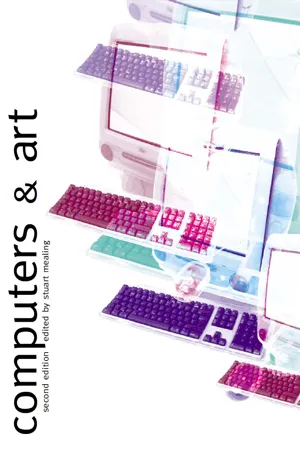
Insightful perspectives on the use of the computer as a tool for artists. The approaches taken vary from its historical, philosophical and practical implications to the use of computer technology in art practice. The contributors include an art critic, an educator, a practicing artist and a researcher. The Editor's contribution will look at the potential for future developments in the field, looking at both the artistic and the computational aspects of the field. This collection seeks to bring together the latest theories and advances in the use of computers in art as well as looking in a practical way at the computational aspects and problems involved.
Information
Mike King was born in 1953 to a family of fine artists. He has a BSc in Physics and Chemistry from London, an MSc in Software Engineering from Oxford and a PhD in Computer Graphics from the Royal College of Art, London. He is currently Reader in Computer Art and Animation at London Guildhall University where he teaches on a course in Digital Moving Image. His digital print series ‘Virtual Visions’ is shown nationally and internationally, and he writes widely on the digital arts. He is also involved with Digital Art Museum, a project which aims to create the world’s leading on-line resource for the history and practice of Computer Art.
Mike King
Artificial consciousness – artificial art
Abstract
The electronic arts derive their energy and fascination from the relationship between artist and machine. Attempts to automate art are increasingly successful as developments take place in artificial intelligence, artificial creativity and artificial life. However, it may take artificial consciousness to create a totally artificial life. This in turn requires the resolution of the question: is quantum mechanics inextricably linked with consciousness? The future of a totally artificial art may hinge on this.
Introductiion
James Gleick points out in Chaos 1 that the 20th century will probably be remembered for three great scientific revolutions: relativity, quantum mechanics and chaos theory. With only five years to go it is probably too late for a fourth revolution to emerge in this century but we are seeing, in embryonic stage, the first scientific revolution of the 21st century: studies in consciousness. The claims for chaos theory are that, unlike the preceding two revolutions, it relates to the more immediately tangible world of our experience. Studies in consciousness relate to an intangible but infinitely more intimate world: our being. The classical sciences of the previous centuries give us a very different world however.
The discoveries by Copernicus, Galileo, and Kepler that showed the Earth to revolve around the Sun have become a metaphor for the growing realisation that Man was not at the centre of the Universe but an insignificant creature on an insignificant planet in an insignificant solar system, of which there are millions or billions. The triumph of Western science has come at the price of an alienation from the previous natural order and a haunting sense of insignificance or angst, to which feeling the 20th century has given a unique flavour. One can characterise our present universe as anthropo-eccentric, that is a universe in which man is no longer at the centre, in contrast to the previous anthropo-centric universe. John Archibald Wheeler points this out in his introduction to the Anthropic Cosmological Principal,2 as does Danah Zohar at much greater length in The Quantum Self3 (more of these later). One can reasonably assert that both the infant and the mystic (mystic in the sense that Evelyn Underhill 4 and Aldous Huxley 5 use, for example) live in an anthropo-centric universe, and one may speculate that certain tribal peoples may also do so, to varying degrees. But the average Westernised person now lives in an anthropo-eccentric universe.
The reductionist, mechanist sciences of Newton and Darwin leave the educated individual in no doubt that, from the perspective of ‘rational’ science, he or she is an accident in an accidental universe — and in no way at its centre. The more recent discoveries of chaos theory show a less ordered universe, with room for ‘emergent’ properties, which allow for more poetic descriptions. Rocks, weather, organisms, society, the economy: these become non-linear systems with unpredictable developments but they are still deterministic. The individual is a system of organs and cells, the result of a gene pool system, embedded within social and economic systems. The individual is still alienated.
Until quantum theory
Quantum theory completes the cycle of scientific revolution and renders the universe anthropo-centric once more. The job of science is done.
Quantum theory is inextricably linked to the current debate on consciousness, which in turn is inextricably linked to debates on creativity. We shall look at quantum theory, consciousness, creativity, computers and the electronic arts, starting with chaos theory and quantum mechanics.
Chaos theory and quantum mechanics
The debate on consciousness involves many disciplines, and many theories from these disciplines are brought to bear. For the purposes of this paper the two most important sets of theories are those related to non-linear systems, and those related to quantum theory.
Chaos theory, or the theory of non-linear systems, involves the study of phenomena whose developments are highly sensitive to small fluctuations in starting conditions. Examples include the weather, turbulent flow and fractal computer graphic images — James Gleick gives a popular introduction in Chaos.6 An example of a linear system is a bicycle: if you pedal twice as fast you cover the same distance in half the time. A one percent increase in speed gives a one percent decrease in time taken and so on. Some linear systems can become non-linear systems at a critical point; an example of this is laminar (orderly) flow in a liquid becoming turbulent flow (indeed much research into non-linear systems arises from efforts to prevent turbulent flow in pipes, and to cause it in spoilers, for example).
As previously mentioned, non-linear systems are, in principle, deterministic. This means that the same starting conditions will give the same end conditions, and, if we have computers powerful enough, we can predict the outcome. In practice, because of the extreme sensitivity to the starting conditions, it may be very difficult to predict the outcome but this is merely a problem of computing power –a non-linear system is said to be computable (in principle). However, these systems are of great interest because there may be an apparent unpredictability and because of emergent properties.
The philosophers Deleuze and Guattari have applied the principles of non-linear systems to a wide range of phenomena, including human society. Manual De Landa gives an interesting account of this in connection with modern warfare.7
Non-linear systems, in terms of physics, are classical systems, that is they conform with Newtonian mechanics and Maxwellian electromagnetic theory. Hence, despite the relative richness of the universe they describe, and the fruitful consideration of emergent properties, they remain part of the anthropo-eccentric universe defined above.
Quantum theory represents a far more radical departure in the sciences from the ordered stream of development in the understanding of the physical universe going back to Copernicus and Galileo. To some it is merely an esoteric and specialised field of knowledge dealing with the sub-atomic level, and represents a small tributary in the growing expansion of an essentially classical vista of knowledge. To others it challenges the roots of the objective, scientific worldview.
Quantum theory grew out of a seemingly innocent debate over whether light consisted of waves or particles. It was assumed that the debate would be resolved in a straightforward way, as countless other debates over the nature of other phenomenon had been (and will be). However, in the last century it became clear that light behaved as a wave under some experimental conditions and as a particle under others. This simple fact was obstinately unresolveable and its unwanted (by classical science) implications were twofold: firstly, that the observer’s behaviour could not be removed from the experiment – thus challenging traditional notions of ‘objectivity’ – and, secondly, that science was going to have to live with the unthinkable: paradox. The Aristotelian law of the excluded middle (something can be A or B but not both), which is the cornerstone of rational thought, would have to be abandoned, though only in some circumstances.
Quantum theory as we now know it gives a terminology for the wave/particle paradox but does not remove the paradox. In fact a quantum scientist is required ‘to believe three impossible things before breakfast’, in the words of the Red Queen, on a regular basis. Sub-atomic particles are to be considered as ‘standing waves’ with discrete energy levels (hence quantisation). The smallest amount of light energy is called a photon and can be considered a particle in the sense that one cannot have less than a photon’s worth of light energy. On the other hand, it has frequency and wavelength. Photons interact with matter by being absorbed by orbiting, standing-wave electrons, which jump an energy level within the atom. Light is emitted when an electron falls to a lower energy level.
David Bohm lists four basic features of quantum theory 8:
1. Indivisibility of the Quantum of Action: this is the basic postulate, that wave energy cannot be divided up below a certain (very small) quantity, proportional to its frequency.
2. Wave-Particle Duality: all waves can be considered as particles at the quantum level, but also as waves — it is up to the observer to set up the conditions for observation that give a wave or particle description of a phenomenon.
3. Properties of Matter as Statistically Revealed Potentialities: the ‘classical’ world of discrete solid objects with deterministic behaviour is a statistical description of large numbers of quantum particles; for example, the half-life of a group of millions of uranium atoms can be stated accurately but nothing can be said about an individual atom.
4. Non-causal Correlations: quantum theory requires sub-atomic particles to behave as if they communicated instantaneously over large distances. This is called instantaneous non-locality and was one of the aspects of quantum theory that led Einstein to search for the remainder of his life for ways to disprove quantum theory. He was unsuccessful.
A deeper understanding of these ideas requires considerable study and a grasp of mathematics. However, quantum theories can be summed up in two terms: quantum indeterminacy and quantum holism. The quantum physicist Erwin Schrödinger invented a ‘thought experiment’ that demonstrates both of these aspects, usually referred to as Schrödinger’s Cat. Schrödinger imagined a single photon being directed through a half-silvered mirror (a mirror that allows 50 percent of light energy through and 50 percent to be reflected). The mirror is arranged in such a way that if the photon (a single quantum of light energy) passes through the mirror it triggers a photosensitive device which kills an unfortunate cat kept in an opaque box.
Because of quantum indeterminacy there is nothing in the history of any part of the experiment that will allow us to predict, even on a statistical level, whether the photon goes straight through or is deflected. Hence the only way that we can know whether the cat is alive or dead is by opening the box. No well-informed bookie would give you odds on the cat’s survival, even if you repeated the experiment a million times with a million cats. Photons do not have ‘form’. Quantum wholeness enters with the observer: the person who opens the box. In technical terms the photon is described as a wave, with a mathematical description known as a wave function; and when the photon is discovered (by the observer) to have gone one way or the other, this is known as the ‘collapse of the wave function’. It has become accepted that the observer is integral to this process and recent thinking places great emphasis on this.
An alternative version of the experiment involves the decay of a small amount of radioactive substance and a Geiger counter to detect it and trigger the release o...
Table of contents
- Cover page
- Title page
- Copyright
- Contents
- Introduction
- On drawing a circle
- Why use computers to make drawings?
- Representing representation: artificial intelligence and drawing
- Some trends in computer graphic art
- Fatal attraction: print meets computer
- A year and a day on the road to Omniana
- The art of interactivity: interactive installation from gallery to street
- Networks and artworks: the failure of the user-friendly interface
- Virtual reality and art
- Visual technology and the poetics of knowledge
- Post-modem art, or: Virtual reality as Trojan donkey, or: Horsetail tartan literature groin art
- Artificial consciousness – artificial art
Trusted by 375,005 students
Access to over 1.5 million titles for a fair monthly price.
Study more efficiently using our study tools.
Frequently asked questions
Yes, you can cancel anytime from the Subscription tab in your account settings on the Perlego website. Your subscription will stay active until the end of your current billing period. Learn how to cancel your subscription
No, books cannot be downloaded as external files, such as PDFs, for use outside of Perlego. However, you can download books within the Perlego app for offline reading on mobile or tablet. Learn how to download books offline
Perlego offers two plans: Essential and Complete
- Essential is ideal for learners and professionals who enjoy exploring a wide range of subjects. Access the Essential Library with 800,000+ trusted titles and best-sellers across business, personal growth, and the humanities. Includes unlimited reading time and Standard Read Aloud voice.
- Complete: Perfect for advanced learners and researchers needing full, unrestricted access. Unlock 1.5M+ books across hundreds of subjects, including academic and specialized titles. The Complete Plan also includes advanced features like Premium Read Aloud and Research Assistant.
We are an online textbook subscription service, where you can get access to an entire online library for less than the price of a single book per month. With over 1.5 million books across 990+ topics, we’ve got you covered! Learn about our mission
Look out for the read-aloud symbol on your next book to see if you can listen to it. The read-aloud tool reads text aloud for you, highlighting the text as it is being read. You can pause it, speed it up and slow it down. Learn more about Read Aloud
Yes! You can use the Perlego app on both iOS and Android devices to read anytime, anywhere — even offline. Perfect for commutes or when you’re on the go.
Please note we cannot support devices running on iOS 13 and Android 7 or earlier. Learn more about using the app
Please note we cannot support devices running on iOS 13 and Android 7 or earlier. Learn more about using the app
Yes, you can access Computers and Art by Stuart Mealing in PDF and/or ePUB format, as well as other popular books in Art & Art General. We have over 1.5 million books available in our catalogue for you to explore.