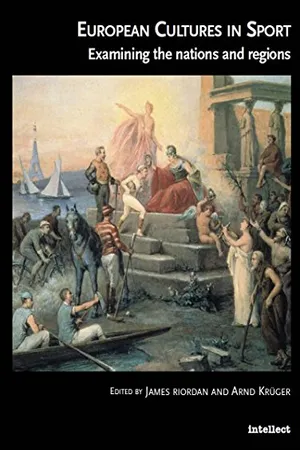
Sport occupies a key position in the cultural profile of a nation. This study forms a comparative guide to sport across Europe, in terms of its relative political and social status, its development, and the ways in which it has contributed to national achievement. Covering sport in ten major European states, each native contributor to the study presents: • a brief historical background: major sports successes, Olympic positions, sporting traditions, • organisation of sport: its structure and financing, • elite sport: how talent is spotted, nurtured and remunerated, sports academies, national qualification schemes, • the role of science and medicine in sport,
- 167 pages
- English
- ePUB (mobile friendly)
- Available on iOS & Android
eBook - ePub
European Cultures in Sport
About this book
Information
Scotland
Ian Thomson
The organisation and administration of sport in Scotland conforms broadly to the pattern elsewhere in the United Kingdom, at least until 1945. This chapter, therefore, focuses on sports development after World War II, when it followed distinctly Scottish lines.
Today, there are four major agencies supported by a variety of voluntary and professional bodies. The main agencies are central government through a Minister for Sport; a Sports Council funded by government but operating at arms-length from it; governing bodies of sport; and local government. The power and influence of each agency has varied from time to time since 1950, as has the spirit of partnership. Scotland has maintained a large measure of independence and has resisted attempts to centralise power at UK level.
The Early Years
The Scottish Council of Physical Recreation and the advisory Sports Council for Scotland 1945-1972
The advisory Sports Council for Scotland grew out of the Scottish Council of Physical Recreation (SCPR) which, in turn, began life as the Scottish section of the Central Council of Physical Recreation. The CCPR had made overtures to the Scottish Fitness Council in the 1930’s to form a Scottish section but this was rejected. In 1944 May Brown, who was to become the first Secretary of the SCPR, approached Phyllis Colson, the Secretary of the CCPR about forming a Scottish section. (Brown 1979:17). Ms Brown convened a meeting of all national organisations concerned with physical education and recreation including representatives of the Scottish Education Department and the two specialist colleges of physical education. The Principal of Dunfermline College of Physical Education chaired the meeting. The strong bond between the colleges, the physical education profession and the sporting community has been a distinctive element in Scottish sport throughout the past half century.
The meeting endorsed the proposal to form a Scottish section of the CCPR, the submission was accepted and the Scottish Education Department (SED) agreed to grant aid the new body, starting in March 1945. Within a few months Ms Brown had appointed an Assistant Secretary, eight technical representatives and clerical staff, all located in new offices in the centre of Edinburgh. Over the next six years the SCPR acted as a driving force for development across a broad front of physical recreation, physical education and sport. In retrospect its achievements during a period of relative austerity were awesome.
The governing bodies of sport were initially suspicious of the intentions of the new organisation and the first attempt at staging a meeting of sport bodies was boycotted. Not a single body turned up. The SCPR turned to the public for recognition. Working with local authorities, Festivals of Sport were organised in Edinburgh, Glasgow, Aberdeen, Inverness and Dundee. In the two largest cities 10 day events in the city centres attracted 80,000 visitors which was a huge response from the public. Governing bodies of sport agreed to stage coaching events and competitions to aid recruitment. Back in the late 1940s there had been nothing to compare with this. It helped to overcome the initial suspicion of the SCPR. Within a few years over 100 national organisations became members of the Council. In some respects it was similar to Confederations of Sports in other European countries.
The SCPR secured a donation of £120,000 from the King George Memorial Trust Fund to establish a national recreation centre. Edinburgh was the favoured site but the growing interest in outdoor activities influenced the decision to purchase a hotel in Largs which would give access to the River Clyde for canoeing and sailing. The centre was officially opened in 1958 by the Queen and Prince Philip, and is still flourishing. It was named Inverclyde after Lord Inverclyde, the first President of the SCPR.
The funding of Glenmore Lodge, the Scottish Centre for Outdoor Training came directly from the government. The SCPR recruited Lord Malcolm Douglas-Hamilton whose family had a keen interest in outdoor activities and who was aware that the Lodge would be on the market. He and other members of a deputation persuaded Tom Johnston, Secretary of State for Scotland that the Government should provide the SCPR with funds for the purchase. The Lodge was opened in 1948 by Tom Johnston himself. Thus, Scotland possessed a national centre for traditional urban sports and a centre to serve the needs of mountaineering, ski-ing and other outdoor adventurous pursuits. They became focal points of SCPR programmes and provided a meeting ground for governing bodies which traditionally had little or no contact with each other.
There was another group of interests in Scotland which needed to be brought together. These were the professional bodies representing male and female teachers of physical education, the advisers in physical education, the colleges and universities and the SCPR. May Brown went to great lengths to ensure that organisations representing teachers, lecturers and the principles of specialist colleges should meet in a common footing with each other and Her Majesty’s Inspectorate. The SCPR became the link between sport and recreation on the one hand and the world of physical education on the other. In 1953 the Scottish Joint Consultative Committee on Physical Education was formed with May Brown as secretary.
The SCPR was expert in mobilising support. They latched on to a long-established tradition of royal and aristocratic patronage of Scottish sport. This ensured support from the dominant Conservative Party, the Scottish Office and the voluntary trusts which controlled substantial funds. The SCPR was itself an essentially conservative agency well suited to the role of a national voluntary organisation. From 1944 to 1948, the President was Sir Iain Colquhoun and he was followed by Lord Inverclyde. In 1953 a massive sports display was mounted in Holyrood Park in Edinburgh to celebrate the Coronation State Visit of the young Queen Elizabeth. Shortly afterwards the Queen agreed to become patron of the SCPR. Then in 1955 the Queen Mother attended the celebrations to mark the 50th anniversary of the founding of Dunfermline College of which May Brown was a governor. The Queen opened Inverclyde officially in July 1958; accompanied by the Duke of Edinburgh who took a keen interest in the SCPR from his position as President of the CCPR.
It was inevitable that Scotland should seek independence from the CCPR, but this raised important issues which have recurred regularly over the past fifty years, namely the rights of the Home Countries in terms of international sport and the value of one voice for sport in dealings with Central government. In 1951 an informal approach was made, indicating that the tide of national opinion and the growing confidence of the Scottish section was leading to separation and the establishment of a fully autonomous Scottish Council of Physical Recreation. Phyllis Colson, the Secretary of the CCPR wrote to Dr Stewart Mackintosh, chairman of the Scottish section expressing her deep reservations:
“Now that the peak of CCPR unity has been reached with the accession of Northern Ireland”, she wrote, “the Council is competent to speak with one voice on really big matters affecting physical recreation national policy, to bring to bear the full potential of every part of the United Kingdom and to pursue any decision reached with singleness of purpose. Split into parts (two to begin with and, without doubt, four later on) and you at once dissipate its force, destroy its assured singleness of purpose and open the door for unilateral action – in short, you lessen the strength of the whole and of each of its component parts.” (Evans, 1974:138)
Despite this warning, the SCPR was incorporated as an independent body in June 1953. For the next ten years it maintained as its main aim ‘to promote healthy living through physical recreation’. At that time it was not concerned with sports specific development or elite sport. It was an entirely different kind of organisation from the Sports Council which exists to-day.
The SCPR concentrated on leadership training courses in a variety of sports, conducted mainly as residential Summer and Easter schools. From 1948 to 1962 it housed the Scottish Athletics Coaching Scheme but made no attempt to replicate the scheme in other sports. It was heavily involved in the opening up of the countryside for public access to new sports and others which were previously the domain of the landed gentry. Thus it spearheaded the growth of angling, canoeing, mountaineering, pony-trekking, orienteering, sailing and ski-ing, assisting in the establishment of new governing bodies or in the staging of events. Concurrently the Council collaborated with the Scottish Tourist Board in the promotion of Sports Holidays.
One of the Council’s major achievements was to retain the Scottish Joint Consultative Committee on Physical Education as a link between physical education and school sport and sport in the community. As in the case of physical recreation the Council created a forum for development without overtly striving for leadership. The Committee staged a major national conference on the future of physical education in Edinburgh in November 1954, and the SCPR undertook the conference administration and publication of a conference report. One of the more radical conference resolutions was that a Degree course in physical education should be introduced. This did not come about for another twenty years. Another sought to persuade central government to utilise revenue from football pools to improve sports facilities in schools. It was defeated heavily. The football pools companies established a Football Grounds Improvement Trust in 1975 which became the Football Trust in 1979. It poured millions of pounds into professional football. To take only one year as an example, in 1987 the Trust allocated £1.3 million to local authorities which led to 71 new pitches, 92 improved pitches, 45 new and 11 improved pavilions. However, school facilities were not improved by Trust funds.
There was little to distinguish the pattern of sports administration in Scotland from England. It was a simple formula of concentrating on the needs of voluntary organisations – leadership training, small grants, and developing a relationship with central government departments of education and promoting a concept of active leisure. The national centres in both countries provided excellent residential facilities for leadership and coach education, as well as venues for national and regional championships and for training camps.
The Wolfenden Report
A group of academics at Birmingham University produced a pamphlet in 1957 entitled Britain in the World of Sport. This contained embarrassing evidence that Britain was rapidly falling behind other countries in international sport. A particularly worrying feature was the threat to amateurism posed by countries from Eastern Europe. That year, the CCPR appointed a small independent committee to examine the general position of sport in Britain. Sir John Wolfenden was chairman of a committee which would profoundly affect British Sport.
It was quickly recognised that the Committee was uncovering serious deficiencies in the state of sport. The prospect of a damaging indictment of British sport led the Conservative and Labour Parties to publish policy statements on sport prior to the appearance of the Wolfenden Report. Both recommended a Sports Council of Great Britain, the Conservatives anticipating the future by proposing a Royal Charter to guarantee independence. Both robustly rejected any idea of a Ministry of Sport and they were in accord that sport should come under the umbrella of Education.
Prior to the Wolfenden Report, startling comparisons were made with European countries. For example Britain had 61 public running tracks: Sweden had 800. West Germany had built 75 swimming pools since the war; Britain had built 12. In other words politicians from all shades of opinion recognised that Britain had fallen behind other countries and changes would have to be made in funding and administering sport; but without State control.
The Wolfenden Report Sport and the Community (CCPR 1960) was a defining document in the history of British sport in the 20th century. The origins and deliberations of the Committee have been recorded by the Secretary of the Committee. (Evans, 1974:145-168). The central recommendation was that there should be a new body, a Sports Development Council which would distribute £5 million to governing bodies of sport –a huge amount in 1960, plus another £5 million to be sanctioned for capital projects. The Committee presumed that the CCPR and the SCPR would run in tandem with the new Council.
Within months of the publication of the Wolfenden Report, the SCPR held a meeting of representatives of governing bodies of sport. It was agreed unanimously that if Wolfenden was likely to be implemented, a case should be made to government for a separate Sports Council for Scotland and that a sum of money should be allocated by the Treasury for Scotland. Following the debate on Wolfenden in the House of Commons in July 1961, the government agreed that national recreation centres would receive statutory financial support which was good news for the Inverclyde centre. The emphasis shifted from recreational leadership training and physical education to the government’s new agenda of raising Britain’s image in world sport and investing heavily in national facilities.
Between 1961 and 1965 the fate of Scottish and British sport was increasingly influenced by politicians. The Conservative government which was in power until 1964 took the line that state intervention could only be justified as a support structure for voluntary sector activity. The Wolfenden proposal for a Sports Development Council was rejected. This was defended by Lord Hailsham, Cabinet Minister, Lord President of the Council and Minister for Science who was given responsibility for sport in 1962. He made his views clear in a House of Commons debate in June 1964.
“In order to carry out the work ... one must have access to the composite bodies, the CCPR, the NPFA, the SCPR and the British Olympic Association. Either a Sports Development Council is the same as these bodies, in which case it is superfluous, or it is different, in which case it is objectionable”.
He started with limited objectives, namely to make the most efficient use of existing sources of government finance and also to increase the flow of funds to the voluntary sector. Hailsham appointed a small committee of senior civil servants to co-ordinate the various government departments which contributed to health, physical education, recreation and sport. This was essentially a Westminster, UK controlled committee but they invited the SCPR to send two representatives to their meetings which were held during 1963.
As a contribution to government thinking the SCPR took three initiatives. First they submitted policy papers for two of the meetings of Hailsham’s co-ordinating committee. The first of these dealt with broad issues of policy for Scotland such as increasing the investment in governing bodies of sport and at the same time strengthening the SCPR as an advisory body to government for Scottish sport. The second policy paper set out an order of priority for national sports facilities, the top of the list being non-residential multi-sport centres around the country.
The second contribution from the SCPR was to ensure that the views they expressed were representative of the 140 members organisations. They organised a national conference in 1963 whose theme was The Future of Sport in Scotland. Lady Tweedsmuir the Under-Secretary of State for Scotland emphasised that the Conservative Government were not in favour of a Sports Development Council. She was convinced that the existing set up in Scotland was satisfactory. Following the conference, SCPR representatives met Lord Hailsham and submitted a strategy for Scottish sport. Hailsham’s advisor Sir Patrick Renison was taken on a tour of facilities by May Brown and met representatives of local government and governing bodies of sport. He was left in no doubt that there was a need for investment in sports facilities in Scotland.
The third step taken to advance the case for sport was the organisation of five regional conferences attended by local authorities, public bodies and Government representatives to discuss planning of new facilities for sport. Lord Provosts of cities and the most senior civil servants in the Scottish Office attended. The most up-to-date information on sports buildings, surfaces, floodlighting and so on was gathered by SCPR staff and presented to the conferences. This was common language in many European countries but it was entirely new information for civic leaders in Scotland. Finland with almost exactly the same population as Scotland (4.5 million) had fourteen multi-sports centres. Stockholm with a smaller population than Glasgow had six such centres and Germany’s “Golden Plan” for sports facilities had provided a sports centre for every community with more than 5,000 inhabitants. By comparison with other small countries in Europe, Scotland was at the very bottom of the ladder. One positive outcome was that the Scottish Office offered 50 per cent funding to Glasgow to build a proto-type multi-sports centre at Bellahouston Park – the first of its kind in the country. It was also the first major government grant for a capital sports project in Scotland which was another indictment of the State’s contribution compared to other countries.
Every SCPR conference held between 1960 and 1963 confirmed that despite the Wolfenden Committee conclusion that there should be a Sports Development Council, there was no enthusiasm in Scotland for that idea. The SCPR found a neat compromise. They created a Sports Development Committee within rather than separate from the SCPR and found an ideal chairman in Peter (later Sir Peter) Heatly. He was a legendary figure in Scottish sport with gold medals for diving in Commonwealth Games in Auckland 1950, Vancouver 1954 and Cardiff 1958.
Shortly before the General Election in 1964 the government introduced a raft of measures to help governing bodies and local authorities. The former were now eligible for grants to help meet recurrent costs on administration as well as the running of coaching schemes. Local clubs could apply for capital grants to improve existing facilities or build new ones. The SED issued a circular to local authorities asking them to carry out an immediate review of facilities for sport and recreation in their areas. A survey conducted in 1964 by the SCPR revealed that there was a complete lack of international standard facilities except for football and rugby.
Advisory Sports Councils
A General Election was held in October 1964 and the Labour Party swept into office after thirteen years in opposition. They immediately set about implementing a manifesto commitment to establish a Sports Council. Denis Howell was appointed as a Minister for Sport, a junior position in government but a significant role in sport. Howell’s views were very different from those of Hailsham. He was totally committed to the Wolfenden concept of a Sports Development Council. He believed that sport needed political leadership and that this could best be delivered by combining the role of Minister with Chairmanship of the UK Sports Council. In this way sport could have a voice at the heart of government while remaining independent of state control. The new Minister strongly favoured an adviso...
Table of contents
- Cover
- Title page
- Copyright
- Contents
- Introduction
- England and Wales
- Scotland
- Denmark
- Germany
- The Soviet Union and Eastern Europe
- France
- Spain
- Italy
Trusted by 375,005 students
Access to over 1.5 million titles for a fair monthly price.
Study more efficiently using our study tools.
Frequently asked questions
Yes, you can cancel anytime from the Subscription tab in your account settings on the Perlego website. Your subscription will stay active until the end of your current billing period. Learn how to cancel your subscription
No, books cannot be downloaded as external files, such as PDFs, for use outside of Perlego. However, you can download books within the Perlego app for offline reading on mobile or tablet. Learn how to download books offline
Perlego offers two plans: Essential and Complete
- Essential is ideal for learners and professionals who enjoy exploring a wide range of subjects. Access the Essential Library with 800,000+ trusted titles and best-sellers across business, personal growth, and the humanities. Includes unlimited reading time and Standard Read Aloud voice.
- Complete: Perfect for advanced learners and researchers needing full, unrestricted access. Unlock 1.5M+ books across hundreds of subjects, including academic and specialized titles. The Complete Plan also includes advanced features like Premium Read Aloud and Research Assistant.
We are an online textbook subscription service, where you can get access to an entire online library for less than the price of a single book per month. With over 1.5 million books across 990+ topics, we’ve got you covered! Learn about our mission
Look out for the read-aloud symbol on your next book to see if you can listen to it. The read-aloud tool reads text aloud for you, highlighting the text as it is being read. You can pause it, speed it up and slow it down. Learn more about Read Aloud
Yes! You can use the Perlego app on both iOS and Android devices to read anytime, anywhere — even offline. Perfect for commutes or when you’re on the go.
Please note we cannot support devices running on iOS 13 and Android 7 or earlier. Learn more about using the app
Please note we cannot support devices running on iOS 13 and Android 7 or earlier. Learn more about using the app
Yes, you can access European Cultures in Sport by Arnd Kruger,James Riordan in PDF and/or ePUB format, as well as other popular books in Biological Sciences & Geography. We have over 1.5 million books available in our catalogue for you to explore.