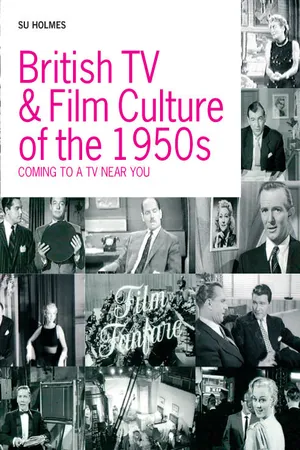
This book focuses on the emerging historical relations between British television and film culture in the 1950s. Drawing upon archival research, it does this by exploring the development of the early cinema programme on television - principally Current Release (BBC, 1952-3), Picture Parade (BBC, 1956) and Film Fanfare (ABC, 1956-7) - and argues that it was these texts which played the central role in the developing relations between the media. Particularly when it comes to Britain, the early co-existence of television and cinema has been seen as hostile and antagonistic, but in situating these programmes within the contexts of their institutional production, aesthetic construction and reception, the book aims to 'reconstruct' television's coverage of the cinema as crucial to the fabric of British film and television culture at the time. It demonstrates how the roles of cinema and television - as media industries and cultural forms, but crucially as sites of screen entertainment - effectively came together at this time in such a way that is unique to this decade.
- 276 pages
- English
- ePUB (mobile friendly)
- Available on iOS & Android
eBook - ePub
About this book
Information
Chapter One
Broadcasting It:
Approaching the Historical Relations between Cinema and Television
This chapter has two related aims. First, given that the cinema programme did not exist in isolation from other spheres of interaction between British cinema and television, it contextualises the wider activity and negotiation occurring at the time. Second, it examines how and why the early relations between British broadcasting and film culture have differed from those in the US and, more specifically, the ways in which this created a particular space for the cinema programme to emerge as the primary site of interaction between British cinema and television in the 1950s.
It has been suggested in the preceding pages that if there are considerable contrasts in historical accounts of the interaction between cinema and broadcasting in Britain and America, then this has as much to do with the construction of these histories as it does with the actual historical relations which occurred. In short, it is fair to suggest that this disparity is a combination of our understanding of this history, as well as the different national contexts in which cinema and broadcasting have developed. Hilmes’ observation that, by the late 1930s, ‘radio virtually became Hollywood’ (1989, p.41), or Anderson’s argument that the ‘history of American TV is the history of Hollywood TV’ (1994, p.12), immediately emphasise the different institutional and economic structures in place here. A similar conception could not be applied to history in the British context, however it might be constructed or explained. Only with the more recent establishment of British television as a key economic force in British film production, not least of all with the advent of Channel Four’s initiative Film on Four which produced films with both a theatrical and television release (Hill, 1996, Stokes, 1999, p.44), have critics felt compelled to make similar comments about a truly ‘symbiotic’ relationship between the media. As John Caughie and Kevin Rockett argue, for example, ‘since at least the early 1980s it has been impossible to discuss British cinema without also discussing British television’ (1996, p.6). In this respect, British television’s involvement in film production has emerged less out of purely commercial imperatives than an ethos of public service (Hill and McLoone, 1996, p.2). For some, this has fostered an economic and aesthetic framework in which the films are seen as ‘lacking in cinematic values’ - effectively falling short of being ‘real cinema’ (Hill, 1996, p.166). These views clearly arise from wider prejudices surrounding technological and aesthetic comparisons of the cinema and television. However, they also reflect back on perceptions of the interaction between British television and cinema as being in some way more ‘parochial’, less successful (and in fact less interesting) than the history of the cinema’s relations with broadcasting in the American context. Particularly when it comes to historical analysis, this perception ultimately pivots on the basis of more direct forms of economic or institutional interaction - in contrast to forms of textual interplay which may, or may not, be directly linked back to economics. Martin McLoone has argued that:
[T]here are really two relationships at stake. First, there is the relationship between cinema and television as institutions and second, between the respective media of electronic imaging... and film. These are not, to my mind, the same thing, though they are often talked about as if they were inter-changeable oppositions... [original emphasis]
(1996, p.83).
While the period under consideration here points to similarities between the British and American situations, it is precisely the different institutional infrastructures of television and cinema in Britain which mean that forms of textual partnership are more important. As discussed below, in both Britain and America, cinema interests were initially prevented from developing controlling interests in either broadcasting institutions or technologies. The key difference with the American context was that the Hollywood film industry were able to become much more involved in the production of broadcast programming from an early stage. When considering the British context, it is for this reason that it becomes important to make a distinction between economic interaction and what we might call textual collaboration, as it was this, in the form of the cinema programme, which played the crucial role. Nevertheless, despite certain similarities, it is also difficult to make direct comparisons between Britain and American given the different structures and scope of their respective film and television industries (see Stokes, 1999). Of course, this study could equally begin by invoking a comparison with other European contexts (were similar early research on the relations between cinema and television available here). However, the narrative of Hollywood and broadcasting, as with Hollywood cinema itself, is undoubtedly the most ‘known’ history in this field, and it is implicitly this to which the Britain situation is compared. Furthermore, the historical centrality of Hollywood film culture in Britain shaped the British cinema programme, a context which makes the Hollywood film companies part of its historical narrative.
‘Controlling’ Television?: The Film Industry and Television in the US and UK
In both Britain and the US, the organisation of television was shaped by the existing structures of radio, thus developing under an ethos of public service in Britain, and the commercial networks in America (Stokes, 1999, p.24). Later to develop under the infamous moral principles of the first Director General of the BBC, Lord Reith, the government deemed that the wavebands necessary to broadcast radio be regarded as a ‘valuable form of public property’ (Scannell, 1990, p.11). The scarcity of wavelengths, as well as the perceived social, cultural and political power of radio, all shaped the belief that ‘the operation of so important a national service ought not to be allowed to become an unrestricted commercial monopoly’ (Scannell, 1990, p.13), and the government ultimately awarded a monopoly, in the context of public service, to the BBC. In differing from the highly complex, competitive and commercial network of radio’s infrastructure in the US (see Hilmes, 1990), it was precisely this concept of a public service monopoly which made the key difference in terms of the film industry’s interaction with broadcasting, and the types of partnership which prevailed.
In contrast to the conventional narrative of Hollywood’s approach to broadcasting as moving through ‘complacency, competition, co-operation’ (Anderson, 1991, p.85), revisionist work has emphasised how Hollywood’s failure to establish ownership or control of radio and television was shaped by more pragmatic reasons. The major Hollywood film companies consistently sought to get in on the ‘ground floor’ of both radio and television - in terms of developing alternative broadcast technologies or operating network stations (White, 1990, Hilmes, 1990). A combination of factors prevented this, not least of all opposition from broadcast interests and the regulations concerning monopoly ownership - as enforced by the Federal Communications Commission (FCC). To place radio in the hands of Hollywood was not considered to be in the ‘public interest’ (White, 1990, p.147), but particularly useful to the FCC was the outcome of the Paramount Case in 1949 when the US Supreme Court found the major film companies guilty of antitrust violations in their monopoly of production, distribution and exhibition. As Timothy R. White explains, this offered the:
Commission and the radio interests ... the perfect weapon with which to keep the film industry out of broadcasting. Because the studios were required to separate production and distribution from exhibition, the FCC argued that the ownership of television stations would restore such a relationship
(1990, p.146).
Hilmes describes how 1927 marked the climax of the film industry’s attempts to move into broadcasting, but by this time radio was taking on the structural and economic features that were to characterize the broadcasting industry for decades to come (Hilmes, 1990, p.46). This was best exemplified by the increasing dominance of the major networks; but while the major film companies may have found themselves outside of radio networking and ownership, their stars and films represented very valuable assets for radio programming given their established appeal, popularity and glamour (Jewell, 1984, p.125). While the opportunity to gain a controlling stake in the medium diminished, Hollywood’s involvement in radio programming became crucial in the 1930s and 1940s, contributing to the development of forms of such the variety special, the dramatic series (featuring big-name stars), the publicity-gossip show and the radio adaptation of successful films (Hilmes, 1990, p.63). The involvement of the Hollywood film companies in broadcast production at this time is complex. In the late 1920s, companies such as Warner Bros, Paramount and MGM developed their own radio shows, although these did not appear on the established networks. In other cases, film companies entered into partnership with networks (such as the RKO-NBC programme Hollywood on the Air which began in 1932) (Hilmes, 1990, p.57). In many of the big network shows, however, control remained with the advertising agency and its client (such as The Lux Radio Theater of the Air beginning in 1934), with Hollywood stars and properties being contracted and hired (Ibid, p.69). For this type of show, film stars were paid well for their services. This indicates the rapid formalisation of radio’s relations with Hollywood, as well as its keen demand for its assets.
As in the British context, then, it was in fact the coverage of film culture that was central to Hollywood’s relations with broadcasting from an early stage. Yet this outline also indicates how the extent of this participation, and its sheer scale, was less feasible in the British context. It would have been impossible, for example, for film companies to produce their own film programmes for radio (even if they had the resources). Buscombe’s comment that the ‘structure of television in the UK made it more difficult [for film companies] to get involved at the production level’ (1991, p.206) is equally true of radio although, prefiguring television, the film industry participated in film-related programming on BBC radio from the late 1920s. While important to acknowledge how the commercial nature of American radio shaped the textual form of film programming in ways which differed from the British context; BBC radio was certainly a site for symbiosis with film culture offering coverage of films, stars and adaptations on a regular basis. In this respect, Anderson’s comment that Hollywood cinema and radio were ‘perceived as complimentary experiences in which stars and stories passed easily from one medium to another’ (1994, p.14), is also applicable to the British situation. This also emphasises how the history of media reception and experience exceeds economic and institutional concerns.
In terms of television, its growth in Britain was considerably slower than the US. This also meant that, in comparative terms, television’s inroads into cinema admissions were more gradual and less dramatic. In the UK, 1946 was the cinema’s peak year, followed by a gradual decline over the next ten years. In 1950, 30 million people attended the cinema on a weekly basis, but this had fallen to ten million by 1960 - a drop of 66% (Stafford, 2001, p.96). But as Stafford notes, the rate of decline was uneven throughout this time, and prior to the advent of British television’s second channel (ITV) and the wider growth of set ownership, the first half of the 1950s saw a noticeably less dramatic decline in cinema admissions. Up until mid-decade, he claims that the industry could ‘still look forward optimistically, hoping for stability at audience levels that were at the average levels of the 1930s’ (Stafford, 2001, p.97). This perspective was not entirely unreasonable given that attendance figures in the late 1940s represented a peak encouraged by the exceptional conditions of wartime. What is important here is that, certainly in the earlier part of the decade, there was no clear conception of what television ‘meant’ for the future of the cinema, and the British film industry’s approaches to television were particularly multifaceted and contradictory.
One approach was again to develop forms of economic and technological control over broadcasting, a strategy which, although in differing degrees, characterised early approaches to television in both national contexts. In the US, the Hollywood majors investigated alternatives to broadcast television in the form of Theater Television (with television beamed into cinema theatres) and Subscription Television (a pay-per-view system which sought to bring the ‘box office to the home’). Despite the fact that comparisons have rarely been drawn, British film interests also attempted to develop their own intervention in big-screen television in the form of ‘Cinema-TV’ (Buscombe, 1991, Macnab, 1993, Stokes, 1999). Although the idea emerged in the 1930s, it was not until the late 1940s that discussions between the BBC and the Rank Organisation became more earnest. Along with the Associated British Picture Corporation (ABPC), the Rank Organisation’s stake in all areas of production, distribution and exhibition made it a vertically integrated company which competed on the closest terms with the Hollywood majors. It was such companies that were in the best position to experiment with the exploitation of broadcast technologies. ABPC, as well as the Granada cinema chain, later followed the Rank Organisation in expressing an interest in Cinema-TV. Yet as Buscombe explains, Sir J. Arthur Rank never made it entirely clear to the BBC what he wanted to do with Cinema-TV, whether he intended to transmit live coverage of events to paying audiences, offer a full range of television programming, or simply distribute cinema films to theatres via electronic means (1991, p.199). The BBC clearly perceived such plans as a threat to their monopoly, and were suspicious of the idea from the start. In any event, the film interests were never granted a license to broadcast. In its evidence to the Beveridge committee (1950) the BBC reaffirmed the view that the ‘future of television would lie in the home’ (Buscombe, 1991, p.201), but the film industry did not immediately give up hope. While Current Release was on air the trade papers were littered with news on the development of Cinema-TV and in 1953, Rank and ABPC used theatrical exhibition to transmit their films of the Coronation. Theater Television was already running into trouble in the US by this time (not least of all because of problems with frequencies, the expense of equipping cinemas CinemaScope technology, and the general expansion of television ownership) (Hilmes, 1990, p.120), and by 1953, its wider growth had not materialised. However, partly because of the slower dissemination of television in the UK it is clear that, in the early 1950s, the British film industry’s forays into Cinema-TV indicated their belief that the institutional and technological future of television was still uncertain. This emphasis on a ‘public’, theatrical location for television, particularly when placed alongside the fact that the cinema was initially envisaged as a domestic technology which would bring ‘the world into the home’ (see Kramer, 1996), tends to undermine essentialist conceptions of the technological and aesthetic identities of cinema and television. As Hill and McLoone describe, ‘the manner in which they have been developed and adapted reflects the strategic and economic needs of the respective industries rather than the aesthetic potential or limitations of either’ (1996, p.3).
Although not fully coming to fruition, these interventions into Theater and Cinema-TV emphasise how, throughout the history of cinema’s relations with radio and television, it is largely cinema exhibitors who have had the most to lose from media competition (Hilmes, 1990, p.42). While for producers and distributors, radio and television have historically represented further exhibition outlets for their products, exhibitors remain attached to their theatres. It seems significant here that Granada, Rank and ABPC - the three British film companies to chase the possibilities of Cinema-TV - all owned cinema chains. (Rank owned the Odeon and Gaumont circuits, and ABPC operated the ABC chain). Exhibitors backed Cinema-TV because it was clearly not a form which cut the cinema out of the equation, and it also represented little threat to film producers. This emphasis on the different fractions of the film industry also explains why and how it was feasible for contradictory approaches toward television to be in evidence simultaneously. While the debates over Cinema-TV reached their climax, the film industry were in constant negotiation with the BBC over publicising their films on television via Current Release, while at the same time stepping up their refusal to sell any feature films. It is certainly the exhibitors who were often at the forefront of negotiations over the cinema programme in the 1950s, and as Chapter Three will demonstrate, fearing that it might usurp the audience for ‘film’ as much as promote the cinema, they increasingly stipulated when the programmes could be scheduled. This in itself often created an interesting disparity between the reports on the programmes in the trade press, and the BBC’s own correspondence with individual film producers and companies.
Despite these various attempts to move into broadcasting, by the mid-1950s neither the Hollywood majors nor the British film industry had any significant ownership interests in television in terms of transmission or technology, although the attempts by the Hollywood industry to appropriate broadcasting had occurred on a much larger scale. Nevertheless, in both national contexts, it was in fact at the level of film-related programming (particularly when we look back to radio), that some of the most culturally visible forms of interaction between cinema and broadcasting had occurred - even if the scale, form and structures which fuelled this coverage differed. In the mid-1950s, however, there are significant shifts in the industrial and institutional organisation of television in both Britain and the US, with significant implications for shaping relations with the film industry. These shifts again point to certain similarities between the contexts which are often overlooked, but they also emphasise the differences in the situations, contextualising the role played by the cinema programme on British television at this time. In short, what we see as a result of this situation is that the significance of film-related programming in approaching the historical relations between Hollywood cinema and television declines. In the British context, however, it emerges as the primary site of interaction, with a cultural and institutional centrality it has not enjoyed since.
Although the American majors were previously prevented from moving into television production, a number of factors reshaped the market for television programming in the 1950s, with considerable implications for the film industry. American television experienced a considerable shift in its economic and institutional infrastructure. In the early 1950s, the system of...
Table of contents
- Cover page
- Title page
- Copyright
- Contents
- Illustrations
- Acknowledgments
- Introduction
- Chapter One
- Chapter Two
- Chapter Three
- Chapter Four
- Chapter Five
- Chapter Six
- Chapter Seven
- Chapter Eight
- Bibliography of Sources
Trusted by 375,005 students
Access to over 1.5 million titles for a fair monthly price.
Study more efficiently using our study tools.
Frequently asked questions
Yes, you can cancel anytime from the Subscription tab in your account settings on the Perlego website. Your subscription will stay active until the end of your current billing period. Learn how to cancel your subscription
No, books cannot be downloaded as external files, such as PDFs, for use outside of Perlego. However, you can download books within the Perlego app for offline reading on mobile or tablet. Learn how to download books offline
We are an online textbook subscription service, where you can get access to an entire online library for less than the price of a single book per month. With over 1.5 million books across 990+ topics, we’ve got you covered! Learn about our mission
Look out for the read-aloud symbol on your next book to see if you can listen to it. The read-aloud tool reads text aloud for you, highlighting the text as it is being read. You can pause it, speed it up and slow it down. Learn more about Read Aloud
Yes! You can use the Perlego app on both iOS and Android devices to read anytime, anywhere — even offline. Perfect for commutes or when you’re on the go.
Please note we cannot support devices running on iOS 13 and Android 7 or earlier. Learn more about using the app
Please note we cannot support devices running on iOS 13 and Android 7 or earlier. Learn more about using the app
Yes, you can access British TV and Film Culture in the 1950s by Su Holmes in PDF and/or ePUB format, as well as other popular books in Negocios y empresa & Negocios en general. We have over 1.5 million books available in our catalogue for you to explore.