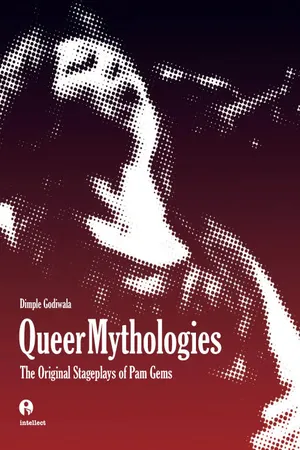
This book on Gems has a thesis or a 'backbone' which elicits the title Queer Mythologies. Pam Gems has written over 25 plays, and has not had adequate detailed analysis of her plays to date. She is a popular playwright produced often at the West End and has a widespread appeal by being on the pulse of cultural iconology. Gems writes strong central characters for both male and female actors, and often writes almost cinematically, with time shifts in a non-linear narrativization. Her characters are metaphors for contemporary women and men and she often herstoricizes, thus righting the balance of dramatic history by creating parts for women in British drama. Her dramaturgy brings to the mainstream theatre the identities and subcultures of class, race, ethnicity, gender and sexuality making her plays queer mythologies.
- 141 pages
- English
- ePUB (mobile friendly)
- Available on iOS & Android
eBook - ePub
About this book
Information
1
BEGINNINGS
Born in Bransgrove, Hampshire to a poor working class family in 1925, Pam Gems started to write drama at school at the age of six or seven. During the war years and after she wrote four television plays for the BBC which never saw the light of day, she wrote a few plays for the radio with little success. In the 1950s one television play, A Builder by Trade, was accepted for television. Although this play portrayed working-class relationships, ‘they did it very middleclass [although] I wanted it to be about working class people and nobody seemed to know what I was talking about.’1
Betty’s Wonderful Christmas was Gems’ first produced play in 1972. Produced at the Cockpit Theatre in London, the producer was David Aukin who later became co-director of the Royal National Theatre, head of Channel Four Films, and a successful West End producer. Betty’s Wonderful Christmas was directed by his wife Nancy Meckler, renowned for many theatre and film productions and for her work with Shared Experience Theatre Company. Set in the early 1920s, the play has autobiographical overtones in the class setting and childhood of meagre possessions. Naturalism dominates the stage directions: ‘A man sells hot potatoes. They are real, and so is the smell.’ (p.7) However, this is not a naturalistic play. Jonathan Gems describes it as ‘a Jungian-feminist dream play, heavy with symbols of the animus, the anima, and changelings from the dark pools of the collective unconscious. It may also owe something to the work of child psychologist Bruno Bettelheim, and, formalistically, to the verse dramas of the 19th century which gave us plays such as Ibsen’s Peer Gynt and informed the Victorian tradition of pantomime.’2
In her early plays Gems focuses on poverty in the lives of young women and how they cope and survive. The two short monologues, My Warren and After Birthday, as well as Ladybird, Ladybird are likewise influenced by the deep naturalism of the ‘slice-of-life’ school of western drama.The difference is that they are about women of the lower middle and working classes. It would be too easy for critics to dichotomize Eileen of My Warren and Lindsay of After Birthday as spinster and abusive mother, but as Gems reminds us in her preface, they are both survivors, ‘trapped in social time […] they are not simply objects of social concern, which would be to patronise them.’ That Eileen, the stereotypical lonely spinster, sent a vibrator as a joke, is able to derive sexual satisfaction from using it sends her out of the strictly demarcated space that forms the stereotype. Lindsay who has killed her unwanted child ends up in prison. As Gems puts it, ‘the nature of her survival may not be orthodox or particularly convenient for society.’ Equally, Eileen is not ‘a “frigid spinster”. Such a woman does not exist.’3
Ladybird, Ladybird is grimly naturalistic in its detail of a working-class mother whose younger children have been taken away by the social services and put in care. The play satirizes the system and also reveals the precarious position of a young widow with several children. The grim detail of the dirty house, the unkempt mother and the hungry children is offset by the officious and insensitive social worker to whom they are just another ‘case’ on the files. Betty of Betty’s Wonderful Christmas is also a survivor like the female protagonists of the early plays. As the pantomime drama diverges into fantasy she meets a prince and later is offered to be taken in by a wealthy lady. Betty rejects both and chooses her mother and her home.
Gems’ plays have a deep grammar even as she keeps with traditional form in her early work, yet she has often been mistaken for a dramatist who is just a ‘fun’ writer. As Gems herself puts it, ‘I have such a reverence for writers who are true explorers, who break form and content …’ yet, she adds, ‘When I pay for my ticket and go through the door, I want to be engaged, to be filled with life.’4
Pam Gems ‘went to a church school, then [won a scholarship to Brockenhurst] grammar school, a very good school where they read operas in French’.5 She later joined the WRENS. After the war she went to Manchester University. At University she wanted to read English but when she went to sign up for courses, ‘the queue was three times around the block’ and she decided to ‘find a very short queue’ and ended up reading psychology for her first degree where she studied Jung, Adler, Sigmund Freud, Anna Freud, among others as well as being embroiled in the existentialism craze which was raging at the time and which included, thanks to the work of Simone de Beauvoir and others, fierce debates about the nature of femaleness and the integration of female principles and qualities into the patriarchal matrix of society. Pam Gems was part of the first post-war generation which was doing the thinking which provided the intellectual climate necessary for the social revolution of the 1960s and 1970s. A number of her plays stem from this experience and the interests it sustained. In 1976, Lala, her youngest child, a Down’s syndrome baby, went to school and Pam Gems had more time to write. She wrote Dead Fish later called Dusa, Fish, Stas and Vi.6 Pam Gems believes in the social-contractual nature of marriage and is against the idea of abortion as well as single mothers rearing children. Having married once, she has four children. Her husband, Keith Gems, an architect and wax model manufacturer whose family firm, Gems Wax Models (est. 1885) has supplied wax figures to Madame Tussauds, made the first British fibreglass mannequins, ‘Fashion Sketch’ designed by Adel Rootstein who had worked in Keith Gems’ wig department. Pam Gems also designed a couple of mannequin ranges.7 In the existentialist 1950s the Gems lived in Paris for a while, and later moved to London from the Isle of Wight.8 Pam has been a gardener and worked for the BBC.
Gems’ experience spans three generations – the war, early inclusive second-wave feminism, and the later separationist third moment (late 1970s and 1980s) which heralded a death knell for popular feminism. Gems’ non-separationist integrated approach to gender speaks for her early political commitment.9 Her essay ‘Imagination and Gender’ echoes Cixous and reflects on the need for gendered writing: ‘[You can’t] write other than from yourself. If you’re a woman you’re bound to write as a woman’.10
Perhaps it is because Gems did not write seriously for the theatre until her forties that her feminist consciousness emerged onto the British stage with a mature mixture of empathy and distance. Possibly, too, it is this mix that allowed her to make the transition from the fringe, where her work first appeared, to the established theatres where her plays have been so frequently produced.11
She is the only feminist dramatist in the mainstream who, despite being imbricated within the dominant heterosexual matrix, has consistently reflected on normative and regulatory ideals such as heterosexuality; and specifically, reflected on the construction of women’s sexuality in the forced matrix of subcultural and exclusionary Other: the prostitute. Despite her feminist political commitment, Gems is the only woman dramatist to have been produced by the Royal Shakespeare Company five times: Queen Christina (1977), The Danton Affair (1986) and The Blue Angel (1991); Camille and Piaf and then Marlene on London’s West End in 1997.12 Her gender-based thinking is conditioned by the early 1970s inclusive approach to class, race, colour; grass-roots feminism for every woman.13
Today’s chemically mutated woman has been released from the murderous dangers of traditional childbed. We are able to begin to explore, to become aware of ourselves autonomously, to be on our own feet, and to write – and rewrite our own history. We have to discover who and what we are. We must discern our own needs, our demands […] And of course a woman writer cannot but be involved in this vital and exciting and profound movement. Being allowed in, being asked to join is one thing. But we are half the world, and this demands proper accommodation.14
Gems is careful to distinguish between political polemic and subversion as a function of drama; in her work subversion becomes the means and the end of dramatic writing as she undercuts mythology, heterosexism and ‘woman’ thereby subverting the dominant ideology.
I think the phrase ‘feminist writer’ is absolutely meaningless because it implies polemic, and polemic is about changing things in a direct political way. Drama is subversive.15
Gems did not initially see herself as a feminist writer for reasons perhaps similar to her metaphoric construct, Queen Christina, who failed to understand the bluestockings’ open hostility to men, and the separate non-integrated lives they chose to lead. Gems’ subject matter is gender-based as a direct result of feeling the need to right the balance and give women a voice and presence on the masculine formulated stage; the need to see woman as centre-stage in a collective solidarity which never implies a hostility between the sexes.
The antagonism between the sexes has been painful, an indictment of our age. It is true that many women have been drawn, properly, to the Women’s Movement after abuse by bad husbands, fathers … they have had hopes pushed aside, seeing brothers favoured from infancy. It makes for grievances, fear and resentment. But, as often, one sees men hopelessly damaged by women […] their mothers. We cannot separate ourselves.16
In this articulation of her belief that men as well as women are both victims as well as perpetrators of the system, caught up within it, inexorably damaged and damaging, she echoes a post-structuralist perspective. Surprisingly, for a dramatist whose central roles are undeniably for women, she [has] ‘sometimes wondered why there hasn’t been more backlash, militant groups formed by men, in retaliation [to feminism]’.17 ‘There will always be the chauvinists among us, of both sexes…’18 ‘[but] if we believe that there is only Us, then something is released, something egalitarian …’19 Gems seems to believe in a kind of bi-sexuality in which both genders can merge and contribute toward an integrity and ethics in identity formation; a bisexuality which is a construction by an integration of genders: an ‘Us’ which is reflected in the characterization of Christina’s bi-sexuality as metaphor.
Although Gems’ central characters are women, it has not been her purpose to alienate them from interacting with men. Her integrationist approach seems separate from her almost herstorical writing, until we realise that her almost non-controversial stance to the history of drama (which has been undeniably male) emanates from the belief that writing is a gendered phenomenon. If the lineage of English drama is male it is because the writers have all been male. This may seem (almost) simple as an approach but when read in conjunction with her texts, this belief emerges as ...
Table of contents
- Cover
- Title
- Copyright
- Contents
- Foreword
- Acknowledgements
- Introduction
- 1. Beginnings
- 2. White women’s mythologies
- 3. Masculinities in crisis: Of straight and gay men
- 4. Creating a space for the racialized Other
- Conclusion
- Bibliography
- Appendix
Trusted by 375,005 students
Access to over 1.5 million titles for a fair monthly price.
Study more efficiently using our study tools.
Frequently asked questions
Yes, you can cancel anytime from the Subscription tab in your account settings on the Perlego website. Your subscription will stay active until the end of your current billing period. Learn how to cancel your subscription
No, books cannot be downloaded as external files, such as PDFs, for use outside of Perlego. However, you can download books within the Perlego app for offline reading on mobile or tablet. Learn how to download books offline
Perlego offers two plans: Essential and Complete
- Essential is ideal for learners and professionals who enjoy exploring a wide range of subjects. Access the Essential Library with 800,000+ trusted titles and best-sellers across business, personal growth, and the humanities. Includes unlimited reading time and Standard Read Aloud voice.
- Complete: Perfect for advanced learners and researchers needing full, unrestricted access. Unlock 1.5M+ books across hundreds of subjects, including academic and specialized titles. The Complete Plan also includes advanced features like Premium Read Aloud and Research Assistant.
We are an online textbook subscription service, where you can get access to an entire online library for less than the price of a single book per month. With over 1.5 million books across 990+ topics, we’ve got you covered! Learn about our mission
Look out for the read-aloud symbol on your next book to see if you can listen to it. The read-aloud tool reads text aloud for you, highlighting the text as it is being read. You can pause it, speed it up and slow it down. Learn more about Read Aloud
Yes! You can use the Perlego app on both iOS and Android devices to read anytime, anywhere — even offline. Perfect for commutes or when you’re on the go.
Please note we cannot support devices running on iOS 13 and Android 7 or earlier. Learn more about using the app
Please note we cannot support devices running on iOS 13 and Android 7 or earlier. Learn more about using the app
Yes, you can access Queer Mythologies by Dimple Godiwala in PDF and/or ePUB format, as well as other popular books in Media & Performing Arts & British Drama. We have over 1.5 million books available in our catalogue for you to explore.