This book develops the thesis that the transition from premodernism to postmodernism in art of the digital age represents a paradigm shift from the Hellenistic to the Hebraic roots of Western culture. Semiotic and morphological analysis of art and visual culture demonstrate the contemporary confluence between the deep structure of Hebraic consciousness and new directions in art that arise along the interface between scientific inquiry, digital technologies, and multicultural expressions. Complementing these two analytic methodologies, alternative methodologies of kabbalah and halakhah provide postmodern methods for extending into digital age art forms. Exemplary artworks are described in the text and will be illustrated with photographs.
eBook - ePub
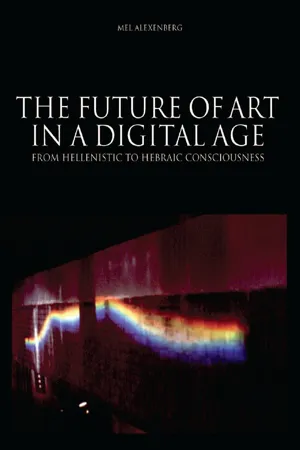
The Future of Art in a Digital Age
From Hellenistic to Hebraic Consciousness
- 187 pages
- English
- ePUB (mobile friendly)
- Available on iOS & Android
eBook - ePub
About this book
Information
1
SEMIOTIC PERSPECTIVES – REDEFINING ART IN A DIGITAL AGE
The eye, so prized an aesthetic organ when it was felt that the difference between art and non-art was visible, was philosophically of no use whatever when the differences proved instead to be invisible. Pop artists were joined by the Minimalists in showing that there is no special way a work of art has to look. It can look like a Brillo box if you are a Pop artist, or like a panel of plywood if you are a Minimalist…. What makes the difference between art and non-art is not visual but conceptual.1
Arthur Danto
there is an easy answer to the question why “new tendencies in art” are always rejected (and, at times, with what a fuss!): because the eye, accustomed to earlier “recipes,” is not immediately capable of perceiving the newly discovered “recipes.” it has to have time to get used to them. something i might describe as “conservatism of the eye.” 2
Wassily Kandinsky
We are experiencing “The End of Art” as the visual perception of surface gives way to the conceptual grasp of inner significance. In Beyond the Brillo Box: The Visual Arts in Post-Historical Perspective, Columbia University philosophy professor Arthur Danto discusses how Andy Warhol’s 1964 exhibition at the Stable Gallery in New York marks the end of art. In the art gallery, Warhol stacked boxes on which he had screen-printed the Brillo logo. They looked identical to the cartons of Brillo soap pads that we see in supermarket aisles. We could no longer see the difference between Brillo Boxes (the work of art) and Brillo boxes (the mere real things). What Warhol taught was that there is no way of telling the difference by merely looking. The history of Western art as a progressive historical narrative of one art style superceding a previous style came to an end.
I believe that what we are witnessing is not the end of art, but the end of art derived from a Hellenistic structure of consciousness. The contemporary redefinition of art is emerging from a Hebraic biblical consciousness as expressed through the Oral Torah. Danto’s radical new proposal that concept and context rather than visual appearance gives meaning to images and objects was seriously discussed centuries ago by rabbis dealing with idolatry and Greek aesthetics. In the Talmudic tractate Avodah Zarah (Strange Worship), rabbis discuss whether found fragments of an image such as the hand or foot of a statue that was worshipped are prohibited or permitted. If the idol fell down and broke, Rabbi Shimon ben Lakish reasoned, then the hand or foot are permitted because the owner of the idol annuls it by saying, “If it could not save itself, so how could it save me?” Samuel explained that if they were mounted on a pedestal they were still valued as idols. Therefore, the exact same hand or foot would be prohibited.3
The Greek Proclos, son of a philosopher, put a question to Rabbi Gamliel who was bathing in a pool in front a large statute of Aphrodite. “If your Torah forbids idolatry, why are you bathing in the Bath of Aphrodite?” The rabbi answered, “I did not come into her domain, she came into mine.” If the statue of Aphrodite was erected and then a pool was made to honor her, it would be forbidden for a Jew to bathe there. However, if the pool was made first and the statue was placed there as an adornment, then it is permitted.4 Concept and context determine meaning in the case of the idol fragments and the statute of Aphrodite, like Brillo boxes in an art gallery rather than in a supermarket and a panel of plywood hanging in a museum rather than stacked in a lumberyard. The visual sense alone cannot discern between art and non-art today or between idol and mere decoration yesterday.
FROM REPRESENTATIONAL TO PRESENTATIONAL ART
A decade after Warhol’s Stable Gallery show, I found that my students at Columbia University had a difficult time making sense out of the multiple new directions in art that they found happening throughout New York. The groundbreaking art forms they were experiencing in galleries, alternative spaces, performance art venues, on the street and in the media, demanded a redefinition of art. In response to this demand, I developed a scheme for classifying these innovative forms of art in relation to older forms.5 I based my taxonomy on the work of Charles Peirce, the late nineteenth century Harvard philosophy professor who is considered the father of semiotics, the theory of signs and how they create significance. He identified three types of representational signs: icon, symbol, and index.6 Representation creates significance through resemblance, consensus, and documentation of after-the-fact signs of what was.
Since I found Peirce’s three semiotic classes insufficient when applied to modern and postmodern art forms, I created three classes of presentational art that located art in the present and future in addition to the categories of representational art that located art in the past. These classes of presentational art are: identic, prioric, and dialogic. Identic art gains meaning by presenting what is. Prioric art presents what can be. Dialogic art gains meaning through dialogue, collaboration, and interaction in a dynamic process of becoming. A work of art can gain meaning through a single mode or any combination of modes of signification. Understanding relationships between the six semiotic classes of art can give us conceptual tools for tracing the evolution of the shift from Hellenistic to Hebraic definitions of art, from representation to presentation, and from icon to dialogue. Applying the three classes of presentational art can help us understand how the impact of digital technologies on postmodern art creates aesthetic significance. Digital art forms and high touch reactions to high tech experience also refresh our understanding of Peirce’s classes of representation.7
ICONIC ART: RESEMBLANCE
Iconic art represents the external appearance of things. It gains meaning by looking like something that we see in the real world. Redon’s painting of a vase of flowers, Michelangelo’s Adam reaching out to touch the hand of God, Picasso’s Three Musicians, and a road map are all icons with different levels of iconicity. Iconic art can range from the Greek art ideal of creating an illusion so great that birds are fooled into eating painted grapes, from trompe d’oeil still lifes, and from photorealist cityscapes, to abstracted objects and schematic drawings. Computer users know the word “icon” as the images of a blank sheet of paper with its corner folded down, the floppy disc, the file folder, the printer, and the scissors icons on the toolbar of computer screens.
Computer simulations can render icons so realistically that they create a virtual world visually indistinguishable from the real world. When I was at the 1984 SIGGRAPH computer imaging and animation convention in Minneapolis, the film The Last Starfighter had just been released. It starts with high touch images of a backwater California trailer park, a warm, friendly, black, elderly gentleman and sleepy basset hound. Even the neon sign announcing the name of the trailer park had a high touch glow in contrast to the high tech dazzle of the sleek, shiny, metallic spaceships that we see later. New digital technologies make the old electric technology quaint. The park’s teenagers’ major source of entertainment was a videogame, The Last Starfighter. One of the kid’s making a perfect score in the game was the big exciting event in the laidback trailer park. The teenagers had no idea that the videogame was placed in different places on planet Earth to identify naturally gifted starfighters for an intergalactic war. The trailer park videogame hero was recruited for the good guys in the war. When he arrived at the distant planet under siege, all seemed lost. There was only one starship remaining to save the defenders of good against the evil armada. The Earthling teenager protests being put into the cockpit of the high tech starship, claiming that he only knows how to drive a pickup truck. He is assured that flying the real starship is identical to playing the videogame simulation at which he proved to be the very best. With amazing skill learned on the flight simulator in the California trailer park, he destroys the enemy armada with his single starship and saves the entire galaxy.
Beyond painted grapes that pigeons come to eat, digital technologies have upgraded iconic representations to simulations in which the real and the imitation are indistinguishable. Indeed, computer graphics images that imitate photographs have become more realistic than the photographs themselves. In the film Jurassic Park, the computer animators made the dinosaurs so perfect that they were too real. Lev Manovich explains what needed to be done to icons with such a high-level of iconicity that they become unbelievable.
Typical images produced with 3-D computer graphics still appear unnaturally clean, sharp, and geometric looking. Their limitations especially stand out when juxtaposed with a normal photograph. Thus one of the landmark achievements of Jurassic Park was the seamless integration of film footage of real scenes with computer-simulated objects. To achieve this integration, computer-generated images had to be degraded; their perfection had to be diluted to match the imperfection of film’s graininess.8
Computer-simulation of high-level iconic images set them in motion in movies and computer games in contrast with iconic representation in painting and sculpture which rendered movement static. Arresting motion is Western art is derived from iconic representation valued in the ancient Greek world, which suspended motion and made life still. Motion was activated, however, in Hebraic paintings 1,800 years ago in the Dura Europos synagogue on the banks of the Euphrates. These fresco-paintings sequenced iconic images in a continuous narrative like comic strips or frames of computer animation. Art historian Ernest Namenyi explains:
The most striking feature of the Dura Europos synagogue’s murals is that the representation of persons and beauty of the human form remain of obviously secondary importance to the artist, who seems not to have been at all concerned with three-dimensional representation and to have felt little interest for the tricks of perspective that he had learned from Greek artists. The general setting of action, its architecture and landscape, are his main preoccupation, and to them he devotes his full attention. The element of motion in the spectacle that he thus provides is developed to such an extreme that it distracts our attention from each human figure in turn.9
It is appropriate at this point to examine the common misunderstanding about the Hebraic aversion to iconic representation and alleged hostility to the visual arts emanating from the second of the so-called Ten Commandments. Elucidation of the semiotic classification scheme for contemporary art will make it clear how a Hebraic aesthetics is best expressed through dialogic art forms in contrast with Hellenistic aesthetic values that honor the iconic. Hebraic aesthetic values are primarily about representing active processes in which time informs space, and presenting opportunities for dynamic dialogue, expansive integral thought, and interactive experience in open-ended systems.
We can best understand the second commandment in the context of the others. First let use make clear the inaccurate translation of the Hebrew dibrot which does not mean “commandments” at all, but rather “utterances.” The Bible describes ten Divine Utterances. Dibrot is from the verb l’daber, “to speak,” and is related to the noun davar, “utterance, thing, idea, or act.” Let us begin by translating the first of the dibrot from the original Hebrew (Exodus 20:1- 14, repeated in Deuteronomy 5:6-18). “God spoke (daber) all these things (d’vrarim), saying: ‘I am Was-Is-Will Be, your God, who has taken you out of the Land of Narrow Straits (mitzrayim, the Hebrew word for Egypt literally means “from narrows straits”), out of the house of slavery.’” The biblical divine name YHVH is a verb, not a noun. It combines the words for “was”, “is”, and “will be.” God does not identify Himself here as the Creator of the world of space, but rather as process acting in time to free us from enslavement to narrow-minded thinking.
“Do not have any other gods before Me. You shall not make yourself any carved statue or picture of anything in the heaven above, on the earth below, or in the water beneath the land.” This second utterance, not exclusively addressed to artists, asks us not to transform dynamic process into static form. God is a verb that cannot become a noun. God is no thing and can only be represented as nothing. More than being commanded not to make an iconic representation of God, we are charged with recognizing the impossibility of depicting an invisible God. We can only become aware of divine light flowing in our world of everyday life. We are enjoined not to freeze the processes of creation and historical processes as fixed images, not to lower ourselves into patterns of narrow-minded thought, not to carve in stone that which is in flux.
“Do not take the name of Was-Is-Will Be, your God in vain” is the third utterance. It enjoins us not to limit the Infinite by assigning it a name. In everyday Hebrew conversation and in contemporary biblical translations, God is called Hashem, literally “The Name.” It would probably be better, however, to call God Bili Shem, “Nameless.” All the many divine names in Hebrew are not considered God’s names, but rather terms for facets of the emanation of divine light into the world of time and space.
The fourth utterance asks us to keep the Sabbath by abstaining from doing creative work. Although we are enjoined from arresting the creative flow by freezing it in space, we do stop the flow in the realm of time. We stop our own creative process every seventh day to enjoy and honor divine creation. Indeed, the Sabbath Day could be called “Non-Art Day” or “Ecology Day.” The only actions that are forbidden on the Sabbath are those derived from the 39 craft categories that were required to build the Tabernacle. We stop our artistic activity to honor the Divine Artist on one day each week. We replenish our souls on the Sabbath so that on the eighth day, we are opened to reassuming the role of partners with the Creator in tikun olam, actively making the world a better place for all humanity. From when the sun sets on Friday evening to the time stars dot the sky on Saturday night, we celebrate “Ecology Day” when we honor nature and leave it undisturbed. We acknowledge that our mastery over our world is a Divine gift.
Three additional biblical passages can help us understand the Hebraic aversion to static, iconic, closed-systems and its appreciation for dynamic, dialogic, open-systems. When Moses sent leaders of all the Israelite t...
Table of contents
- Cover page
- Fmt
- Dedication
- Title page
- Copyright
- Contents
- Acknowledgements
- Introduction – Postmodern Paradigm Shift: From Hellenistic to Hebraic Consciousness
- 1 Semiotic Perspectives – Redefining Art in a Digital Age
- 2 Morphological Perspectives – Space-Time Structures of Visual Culture
- 3 Kabbalistic Perspectives – Creative Process in Art and Science
- 4 Halakhic Perspectives – Creating a Beautiful Life
- Index
Trusted by 375,005 students
Access to over 1.5 million titles for a fair monthly price.
Study more efficiently using our study tools.
Frequently asked questions
Yes, you can cancel anytime from the Subscription tab in your account settings on the Perlego website. Your subscription will stay active until the end of your current billing period. Learn how to cancel your subscription
No, books cannot be downloaded as external files, such as PDFs, for use outside of Perlego. However, you can download books within the Perlego app for offline reading on mobile or tablet. Learn how to download books offline
Perlego offers two plans: Essential and Complete
- Essential is ideal for learners and professionals who enjoy exploring a wide range of subjects. Access the Essential Library with 800,000+ trusted titles and best-sellers across business, personal growth, and the humanities. Includes unlimited reading time and Standard Read Aloud voice.
- Complete: Perfect for advanced learners and researchers needing full, unrestricted access. Unlock 1.5M+ books across hundreds of subjects, including academic and specialized titles. The Complete Plan also includes advanced features like Premium Read Aloud and Research Assistant.
We are an online textbook subscription service, where you can get access to an entire online library for less than the price of a single book per month. With over 1.5 million books across 990+ topics, we’ve got you covered! Learn about our mission
Look out for the read-aloud symbol on your next book to see if you can listen to it. The read-aloud tool reads text aloud for you, highlighting the text as it is being read. You can pause it, speed it up and slow it down. Learn more about Read Aloud
Yes! You can use the Perlego app on both iOS and Android devices to read anytime, anywhere — even offline. Perfect for commutes or when you’re on the go.
Please note we cannot support devices running on iOS 13 and Android 7 or earlier. Learn more about using the app
Please note we cannot support devices running on iOS 13 and Android 7 or earlier. Learn more about using the app
Yes, you can access The Future of Art in a Digital Age by Mel Alexenberg in PDF and/or ePUB format, as well as other popular books in Art & Art General. We have over 1.5 million books available in our catalogue for you to explore.