![]()
Chapter 1
Race, Mobile Masculinities, and Class
![]()
Between 1945 and the early 1970s, quickly growing Western European countries created guest worker programs to speed up postwar reconstruction and cope with labor shortages. Central and Northern European countries made recruitment agreements with Southern European countries and later with Yugoslavia, Turkey, and Morocco. In colonizer countries, such as the United Kingdom, the Netherlands, and France, migrants were recruited from current and former colonies. In these colonizer countries, labor migration was intended to be temporary, “to ensure ‘rotation’ by recruiting workers for a limited period, restricting their rights, and minimizing family reunion.” In other words, Western European states sought to import “labor but not people” (Castles 2006: 742). As Stephen Castles writes, “Policies were shaped by the view that migrant workers were temporary labor units, which could be recruited, utilized, and sent away again as employers required” (1986: 769). The majority of foreign guest workers were single young males without much education or training who were steered toward unskilled, dirty, and difficult jobs. These workers were housed in communal factory housing or crammed in run-down and unsanitary apartments located in marginal urban areas. They were not allowed to bring dependents with them and were not regarded as permanent citizens, and their civil rights were severely restricted (Castles 1986: 762).
By 1974, however, most European governments had put an end to regulated migrant entry. Although the main reason for ending regulated migration was the 1973 oil crisis, which was seen as the onset of a period of economic stagnation and high unemployment, other factors were also at play. Industries were becoming dependent on migrant labor, which contributed to a discontinuation of the “rotation” principle. Migrant families grew and their social needs (schooling, health benefits, housing) increased, and migrant workers joined trade unions and participated in a wave of labor militancy in the early 1970s (Castles 2006: 743). The reality was that despite the restrictions the rotation principle implied, family reunification and undocumented entry had been increasing since the late 1960s, and what had been conceived as a temporary labor system transformed into permanent settlement. One of the principal negative consequences of the guest worker system was the contradiction that emerged between theory and practice, that is, Western European societies were unwilling to integrate immigrants as equals, forcing them to remain disadvantaged minorities who suffered racial discrimination and who settled in separate neighborhoods, marked by inferior housing and infrastructure, leading to “today’s ethnically diverse but socially divided European societies” (Castles 2006: 744). This situation was aggravated in the early 1990s as undocumented migrants and asylum seekers continued to enter Western Europe irregularly in larger numbers, and Southern European countries, which had been major sources of migrant workers in the past, became immigrant destinations. Although official views have changed and Western European governments have had to admit that they need to rely on labor migration to fill less-skilled jobs and compensate for their demographic decline, the European Union has failed to set up mechanisms to regulate legal migration for lower-skilled workers, leading, in Castles’ words, to:
the great hypocrisy of modern migration policy: the systematic use of undocumented migrant workers, who are denied many of the rights laid down in the human rights instruments and labor conventions endorsed by these same countries […] The EU and its member states seem still to be trying to import labor but not people—just as the Western European countries did forty years ago.
(2006: 760)
A great number of immigration films have documented the situation of single male guest workers and undocumented immigrants as well as the exploitation and social exclusion they went through in European societies since the creation of guest worker programs. Many of them focus on the experiences of nonwhite immigrants and portray racial discrimination as the salient feature of their disadvantaged positions in European societies. These films frequently establish connections between race, masculinity, and social class and prioritize the exchanges between the different marginal (or undesirable) positions that constitute Otherness in their given societies. In these films, male brotherhood is presented as a survival resource for immigrants to cope with societal rejection and racial discrimination, and social class functions as an equalizer that provides common ground between the male (nonwhite) immigrant and the working class local (white) woman, who typically plays the role of a sexual as well as social mediator between the omnipresent reactionary segments and institutions of the receiving society and the invisible—and thus vulnerable—Others. Redemption of the white national character is accomplished through romance and/or solidarity with the discriminated Other, and the racial objectification of nonwhite immigrants is exposed and denounced. The purpose of this chapter is to analyze the diverse fictional representations of racial masculinities and the twofold pattern—brotherhood/heterosexual romance—found in the following films: Angst essen seele auf/Ali: Fear Eats the Soul (Rainer W. Fassbinder, 1974); Las cartas de Alou/Letters from Alou (Montxo Armendáriz, 1990); Brothers in Trouble (Udayan Prasad, 1996); Saïd (Llorenç Soler, 1999); La faute à Voltaire/Blame It on Voltaire (Abdel Kechiche, 2001); El traje/The Suit (Alberto Rodríguez, 2002); and Hop (Dominique Standaert, 2002).
These films present masculinity in transition, or “on the move” and “mobile,” insofar as it is contingent on an internal–external dialectic: the immigrant characters’ performances of masculinity are located at the intersection between subjective positions and social and cultural situations, which are defined by the immigrant characters’ movement across and between public and domestic spaces and in relation to other immigrant men with whom they share a sense of community. The immigrant characters move constantly and shift between settings, and public and private are not necessarily separate spheres. Work has a major influence on definitions and performances of masculinity. Men’s sense of who they are is constantly reaffirmed at work (Robinson & Hockey 2011: 20). However, this reaffirmation is compromised as the immigrants’ public world and their workplaces—the street, factory, greenhouse, or construction site—are defined by instability and concealment. The immigrants don’t fit in the larger community and society as a consequence of their unstable and undocumented status or the social/racial discrimination they suffer. Often, within the private sphere, home (a feminized environment) can be seen as a haven in a heartless world. However, in the context of these films, home—a brotherhood in a shelter, a boarding house, or an apartment shared only between men—is less than private and is a masculine environment that is not always feminized. Masculinity is often defined in relation to other men, in homosocial terms, as communal rather than differential. Interdependency between men in a communal living environment can make a house seem like one shared among “one big family,” as Whitehead explains: “[W]hether based around straight, gay, white, or black identities, men’s friendships with other men can be seen to be crucially important in sustaining masculine subjectivities and men’s sense of identity as men” (Whitehead 2002: 158–159).
At the same time, the male characters’ heterosexual romantic relationships with white European women seem heavenly, a respite from the stress and vulnerability that result from an irregular and undocumented work status and social rejection. The male characters perform in the public sphere and survive social and racial alienation because of women’s emotional involvement in relationships and in the private sphere. In these films, immigrants are not depicted as mere erotic objects but rather as human beings vulnerable to distress, both physical and emotional. Women’s empathy and support is crucial to the immigrants’ well-being.
Fassbinder’s Tale of Immigration: Guest Workers in Germany
Although I have consistently limited the scope of this chapter (and this book) to immigration films released since the early 1990s, I could not leave out Fassbinder’s film Angst essen Seele auf/Ali, Fear Eats the Soul, released in 1974. Fassbinder, following his usual method of combining social issues with avant-garde techniques, offers one of the earliest and most accurate depictions of West Germany’s xenophobia against immigrants and of the romantic interaction and economic alliance between a black guest worker and a white European woman. I consider it an exemplary model and a precursor to the conflation of race, masculinity, and class found in the more recent examples I include in this chapter. The film is considered a milestone in the history of German cinema, and it brought international recognition to Fassbinder himself and to the New German Cinema and its contribution to the debate on the subject of immigrant workers when the film was awarded the International Critic’s Prize at the Cannes Festival in 1974 (Burns 1995: 56–57). Fassbinder’s film depicts a love story between a German cleaning woman in her fifties and a young Moroccan immigrant in his thirties (played by Fassbinder’s lover at the time, El Hedi ben Salem) who is participating in Germany’s guest worker program.1 The two characters are drawn to each other through a mutual need for company and comfort, but as their relationship becomes known, they experience various forms of hostility and public rejection. Fassbinder makes it apparent that social and economic factors constrain the couple, and as in all his films, he denounces exploitation and social complacency and emphasizes how capitalist society infects relationships at every level.
In the eyes of German society, by marrying Ali, a black Moroccan mechanic, Emmi, the German cleaning lady, has become a foreigner herself, “a disgrace.” Emmi has the experience Franz Fanon warns about in the chapter of Black Skin, White Masks titled “The Man of Color and the White Woman:” “Associating with anybody of that race is just utterly disgracing yourself” (1967: 66). However, Fassbinder’s characterization of Ali and of the couple’s interaction counteracts racist and xenophobic prejudices against the foreigner and problematizes the German/foreigner dichotomy. While German neighbors and Emmi’s children project the common prejudices against guest workers in the 1970s onto Ali—filthiness, lust (the guest workers were after German girls), anger, aggressiveness, and an inability to speak the language (Castles 1996: 626)—Ali’s character defies these prejudices. He is cleaner than anyone (he constantly takes showers); he is more resigned and less angry than Emmi’s sons and son-in-law; he learned German in two years; and rather than chasing German girls, he is chased by them at the Asphalt bar, where he and his Moroccan friends hang out, and he is made into an object of desire and admiration by Emmi’s coworkers. Finally, he marries an older woman, not for sex (or to legalize his residency status) but because of their mutual loneliness and search for understanding.
The film conspicuously lacks explicit references to race. Ali is referred to as “scum” and a “foreign swine,” but no mention is made of the color of his skin, the implicit reason for the familial and social rejection Emmi suffers for being with him. Racism is hidden under the supposedly more benign category of nationalism, which is systematically opposed to foreignness. The German/foreign dichotomy is reproduced in the prejudiced view of Ali held by Germans who suspect him of being a terrorist, but it is also reproduced in the music (Arabic/German) played at the Asphalt bar, in the different foods Emmi and Ali prefer (German food/couscous), in the workers’ relationship with their bosses and colleagues at both Ali’s and Emmi’s workplaces (German master/Arab dog, German national worker/foreign swine worker), and in the languages spoken by characters (German/broken German–pidgin Arabic). Despite this binary backdrop, Fassbinder’s interest resides in showing the couple’s shared foreignness, what they have in common, and what makes them both foreigners to the German culture: they are both lonely, and as a cleaner and mechanic, living in a shabby neighborhood, they both belong to the lower working class.
Most importantly, as Judith Mayne argues, their identity as “undesirable others” is determined by how they are looked at and how they are progressively reduced to a spectacle (1997: 72). As an older woman, Emmi in particular is made an object of gossip and discrimination by her children, neighbors, and coworkers, who consider her too old for romance with a younger black man. Emmi’s female coworkers objectify Ali for having a handsome and muscular body. Their love story is staged both for other characters who are diegetic spectators whose objectifying gazes serve as a metaphor for social prejudice and xenophobia and also refer to spectatorship itself. At the Asphalt bar, where Emmi and Ali meet and where Ali regularly hangs out with his Arab friends, Emmi occupies the place of the foreigner and is exposed to the alienating gazes of both bartender and bar patrons because of her old age and disheveled looks at the film’s beginning and end. In the opening sequences, Emmi finds refuge from the rain in the bar. As she timidly sits in one extreme, her foreignness is emphasized through the use of long shots and the spatial separation between her and the insolent watchers, both of which are never captured in the same frame. After Ali asks her to dance on a dare from his friends, Emmi and Ali dance together, and are exposed to uncomfortable stares as the dance floor becomes a stage where their relationship is staged for other characters and spectators to judge.
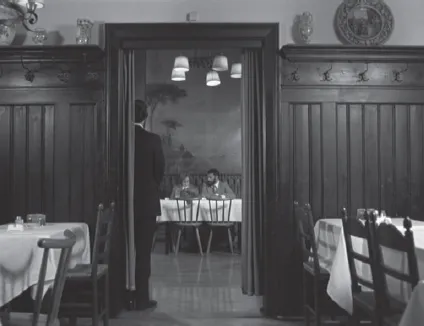
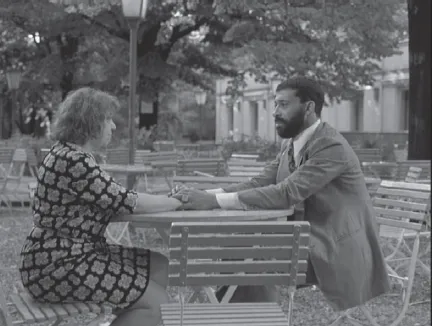
Beginning with the film’s first scenes, the spectacular and performative element is highlighted by the recurrence of still shots composed as tableaux vivants in which immobile characters in a group stare impassively and at length at Emmi, Ali, or the couple together. Rob Burns and Stephen Lamb write that “both camera and characters assume a static position, as if the action has been suspended and we are looking at a photograph,”2 referring implicitly to spectators in the movie theater whose gazes are fixed without expression or movement (1981: 203). The day Emmi and Ali get married, they decide to have lunch at the Osteria Italiana, a formal restaurant famous because it used to be frequented by Hitler. The waiter stares at the couple condescendingly and refuses to help them as it becomes clear that they have never dined in a fancy restaurant and do not know what to order. The objectification effect is emphasized when the camera zooms out until it holds the lonely couple in the door frame. Later, while Emmi and Ali sit outside in the empty garden of another restaurant, cooks and bartenders stare at the couple from the distance, and their judgmental gaze is maximized as the camera pans around the couple. This sequence serves as a metaphor for the extreme social scrutiny that the characters suffer and prompts the couple to take a vacation and seek change.
The theatrical element is enhanced not only through the static still shots but also through the consistent use of double framing still long shots taken from another room that always use the door to frame the scene. These shots create the sensation of a play being acted and then filmed and may bring to mind a previous theatrical condition or characters in a painting. As Mayne points out, Fassbinder shoots the characters through door frames, as if contained by image and sound, so that the contexts in which the characters appear are marked by a series of formal constraints that implicitly refer to their liminal, transitional, and vulnerable situations in society (1977: 72). Emmi’s coworkers, who belittle her once they find out she is with Ali and discriminate against a new Yugoslavian guest worker, are shot through the bars and railings of the workplace staircase where they usually sit to have lunch. Fassbinder also emphasizes the neighbors’ nosy and intolerant attitudes by shooting Emmi going up and down her apartment staircase, always from the point of view of the neighbor who spies on Emmi through the window of her room. As Burns and Lamb point out, “[S]till camera and mise-en-scene collude, and by dint of a camera angle, characters appear literally enclosed within windows or doorways, thereby enhancing the impression of a still” (1981: 203).
Figure 1.1: Angst essen Seele auf/Ali, Fear Eats the Soul by Reiner W. Fassbinder (© 2003 The Criterion Collection) Ali and Emmi at Osteria Italiana.
Figure 1.2: Angst essen Seele auf/Ali, Fear Eats the Soul by Reiner W. Fassbinder (© 2003 The Criterion Collection) Ali and Emmi at Bier Garden.
In the second half of the film, after the holidays, Emmi and Ali find their neighbors and family members suddenly cooperative. Once they need the couple, they seem to conveniently forget their previous distaste for them. The prying neighbors need Emmi and Ali’s basement space and Ali’s help moving furniture. The shopkeeper, who until this point has refused to attend Ali and as a consequence has lost Emmi as a customer, now fears competition from other shops in an increasingly globalized market. Emmi’s son, who insulted her and angrily destroyed her TV when she introduced Ali to the family, now needs Emmi to babysit his child. Emmi’s coworkers face the firing of a coworker and the hiring of a foreigner, and they fear being fired themselves and seek Emmi’s sympathy. They are all willing to forget Ali’s Otherness in their time of need. The characters’ changes in attitudes as a result of self-interest serve as a microcosm of the larger socioeconomic situation: social and racial prejudice is appeased and integration measures are supported when a foreign labor force is needed. Fassbinder acknowledges that consciousness and attitudes do not exist in a vacuum but are determined in part by material factors; prejudices are rooted in social reality and as such are n...