eBook - ePub
Available until 23 Dec |Learn more
Dysfunction and Decentralization in New Media Art and Education
This book is available to read until 23rd December, 2025
- 140 pages
- English
- ePUB (mobile friendly)
- Available on iOS & Android
eBook - ePub
Available until 23 Dec |Learn more
Dysfunction and Decentralization in New Media Art and Education
About this book
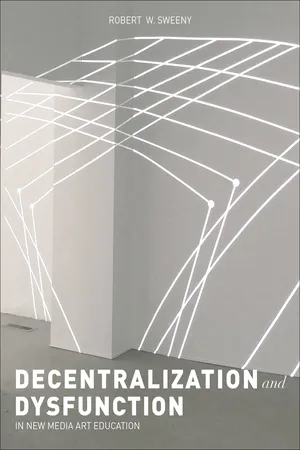
When using digital technologies, many types of dysfunction can occur, ranging from hardware malfunctions to software errors to human ineptitude. Many new media artworks employ various strategies of dysfunctionality in order to explore issues of power within societies and culture. When using digital technologies, many types of dysfunction can occur, from hardware malfunctions to software errors and human ineptitude. Robert W. Sweeney examines how digital artists have embraced the concept of the error or glitch as a form for freedom—imperfection or dysfunction can be an integral element of the project. In this book, he offers practical models and ideas for how artists and educators can incorporate digital technologies and integrate discussions of decentralized models of artistic production and education.
Frequently asked questions
Yes, you can cancel anytime from the Subscription tab in your account settings on the Perlego website. Your subscription will stay active until the end of your current billing period. Learn how to cancel your subscription.
No, books cannot be downloaded as external files, such as PDFs, for use outside of Perlego. However, you can download books within the Perlego app for offline reading on mobile or tablet. Learn more here.
Perlego offers two plans: Essential and Complete
- Essential is ideal for learners and professionals who enjoy exploring a wide range of subjects. Access the Essential Library with 800,000+ trusted titles and best-sellers across business, personal growth, and the humanities. Includes unlimited reading time and Standard Read Aloud voice.
- Complete: Perfect for advanced learners and researchers needing full, unrestricted access. Unlock 1.4M+ books across hundreds of subjects, including academic and specialized titles. The Complete Plan also includes advanced features like Premium Read Aloud and Research Assistant.
We are an online textbook subscription service, where you can get access to an entire online library for less than the price of a single book per month. With over 1 million books across 1000+ topics, we’ve got you covered! Learn more here.
Look out for the read-aloud symbol on your next book to see if you can listen to it. The read-aloud tool reads text aloud for you, highlighting the text as it is being read. You can pause it, speed it up and slow it down. Learn more here.
Yes! You can use the Perlego app on both iOS or Android devices to read anytime, anywhere — even offline. Perfect for commutes or when you’re on the go.
Please note we cannot support devices running on iOS 13 and Android 7 or earlier. Learn more about using the app.
Please note we cannot support devices running on iOS 13 and Android 7 or earlier. Learn more about using the app.
Yes, you can access Dysfunction and Decentralization in New Media Art and Education by Robert W. Sweeny in PDF and/or ePUB format, as well as other popular books in Art & Art General. We have over one million books available in our catalogue for you to explore.
Information
Chapter One
The glowing, green characters shift against the black background of the computer screen. The characters, unrecognizable as words, begin to form fragmented images:
A car pulls into a driveway.
A figure emerges from the car and enters a house.
A close up of what appears to be someone receiving fellatio.
***
Text flows from the sidewalk into the gallery space, fragmented bits of English and Spanish that break apart and come together in bursts of legibility.
***
Speakers mounted midway on opposing walls produce a series of bell-like sounds that shift timbre and pitch, swirling through the space. Numbers are projected on the gallery wall, filling the space, side to side and top to bottom.
Introduction
Each of the works of art described at the start of this chapter has been characterized by the term “new media art.” At the outset, they seem to have very little in common with one another. The first work is Deep Throat (1998), by Vuk Ćosić , one of the six pieces that make up the ASCII History of Moving Images series. Deep Throat is a reproduction of the notorious pornographic film of the same name from 1972; this reproduction replaces the grain of the original film with American Standard Code for Information Interchange (ASCII) computer code, shifting from the realism of 24 sequential frames per second to a fragmented simulation of letters and numbers, glowing green-on-black. The second work is an excerpt from ESCaperucita & Little Flying Hood (2009), by Nayda Collazo-Llorens. This is a multimedia installation piece that combines a site-specific intervention with a lithographic print series that also exists as a digital animation. The third work that is described is American Cypher (2012), by Mendi and Keith Obadike. This intermedia work combines a gallery installation that displays DNA-like code on the walls, with an audio piece created from a bell owned by Sally Hemings that produces sound only when the projected soundwave is broken. While these works are indeed quite different—having been created by different artists at different times, using varied techniques and methods of production and presentation—they share one prime similarity: dysfunctionality. As will be discussed, many new media artists comment upon developing digital technologies through representations of dysfunctionality, identifying moments when complex technological networks break down or are overloaded, and when the smooth interface between user and machine begins to fail.
Technologies fail. They are sometimes built to fail, whether as a guard against further damage, as in the case of the circuit breaker, or due to the marketplace, in the case of planned obsolescence. They fail in the hands of the user, where they might be misused by individuals who have not read the product specifications, or are abused by those trying to push the technologies beyond how they are intended to perform. Technologies also fail when they come in contact with other technologies; the rapid pace at which such developments take place often means that networked connections are fraught with disconnections, where components are incompatible, or require additional linkages in order to facilitate connection and communication. Networks bring a wide variety of technologies together. These intersections may allow for the amplification of existing applications, such as the Folding @home project, which links home computers in a massively parallel manner so that computational challenges that exceed the processing power of single computers may be solved. Complex technological networks also allow for file sharing, upon which networks such as Napster were founded, allowing individuals to share music and image files, and altering the landscape of the recording industry in the process. Such networks inevitably combine new possibilities for interaction with challenges to legal, social, and ethical structures that currently exist, as Benkler (2005) has exhaustively detailed.
With the possibilities of networked digital media come the challenges associated with interlinked machines, individuals, and information. Networks such as those mentioned above multiply the possible benefits of increased computing power; they also amplify the frustration and devastation that can occur when such networks fail. Networked technological failure calls into question the narrative of efficiency central to modernist epistemologies, as well as narratives of technological progress. In this text, a study of technological failure as presented through contemporary new media art will outline possibilities for productive, and even radical, applications of the digital in a variety of settings, including philosophical thought, artistic practices, and educational interactions. We can learn much about how technologies work by studying how they fail. New media art can present these failures in provocative, playful, and probing ways.
While many new media artists such as those discussed earlier emphasize and utilize moments of technological dysfunction, educators tend to emphasize the efficient, orderly, and smooth functioning of networked digital technologies in the spaces of education. Art educators in particular can learn much from the work of new media artists who deal in dysfunction, as these artists speak to the critical possibilities inherent in the mistake, the error, the glitch. As seen in the previous examples, new media art makes use of a variety of technologies, both advanced and outdated, high-tech and low-tech, to speak to contemporary issues of representation, cultural hybridity, race, class, and biology. New media art has the ability to present these narratives in ways that are not germane to related fields such as anthropology, cultural studies, or the so-called “hard sciences,” primarily due to the fact that new media art can present dysfunctionality as a trope, a form of visuality that isolates and highlights the limits of technological progress, while pointing toward new and novel applications for digital technologies.
This book is first and foremost a study of dysfunction in new media art. It is intended for those who are teaching about, learning through, and expressing themselves via digital technologies. New media artists will find that the study of digital media and dysfunction will inform current and future artmaking practices. New media theorists will find the analysis of dysfunction in information science and cybernetics to be a useful historical reference. Educators, particularly those involved with art and art education at the university level, will find the discussion of dysfunction to be of great value as learners navigate the increasingly decentralized spaces of contemporary society. In order to suggest possibilities for learning from, in, and through, dysfunction, I will first present an analysis of decentralized networks within technological and educational settings. I will propose ways to think about, teach through, and make artwork that reflects the dysfunctional and productive aspects of such networks, which, although seemingly contradictory will be shown to be otherwise. The series of tactics that will be proposed will draw from the critical power of new media art and theory, the interdisciplinary possibilities of cybernetics, the contemporary relevance of complexity theory, and the untapped power of technology-based educational reform. At present, none of these fields have looked closely enough at the dynamics of networked dysfunction, beyond describing ways to avoid technical glitches and avoid losses in productivity. Contemporary networks connect and combine disciplines in everchanging multitudes. By studying the ways that these networks fail, through philosophical and scientific models of dysfunction, contemporary educators will be better equipped to understand these changes. Better yet, the connectivity of these networks can present educators with opportunities for engagement and interaction that extend far beyond models of passivity reinforced by earlier technologies.
Educators at all levels surely understand a wide variety of models of dysfunction. Dysfunction will be presented in this book as an artistic tactic that is intentional, designed to test the limitations of a given system in ways that are not common within scientific, sociological, and/or technological disciplines. The artistic tactics that will be discussed are presented in and through networked digital technologies that have their beginnings in communications media. Each of the systems that will be analyzed—artistic, educational, and technological—utilizes communicational networks in unique ways. It is just as important to acknowledge where these communicational networks align as it is to identify moments where the interconnections fail. As I will discuss, new media artists often make these moments of identification visible, and, perhaps most importantly, visual. They present descriptions of the social, cultural, political, physiological, and personal networks that connect to form complex network forms. In these forms, dysfunction that can block one informational pathway can be rerouted in another direction, taking advantage of the decentralization that is a manifestation of complex interconnections. In this book I will suggest that models of dysfunction within decentralized networks can provide educators with models for practices that are relevant within the complex technological networks of contemporary life.
In order to explore dysfunction within decentralized networks, I will begin with a discussion of technology and philosophy. Concepts of dysfunctionality unsettle modernist notions of technological order and efficiency that have been well mapped in philosophical circles. In Chapter Two, my discussion of philosophy and dysfunction will begin with the work of Martin Heidegger, and his essay “The Question Concerning Technology” (1954), which is perhaps the most influential philosophical text dealing with technology and modernism (Feenberg 1999). Following a discussion of technology and modernist thought, I will look at ways in which Heidegger’s theories have been taken up by current philosophers and new media theorists. The chapters that will follow look at the history of networked forms of communication that grew from research in fields such as cybernetics and information science. Chapter Three will focus upon disruption in complex networks, looking to the ideas developed in the first wave of cybernetics. As will be discussed, cybernetics was an interdisciplinary attempt to respond to the wide-ranging shifts taking place within technologically advancing societies. Once the attributes of communications networks are discussed, I will look at the ways that educational theorists have integrated network theories into discussions of curriculum design and pedagogy, with particular concern for the current interest in complexity theory and teaching. In Chapter Four, I will discuss educational approaches that draw from complexity theory. These theories are an attempt to respond to the increasing interconnectedness of everyday life. However, as I will discuss, many curriculum theorists fail to understand how discussions of complex systems were intimately tied to concerns with dysfunction. And, although discussions of complexity theory in education rarely implicate Heidegger’s theories directly, they are nonetheless fraught with similar forms of abstraction and oversimplification. In Chapter Five I will employ the concepts discussed previously in an assessment of the work of contemporary new media artists who use tactics of dysfunction, identifying moments of failure, overload, and noise within communication networks. These strategies will inform my discussion, in Chapter Six, of possible applications of dysfunction and decentralization applicable in new media art educational approaches.
Throughout this text I will use the phrase “new media art + education.” It is an equation that figures prominently in the title, and describes a hybrid form of the fields that would benefit most from a consideration of dysfunction and digital technologies. The addition symbol is representative of this hybridization, as well as the open-ended possibilities represented by this synthesis. A similar phrase—“new media art education”—has been used most notably by Trebor Scholz (2004) to outline possibilities for teaching and learning in new media arts programs in higher education. In his writings, Scholz suggests that such programs should shift from media-based to theme-based approaches, acknowledge alternative media histories, and DIY/open course software models. This text will emphasize the potential for learning about, in, and through various intersections between new media art + education, highlighting the dysfunctional aspects of digital technologies. I will respond to the previously mentioned notions in detail, in Chapter Six. These responses are summarized as follows:
1. The category of new media art includes art that references and comments upon new media, without directly using new media.
Art that responds to and predicts technological shifts, regardless of the medium used, should be acknowledged by a wide range of educators, including but not limited to art educators. While it is important to look at specific media use, it is also important to look to the ways that digital media is used to destabilize, deconstruct, and distribute traditional works of art. Digital technologies have allowed, or, perhaps forced, many to rethink longstanding traditions of belief, communication, and thought; new media artists can present the aspects of dysfunction inherent to these technologies through new media art, allowing educators to better understand the dynamic qualities of failure, overload, and noise. These are artistic tactics that can inform educational approaches that draw from aspects of complex systems that are ubiquitous and influential in contemporary life.
2. New media art that responds to dysfunctional aspects of digital technology can inform general educational approaches.
There is overwhelming acceptance that new media is a relevant, vibrant, and necessary genre within contemporary artistic practices, even as it challenges disciplinary boundaries and calls into question traditions of permanence and interactivity (Wardrip-Fruin, Montfort 2003). In higher education, it is now commonplace to find entire new media departments that are dedicated to digital technologies, along with numerous fields that are banding together under the banner of “digital humanities.” These are major shifts that have taken place since the beginning of the 21st century, within academic systems that are often the most resistant to change, as sociologist Manuel Castells (1996) has proposed. An awareness of the work of new media artists can allow educators to rethink habitual patterns of technology use in the classroom, just as new media departments and digital humanities programs have disrupted the historical disciplinary boundaries reified in the university. In addition, many new media artists are utilizing collaborative, interdisciplinary approaches that can be modeled in similar ways within a variety of educational spaces.
3. Art educators can and should address the work of new media artists, as such artists critically and creatively respond to digital technologies that exert an increased influence in contemporary life.
Art is currently being made through an expanded range of technological practices and strategies. “New media” is considered dated by some, as seen in the attempt to augment or perhaps replace it with the term “new aesthetic” (Sterling 2012). Though the term may not be as “new” as it once was, it still functions to describe art that embraces developing digital strategies and techniques, while at the same time it engages participants in a critical reexamination of historical media forms. Many new media artists respond to and rethink ways of using prior technologies, which, in turn, allows technology users to reconsider easily accessed applications that may be currently underexamined. Art educators would be able to better relate to these wide-ranging sociocultural shifts if they could incorporate similar ways of making and discussing digital technology in the art classroom.
If we look back to the new media works that introduced this chapter, we can see the importance of considering such approaches in the study of new media art. First, these works utilize a wide variety of technologies, none of which are particularly “new.” Ćosić uses ASCII code that was first developed in 1964 at Bell Labs (Gertner 2012), employed in the reproduction of classic motion pictures. Nayda Collazo-Llorens references the syntax of the text message, but presents the information in printed form, a technology with hundreds of years of history. Mendi and Keith Obadike rely upon perhaps the most technologically advanced mode of presentation, using digital sound projection that is calibrated to the specifications of the room and the movement of the viewers. Each work raises questions regarding the relationship between dysfunction and contemporary digital technologies: What is the cultural impact of sharing the videos that are uploaded to YouTube, and the films that are downloaded, possibly illegally, from numerous sources? How is identity influenced by the messages that we send, broken by constraints such as the 140 character limit that we find in Twitter, and built from newly forming digital dialects? How do we see ourselves through the mirrors provided by developing biotechnologies and institutional structures? As I will discuss, the dynamics of technological dysfunction and decentralization can provide an analytical framework that will allow for these questions to be expanded and answered.
Second, there are important questions raised by these new media works which can inform general educational approaches. The ASCII cinema of Vuk Ćosić prompts the viewer to question the translation that takes place when shifting from one dominant media form to another. What underlying modes of translation are inherent to the learning processes that are facilitated in the spaces of education? Might such modes of translation be addressed in fields such as journalism, history, and film studies? The text fragmentation found in ESCaperucita & Little Flying Hood raises issues of colonialism in technological development and access. Might such new media work address the politics of technological implementation in public schooling? Could these forms of influence be analyzed in the context of linguistics, or mapped through Geographic Information Systems? The work of Keith and Mendi Obadike speaks to assimilation and racism, cultural acceptance, and historical revisionism through multisensory forms of presentation. Educators may learn much from a careful study of new media artists who present narratives that frustrate simplistic notions of cultural assimilation. Might these topics be looked at anew through study in the fields of history, as well as biology and genetics? New media art + education can go beyond the superficial application of art as illustration; if educators were to look at the interdisciplinary practices of new media artists such as Ćosić, Collazo-Llorens, and the Obadike’s, they might see opportunities for artistic strategies to be meaningfully incorporated within the disciplinary research methodologies that are common within the tradition of the individual fields.
Third, art educators can and should address the work of new media artists, as such artists critically and creatively respond to digital technologies that exert an increased influence in contemporary life. The artists previously mentioned are involved with relevant contemporary practices that utilize digital technologies in novel ways. These are practices that can be taken up by practitioners in the field of art education, without the requirement that those involved become enveloped in technical issues that may be impossible due to time constraints, material limitations, or general lack of knowledge or interest. The works that begin this chapter each point to a way of working with technology that treats the digital as a medium to be explored and experimented upon, not a pre-programmed set of constraints that are to be followed to the letter. As I will discuss, new media artists have the ability to speak to some of the most pressing issues of our time; through tactics based in dysfunction and decentralization, they offer a crucial counterpoint to the rhetoric of consumption and cultural utopianism that runs through most presentations of contemporary digital technologies. While each of the artists mentioned will be discussed in greater detail later in this text, it may be interesting to describe the dysfunctional, decentralized approaches that they, along with their new media contemporaries, use, through the words of Vuk Ćosić .
In a statement released as part of his ASCII Cinema works, shown at the Zentrum fur Kunst und Media (ZKM), in Karsruh, Germany, Ćosić stated the following:
Artists dealing with technology today are falling in the trap of accepting somebody else’s creativity as their limit and in this way they are becoming advertisers for equipment. One possible reaction for an artist is to investigate the misusage of technology as a gesture of freedom, and in this way...
Table of contents
- Cover Page
- Title Page
- Copyright
- Contents
- Preface
- Chapter One: Dysfunction and Decentralization1
- Chapter Two: Dysfunction and Decentralization in Philosophical Networks
- Chapter Three: Dysfunction and Decentralization in Technological Networks
- Chapter Four: Dysfunction and Decentralization in Educational Networks
- Chapter Five: New Media Art and Network Dynamics
- Chapter Six: New Media Art + Education
- Bibliography
- Back Cover