eBook - ePub
Available until 23 Dec |Learn more
Arts Integration in Education
Teachers and Teaching Artists as Agents of Change
This book is available to read until 23rd December, 2025
- 410 pages
- English
- ePUB (mobile friendly)
- Available on iOS & Android
eBook - ePub
Available until 23 Dec |Learn more
Arts Integration in Education
Teachers and Teaching Artists as Agents of Change
About this book
Arts Integration in Education is an insightful, even inspiring investigation into the enormous possibilities for change that are offered by the application of arts integration in education. Presenting research from a range of settings, from preschool to university, and featuring contributions from scholars and theorists, educational psychologists, teachers and teaching artists, the book offers a comprehensive exploration and varying perspectives on theory, impact and practices for arts-based training and arts-integrated instruction across the curriculum.
Frequently asked questions
Yes, you can cancel anytime from the Subscription tab in your account settings on the Perlego website. Your subscription will stay active until the end of your current billing period. Learn how to cancel your subscription.
No, books cannot be downloaded as external files, such as PDFs, for use outside of Perlego. However, you can download books within the Perlego app for offline reading on mobile or tablet. Learn more here.
Perlego offers two plans: Essential and Complete
- Essential is ideal for learners and professionals who enjoy exploring a wide range of subjects. Access the Essential Library with 800,000+ trusted titles and best-sellers across business, personal growth, and the humanities. Includes unlimited reading time and Standard Read Aloud voice.
- Complete: Perfect for advanced learners and researchers needing full, unrestricted access. Unlock 1.4M+ books across hundreds of subjects, including academic and specialized titles. The Complete Plan also includes advanced features like Premium Read Aloud and Research Assistant.
We are an online textbook subscription service, where you can get access to an entire online library for less than the price of a single book per month. With over 1 million books across 1000+ topics, we’ve got you covered! Learn more here.
Look out for the read-aloud symbol on your next book to see if you can listen to it. The read-aloud tool reads text aloud for you, highlighting the text as it is being read. You can pause it, speed it up and slow it down. Learn more here.
Yes! You can use the Perlego app on both iOS or Android devices to read anytime, anywhere — even offline. Perfect for commutes or when you’re on the go.
Please note we cannot support devices running on iOS 13 and Android 7 or earlier. Learn more about using the app.
Please note we cannot support devices running on iOS 13 and Android 7 or earlier. Learn more about using the app.
Yes, you can access Arts Integration in Education by Gail Humphries Mardirosian, Yvonne Pelletier Lewis, Gail Humphries Mardirosian,Yvonne Pelletier Lewis, Gail Humphries Mardirosian in PDF and/or ePUB format, as well as other popular books in Education & Education General. We have over one million books available in our catalogue for you to explore.
Information
Section III
Practice: Arts Integration in the Classroom, the School, the Community
Reflection, Section III
Gail Humphries Mardirosian, Ph.D.
Systemic Activation of Change: From Teacher to School to Community
There is an old adage that one should look back for insight and then move forward to make a difference. In this section, you will find a convergence of voices from diverse constituencies speaking to the power of research and practice in the field of arts integration. The voices provide important incentives for change, urging the reader to look backward for wisdom and then move forward expeditiously to bring about change. They provide models for change, ranging from elementary and high-school classrooms to school-wide systems. They speak vigorously about the mechanisms to facilitate local, regional, and systemic change. Importantly, there is great synchronicity in their assertions about the potential of arts integration to change the cultural life of an individual, a school, an entire school system – perhaps, the face of education – providing the arts are truly made a part of the process of education.
Section III chronicles the experiences of dedicated classroom teachers and teaching artists from schools across the country, e.g., Tampa, FL; Washington, D.C.; Los Angeles, CA, who speak of the implementation and profound impact of arts integration on students’ learning. Classroom teachers and teaching artists discuss a wide depth and breadth of topics that range from a focus on Katrina to the significance of reckoning with bullying to arts integration for science instruction and bilingual education. Professors in higher education from Georgia, Florida, Washington, D.C., and even Prague, Czech Republic, speak about the creative catalyst that arts integration provides to promote global understanding; to further human connections; and to imbue us with a deeper sense of humanity, regardless of where we are.
In 2000, Charles Fowler spoke eloquently of the promising potential of education when the arts are fully utilized. The content of his opening chapter in Strong Arts, Strong Schools still resonates with profound accuracy. He states, “The arts have enormous educational potential, presenting a multitude of learning and teaching opportunities. Students who are involved in the arts are more motivated, more engaged, more sensitive, and more focused, creative and responsible. They perform better in all aspects of school, including academic achievement.” The wide range of contributors to this section speaks with great clarity about the results that can emerge from embracing this outlook and about the complex power of the arts and arts integration to change lives, e.g., Patrick N. Pope and Carol Foster’s delineation of one inner city school that embraced arts integration and is undergoing a marked cultural change (Chapter 16); Leslie J. McRobie’s exploration of the impact of arts integration when science is actively infused with arts-based teaching strategies (Chapter 23); and Topher Kandik’s discussion of high-school students experiencing the relevance of the stories of Hurricane Katrina through the use of multiple arts-based lessons (Chapter 20). Through the lens of the authors in this section, we see change in educational processes that is significant when the skills of the teaching artist are aligned with the skills of the classroom teacher, with the result that teachers and students alike are inspired to explore content with new and deeper understanding. While the authors in this section focus constructively on the outcomes and lessons learned through conviction and a deep dedication to arts integration, they acknowledge that the challenges of implementing change must be handled with persistence, an outlook that is critical for the future.
In composite, Section III represents a call for action as each author writes from the perspective of one individual who has made an impact on their given community, whether it is a given school or a college campus. Their work demonstrates how the commitment of one dedicated individual can influence a given community to effect significant change. As John F. Kennedy stated in his address at the University of California, Berkeley, March 23, 1962, “We must think and act not only for the moment, but for our time.” The authors have acted and continue to act for our time and for the future of education. Their examples call us to apply the empathic and intellectual propensity of arts integration to affect the lives of children; and to change a classroom, a school, a community, a region, perhaps even a nation.
In composite, Section III represents a call for action as each author writes from the perspective of one individual who has made an impact on their given community, whether it is a given school or a college campus. Their work demonstrates how the commitment of one dedicated individual can influence a given community to effect significant change. As John F. Kennedy stated in his address at the University of California, Berkeley, March 23, 1962, “We must think and act not only for the moment, but for our time.” The authors have acted and continue to act for our time and for the future of education. Their examples call us to apply the empathic and intellectual propensity of arts integration to affect the lives of children; and to change a classroom, a school, a community, a region, perhaps even a nation.
In the final chapter in this section (Chapter 25), Kathi R. Levin speaks to the great challenges and promising rewards of addressing the ways in which arts education can be sustained in schools and impact systemic change. She shares her perspective and the perceptions and experiences of colleagues who are leaders in the field of arts education. From these individuals, we learn that we need to reflect on how, as leaders, we can communicate better and improve practice so that arts education can realize its potential for developing arts-literate citizens and have a more prominent role in teaching and learning.
There is both an overt and a covert scaffolding regarding leadership presented in the chapters in this section. Arts education leaders must both respect tradition and be a catalyst for innovation. Leadership requires courage to inspire change and a shared vision. An arts leader develops the intellectual and creative potential of those around him or her – be it students or colleagues – and fosters excellence through leading and sustaining improvement, always remaining acutely aware of local concerns and issues while embracing a global vision that exceeds those concerns. Each of the contributors in this section embodies the key attributes of sophisticated conceptual thinkers who have guided and facilitated ideas into action. Their work represents deep and telling implications for research, policy, and practice in education for the twenty-first century and for the global citizenry of tomorrow.
Chapter 15
Arts Integration for School Change
Tanya Thomas
INTRODUCTION
Education is the beginning of a journey to discovering a lifetime of possibilities. When teachers engage young minds in learning and prepare those young minds for the world they live in, they achieve a perfect balance. Infusing the arts into a content-rich curriculum balances the learning process. The arts create a space in which knowledge can flourish and grow. One such project was created by a group of instructional support staff and a 4th grade teacher at an elementary school in Florida taught by teachers at the school in grades kindergarten to 5th grade. Teachers often feel there is not enough time to implement character-based education. However, this project was embraced by the teaching staff for several reasons: (1) the teacher1 who developed it had realistic time expectations in mind; (2) it involved the school in a cooperative effort that facilitated the use of a new pedagogy aligned with important goals in character building; and (3) it is an excellent example of how an arts-based project that is aligned with important goals can unite an entire school and a community. It also represents a step in a journey for many teachers who are willing to embrace change and can, in turn, assume a leadership role in applying arts-based pedagogy to affect an entire school.
ONE SCHOOL’S BALANCING PROJECT
In 2010, a committee of teachers and support staff – guidance counselors, 4th grade teachers, literacy coaches, and media specialists – at Oakstead Elementary,2 Land O’Lakes, FL, combined their multiple professional perspectives to create a program that teachers could easily incorporate into the current curriculum for grade levels K-5. Their collaboration resulted in an arts-based unit that helped unite the school in an anti-bullying campaign. The short-term objective of this arts-based unit of learning was participation in Oakstead’s annual campaign against bullying, but the long-term objective was to connect classroom learning with lifelong learning.
Together, committee members wrote – and were awarded – a grant from the Pasco Education Foundation to fund this school-wide literacy project to integrate a school-based reading goal with arts-infused character development. Each class used the book, The Hundred Dresses,3 according to the grade-level standards. Set in Poland, the story focuses on the fictional character, Maddie, who is bullied because of the clothes she wears and teased because she wishes she had more. In the story, Maddie walks to school every day with the same tattered dress and shoes, but tells her classmates that she has beautiful dresses at home. The classmates tease her and think that she is lying about the dresses. In the end, they learn that Maddie does, indeed, have one hundred dresses, i.e., one hundred drawings of the beautiful dresses she wishes for.
The impetus for the unit was generated by a weekend learning seminar sponsored by the University of Tampa, entitled Find Arts, and held at University of Tampa (Tampa, FL). During the seminar, the participants were provided with lesson plans that infused language arts with “Right Brain4” learning, and included a workshop on Imagination Quest (IQ),5 an arts-based teaching and learning model. IQ (see Lesson Plan Template, Chapter 5, Attachment 3) incorporates content learning standards with standards in the arts. While attending the workshop with IQ, a 4th grade teacher believed an arts-based lesson could help integrate content standards with character education.
HOW THE FULL SCHOOL PROJECT WORKED
The Hundred Dresses project and book were introduced to the teachers at Oakstead during a staff meeting. Because an Anti-Bullying Campaign was an annual event at Oakstead, the staff expected a project. This year was different, however. The teachers were to implement the project using arts integration, linking the campaign with content standards as well as arts standards. The project proceeded as follows:
• Each class received one fabric square to depict a motto or reflection regarding bullying.
• Parent volunteers helped by cutting fabric into the shape of a dress.
• Guidance counselors and teachers organized the patches into the desired pattern, and then hand-stitched them onto the dress, filling both the front and back of the dress (usually staying after school to complete the project). They enjoyed reading the students’ messages and seeing the variety of creativity. Once the patches were placed together in the final pattern, they marveled at the visual representation of individual classes coming together for a common goal.
• As a final step, the dress was displayed in the school’s media center for students and staff as a reminder to the school that, together, they could unite against bullying.
When the committee members were asked why they were drawn to the planning and implementation of this particular project, their responses centered on the confidence they had that the project would tap into the talent of the community and the school. They believed that to unify students meant to unify a classroom, school, and community.
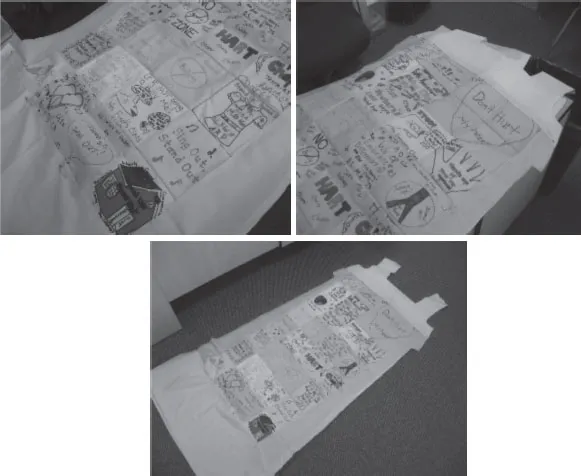
Above, classroom patches sewn together in dress form. Photos by Tanya Thomas.
THE PROJECT AND ITS MESSAGES CONTINUED
Several outreach- and community-based activities and in-school projects took place at Oakstead as a a follow-up to the school project:
• A field trip to see a community play based on the theme of anti-bullying was approved by the principal and arranged by the teachers. Because the play was intended for older students, only 4th and 5th grade students attended. Although the subject of the play involved a child with ADHD struggling with personal feelings and reactions of teachers, parents, and peers, the students connected her alienation with Maddie’s in The Hundred Dresses. Back in class after the field trip, a student with ADHD shared with his classmates his personal struggles with his condition and how he often feels different than his peers. He said that sometimes his peers become upset with him because he makes mistakes that he does not intend to make. His classmates expressed a new empathy and compassion toward this student.
• When literacy teachers at Oakstead saw a need to improve fluency scores, they were again abl...
Table of contents
- Cover Page
- Title Page
- Copyright
- Contents
- Foreword
- Acknowledgments
- Introduction: Teachers First
- Yvonne Pelletier Lewis and Gail Humphries Mardirosian, Ph.D.
- Section I: Theory: Foundations of Arts Integration and Teacher Training
- Section II: Impact: Training Teachers and Teaching Artists in Arts Integration
- Section III: Practice: Arts Integration in the Classroom, the School, the Community
- Conclusion: Looking Forward: Infinite Possibilities for Teaching and LearningYvonne Pelletier Lewis
- Editors
- Contributors
- Index
- Back Cover