![]()
Fan Appreciation no.1
Raymond Benson, Fourth Official Bond Author
Interview by Claire Hines
![]()
Chapter
02
James Bond as Transmedia Fan Anomaly
Matthew Freeman
![]()
It’s the right way to [tell a story] – to blow the whole thing up! It’s better than trying to spin the thing out indefinitely like the Bond franchise. They’ve successfully pulled it off with Bond, but at certain costs. I think with almost every other franchise it’s a mistake to try and keep those plates spinning. You want stakes.
– Jonathan Nolan
In the above quote, Hollywood screenwriter Jonathan Nolan discusses how, over the years, the James Bond franchise – spanning decades’ worth of films, books, video games and merchandise, etc. – has achieved longevity at the expense of certain elements that are typically important to how fans engage with franchises over time. As I will suggest shortly, such elements might include narrative coherence across texts, story progression, character development, etc. Yet in the Bond movies, actors change, story threads are dropped from one film to another, and the death of characters more often than not goes unnoticed in the heart of the hero. And that’s not even to consider Bond in other media besides film, whose own narratives contradict, stray and repeat old ground as often as they tell new stories.
Bond being a franchise of contradictions and straying repetitions wouldn’t be much of an issue if it didn’t directly oppose the common structure of how media franchises are typically built in the twenty-first century. According to prominent media scholars such as Henry Jenkins, ‘everything about the structure of the modern entertainment industry [is] designed with this single idea of transmedia in mind’. Transmedia speaks about the sort of narrative coherence, story progression and character development I acknowledge above; transmedia storytelling therefore encourages adventures to be told across multiple media as components of a larger fictional storyworld, with each medium contributing a piece to the larger story.
How, then, has this noted lack of narrative coherence, story progression and character development across the Bond franchise affected how fans engage with this franchise? Is transmedia even a possibility for a franchise as contradictory, longstanding, episodic and fundamentally un-serialized as Bond? Do the films and the video games actually unfold in the same fictional storyworld – and do fans even require them to? Are James Bond video games consumed as coherent extensions of the Bond films, or rather as distinct versions of some alternate Bond universe? And if so, is Bond a transmedia anomaly in today’s multimedia landscape – and what might all of this tell us about the nature of Bond fandom?
In examining the James Bond fictional storyworld across media, this chapter will look at some of the more recent films and video games. Specifically, I will discuss particular reviews and features about particular Bond video games so as to highlight the different ways in which the Bond franchise has been received across media compared to other, more characteristically transmedial franchises, such as the Matrix franchise. I argue that the Bond franchise doesn’t actually engage with popular strategies of transmedia storytelling; instead, I show that Bond makes use of a fixed temporality that works to engage fans across multiple media via strategies based around wish-fulfilment, nostalgia and retroactive continuities.
What is transmedia anyway?
Let’s begin by looking a little more deeply into what I mean by transmedia, and exactly what I mean when I suggest above that transmedia storytelling occupies the common structure of how media franchises are typically built in the twenty-first century. A term that has gained significant academic, industry and fan presence over the last decade, transmedia storytelling refers to the convergence of different forms of media. As I indicated at the start of this chapter, Jenkins defines transmedia storytelling as the telling of ‘stories that unfold across multiple platforms’. And so each new media text produced in a franchise – whether it’s a comic book, a novel, a video game, a mobile app, a film or a television series – functions as part of a bigger story that is unfolding across multiple media. Like a piece of a puzzle, if you will. For fans, the process of transmedia storytelling is thus accumulative, as each new text adds richness and detail to the fictional storyworld, working to build on what came before. New stories across media often work like sequels, as in a ‘chronological extension of a narrative’, as Paul Budra and Betty A. Schellenberg define in their introduction to the book Part Two: Reflections on the Sequel (1998).
Consider the relationship between the Matrix movies and Atari’s accompanying video game, titled Enter the Matrix (2003). In the film The Matrix Reloaded (Wachowski Brothers, 2003), characters Morpheus and Trinity are rescued by a secondary character called Niobe in the midst of a high-speed freeway chase. In the context of watching the film, it’s never quite clear how Niobe knew to be on that particular freeway at that particular time. How could she have possibly known that Morpheus and Trinity needed rescuing? The answer to this mystery became clear only to players of the Enter the Matrix video game, who discovered the reasons for how and why Niobe knew to be on the freeway when taking part in a specifically designed mission.
We might therefore note that the video game was much like an additional Matrix movie, with a whole intricate story weaved into the stories of the actual movies; the Matrix films were interspersed within and around the video game – the story extended and the storyworld expanded across multiple media forms in strikingly coherent and consistent ways. Jenkins would assert that such coherence and consistency across media is designed to encourage fans to migrate across multiple media, inspiring audiences to consume one text after another.
This transmedia model is indeed a thriving, arguably dominant model right now, but it’s certainly not the only model. And we need look no further than James Bond to see how media franchises built on incoherence and inconsistency can also work to provide alternative (but no less effective) means of encouraging fans to migrate across multiple media. Before I go on to elaborate on these alternative strategies, however, I will first suggest a reason why Bond isn’t necessarily even suited to today’s more transmedial tendencies in the first place.
James Bond: A storyworld in stasis
An underpinning reason why James Bond struggles to suit the template of the transmedia story model so typical of today’s entertainment industry is because the character has always been rooted in a sense of stasis. Whereas transmedia storytelling depends on narratives evolving and continuing across media, Bond is a fictional storyworld that relies on a tendency to keep things the same. And this sense of stasis was written into the fabric of the Bond character right from his inception in Ian Fleming’s novels in the mid-1950s.
At the start of Fleming’s first Bond book, Casino Royale (1953), the character is already a 00 agent. Bond was always a fully-formed character from the outset; fans’ interest in the character is not based on seeing him evolve or on yearning to understand his history, but rather in relishing the wish-fulfilment and fantasy that the character has come to epitomize.
Even in Fleming’s novels, James Bond does not age, and Fleming never explicitly provided Bond’s date of birth. It was only in later novels like On Her Majesty’s Secret Service (1963) and You Only Live Twice (1964) that Bond’s family background was alluded to. Such novels reveal that Bond has a Scottish father (presumably because Fleming was influenced by the Scottish casting of Sean Connery in the films!) and a Swiss mother, both of whom were killed in a climbing accident when Bond was just 11 years old, leaving him orphaned.
Thus because James Bond does not age across novels, films or video games, and nor do his actions seem to have lasting impact from one story to the next, the Bond storyworld is always defined by a constant adherence to a fixed temporality, to a stasis in which the past and future are equally hazy. As such, the Bond storyworld is forever trapped in an eternal present that denies story development and indeed a sense of past or future. With the notable exception of Quantum of Solace (Marc Forster, 2008) being a sequel to Casino Royale (Martin Campbell, 2006), the Bond movies have employed a stand-alone series structure, whereby the central character returns each time but there is little other sense of narrative coherence across stories. Nor is there much character development from one adventure to another, given that the character’s face changes every few years despite remaining roughly the same age regardless of the many decades that come to pass.
There is indeed a tendency in Bond to reset the narrative clock back to zero come the end of any particular adventure, a tendency to return to and remain perpetually in a temporal present. And this resetting ultimately means that the larger Bond narrative that plays out across multiple films and multiple media can’t make use of the sorts of transmedia storytelling strategies that have become commonplace today. Whereas transmedia storytelling is about producing sequels, Bond is typically about stand-alone adventures; whereas transmedia stories intricately weave story information into the stories of other stories in coherent and consistent ways, Bond’s adventures are characterized by changing faces, by the dropping of story threads from one story to the next, and by a constant adherence to a present stasis.
So how exactly are fans prompted and encouraged to engage with James Bond across multiple media? In what ways do Bond video games relate (or not) to the Bond movies? Let’s see how wish-fulfilment has worked to engage Bond fans across the movies and video games.
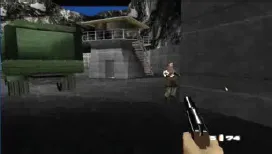
Figure 1: The first-person shooter perspective of GoldenEye 007 gave video gamers the opportunity to be Bond © Nintendo/Rare and Danjaq, LLC, 1997.
Wish-fulfilment
The fixed temporality underpinning Bond – far from preventing fans from continuing to consume more Bond adventures in other media – actually serves as the basis for one of the key reasons why fans love engaging with Bond in other media; a storyworld that remains pretty much the same across time and across media affords fans to revel in the act of being James Bond, in immersing themselves in the same world that they already know and love.
Wish-fulfilment, then, can be seen as a central strategy used by Bond video game developers when re-locating the character from the screen of the movies to the screen of a video game. Consider how reviewers discussed the classic Nintendo 64 video game GoldenEye 007 (1997), a game that is arguably ‘still the best Bond game by a country mile’, as Empire magazine once wrote. IGN’s review of GoldenEye 007 stressed the importance of the video game’s ‘single-player first-person’ perspective, which ‘enabled gamers to immerse themselves in spy-style tactics and covert operations’. The idea of allowing gamers to feel like they were Bond, in other words, to enable fa...