eBook - ePub
Available until 23 Dec |Learn more
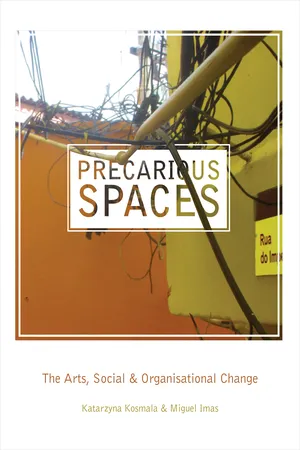
Precarious Spaces
The Arts, Social and Organizational Change
This book is available to read until 23rd December, 2025
- 220 pages
- English
- ePUB (mobile friendly)
- Available on iOS & Android
eBook - ePub
Available until 23 Dec |Learn more
Precarious Spaces
The Arts, Social and Organizational Change
About this book
Using an arts-based inquiry, Precarious Spaces addresses current concerns around the instrumentality and agency of art in the context of the precarity of daily life. The book offers a survey of socially and community-engaged art practices in South America, focusing in particular on Brazil's 'informal' situation, and contributes much to the ongoing debate of the possibility for change through social, environmental and ecological solutions. The individual chapters, compiled by Katarzyna Kosmala and Miguel Imas, present a wide spectrum of contemporary social agency models with a particular emphasis on detailed case studies and local histories. Featuring critical reflections on the spaces of urban voids, derelict buildings, self-built communities such as favela and roadside occupations, Precarious Spaces will make readers question their assumptions about precarity, and life in precarious realms.
Frequently asked questions
Yes, you can cancel anytime from the Subscription tab in your account settings on the Perlego website. Your subscription will stay active until the end of your current billing period. Learn how to cancel your subscription.
No, books cannot be downloaded as external files, such as PDFs, for use outside of Perlego. However, you can download books within the Perlego app for offline reading on mobile or tablet. Learn more here.
Perlego offers two plans: Essential and Complete
- Essential is ideal for learners and professionals who enjoy exploring a wide range of subjects. Access the Essential Library with 800,000+ trusted titles and best-sellers across business, personal growth, and the humanities. Includes unlimited reading time and Standard Read Aloud voice.
- Complete: Perfect for advanced learners and researchers needing full, unrestricted access. Unlock 1.4M+ books across hundreds of subjects, including academic and specialized titles. The Complete Plan also includes advanced features like Premium Read Aloud and Research Assistant.
We are an online textbook subscription service, where you can get access to an entire online library for less than the price of a single book per month. With over 1 million books across 1000+ topics, we’ve got you covered! Learn more here.
Look out for the read-aloud symbol on your next book to see if you can listen to it. The read-aloud tool reads text aloud for you, highlighting the text as it is being read. You can pause it, speed it up and slow it down. Learn more here.
Yes! You can use the Perlego app on both iOS or Android devices to read anytime, anywhere — even offline. Perfect for commutes or when you’re on the go.
Please note we cannot support devices running on iOS 13 and Android 7 or earlier. Learn more about using the app.
Please note we cannot support devices running on iOS 13 and Android 7 or earlier. Learn more about using the app.
Yes, you can access Precarious Spaces by Katarzyna Kosmala, Miguel Imas, Katarzyna Kosmala,Miguel Imas, Katarzyna Kosmala in PDF and/or ePUB format, as well as other popular books in Art & Art General. We have over one million books available in our catalogue for you to explore.
Information
Part I
Introducing the Volume
Chapter 1
Why precarious spaces?
Katarzyna Kosmala and Miguel Imas
Precarious?
This volume addresses current concerns in art discourse around the instrumentality and agency of art in the context of the precarity of daily living, urban informality and the proliferation of alternative forms of organizing. Authors from South America as well as Europe, the United States and Canada engage with spatial strategies behind the utilization of precariousness, and examine ways of challenging forms of precarity, and indeed, the instigation of precarity.
The volume draws upon interdisciplinary research including cultural and visual studies, art theory, organization studies, architecture, urban planning, geography and contemporary philosophy, and supplements local histories and experiences in the Global South, as well as their theoretical frameworks, with theories of art and socio-political practice as they have been debated and developed in European and North American contexts. The book offers a survey of socially and community-engaged art practices in South America and from there expands to address similar issues in the Global North. The individual chapters examine examples of projects based on performances of space that can be seen as exceeding the norm, as well as case studies concerning art-informed inquiry aimed at social and transformative consequences, set against the backdrop of neo-liberal economies that have contributed to the emergence of precarity in both life and work. Such an inquiry implies not only a particular philosophical and theoretical position, but equally demonstrates how, in practice, groups, individuals, and communities can challenge constructed, established orders to create spaces of emancipation. Thus, the book offers a unique interdisciplinary perspective for engaging with some of the themes of precarious spaces by mobilizing the use of arts-based inquiry both as a research method and as an intervention that aims at social and organizational change; drawing on resources that originate from South America, including examples from Brazil, Mexico, Peru, Argentina and Chile, supplemented with insights and resources emerging from the North, including the United Kingdom, the United States and Canada.
The key phrases surrounding precarity, such as unstable condition of today’s living; flexible, context-dependent and time-contingent employment; self-organization, disposability and contingency, have opened up new thresholds in theory development as well as in art-centred activism and the arts more generally. Foster (2009) identifies contemporary art practice with the precarious condition many artists share and respond to by creating meanings from uncertain circumstances, especially through a comment or an evocation of discourse, in response to a political confusion, and in association with socio-economic unrest. Such processes associated with reimaging the precarious condition into spaces of opportunity also require a theoretical reflection upon the processes of intervention and self-organization. At the same time, the scope of the critique of contemporary Capitalism and neo-liberal sentiments threatens to generalize precarity as a somewhat undifferentiated and ubiquitous condition.
We could argue, following on from Judith Butler’s investigation into human vulnerability in Precarious Lives: The Power of Mourning and Violence (2004), that, while what can be termed as precariousness is common to all life and contemporary living, a state of precarity associated with the contemporary moment of neo-liberalism is largely politically induced and, we would add, requires to be problematized. Precarity commonly refers to a living condition based on temporality, fragmentation and job insecurity in increasingly flexible labour markets. Precarious spaces are often seen as not being stable, settled or well staked out; these spaces are perceived as unstable, unsettled and relatively unmapped or less visible. Precarious places reflect exposure to spaces that are marginal in our societies (Wacquant, 2008) and yet, often, informality of marginalized groups becomes a groundwork for ‘inverse colonialism’ (Yiftachel, 2009).
Butler (2004) returns to Emmanuel Levinas and his analysis of the meaning of being human, and, from such a basis, argues for a kind of political and ethical work needed to achieve peace globally, and indeed, for creating a condition for better, ‘liveable’ lives. Zygmunt Bauman refers to contemporary times as an era of uncertainty, a state of ‘liquid modernity’ and ‘liquid times,’ where instability and unpredictability are reshaping the society as a network rather than conforming to a solid structure. Bauman (2007) also notes that the responsibility to shape a liveable life has fallen on the individual, as a life, demarcated by a series of short-term projects, requires most of all flexibility and adaptability to the rigours of the social factory and demands for increased productivity. In this frame, he argues for solutions emerging from the ‘local’ organization or a community rather than institutional structures or a state authority.
There is also the precariat. What has been commonly referred to as the precariat – a term describing a recent, tangible phenomenon – is a social class in the making, and approaches the consciousness of common vulnerability that Butler, Bauman and others have been hinting at (Harvey, 2010: 243). The precariat consists of those who feel their living and identities are made up of fragmented and fractured elements, in which it seems impossible to construct a desirable narrative by weaving work and quality time for a life outside work (Harvey, 2010, 2014; Standing, 2011). Under neo-liberal Capitalism, the balance of power has switched from labour to capital, resulting in occupational insecurity, precariousness and individualization of life (McGuigan, 2010).
We would argue that a notion of precariat can be viewed as an umbrella term, encompassing experiences of all those who need to train themselves – regardless of their origin – in order to compete on labour markets and to find a source of income, often on a temporary basis, and without social security in the case of illness or when needing assistance (e.g. Neilson and Rossiter, 2006; Kalleberg, 2009). Thus, precariat refers to experiences of people that have been made redundant, those on zero-hours contracts, migrants, asylum seekers as well as the so-called creative class, and, in particular, those who are most likely to be in debt at the time of entering the labour market.1 Referring to the latter, Gregory Sholette in his book Dark Matter: Art and Politics in the Age of Enterprise Culture has pointed out, drawing on an astrophysics-derived metaphor of ‘dark matter,’ that ‘without this obscure mass of “failed” artists the small cadre of successful artists would find it difficult, if not impossible, to sustain the global art world as it appears today’ (2011: 3). Sholette describes a complex division of labour in the art world whereby many excluded creative practices as well as marginalized and ‘unsuccessful’ artists sustain the functioning of the system through volunteering practice; serving as interns at art galleries, taking underpaid art teaching positions or other jobs and consuming art experience more generally. The author argues that it is the system that keeps the creative class in a state of subservience, and, in a sense, a state of co-dependence.
Bauman, Butler, Wacquant, and to some degree Harvey as well as others, all imply an individual pressure in the struggle to make a living in relation to precarity. And such a positioning of individual agency, indeed, implies vulnerability. Analysing Butler’s ethical position, Lloyd points out that for Butler, the body is central to a conceptualization of vulnerability since it is precisely the body that exposes us and opens us to the other, their gaze, touch and various forms of violence (2008: 94).
The main focus of the collection is a critical reflection upon the concepts of space, precariousness and broadly defined, art-based activities as well as their dynamic relationship, in seeking a change and transformation of living conditions, associated with what Butler (2004) described as ‘liveable’ lives. Similarly, Anna Dezeuze debating precariousness in art practices in the context of socio-economic development refers to Hannah Arendt’s conceptualisation of human condition as ‘human existence as it has been given’ (Ardent, 1958: 2 in Dezeuze, forthcoming) and argues that ‘it is a matter of addressing the situation of the individual, here and now, in the concrete world, on a human scale’ (Dezeuze, forthcoming: 27).
The chapters in this volume examine various urban spaces and locations associated with the imaginary of precariousness, seek practices within such contexts that are neither formally managed nor organized, as well as explore examples of interventions in the geographical imaginary of the precarious that emerge out of architecture, design, visual arts, music and performative practice. The chapters articulate different discourses of social change, instigated by arts-based intervention that can imply a cross-cultural engagement, neighbourhood-driven action, politically infused activism in a particular area and community building. The volume also explores uses of media discourse as platform for a social change and a forum for asking questions on established perceptions of existence in the imaginary of precarious realms, including examples of urban voids, derelict buildings, self-built communities, such as a favelas or shantytowns, as well as dwellings based on occupation of urban infrastructure, such as an underpass or roadside.
Precarious Spaces is devoted to explorations of the South, pointing out that some locations and geographical imaginings appear more vulnerable to enactments and investigations of precarity than others. The Latin American Modernist movement, with its often unacknowledged debt to the vernacular architecture of the 1920s and 1930s, has drawn inspiration from local communities’ experiences of communal living and reflected upon the ways of coping with exclusion in different socio-economic environments. By looking at the South American experience, and Brazil’s ‘informal’ situation in particular, for transferable methodological processes and from such a position, expanding to the North, the volume contributes to a debate on the possibilities of change through social, environmental and ecological solutions offered to the spatial problems and socio-economic challenges associated with ‘liveable’ life.
Artistic engagement with the imaginary of the precariousness
Precarity signifies many things and is commonly associated with socio-economic challenges of contemporary living, uses of public space, political issues of the creative classes, agency in arts, interventions and social movements. More broadly, it reflects contemporary interests in political philosophy and cultural theory, including the writings of Michael Hardt, Antonio Negri, Achille Mbembe, Paolo Virno, Zygmunt Bauman, Judith Butler, Claire Bishop and others.
This edited collection is concerned with a set of broadly defined arts-based relational practices and their potentiality to creatively facilitate knowledge exchange and to instigate social change. A closer examination of the agency, emerging out of relational or participatory art practices in precarious contexts, or addressing imaginary of precariousness, puts the role of self-organizing systems and its micro-politics at the centre of discussion.
In aesthetic terms, associated with broadly defined participatory or relational practice, that is, in dialogical aesthetics, the art object appears less important than the participatory process, or transgresses the purely artistic enactment of and engagement in a particular context; as argued by Claire Bishop, Grant Kester and others. The book seeks alternative answers as to how the artistic engagement within the participatory and relational paradigm can provide a tangible platform for an exploration of political alternatives for social change. The book also examines organizational practices that emerge from the grassroots, including circumstances of impoverished and dis-possessed communities and their bottom-up organizational forms. The question is: What kind of aesthetic lens is required for such an engagement?
Theoretical framings of dialogical aesthetics appear complex, oscillating between structuralist and post-structuralist positions and critical hermeneutics. Referring to Jürgen Habermas’ concept of discursive interaction and the importance of openness, Jean-Francois Lyotard and his aesthetics of the differand and Ken Hirschkop’s take on Mikhail Bakhtin’s redemptive inter-subjectivity, Kester in Conversation Pieces provided a useful definition by describing dialogical aesthetics as being ‘based on the generation of a local consensual knowledge that is only provisionally binding and that is grounded at the level of collective interaction’ (2004: 112). Within a set of art practices that broadly aspire to dialogic aesthetics, a reflective positioning can act as a catalyst for change, potentially revealing more of the experiential specificity of the world as the context-focus unfolds. In a dialogic aesthetic frame, artistic practice embraces the importance of a dialogue, as an integral component to an engaged practice (Kosmala, 2010).
Nicolas Bourriaud, putting aside criticism associated with his writing, pointed out that the way of working for some contemporary artists today is governed by a concern to ‘give everyone their chance,’ through forms that do not establish any precedence, a priori, of the producer or the artist over the beholder, but rather negotiate open relationships (Bourriaud, 2002: 58). Representational conventions of the arts and aesthetics, therefore, may be challenged by the creative facilitation of knowledge exchange. It is also a site-specificity that can become a space for encounter. The space and its specificity can facilitate the possibility of change, with a shift away from art as object-making to art conceptualized as an open form of exchange or co-production, whether in reference to the gallery context, as Bourriaud discussed in Relational Aesthetics (1998/2002), or outside the gallery realms, as Kester delineated in Conversation Pieces (2004), and further developed in The One and the Many: Contemporary Collaborative Art in a Global Context (2011) in relation to politically engaged practice, blurring the line between community activism and art production. Yet, participative, interventional action does not necessarily embrace a ‘positive’ paradigm, as some artists and activists may be drawn to the ‘good vibe’ and ‘social activism’ promoted by Bourriaud (2002) or ‘community art’ (Kester, 2011: 2004), while others may incorporate ‘aestheticisation’ of poverty (Dezeuze, 2006) or an act of antagonism (Bishop, 2004) in artistic renegotiation and political reframing. There is also a wider problem associated with the way of art functioning in the processes of neo-liberal appropriation and the proximity of art and politics (Kosmala, 2015). Sholette (2011) has warned that political agency in art and collective action, although initially aimed at challenging the hegemony of the art world, risks being eventually co-opted or absorbed by the dominant system, appropriated by its institutions, or simply forgotten and marginalized.
Structure of the volume
This edited collection focuses on precarious spaces associated with or located in public realms, predominantly drawing on the South American experience, where alternative forms of urban informality may be emerging as a ‘new paradigm for understanding urban culture’ (Roy and AlSayyad, 2004). Some chapters also address the concepts of ‘site-specificity’ (Kwon, 2002) and location, pointing out the privilege of the artist’s agency and origin in relation to cultural and social regeneration of precarious spaces and working with peripherally located communities around the globe. Artists can be seen as agents that can simulate change but also may act as those who contaminate space by their enacted roles in specific time-defined moments, challenging the boundaries of art production between politics and aesthetics. The authors in their chapters discuss various encounters and alternative strategies that can express experiential effects of intervention for being and becoming a more ‘liveable’ place. By doing so, the book’s individual contributions help to invent archives and utilize modes of engagement for unleashing the hidden potential, aimed to transform the current condition (less ‘liveable’ place) and to discover innovative means for change.
The book consists of three Parts: I: Introducing the Volume explores the key terms advanced throughout, including a notion of precariousness, autonomy, community at periphery in global realms and social and organizational change, as well as introduces the context of the book; II: Emancipating: The Arts and the Possibility of Change discusses examples of artistic engagement in and with the precarious, and examining interventions addressing the questions of socio-economic change; III: Resisting: Opening Organizations, Altering Organizing explores the potentiality of cultural and other forms of organizations in engaging with the precarious, as well as discusses how forms of (self-)organizing can alter the political dynamics of neighbourhood and community building.
This opening chapter contextualizes the volume by introducing key terms associated with the notion of precarity and precariousness, as well as briefly discussing types of arts-ba...
Table of contents
- Cover Page
- Title Page
- Copyright
- Contents
- Acknowledgements
- Preface
- Part I: Introducing the Volume
- Part II: Emancipating: The Arts and the Possibility of Change
- Part III: Resisting: Opening Organizations, Altering Organizing
- Back Cover