eBook - ePub
Available until 23 Dec |Learn more
Gay Men at the Movies
Film reception, cinema going and the history of a gay male community
This book is available to read until 23rd December, 2025
- 250 pages
- English
- ePUB (mobile friendly)
- Available on iOS & Android
eBook - ePub
Available until 23 Dec |Learn more
Gay Men at the Movies
Film reception, cinema going and the history of a gay male community
About this book
Cinema has long played a major role in the formation of community among marginalised groups, and this book details that process for gay men in Sydney, Australia from the 1950s to the present. Scott McKinnon builds the book from a variety of sources, including film reviews, media reports, personal memoirs, oral histories and a striking range of films, all deployed to answer the question of understanding cinema-going as a moment of connection to community and identity – how the experience of seeing these films and being part of an audience helped to build a community among the gay men of Sydney in the period.
Frequently asked questions
Yes, you can cancel anytime from the Subscription tab in your account settings on the Perlego website. Your subscription will stay active until the end of your current billing period. Learn how to cancel your subscription.
No, books cannot be downloaded as external files, such as PDFs, for use outside of Perlego. However, you can download books within the Perlego app for offline reading on mobile or tablet. Learn more here.
Perlego offers two plans: Essential and Complete
- Essential is ideal for learners and professionals who enjoy exploring a wide range of subjects. Access the Essential Library with 800,000+ trusted titles and best-sellers across business, personal growth, and the humanities. Includes unlimited reading time and Standard Read Aloud voice.
- Complete: Perfect for advanced learners and researchers needing full, unrestricted access. Unlock 1.4M+ books across hundreds of subjects, including academic and specialized titles. The Complete Plan also includes advanced features like Premium Read Aloud and Research Assistant.
We are an online textbook subscription service, where you can get access to an entire online library for less than the price of a single book per month. With over 1 million books across 1000+ topics, we’ve got you covered! Learn more here.
Look out for the read-aloud symbol on your next book to see if you can listen to it. The read-aloud tool reads text aloud for you, highlighting the text as it is being read. You can pause it, speed it up and slow it down. Learn more here.
Yes! You can use the Perlego app on both iOS or Android devices to read anytime, anywhere — even offline. Perfect for commutes or when you’re on the go.
Please note we cannot support devices running on iOS 13 and Android 7 or earlier. Learn more about using the app.
Please note we cannot support devices running on iOS 13 and Android 7 or earlier. Learn more about using the app.
Yes, you can access Gay Men at the Movies by Scott McKinnon in PDF and/or ePUB format, as well as other popular books in Art & Art General. We have over one million books available in our catalogue for you to explore.
Information
Part One
Friends of Dorothy in the Emerald City
Chapter 1
The 1950s — Censored from view for all to see
“Not looking at a fire doesn’t put it out.”
– Maggie “The Cat” Politt, Cat on a Hot Tin Roof (1958)
Gay space, cinema-going and censorship in 1950s Sydney
In the 1950s, Hollywood made films in which homosexual characters could be found, if you knew where to look and how to identify them. Up on the screen were men whose very presence relied on their deniability. They existed in a liminal space, revealed and hidden, simultaneously presented on-screen and excluded from it. This containment of homosexuality had certain similarities with the public position of homosexual people in Sydney. Gay life in the city was an open secret through which male homosexuality was criminalised while its very existence was denied. This was a crime so unspeakable that it had to be loudly condemned. The 1950s were a time of oppression and persecution of homosexual men, yet some did participate in an active social scene. Occasionally lives like their own could be found at the movies, either on-screen or in the audience. The presentation of those on-screen lives, the discussion about them in the media and their presence in picture theatre audiences, all served as kindling to a newly lit fire. Through them, the contradiction inherent to the liminal framing of homosexuality began to be revealed; it gradually became impossible not to see that which had always been visible.
Beginning with Mr Entwhistle
In order to understand both the cinematic reception of gay characters and the cinema-going habits of gay men in the 1950s, it may be useful to venture back a little further to gain some historical context. I’m going to begin slightly earlier, therefore, in 1938. In that year, the third in a popular series of Australian film comedies was released. Following the adventures of “Dad Rudd” and his son Dave, the series presented Australian life through the lens of two farmers, both of whom typified the stereotype of the naïve and unsophisticated, if well-meaning and ultimately heroic, rural Australian male. Although the first two films in the series kept our heroes in familiar rural territory, in Dad and Dave Come to Town, Dad inherits a women’s clothing store in Sydney, and he and Dave travel to the big city to inspect their newly acquired, glamorous and altogether modern business. While exploring urban life, the two must deal with a succession of difficulties resulting from their position as strangers in a strange land.
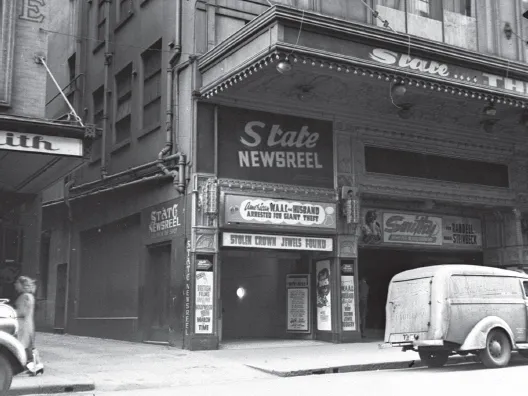
The State Theatre Newsreel Theatrette, Market St, Sydney in the 1940s. Image courtesy of the State Library of New South Wales.
One such difficulty appears in the swishy form of Mr Entwhistle, the manager of Dad Rudd’s new store, who is played in a gloriously affected fashion by local actor Alec Kellaway. Entwhistle’s effeminacy and camp mannerisms are something Dad and Dave have never previously experienced, placing this character as a creature of the modern city. In this role, Kellaway became a direct confrere of American actors including Franklin Pangborn, Edward Everett Horton and other Hollywood “sissies” of the 1930s and 1940s. They were the coded queers who flitted on to screens in a time when homosexuality was meant to be unknown and invisible.
But if queers were supposedly unknown, on-screen and off, it is equally true that Mr Entwhistle’s appearance as a retail employee in an inner-city store was no mere coincidence. To those who shopped in the more stylish and modern of the stores of the Sydney CBD, he may well have been a familiar figure. Those with an added layer of knowledge may have also been aware that men “like that” could be found spending their leisure time in several of the area’s cafes, hotels and, depending on the time of night, public parks. It was in these spaces that Sydney’s gay life was born. There were suited office-workers meeting at the Australia Hotel and sailors at Belfields.1 The Latin Café served European food to a refined, cosmopolitan crowd. Across a range of inner-city venues, homosexually attracted men found places to meet in the 1930s.
Understanding the lives of homosexually attracted men in these years requires a certain amount of reading between lines and allowance for the vagaries of liminality. We do know, however, that although condemned as degenerate and perverse, and brutally treated by the law and the media, homosexual men in the first half of the twentieth century managed to find spaces in inner-city Sydney in which to have sex, fall in love and establish what Garry Wotherspoon has described as the “friendship networks”2 that would eventually become a community. Many referred to themselves and each other as “camp”, a label connected, certainly, to the more broadly understood cultural meanings of “camp” but operating in Australia as a distinctive form of homosexual identification.
Along with the Australia Hotel or the Latin Café, a man like Mr Entwhistle may well have been aware that certain Sydney cinemas also served as spaces in which to meet men, at times providing an attraction unrelated to the quality of the film on the screen. In the inter- and post-war years, the dark spaces of some inner-city movie theatres were frequently, to borrow a phrase from George Chauncey, “put to queer use”.3 The history of cinemas as places for sexual interaction is certainly not limited either to homosexual men or to the city of Sydney. It is clear, however, that certain cinemas were attended by some men primarily for the purposes of meeting other men for sex. In 1948, for example, the Sydney Morning Herald reported claims by Vice Squad detectives that Sydney was “infested with perverts” who “gathered at fun parlours” and “frequented picture theatres”.4 Raids were intended on these locations to “stamp out homosexual offences”.
In the pre-television era, the only means of watching “the news” was through newsreel clips that played in many cinemas before the main attraction. In the Sydney city centre, several smaller cinemas specialised in newsreels, running a collection of current news stories on a continuous loop. Ken Lovett, a gay man who participated in the camp scene of the post-war 1940s in Sydney, has recalled that certain small venues were known as places to meet men.5 Sitting next to a stranger in these cinemas and making contact, in the words of Lovett, “with the knee, that was the easiest way”, became a way of initiating sex. This may have been an encounter with another camp man, certainly, but sex with men who were otherwise straight was not unknown. Because there was no start or finish time for screenings, patrons had a valid reason to linger as long as they liked and could come and go as they pleased. Thus were provided ideal conditions in which to wait, or not, for a new encounter.
While these meetings may often have been anonymous and fleeting, others led to lasting friendships or loving relationships. Lovett met a man at a newsreel theatrette with whom he developed a relationship lasting several months and through whom he met several other camp men who became his friends. Given the lack of a public and visible camp presence and, indeed, the need for camp men to meet in secret and protect their privacy, these points of access and opportunities to meet, explore and discover were critically important. Cinema spaces were, at times, a way of connecting with networks through which sex, romance and friendship could be found.
Camp life in the 1950s: Public and private at home and at the movies
In this chapter, I examine the ways in which homosexually attracted men in the 1950s may have responded to particular film texts and incorporated the movies into their culture. In doing so, it is necessary to acknowledge that, without the large and more public culture and community that would begin to develop in Sydney in the 1960s, many homosexual men had no means of conceiving of an identity based around their sexual desires. Many found in these desires a source of shame; a regrettable affliction that would prevent them from finding a “normal” life. It is possible to imagine a sense of identity building around participation in the friendship networks of camp men, but, for most, the profound threat of legal prosecution and social stigma meant that participation in this life was conducted in secrecy.
Men who acted on their homosexual desires in the 1950s continued to do so at great risk. Between 1945 and 1960, over 3000 men in Australia were arrested for “indecent acts”.6 In 1958, New South Wales Police Commissioner, C.J. Delaney, told a Rotary Club luncheon that homosexuality was “Australia’s greatest menace”.7 Delaney’s determination to enforce the State’s vice laws extended well beyond acts committed in public spaces. In 1953, he had sought public help to remove this “cancer eating at the community”, stating that “we need the whole-hearted co-operation of the public to deal effectively with those who operate behind closed doors”.8 Delaney encouraged members of the public to report any parties held by homosexuals in private dwellings, denying camp men not only the right to sex and love but criminalising even the act of entertaining friends at home.
Through the decade, the search for a private space in which to conduct a sexual or romantic life would continue to be a critical element of many homosexual lives. The contrast between the space of the home and that of a cinema offers an interesting example of ways in which “public” and “private” may have had shifting and conflicting meanings for camp men. For many homosexually attracted men, the ostensibly private space of the home meant something far different than the suburban residences of post-war newlyweds and expectant parents. The homes of camp men may well have been more heavily monitored—by family, by landlords, by neighbours—than public spaces such as movie theatres.
The novel No End to the Way, first published in Britain in 1965, struck controversy for its interest in the lives of homosexual Australian men. It was initially banned by Australian censors, but was released locally in 1966.9 Centred on a romance between two camp men, the novel highlights the complexities of conducting a same-sex relationship in pre-gay liberation Australia. The narrator, Ray, is always conscious of monitoring his behaviour for fear that even a simple expression of affection will be witnessed by others. Choosing a rental home, Ray checks that no passers-by can see in through the windows and that the owner of the property won’t be too nosy. He describes being at “cinemas, and the two of you holding hands down low in the seats all the time”.10 For Ray, the constant consciousness of being forever on-guard, fearful of discovery, is debilitating. Once the lights went down, a movie theatre offered at least some sense of seclusion. Like the gay characters on-screen through the 1950s, gay men in the audience used cinemas as locations in which it was possible to be simultaneously out in the world and hidden from view.
One interviewee’s memories similarly highlighted the shifting ...
Table of contents
- Cover Page
- Title Page
- Copyright
- Contents
- Dedication
- Acknowledgements
- Introduction
- Part One: Friends of Dorothy in the Emerald City
- Part Two: Memories of Dorothy: Memory, Movies, Gay Men
- Conclusion: Gay men at the movies
- Bibliography
- Index
- Back Cover