This book is available to read until 23rd December, 2025
- 200 pages
- English
- ePUB (mobile friendly)
- Available on iOS & Android
eBook - ePub
Available until 23 Dec |Learn more
About this book
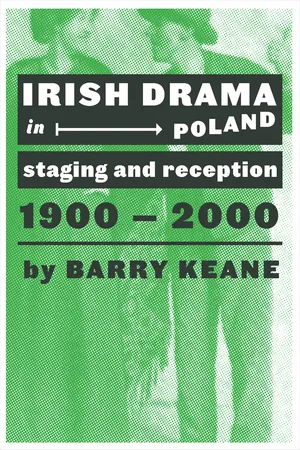
Irish Drama in Poland is the first book to broadly assess Irish drama's impact on both Poland's theatrical world and its cultural and literary heritage in the twentieth century. With a wide-ranging analysis – from Yeats, Synge, O'Casey and Behan, to Wilde, Shaw and Beckett – this engaging study explores the translation, production and reception of Irish plays in Poland. Barry Keane presents readers with the historical and literary context for each production, allowing readers to understand the many ways Irish theatre has informed Poland's theatrical and literary heritage. Including a foreword by translation scholar Michael Cronin, Irish Drama in Poland drives home the importance of exploring intercultural contexts, allowing readers a more informed understanding of European culture and identity.
Frequently asked questions
Yes, you can cancel anytime from the Subscription tab in your account settings on the Perlego website. Your subscription will stay active until the end of your current billing period. Learn how to cancel your subscription.
No, books cannot be downloaded as external files, such as PDFs, for use outside of Perlego. However, you can download books within the Perlego app for offline reading on mobile or tablet. Learn more here.
Perlego offers two plans: Essential and Complete
- Essential is ideal for learners and professionals who enjoy exploring a wide range of subjects. Access the Essential Library with 800,000+ trusted titles and best-sellers across business, personal growth, and the humanities. Includes unlimited reading time and Standard Read Aloud voice.
- Complete: Perfect for advanced learners and researchers needing full, unrestricted access. Unlock 1.4M+ books across hundreds of subjects, including academic and specialized titles. The Complete Plan also includes advanced features like Premium Read Aloud and Research Assistant.
We are an online textbook subscription service, where you can get access to an entire online library for less than the price of a single book per month. With over 1 million books across 1000+ topics, we’ve got you covered! Learn more here.
Look out for the read-aloud symbol on your next book to see if you can listen to it. The read-aloud tool reads text aloud for you, highlighting the text as it is being read. You can pause it, speed it up and slow it down. Learn more here.
Yes! You can use the Perlego app on both iOS or Android devices to read anytime, anywhere — even offline. Perfect for commutes or when you’re on the go.
Please note we cannot support devices running on iOS 13 and Android 7 or earlier. Learn more about using the app.
Please note we cannot support devices running on iOS 13 and Android 7 or earlier. Learn more about using the app.
Yes, you can access Irish Drama in Poland by Barry Keane in PDF and/or ePUB format, as well as other popular books in History & British Drama. We have over one million books available in our catalogue for you to explore.
Information
Chapter 1
Compromised Heroes: Irish Drama in the Era of Young Poland (1900–1918)
Introduction: Art and the Hopes for Polish Nationhood
Coined by critic Artur Górski, in 1898,1 the term ‘Young Poland’ came to represent the leading exponents of a generation of writers that emerged at the beginning of the 1890s, who rejected the deterministic values of Positivism, a literary movement that had looked to brush over the disastrous rebellions of the nineteenth century and promote the scientific and social advances made during the partitions of Poland. In doing so, Positivists placed the burden upon the shoulders of the intelligentsia to instruct society in matters of science and modern ideas. Broadly speaking, the generation of Young Poland looked at the world from a more spiritual and metaphysical dimension and embraced the Symbolist ideas of Jean Moréas and the theories of the Belgian poet-playwright, Maurice Maeterlinck, in particular their incorporation of mysticism, mythology and occultism. In fact, during this era, Symbolism was referred to frequently as the ‘new art’, but it was also understood in tandem with Impressionism,2 which, together with the ‘new art’, not only suggested images possessing an esoteric ‘other’ quality, but also a medium that revealed the psychological state of the artist at the time of writing.3 In keeping with the times and the situation with regard to the continued partition of Poland, suffering and pessimism were also central motifs – particularly in the 1890s – where death was hailed as a feminine goddess (‘death’ being feminine ‘śmierć’) who could liberate people from earthly suffering and raise them up to a Nirvana-like existence.4 Naturally this quasi-religious outlook did little to move forward the protracted and largely unresolved debate about the thorny issue of art and nationhood in and around the fin de siècle. And indeed, the two most high-profile forums who clung to this artistic aloofness, at least in a programmatic sense, were the journals Życie [Life] of Kraków and Chimera of Warsaw.
Życie was founded in 1897 in Kraków by a young journalist called Ludwik Szczepański, and in accordance with its name, it sought to engage in a wide range of issues beyond literature. As a critic, Szczepański rejected utilitarianism and socio-political realism, stating that a national and patriotic literature was a worthy aim, but contended that writers should only look to express themselves, and in a manner that suited their purposes.5 Steered towards a small elite circle, Życie soon met with financial problems and it was taken over by Stanisław Przybyszewski, a prolific literary critic and novelist, who made Herculean attempts to rescue the journal from its financial crisis. Przybyszewski set Życie on a different course and proclaimed in his manifesto, ‘Confiteor’,6 an era of art for art’s sake – separating art from social commitment. In turn, Przybyszewski stated that art remained beyond the parameters of life, and thus, being so inexorably linked with the absolute, it could not be harnessed to serve ideas, which basically meant that the journal would assiduously avoid getting dragged into the nationalist debate and uphold the notion that artists should not get caught up in social causes. However, Przbyszewski’s principal achievement during his short tenure as editor of Życie was to showcase the art sketches of Stanisław Wyspiański, together with his early dramas, Warszawianka [The Varsovian Anthem] (1898) and Klątwa [The Curse] (1899). Although Życie had run its course by 1900, the spirit of the journal found its successor in the Warsaw journal, Chimera, which was edited and published by Zenon Przesmycki, better known by his pseudonym, ‘Miriam’.
From the outset, Przesmycki declared the primacy of art for its own sake,7 which left him open to accusations by some quarters of having his head in the sand when it came to the nation’s continuing bondage. However, highly significant in terms of Polish heritage was Przesmycki’s discovery and publication of the works of the late Romantic poet Cyprian Kamil Norwid, who had died in obscurity decades before and whose career had been overshadowed by those of Mickiewicz and Słowacki. Also under Przesmycki’s guidance, many Western literary currents were introduced to Poland, with Chimera featuring the translation of Western symbolists such as Charles Baudelaire, Paul Verlaine and José-Maria de Hérédia. Also gathered around the journal Chimera were many of the most celebrated Polish writers of the age, such as Stefan Żeromski, Wacław Berent, Jan Kasprowicz, Bolesław Leśmian, Władysław St. Reymont, Przybyszewski, and others.
Generally in the Young Poland era reviews of foreign plays did not make mention of the translators, nor indeed did they offer any critical comment on the translations themselves. Having said that, much of Western literature, particularly poems, short stories and prose extracts, were generally translated by Poland’s celebrated writers, who left little commentary aside from the work itself. In some respects this is unsurprising, especially given the fact that such translations were often first featured in literary reviews around which closed circles of polyglot writers, critics and literature enthusiasts were gathered. Przesmycki summed up this notion best when he wrote, ‘Above all, a perfect thing in a perfect translation is neither what is its own or what is foreign, it is perfect, and that is enough’.8
The following chapters will show that the critical reception of Irish plays also drew attention to the Irish aspiration for independence from England and the cultural importance of the Irish Literary Revival at a time when Poland’s pantheon of poets and prose writers programmatically avoided incendiary politicking, and who ignored, or were unaware of, what was happening in Ireland. There are always exceptions to every rule, however, and here we may mention the singular efforts of firebrand critic and dramatist Adolf Nowaczyński (1876–1944), who supported the staging of Irish drama in Poland at every turn, and who very much held up the Irish cause as an inspiration for the Polish people, pointing to cultural and technical advancement as being Poland’s best means of achieving independence.
At this juncture, it is important to note that the story of Irish drama at the beginning of the twentieth century in Poland is a fairly tangled affair, and this is due to the fact that premieres and other related events were spread over partitioned Poland, and rarely took place concurrently. As a consequence, there will be occasions where our account goes forwards and backwards in order to incorporate as many threads and deviations of the story as possible.
Bunbury Revellers
Leon Winiarski, London correspondent for the socialist gazette Prawda [The Truth] attended the London premieres of Lady Windermere’s Fan (1892) and A Woman of no Importance (1893), but remained unimpressed by what he had seen. In fact, Winiarski referred to Wilde as a dilettante who had penned plays that only reflected his immorality and cynicism.9 However, reflecting poorly on the critic himself was his translation of A Woman of no Importance as ‘A Woman of Little Value / Dubious Reputation’ [Kobieta małej wartości], although perhaps Winiarski was deliberately emphasizing what he felt to be the ‘decadence’ of the works, or more pointedly, the ‘decadence’ of the author. In spite of such strident tones, only a year later, possibly impressed by Wilde’s own socialist pamphlets, Winiarski was positively in thrall to the Wildean outlook, stating that the artistic age belonged to the aesthetes, ‘who do not want to be taken seriously’,10 and this was more an expression of concern than criticism. Here Winiarski proclaimed Wilde the leading exponent of the movement, whom ‘only fools would call a charlatan’.11 This volte-face on the part of the Prawda correspondent took on a deeper dimension with the trial and imprisonment of Wilde. In particular, Winiarski took exception to the universal rejection of prisoner-Wilde as an artist, and the critic reserved his ire for the French journal Revue des Deux Monde,12 which had described Wilde’s dramatic works as insignificant. He went on to say that it was just as well that Wilde’s career had been interrupted, the suggestion being that the public had been spared more of the same. Incensed as he clearly was at this good riddance’ing of the disgraced Irishman, Winiarski could not help agreeing with a widely held view that Wilde had diminished his art by having looked to flourish in the commercial world; something which had both compromised and somehow precipitated his downfall. And here one gets the sense that Winiarski was grabbing at a unique opportunity to firstly stand against what was at the time a fairly universal rejection of Wilde, and secondly, to champion his importance as an artist, going so far as to describe Wilde as the greatest creative talent from amongst the youngest generation of English-language writers.13 Here, with this article, the era of ‘Winiarski on Wilde’ ended, but the Irish writer soon found a place in the most prestigious artistic journal of the era.
In 1898, Wilde’s essay, The Critic as Artist [Krytyk jako artysta] (1891), was serialized in Życie, translated by an initialled R.W., and uniquely came with an introductory footnote referring to Wilde as a theoretician completely unknown in Poland, who had conceived the notion of a refined art that would exist in an ivory tower, inaccessible to the masses14 – a view which is certainly at odds with the accessibility of Wilde’s work. Notable also was the inclusion of Wilde’s poetic vignette, The Disciple (1894), the following year.15 However, this small entry would mark the beginning of a short hiatus when it came to the translation of Wilde in Poland, explainable in some part by the closure of Życie in 1900. Życie’s cessation also meant that there was no literary forum in Poland at the time that felt a need to provide the recently deceased Wilde with a suitable obituary. For example, all that the weekly newspaper Prawda announced was that Oscar Wilde, ‘the English writer’ had died in Paris.16 Only the newspaper Kurier Warszawski [The Warsaw Courier] would provide a longer obituary of some eight lines, but managed to mistranslate The Importance of Being Earnest (1895) as Nieszczęście Ernesta [The Misfortune of Ernest], which illustrates the extent to which Oscar Wilde was largely unknown in Poland at the time of his death.17
In 1903 the success of the stage adaptation of Salome (1894) in Berlin at the Neues Theatre marked a resurgence of interest in Wilde on the Continent, while in Poland the publication of anonymous translations of his children’s stories in various newspapers and journals also did much to cement his reputation. But precisely why so many of his stories were translated anonymously remains puzzling, and here we can only hazard a guess that the translators were simply enthusiasts writing on editorial initiatives. At any rate, Wilde’s first book publication in Poland, the same Salome,18 did appear with the name of the translator, Władysław Fromowicz, printed on the inside title page. But the translation itself was met with a mixed recepti...
Table of contents
- Cover Page
- Title Page
- Copyright
- Contents
- List of Illustrations
- Foreword
- Acknowledgements
- Introduction
- Prologue: Thomas Moore: An Early Meeting of the Waters
- Chapter 1: Compromised Heroes: Irish Drama in the Era of Young Poland (1900-1918)
- Chapter 2: A Fall from Grace: Irish Drama During the Inter-War Years (1918-1939)
- Chapter 3: Walking on Eggshells: Irish Drama in the Post-War Era (1945-1960)
- Chapter 4: Towards the Modern Era (1960-1979)
- Epilogue: The Millennial Surge
- Bibliography
- Index
- Back Cover