eBook - ePub
Available until 23 Dec |Learn more
New Patterns in Global Television Formats
This book is available to read until 23rd December, 2025
- 346 pages
- English
- ePUB (mobile friendly)
- Available on iOS & Android
eBook - ePub
Available until 23 Dec |Learn more
New Patterns in Global Television Formats
About this book
The past twenty years have seen major changes in the ways that television formats and programming are developed and replicated internationally for different markets – with locally focused repackagings of hit reality shows leading the way. But in a sense, that's not new: TV formats have been being exported for decades, with the approach and methods changing along with changes in broadcast technology, markets, government involvement and audience interest. This book brings together scholars of TV formats from around the world to analyse and discuss those changes and offer an up-to-the-minute analysis of the current state of TV formats and their use and adaptation worldwide.
Frequently asked questions
Yes, you can cancel anytime from the Subscription tab in your account settings on the Perlego website. Your subscription will stay active until the end of your current billing period. Learn how to cancel your subscription.
No, books cannot be downloaded as external files, such as PDFs, for use outside of Perlego. However, you can download books within the Perlego app for offline reading on mobile or tablet. Learn more here.
Perlego offers two plans: Essential and Complete
- Essential is ideal for learners and professionals who enjoy exploring a wide range of subjects. Access the Essential Library with 800,000+ trusted titles and best-sellers across business, personal growth, and the humanities. Includes unlimited reading time and Standard Read Aloud voice.
- Complete: Perfect for advanced learners and researchers needing full, unrestricted access. Unlock 1.4M+ books across hundreds of subjects, including academic and specialized titles. The Complete Plan also includes advanced features like Premium Read Aloud and Research Assistant.
We are an online textbook subscription service, where you can get access to an entire online library for less than the price of a single book per month. With over 1 million books across 1000+ topics, we’ve got you covered! Learn more here.
Look out for the read-aloud symbol on your next book to see if you can listen to it. The read-aloud tool reads text aloud for you, highlighting the text as it is being read. You can pause it, speed it up and slow it down. Learn more here.
Yes! You can use the Perlego app on both iOS or Android devices to read anytime, anywhere — even offline. Perfect for commutes or when you’re on the go.
Please note we cannot support devices running on iOS 13 and Android 7 or earlier. Learn more about using the app.
Please note we cannot support devices running on iOS 13 and Android 7 or earlier. Learn more about using the app.
Yes, you can access New Patterns in Global Television Formats by Karina Aveyard in PDF and/or ePUB format, as well as other popular books in Art & Art General. We have over one million books available in our catalogue for you to explore.
Information
Part 1
Overviews
Chapter 1
Television Format as a Transnational Production Model
Mats Nylund
One of the most notable developments in the television industry in recent years is the growth of the global television format industry (Küng 2008: 183). Television formats pervade programme listings seemingly everywhere (see Esser 2013; Jensen 2013). A recent study describes reality television as the biggest genre in Finnish television, making up no less than 21 per cent of the television content (Juntunen and Koskenniemi 2013). Not all realities are formats, but many of them are, and realities are certainly one of the key genres of the format trade (Chalaby 2011: 294).
Formats involve selling and buying intellectual property. The buyer acquires rights to recreate a programme on a local market with the same logic, often with the same theme music, and possibly also with translated scripts (see Moran and Malbon 2006, Moran 2009; Haven 2006; Oren and Shahaf 2012; Jensen 2013). The supply chain in television formats can involve several local adaptations of one global format. Thus, format production is inherently a transnational activity. Accordingly, formats can be defined as a television show with a distinctive narrative that is licensed outside its country of origin in order to be adapted to local audiences (Chalaby 2011: 296; see also FRAPA 2011: 5). The licensing and adaption of the format, and the buying and selling of intellectual property, is obviously at the heart of the global format trade.
However, there is also a broader and less specific understanding of formats. Within the industry, the notions of format and formatting are also used to refer to standardized sets of production practices that enable an industrial and cost-effective production and reproduction of television content (Lantzsch et al. 2009: 80). Hence, in this chapter, format is primarily understood as licensed and adapted television shows. However, at some points I will also discuss formats in the wider sense of the word, as standardized sets of production practices.
The rise of the format industry is related to several changes in television industry in the last 20 years (Moran 2006; Küng 2008). Digitization, globalization and commercialization come across as key tendencies. Today, there is an abundance of content, channels and companies that struggle to attract an increasingly fragmented audience. Even the most popular programmes seldom come up to similar audience figures than in the previous decades. Falling audiences have led to lower programme budgets. This has resulted in an increased demand for more cost-efficient types of content, such as formats. Obviously, public service television and commercial television companies experience changes and tendencies in the television industry somewhat differently. For instance, in Denmark public service television programming format adaption still constitutes a relatively small proportion of total production, whereas there has been an “explosive rise” in the Danish commercial television sector (Jensen 2013: 99).
In both public service and commercial television, there has been an extensive outsourcing of programming. The format industry has strongly contributed to the rise of a new form of television production system in which content is increasingly produced by independent production companies (indies) that operate outside the television channels and sell programmes to broadcasters.
Aim of the Chapter
The purpose of this research is to understand television formats and how they change the television industry. What is a television format? How can we approach and explain television formats here? Why do formats dominate the television industry? How does format production relate to and differ from traditional television production?
A large part of the academic research in formats, and television in general, is concerned with analysing content. More specifically, scholars investigate how television programmes are constructed through signs and codes for audiences to read. In contrast, this chapter focuses on production practices and how television executives and professionals experience and relate to their work with television formats and within a format industry. This chapter provides a conceptual framework that identifies four key dimensions of television formats and describes relations between (1) creation and adaption of formats, (2) local (national) and global production, (3) independent production companies and broadcasters, as well as the tension between (4) cultural value and business value. This framework offers an integrative and a systematized model for research in television formats. It is based on evidence from the television industry and format production in Finland and was generated in a data-driven manner through inductive reasoning. In the latter part of this chapter, the framework is used to organize more detailed evidence about the format industry. The purpose is to illuminate the dynamics and key intricacies of format creation and adaption (see Jensen 2013). These include, among others, creative autonomy and restraints in format production, the influence of the market size, changing relations between independent production companies and broadcasters on one hand, and global and national industry operators on the other.
The Finnish experience of television formats is still largely unexplored. Conversely, the assumption is that the format industry in Finland resembles in many ways the one in other small countries where the import of television formats is on a much higher level than the export. This is, as a matter of fact, true for many countries (FRAPA 2009: 11). It is worth emphasizing this perspective as media scholars in general tend to gravitate towards success stories produced in large media markets such as United States and United Kingdom.
Data and Methods
This chapter is based on an analysis of 44 qualitative interviews with television professionals, executives and producers in Finland. The interviewees represent both public service and private broadcasting companies, independent television production companies and also to some extent freelance workers within the television industry. Most of the interviews were conducted in a semi-structured way by third year BA students in Film and Television at Arcada University of Applied Sciences, Helsinki. The interviews include questions on perceptions and experiences of formats with a special emphasis on the production processes. The interview data collected by the students was later supplemented with key interviews with six executives in television production. Research assistant Saimy Sward conducted these interviews, and all interviews were carried out in 2012 and 2013.
Together with Saimy Sward, we also collected some secondary data. We analysed official registers concerning ownership structures in independent production companies, and combined and compared this information with television ratings and viewer statistics. A figure based on some of this data is presented in the empirical part. Furthermore, a general understanding of the status and meaning of the format industry in Finland was also derived by analytically watching some of the popular television formats, as well as monitoring popular news coverage on formats, including viewer and fan discussions on social media.
Regarding previous research, important contributions on television formats have been made by Moran (2006, 2009), Chalaby (2011, 2012), Oren and Shahaf (2012), and Esser (2013), Küng (2008) and Doyle (2013) have approached television formats from the broader context of media management and media economics. This is also, in a wider sense, the main theoretical framework of my study.
A Conceptual Framework for Television Format Inquiry
This section presents a data-driven, conceptual framework that captures and systematizes elementary and essential dimensions in television format production. The framework was subsequently elaborated on and used to present and organize the more detailed empirical findings. The framework as stated previously describes relations between (1) creation and adaption of formats, (2) local (national) and global production, (3) independent production companies and broadcasters as well as the tension between (4) cultural value and business value (Table 1).
Table 1: A conceptual framework for analyzing television formats.
| Creation | Adaption |
| Local | Global |
| Independent production companies | Broadcasting companies |
| Cultural value | Business value |
To start with, it is important to acknowledge that format production often involves both the creation of an original format and local adaptions of that format. Format creation can be approached as a particular form of cultural production, or as a value chain (Lantzsch et al. 2009; see also Hesmondhalgh 2007; Küng 2008). An important part of format creation is concept generation, but to assemble funding with initial customers, sponsors and funding agencies is equally crucial (Moran 2006: 30; see also Davis et al. 2008; Nylund and Mildén 2012). In this respect, format creation resembles traditional television production and also other forms of cultural production.
The adaption of format production brings forth an additional stage to the production chain and also to the global trade flows in the television industry. Once, this trade consisted of mainly ready-made television programmes produced in one country and sold to other countries. In contrast, format trade is more about licensing and selling rights to a formula that needs to be adapted and recreated for the local market. A crucial element in the creation and adaption of a format is the format bible. This is an extensive and detailed manual describing how to recreate the format. Because a format is licensed outside its country of origin, we also need to pay attention to the relationships, material and immaterial flows between global creators and local adaptors.
Another remarkable feature in the format industry is the prominent role of independent television companies. The rise of the format industry has turned independent television companies such as Endemol (the Dutch originator and producer of Big Brother) and Fremantle (the UK creator of the Idols format) into global heavyweights in the television industry. However, there are independent producers operating on the local level as well, as recreators and adapters of original formats. Independent producers on the local level also function as format creators. In the case of Finland, most independent companies are small and they create formats mainly for the domestic market. More specifically, the programmes are created as formats, but their licensing and export potential are seldom realized.
There are, however, increasing ambitions and efforts to also reach out to foreign markets. This has led to the rise of a new form of television production system in which independent production companies that sell programmes to broadcasters increasingly produce content. Independent television production companies produce television programmes for customers, who are almost always broadcasters (Nylund and Mildén 2012). This tendency may be especially strong in format production. The rise of the format industry has several important consequences for the television industry. To some extent, and for some companies, format production is a growing and a lucrative business, however the advent of the format industry represents a negative change for many television workers.
The fourth dimension in the framework addresses the tension between business value and cultural value. The rise of the format industry has been to a large extent explained by business considerations, standardization and cost-efficiency. In this respect, the Finnish case does not differ from what has been already observed elsewhere. Now, the question arises: does the format industry provide us with quality television, does it also create cultural value or is it just about making profit and/or cutting costs?
Format Creation and Adaption in Finland
Finland is a small television market (cf. Rohn 2014). As many of our interviews confirm, scale is highly important, since television production, as well as many other forms of cultural production, is characterized by high production costs and low reproduction costs (e.g. Hesmondhalgh 2007). In other words, it is expensive to make television but, as a commodity, comparatively inexpensive to distribute it. Once you have produced the format, it would be an advantage to be able to sell it to as many customers and markets as possible. As one executive in an independent television company explains: “Television budgets in Finland are ten times smaller compared to US, and five times smaller compared to UK”. Therefore, Finnish adaptions cannot be produced in the same way as the original global formats. A major creative challenge in format adaptions in Finland is often about how to reach an original quality with a much smaller budget.
Formats shown on Finnish television can be divided into three categories: (1) Finnish adaptions of international formats, (2) formats created by Finnish producers mainly for the Finnish market and (3) international formats that are shown on Finnish television as ready-made imports.
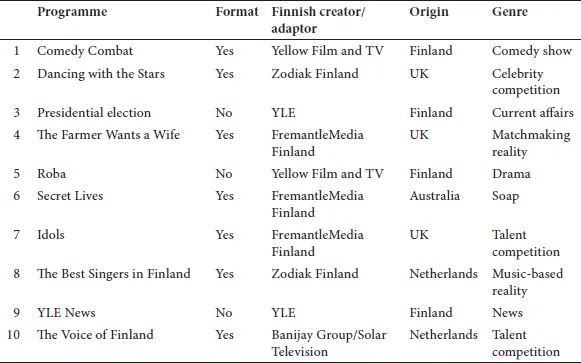
Table 2 is informative and also representative in many respects. It shows that no less than seven out of the ten most popular programmes are formats, illustrating the dominance of the format industry in contemporary television ratings. Finnish adaptions of such global music-based formats as Dancing with the Stars, Idols, The Voice of… and The Best Singer in… are among the most popular shows making it clear that Finland is yet another television market where these global hits achieve local triumphs. These hits also represent key genres in the format industry. Dancing with the Stars can be described as a celebrity competition; Idols and The Voice of… are both talent competitions. In such competitions, the attraction is to a large extent based on the transformation from the state of being ordinary (a nobody) to becoming a professional performer on his or her journey to stardom (cf. Chalaby 2011: 294), with the scope of this transformation emphasized and reinforced in the narrative through editing and cutting.
Table 2: Top ten recurring programmes in Finland 2012.
Sources: Finnpanel 2013 and media companies.
The Farmer Wants a Wife represents another standard genre in format industry, matchmaking reality. In contrast to these standard format genres, the most popular programme, a Finnish comedy show called Putous/Comedy Combat, is somewhat different. The popularity of this format is based on a competition between fictional comedy characters especially developed for the show and played by popular Finnish actors. ...
Table of contents
- Cover Page
- Title Page
- Copyright
- Contents
- Acknowledgements
- Foreword
- Introduction: A Changing Format Mosaic
- Part 1: Overviews
- Part 2: History
- Part 3: Industry Players, Big and Small
- Part 4: Territories and Markets
- Part 5: Producers and Audiences
- Index
- Back Cover