eBook - ePub
Available until 23 Dec |Learn more
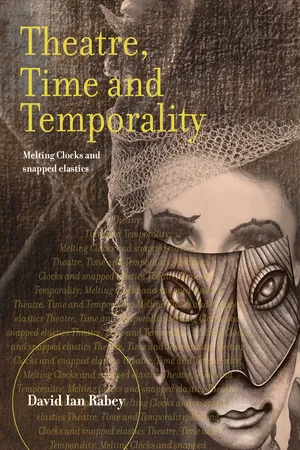
Theatre, Time and Temporality
Melting Clocks and Snapped Elastics
This book is available to read until 23rd December, 2025
- 280 pages
- English
- ePUB (mobile friendly)
- Available on iOS & Android
eBook - ePub
Available until 23 Dec |Learn more
About this book
Theatre, Time and Temporality is the first book-length exploration of the subject of temporality within theatre and performance. David Ian Rabey brings in sources ranging from medieval and Renaissance theatre to contemporary performances – in addition to recent writings from physics, philosophy and psychology – to analyse ways that time can be presented, communicated and transformed in the theatre. How do we experience time in theatre, and how can that experience be altered or manipulated? Rabey's analysis and exploration will spark discussion among students and scholars of drama, as well as among practicing performers and dramatic writers.
Frequently asked questions
Yes, you can cancel anytime from the Subscription tab in your account settings on the Perlego website. Your subscription will stay active until the end of your current billing period. Learn how to cancel your subscription.
No, books cannot be downloaded as external files, such as PDFs, for use outside of Perlego. However, you can download books within the Perlego app for offline reading on mobile or tablet. Learn more here.
Perlego offers two plans: Essential and Complete
- Essential is ideal for learners and professionals who enjoy exploring a wide range of subjects. Access the Essential Library with 800,000+ trusted titles and best-sellers across business, personal growth, and the humanities. Includes unlimited reading time and Standard Read Aloud voice.
- Complete: Perfect for advanced learners and researchers needing full, unrestricted access. Unlock 1.4M+ books across hundreds of subjects, including academic and specialized titles. The Complete Plan also includes advanced features like Premium Read Aloud and Research Assistant.
We are an online textbook subscription service, where you can get access to an entire online library for less than the price of a single book per month. With over 1 million books across 1000+ topics, we’ve got you covered! Learn more here.
Look out for the read-aloud symbol on your next book to see if you can listen to it. The read-aloud tool reads text aloud for you, highlighting the text as it is being read. You can pause it, speed it up and slow it down. Learn more here.
Yes! You can use the Perlego app on both iOS or Android devices to read anytime, anywhere — even offline. Perfect for commutes or when you’re on the go.
Please note we cannot support devices running on iOS 13 and Android 7 or earlier. Learn more about using the app.
Please note we cannot support devices running on iOS 13 and Android 7 or earlier. Learn more about using the app.
Yes, you can access Theatre, Time and Temporality by David Ian Rabey in PDF and/or ePUB format, as well as other popular books in Literature & Drama. We have over one million books available in our catalogue for you to explore.
Information
Part I
Theatre in Time
Chapter 1
Whose Time Is It?
What fundamental things apply?
When we consider both time and theatre, we are brought into contact with issues of perception, speculation and action, which are fundamental − and fundamentally contentious. The significantly mercurial qualities of time and theatre make them difficult to discuss, either separately or in combination. Any attempt to establish a single authoritative perspective on, or arising from, either time or theatre will rightly be suspect. Both time and theatre provide forms of definition, which are also indefinite; time and theatre both intrinsically indicate alternatives and adjacencies, even as we perceive their moments of highest precision.
One useful starting point is provided by Stefan Klein (succinctly paraphrasing Aristotle): ‘Time comprises the state of everything around us, and of how everything changes’; furthermore, we experience and identify every moment as specific to its time (Klein 2008: 255). However, if (as Kant suggested) our perception of time is an inherent part of human life, our experience of time is dialectical: our ‘encounter with time is quite unlike colour or shape, since our experience is not just of time, but also manifestly in time’ (Arstila and Lloyd 2014: 143). Similarly, theatre invites us to focus our perceptions, communally but from different subjective angles, on what is before and, to some degree, around us: how these things change, and can be made to change; what may be specific to the present, in its relation to the past and the future; and what might be the limitations inherent in confinement to a single perspective. It is one of the ways in which we try to define and structure the world around us, and to imagine how (and why) it might change; and it works through creating particularly dialectical experiences, of time, in time.
Ilya Prigogine proposes that time is ‘our basic existential dimension’ (Prigogine 1997: 13). Similarly, Eva Hoffman observes, ‘we live in time’, with the resonant addendum that it comprises ‘the one dimension of experience we cannot leap out of, at least until the final act’ (Hoffman 2009: 10). Barbara Adam characterizes Time as not ‘a fact of life’ but as something that is ‘implicated in every aspect of our lives and imbued with a multitude of meanings’ (Adam 1990: 2). Adam notes how concepts of time are ‘inextricably bound up with human reflexivity and the capacity for self-knowledge’, but also observes how ‘contemporary industrialised societies’ insist on their own fundamental systematized sense of time, as means ‘not merely to synthesise aspects of mind, body, nature and social life’, but also something ‘employed’ ‘on a world-wide basis as a standardised principle for measurement, co-ordination, regulation, and control’ (9).
Theatre, by contrast, is something we are only sometimes ‘in’ (even if we work in it professionally). Theatre is an event (or series of events) with particular co-ordinates: it is designated spatially to occur in a specific space (or series of spaces) identified to host the event, involving specific participants, and designated temporally to commence at a specific time (or series of times).1
Gaston Bachelard proposes that if we decide to ‘think time’, to confront or foreground or reassess what we generally construe as the forms and claims of time, ‘it means that we place life in a framework’ (Bachelard 2000: 92), which also provides a basis for thinking (about) theatre, or any art. Marvin Carlson suggests that ‘the major feature generally separating a work of art from other activities of the consciousness lies in the particular way it is framed’, as ‘an activity or object created to stimulate interpretation’ and invite interaction: an interaction that will ‘in turn be primarily based upon their previous experience with similar activities or objects’, ‘upon memory’ (Carlson 2003: 5).
However, when a theatre event occurs within (and/or around) its specified space (usually a building), we, as attending audience members, are unlikely to be the regular central focus of the event. We might be, if we were the professional theatre artists or active amateurs, presenting the production, or might be, more regularly than usually, if we were spect-actors in a participatory programme constituting one dimension of an Applied Theatre or Theatre of the Oppressed performance: such as one that might overtly acknowledge and respond to our immediate reactions, by way of reconstituting ‘observers’ as embodied participants and creators of their observations, knowledge and historical situation, and reflecting the unavoidable centrality of the constitutive self in analysis.
Each theatre performance is contextually situated: it has its own spatial and temporal co-ordinates, of its start and duration (and sometimes an interval), by which that performance is locatable, even as it sets one idea of time against another, fictionally and/or experientially. In the process, it ‘faces the uncertainty, indeterminacy and contingency of its own making’ in ways that fulfil Ermarth’s criteria for modes of invention that exercise responsibility and freedom (Ermarth 1992: 23). Susan Bennett remarks how, at ‘its core, theatre is both live and transient’ (Bennett 2013: 42). Harry Burton reflects on theatre’s ‘maddening ephemerality’ that may also be the source of its ‘powerful ritual magic’: perhaps several times a week, in a specified location, ‘the lights dim as the actors (supported, lest we forget, by a director, a designer and a team of technicians) create the illusion of an often familiar story being told for the very first time’ (Burton 2014: 210). Alan Ayckbourn succinctly observes how, during a theatre performance, (at least) two time schemes run simultaneously, which he calls ‘stage time and real (theatre foyer) time’ (Ayckbourn 2002: 21).2 The latter is the duration of the convening of practitioners and spectators, whether for a continuous 75 minutes or three hours (including a 15-minute interval). The former refers to the temporal span of the fictional action (which may encompass several years of a family or country’s history), though it might also apply (experientially) to how long that action feels under sustained and detailed focus (the last scene of King Lear unfolds an astonishing extent of strenuous experience, for characters, performers and audience alike, beyond the fictional time of its enactment).
Theatre aims to focus our eyes, ears and imaginations selectively, and draws our attention to things, people, actions and consequences. It invites us to focus, to an unusual degree, on process in relation to outcome, and to entertain and consider hypothetical situations (which may inform future decisions). The objective of theatre is not the same as the goal of science, which Stephen Hawking describes as a quest for ‘nothing less than a complete description of the universe we live in’ (Hawking 1988: 15); rather, theatre deals and delights in partial truths, incomplete descriptions, highlighting and playing with the provisionality of everything.3 However, another observation by Hawking may indicate some occasionally shared terrain: ‘since the dawn of civilization, people have not been content to see events as unconnected and inexplicable’ (15). Theatre often examines and explores prevalent connections and explanations − and often finds and shows them wanting, and sometimes attempts new ones. Theatre, like science, addresses questions of human purpose and meaning.4 However, it is distinctively intersubjective in its form, thematic concerns and effects, which are manifested through different frames of foregrounded subjective time – and through considered and resonant estrangements of linear time – in a specifically dynamic space, to create an event. An intriguing comment attributed to Tom Waits is the observation: ‘If you don’t change time in some way, it’s not theatre – it’s real’ (Waits 2014: 91).5
Rebecca Schneider claims that theatre (like history) is an art of time; indeed, perhaps theatre is ‘the art of time’, because time is ‘the stuffing of the stage – it’s what actors, directors, and designers manipulate together’ (Schneider 2014: 7), working in a space to create and embody practice where ‘then and now’ (and, sometimes, living and dead) can become unusually simultaneous (3), extending the frame of a single perspective and lifetime: theatre ‘cites, and replays, other places and other times’ (24), in startlingly embodied ways, from a multitude of angles. As Patricia Schroeder observes, theatre often offers an investigation of how the prior events of the past are related to the present (and, I would add, how these might relate to the future), but in the process may indicate how the past is ‘not entirely’, or only, ‘a sequence of objective facts but a matter of recollection and interpretation’ (Schroeder 1989: 12), a process into which the audience is incorporated. At its best, theatre may be a form of praxis: a form of joint exploration, which ‘presents as an integrated whole what institutional knowledge and professionalization have set apart: academic knowledge, practical activity, embodied sense experience and aesthetic sensibilities’, an embodied knowledge conceived not ‘as inscription but incorporation’ (Adam 1998: 5). This book is also a manifestation of praxis, which ‘reflectively acknowledges the theorist as part of her[/his] story and analysis’, as someone who is inescapably physically implicated in time (7). Indeed, theatre reminds all involved of our physical implication in time: as Kalb points out, because ‘theatre confronts us with the physical, real-time pressure of toiling performers as well as fellow audience members, it provokes a greater awareness of the body – and of the ticking clock of mortality – than recorded performances can’; Kalb identifies the ‘palpable exertions of living performers’, ‘replenishing our energy with theirs as we watch them’, as ‘theatre’s signature feature’ (Kalb 2011: 17). Here, the ‘intense physical exertion’ behind ‘the prolific flow of demanding techniques’ may become ‘a poignant, tactile trope for the perseverance of mortal bodies – fragile flesh caught but still wriggling in the implacable fact of time’ (Kalb 2011: 63). This might also be identified as energy transferred (not lost) from one system of perception/action to another.
Theatre demands an unusual intentness of focus on the parts of audiences and performers,6 although – or because – it elicits this through an unusual variety of forms (human and object), presented in unusual three-dimensional spatial combinations.
Theatre is also three-dimensional, in temporal terms: it involves intense layerings of synchronized and responsive behaviour, often attempting enlargement of a sense of present possibilities, by activating social awareness of the past and/or future.
Thus, theatre raises questions of value: of what should be communicated, endured and changed over time. From a neoliberal economic perspective that conceives of power in exclusively monetary terms, theatre might be condemned or dismissed as a ‘waste of time’, without immediately visible or predictable consequences in terms of exchange or investment (according to the presumption that ‘any time that is not translatable into money tends to be associated with a lack of power’, Adam 1998: 68). However, theatre’s different power is how precisely its speculations and transpositions may throw signs and values (inevitably including the terms of power) into play, thus showing itself to be an ostensible ‘waste’ of time that may nevertheless prove paradoxically plentiful.7
Time is ticking (clock of the heart)
G. J. Whitrow remarks on the difficulty of discussing time objectively, even though it is something that we all unavoidably and inevitably go on experiencing whilst alive: ‘only time has this peculiar quality which makes us feel intuitively that we understand it so long as we are not asked to explain what we mean by it’ (Whitrow [1972] 2003: 1). Hoffman notes how, nevertheless, ‘time is to the mind what air is to the lungs: invisible, ubiquitous and absolutely necessary’ to perform mental acts such as meaningful recall and informed self-orientation; the waking question, what time it is, seeks to establish ‘where we are in the day and how we should pitch ourselves towards it’ (Hoffman 2009: 63). Strikingly, Adam points out that while ‘space is associated with visible matter and sense data, time is the invisible “other”, that which works outside and beyond the reach of our senses’ (Adam 1998: 10). But perhaps this notable observation might be further developed: time works outside and beyond the complete or comprehensive reach of our senses, as it is possible to sense and perceive aspects of time, fortunately, even though we have no single sense organ dedicated to it; rather we are required to use several senses in complementary combination with imagination, to approach the senses of time, with which we experience and organize our lives.
Nature itself is intrinsically temporal: at their most basic level, all living organisms, plants and animals contain cells that measure time – most discernibly in the instances of a pulse or heartbeat – as a requirement for life: the principle of rhythmicity. We sense and feel time’s passages through the periodic rhythms of our biological metabolisms: breathing, heartbeats, pulses, digestion, reproductive and menstrual cycles, nervous reflexes, sonic location, all of which can be affected by our feelings in relation to our environment (and its changes, seasonal or otherwise). A physiologically sensed variation in tempo, in relation to some environmental and/or internal change, often prompts, and registers as, our unusual awareness of a sense of time. We not only sense and act, but interact, with others and with our environment, rhythmically: focusing on bodily rhythms will throw into relief how we ‘eat, sleep, breathe, use energy, digest, perceive, think, concentrate, communicate and interact in a rhythmic way’ (Adam 1990: 73), within larger contextual cycles of day and night, tides and seasons. This is given vividly erotic dramatic expression by the protagonist in Kaite O’Reilly’s play Woman of Flowers, when she proclaims her lover
[…] touches me and flowers bloom against my skin. Meadowsweet, broom, the flowers of the oak. All the petals, stamens, the cells, feathers, the claw and hollow bone, all the ticking in a clock, the pulse of life beating, beating, beating of wings, of time passing, of life, all this is him.
(O’Reilly 2014: 61)
In highly contrasting terms, Michon characterizes human time in terms of information exchange, ‘the manifestation of the need to exchange experience with the environment’ (Michon 1985: 47). Barbara Adam notes that Michon’s paradigm allows for ‘prediction, anticipation, self-observation and modificatory behaviour’, but this information exchange is not a prerogative of the human, but a general characteristic of the biological order (Adam 1990: 92). From the human perspective, it may seem that animals live more in the present (though pets can demonstrate that they have learnt lessons and expectations from past experiences, and bees are particularly notable in performing their waggle dance, during which a scout communicates the proximity of food to a colony through indicating direction and distance over time needed to attain it). Though Fraser contentiously suggested a concern with posterity, or even an afterlife, was the decisive manifestation of the ‘fully human’ (Fraser, introduction to Whitrow [1972] 2003: x), it may be more appropriate to begin by noting how all ‘rhythmically organised beings’ extend their sensibilities ‘beyond the present’ (Adam 1990: 126). As far as we can see and tell, humans seem to be particularly equipped (imaginatively) and inclined (temperamentally and socially) to construct and rehearse images of a possible future (sometimes by way of a possible past, very occasionally by an alternative present, or alternative immediate future), as their imaginations project beyond the more immediately observable cyclical rhythms of day and year to those of other generations, centuries, millennia. This is one aspect of their biological capacity for self-renewal (the internal abilities to heal, regenerate and self-replicate, morphogenetic processes that machines lack), in dynamic offset of discernible decay.
However, all forms of life are united by the fact of death. The foreknowledge of death is something that human beings seem, according to current knowledge, ‘to share with only a few of the “higher” animals such as elephants’; and human beings seem, again according to current knowledge, to be ‘the only beings that express that knowledge symbolically’ (Adam 1990: 128); and that, moreover, posit an existence beyond death, in terms and relationships that vary between individuals and cultural contexts in different ages.
Temporality: What is ‘the time’?
Sean Carroll helpfully provides three identifications of different aspects of time:
1. Time labels moments in the universe.
Time is a co-ordinate; it helps us locate things.
2. Time measures the duration elapsed between events. Time is what clocks measure.
3. Time is a medium through which we move.
Time is the agent of change. We move through it, or – equivalently – time flows past us, from the past, through the present, towards the future.
(Carroll 2010: 10)
‘Space/time’ – or perhaps more elegantly, ‘spacetime’ – is here used in Carroll’s first sense of an objective co-ordinate, helping us to locate things in the universe by identifying the presence of something through reference to the th...
Table of contents
- Cover Page
- Title Page
- Copyright
- Dedication
- Contents
- Acknowledgements
- Introduction
- Part I: Theatre in Time
- Part II: Time in Theatre
- References
- Index
- Back Cover