The notion of landscape is a complex one, but it has been central to the art and artistry of the cinema. After all, what is the French New Wave without Paris? What are the films of Sidney Lumet, Woody Allen, Martin Scorsese, and Spike Lee without New York? Cinema and Landscape frames contemporary film landscapes across the world, in an exploration of screen aesthetics and national ideology, film form and cultural geography, cinematic representation and the human environment. Written by well-known cinema scholars, this volume both extends the existing field of film studies and stakes claims to overlapping, contested territories in the humanities and social sciences.
eBook - ePub
Cinema and Landscape
Film, Nation and Cultural Geography: Film, Nation and Cultural Geography
- 315 pages
- English
- ePUB (mobile friendly)
- Available on iOS & Android
eBook - ePub
Cinema and Landscape
Film, Nation and Cultural Geography: Film, Nation and Cultural Geography
About this book
Information
Chapter 1
Introduction – Cinema and Landscape
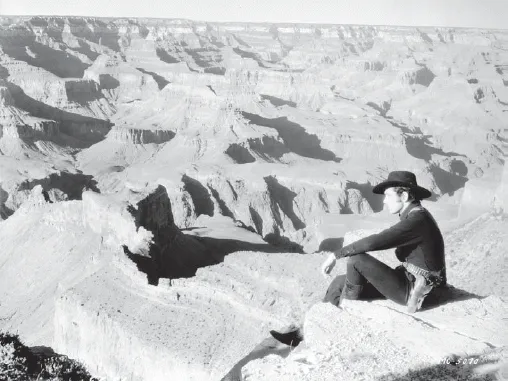
14th May 1930: American actor Johnny Mack Brown (1904–1974) surveys the rugged landscape of the Grand Canyon in Arizona in a scene from ‘Billy the Kid’ (aka ‘The Highwayman Rides’), directed by King Vidor. (Photo by John Kobal Foundation/Getty Images)
Photographs are not hand-made; they are manufactured. And what is manufactured is an image of the world.1
Cartography
This book is a cinematic circumnavigation. Though extensive, it is not exhaustive. The journey’s impetus here, in comparison to the treks of Arctic explorers, the voyages of ocean navigators or the conquests of mountaineers, is not concerned so much with physical exertion, or with the possession of tangible space, but with the examining of the evidence of cultural production – in this case, specifically, the cinema. This book provides a map. All maps involve stories, in which there is both a narrative and a discourse. All maps involve selection, inclusion, omission, observation and, on occasions, invention. Maps are predicated on the use of specific techniques and, therefore, specific technologies. Ptolemy’s eight-volume Geography showed the Earth as flat, and disc-shaped. Medieval exploration offered alternate views of where, and how, land and sea, mountains and valleys, might be depicted, and raised questions about the notion of location, the place of the individual, in both the natural and constructed worlds. The earliest surviving terrestrial globe, a representation of the Earth in its true spherical form, was made by the German geographer Martin Behaim in 1492, and may well have directly reassured Christopher Columbus of the potential of his explorations.
European efforts to discover what became known as the ‘New World’ brought about new techniques in cartography. Maps exist in time, and they raise questions that are equally spatial and temporal. They have a shape and form, and suggest an order. Maps can be the product of an individual, or of many individuals working together, or sequentially, over time. In this way, map-making is analogous to the cinematic endeavour, where communal effort and singular vision often meet. The role of the film director could be seen as similar to the role of the individual map-maker; while the role of the actors and film crew could, indeed, be compared to the role of the ship’s crew or mountaineering team. Both maps and films assume and position audiences, ideologically as well as geographically. The interaction between map-makers/filmmakers and their audiences can be akin to a shared pilgrimage, in which the individual, or the group, or a culture, moves through a familiar or newly discovered landscape. This relationship with landscape, temporal and spatial as it is, can even form the basis of a rite of passage, in which the depth or breadth of what is known is enhanced or acquaintance made with that which was previously unknown. Landscape then – in a particularly useful application of the term – offers a cartographic receptacle to assist the acquisition of further human understanding.
Defining landscape
Landscape involves isolation of a certain spatial extent and a certain temporal length. That is, all notions of landscape are produced by human interpretation which, simply due to human physiology or due to political or cultural bias, is selective. Subsequent aesthetic treatments of landscape, whether in painting, photography or film, involve further selection, interpretation and omission, whether by an individual or group. Landscapes can be comforting or daunting, challenging or reassuring. The newly discovered landscapes found on the world journeys of European adventurers in the seventeenth and eighteenth centuries often brought forth highly emotive texts, with discoverers engaging in personal as well as scientific recollection. But landscapes are not always discovered, they can also be created. Reproduced, or even invented landscapes, landscapes created largely in the imagination of painters or filmmakers, often initiate similar responses to the discovered or recorded landscapes of the real world. Landscapes, therefore, are not only selective but are never neutral in intention or reception. Depicted landscapes are often symbolic, and frequently contribute to social formation, impacting upon human associations and societal norms. In the sense of landscape as illusionistic space, in which invented features are foregrounded and the topographical is secondary to the evocative, the relationship between individual or group disposition and landscape depiction is even further heightened.
A definition of landscape, therefore, needs to acknowledge different kinds of environments, from the rural to the urban, from the macro-environment of expansive ecology to the micro-environment of human habitation. Depictions of landscapes can incorporate the manifestations of modernity or be entirely composed of occurrences of nature. While it is possible to narrow landscape definitions on the basis of human intervention, absence or presence of natural features or, indeed, the impact of conspicuous characteristics, the key point about landscapes is that they are composed of many elements and that these elements interact to create our overall conception and reception.
Like a map, the cinematic landscape is the imposition of order on the elements of landscape, collapsing the distinction between the found and the constructed. Like a map, the cinematic landscape has involved technologies and techniques which have evolved. Through the twentieth century, the association of new film technologies with the formation of cinematic landscapes worked to enhance the ways in which the communication and interpretation of landscape was shared. Cinema, as the twentieth century’s most successful art form, worked in an analogous way to the globe produced by Behaim in the fifteenth century, in that it delineated and disseminated images and ideas about landscape, and promoted them for further discovery.
Cinema reached a key developmental point in the latter twentieth century with the arrival of digital film technologies. Digital technologies, progressing swiftly on the domestic front with such hardware as the Apple Mac, the first readily accessible home computer, arriving in the later 1970s, software such as the CD-ROM, arriving in the early 1980s, offering convenient data storage and the DVD of the 1990s, with its supplementary platforms of filmic information, have already asked us to reconsider such things as visual veracity and aural truth.
The arrival of digital film technologies has coincided with a reorientation of our understanding of what constitutes a nation, or nation state, with a reevaluation of the idea of community, corresponding to the rise of communities founded on the world wide web and facilitated by the internet, and with the increased significance of the global, supported by this digitally enhanced communication. However, concepts and ideas that currently inform our understanding of film, and of cinematic landscapes, are those concepts and ideas formed in the analogue era of the twentieth century.
In the future, those born in the emerging digital age may have a different response to cinematic landscapes, founded on the coherence of the image and sound, perhaps, rather than on the correspondence of the film to a sense of pre-existing form, or verisimilitude connected with experience. But here, at the end of the analogue age, cinematic landscapes relate to the analogous nature of representation, whether this representation is produced by selection or construction, or an amalgam of these, and these landscapes have corresponding degrees of authenticity and originality.
Framing landscape
Film, composed of frames of reference as well as frames of composition, largely presents its art as a serial choice. Depictions of landscapes, as complex combinations of found or chosen features, emphasize the incredible variety of possible interrelations that make up the world; cinematic landscapes, most often further complicated by movement, rely on the frame to both suggest a reading and limit the range of interpretations. While it might be possible to envisage a film in which the line between one frame and the next might be seen as entirely continuous, and the frames themselves given the appearance of being devoid of boundaries, the technologies of the cinema have been used to provide encapsulated pictures that, rather than limit human perception, have the ability to enhance it. That is, the importance of the cinematic frame is in its ability to make possible interpretation and understanding by conferring form. This formal structure, related as it is to the historical context of pictorial art, is an enabling device, much as the formal structures of certain kinds of poetry enable the poet to better construct poetic argument.
As Ross Gibson points out:
the camera is not a machine designed for expressing sublimity – either of the Romantic Pantheistic kind or the post-modernist, supra-systemic kind before which the cohesive, centralized self begins to disintegrate. The camera does not express inexpressibility. Quite the opposite. It is designed not to warp the perspectival codes which were installed in art practice during the Renaissance.2
The role of framing in the cinema, using the camera to record or select scenery, is different, however, to the role of the frame in painting in that within the cinematic frame movement is most often one of the substantive indicators of meaning. The frame, most often, is a contributor to movement (that is, it is known to be one portion of a continuum); it often contains movement, but suggests that this movement goes beyond its limits. Within the frame, camera movement can occur, through the use of deep and rack focus; shots can pan or zoom; a filmmaker can present and pull back from an object or person; the frame can appear to expand of contract, through shifts from medium to wide shot. Not all of this occurs in the staging of action or the setting-up of a scene, much occurs in the edit suite, and in the application of editorial emphasis in relation to speed, juxtaposition, contrast and rhythm. The frame allows for, or even encourages, the audience to move over, or scan, the image; and the overall effect of a film is to place the audience in a dynamic and extensive experience.
Within any given frame, or in the entirety of any cinematic landscape, not only movement but colour and shape play a part. Colour and shape in the cinema have natural precedents. We only need look at the animal or plant kingdoms to recognize the role of colour and shape in declarations of danger or safety, in the formation of patterns of behaviour and in the cycles of seasonal activity. The natural world, informing our own practical and instinctive senses, has impacted on our constructive nature, suggesting to us ways in which we might compose and orchestrate visual art. Given the expansive quality of the cinema, the range of potential tonal and configural alternatives is considerable, and the role of individual filmmakers, or creative contributors in a film team, is enhanced. In many cases, cinematic landscapes involve a group or shared vision; in some cases they are the product of a strong individual sense, nevertheless related to a cultural or societal history. Yet, in all cases, tonal and configural alternatives rest on communal conventions of reference. These work as mnemonics, recalling for us our natural understanding, and referring us back to associations and origins which, in many ways, are pre-linguistic. Film language, therefore, and the language of cinematic landscapes, are portrayals that connect filmmakers and audiences with an innate and primal sense of self and of the world.
Cinematic landscapes are not simply of the moment, but can recall both our own and a general condition prior to their representation. This mnemonic offering, founded on the complexity of such a framing and such a juxtaposing of framing, and on the place of elements of the composition in our innate understanding, is atemporal in that it does not necessarily correspond to the day-to-day time that is imposed on human life. Rather, in the way discussed by Henri Bergson, this time is pure or actual and the memories stimulated interweave with the surface actions of day-to-day existence. Bergson’s suggestions have particular reference here because, in analysing cinematic landscapes, it is possible to observe a set of referential characteristics that are as much meta-physical as physical. Bergson once wrote:
Everything, then, must happen as if an independent memory gathered images as they successively occur along the course of time; and as if our body, together with its surroundings, was never more than one among these images, the last is that which we obtain at any movement by making an instantaneous section in the general stream of becoming.3
So cinematic landscapes, while obviously part of a continuum, and equally composed of frames, can also be considered conduits to memories, and a form of time, that transcends the cinema itself.
It would be incorrect, however, to suggest that cinematic landscapes are composed only of images, and the careful arrangement, or the collection, or the construction of these images. What of the aural landscape? Sound and music are integral to cinematic landscapes. Whether these work as naturalist reinforcements of the image, or whether they are complementary, their contribution is considerable. Of course, this has not always been the case: cinema’s history, and the earliest examples of pre-sound cinema being enamoured of the pictorial, reveal a set of relations with aural understanding that bear further examination from the point of view of the connotative as well as the denotative. Film’s acoustic environments reveal a set of relations with sound as well as offering a variety of associations for film narrative, the responses of film audiences and the compositional possibilities available to directors and editors.
As with movement, colour and shape, cinematic landscapes use film sound as an attribute, but not as a discrete, concrete element; rather, film sound is experienced in relation to what we see on screen; what we hear adds, questions, progresses, extends, completes or challenges the action, image, movement, colour or shape. Sound, or music, can foreground – signalling forthcoming action or event, suggesting character traits or potential narrative turns. Sound can mark a place, or time – history, or a specific moment or movement in history, for example, can be indicated in the cinematic landscape as much through the incorporation of sound and music as by the use of costume or setting. Sound also, or in particular music, stresses the performative nature of film, and the theatrical aspects of the cinematic landscape can be augmented by the use of sound and/or music.
Whereas visual space is almost exclusively solid or opaque, aural space is transparent. Interestingly, were we to reverse ideas of this relationship in terms of the visual and the aural in the cinema, we could even view film as a transparent map for its sound. Maps represent, and endeavour to embody the physical. They are successful if they become transparent; no longer objects themselves, rather they are the canvas on which the representation finds form. Sound and music, as with image, have a perspective. They can add a mimetic depth to a frame, or film sequence. They can also be purely evocative, and this is often the case with film music. The cross-sensory aspects of cinematic landscapes are considerably evaluated in any consideration of the aural, and in differentiating between sound, music and, indeed, noise. Noise, which tends to denote unexpected or unpleasant sound, interrupts a cinematic landscape, suggesting a disturbance to the equilibrium of the image or sound track.
The framing of a cinematic landscape involves a complex combination of found or chosen features – some visual, some aural, some relating to movement, some based in innate understanding. The variety of interrelations between these features is infinite, and dependent not only on individual creativity or individual interpretation, but also on group or cultural comprehension. Framing the cinematic landscape is both formal and conceptual and our reading of cinematic landscapes asks us to be complicit with both filmmakers and our fellow film viewers.
Typology of landscape perceptions
When considering cinematic landscapes, we don’t necessarily construct doctrinal classifications but we do enter realms of agreement. So, for example, agreement on what constitutes interior or exterior space, agreement on the relationship between foreground and background, agreement on how we perceive height, width and length and their relevance to such concepts as status, distance, duration, longevity, and even beauty. Film, being a complex collection of movement, colour, shape and sound, needs such agreements to allow its ordering to have coherent or relatively consensual meaning. This can include reference to geographic locale, to culture or historical period. Such things can, of course, be manipulated: take the role of costume in some Science Fiction cinema in both referencing an alien world and, as is in the case of Star Wars (1977) or Blade Runner (1982), providing consciously anachronistic allusion to earlier periods of history. Personal as well as public typologies rel...
Table of contents
- Cover
- Title page
- Copyright
- Contents
- Foreword
- Acknowledgements
- Chapter 1: Introduction – Cinema and Landscape
- Part I: The Invention of the Cinematic Landscape
- Part II: Mapping Cinematic Landscapes
- Filmography
- Contributors
- Index
Trusted by 375,005 students
Access to over 1.5 million titles for a fair monthly price.
Study more efficiently using our study tools.
Frequently asked questions
Yes, you can cancel anytime from the Subscription tab in your account settings on the Perlego website. Your subscription will stay active until the end of your current billing period. Learn how to cancel your subscription
No, books cannot be downloaded as external files, such as PDFs, for use outside of Perlego. However, you can download books within the Perlego app for offline reading on mobile or tablet. Learn how to download books offline
Perlego offers two plans: Essential and Complete
- Essential is ideal for learners and professionals who enjoy exploring a wide range of subjects. Access the Essential Library with 800,000+ trusted titles and best-sellers across business, personal growth, and the humanities. Includes unlimited reading time and Standard Read Aloud voice.
- Complete: Perfect for advanced learners and researchers needing full, unrestricted access. Unlock 1.5M+ books across hundreds of subjects, including academic and specialized titles. The Complete Plan also includes advanced features like Premium Read Aloud and Research Assistant.
We are an online textbook subscription service, where you can get access to an entire online library for less than the price of a single book per month. With over 1.5 million books across 990+ topics, we’ve got you covered! Learn about our mission
Look out for the read-aloud symbol on your next book to see if you can listen to it. The read-aloud tool reads text aloud for you, highlighting the text as it is being read. You can pause it, speed it up and slow it down. Learn more about Read Aloud
Yes! You can use the Perlego app on both iOS and Android devices to read anytime, anywhere — even offline. Perfect for commutes or when you’re on the go.
Please note we cannot support devices running on iOS 13 and Android 7 or earlier. Learn more about using the app
Please note we cannot support devices running on iOS 13 and Android 7 or earlier. Learn more about using the app
Yes, you can access Cinema and Landscape by Graeme Harper, Jonathan Rayner, Graeme Harper,Jonathan Rayner in PDF and/or ePUB format, as well as other popular books in Media & Performing Arts & Film & Video. We have over 1.5 million books available in our catalogue for you to explore.