eBook - ePub
Available until 23 Dec |Learn more
Walking, Writing and Performance
Autobiographical Texts by Deirdre Heddon, Carl Lavery and Phil Smith
This book is available to read until 23rd December, 2025
- 184 pages
- English
- ePUB (mobile friendly)
- Available on iOS & Android
eBook - ePub
Available until 23 Dec |Learn more
Walking, Writing and Performance
Autobiographical Texts by Deirdre Heddon, Carl Lavery and Phil Smith
About this book
This collection charts three projects by performers who generate autobiographical writing by walking through inspirational landscapes. Included in the book are the full texts of The Crab Walks and Crab Steps Aside by Phil Smith, Mourning Walk by Carl Lavery, and Tree by Deirdre Heddon, each accompanied by photographs and contextual essays. Taken together or separately, the work of all three artist-scholars raises important issues about memory, the ethics of autobiographical performance, ritual, life writing, and site-specific performance.
Frequently asked questions
Yes, you can cancel anytime from the Subscription tab in your account settings on the Perlego website. Your subscription will stay active until the end of your current billing period. Learn how to cancel your subscription.
No, books cannot be downloaded as external files, such as PDFs, for use outside of Perlego. However, you can download books within the Perlego app for offline reading on mobile or tablet. Learn more here.
Perlego offers two plans: Essential and Complete
- Essential is ideal for learners and professionals who enjoy exploring a wide range of subjects. Access the Essential Library with 800,000+ trusted titles and best-sellers across business, personal growth, and the humanities. Includes unlimited reading time and Standard Read Aloud voice.
- Complete: Perfect for advanced learners and researchers needing full, unrestricted access. Unlock 1.4M+ books across hundreds of subjects, including academic and specialized titles. The Complete Plan also includes advanced features like Premium Read Aloud and Research Assistant.
We are an online textbook subscription service, where you can get access to an entire online library for less than the price of a single book per month. With over 1 million books across 1000+ topics, we’ve got you covered! Learn more here.
Look out for the read-aloud symbol on your next book to see if you can listen to it. The read-aloud tool reads text aloud for you, highlighting the text as it is being read. You can pause it, speed it up and slow it down. Learn more here.
Yes! You can use the Perlego app on both iOS or Android devices to read anytime, anywhere — even offline. Perfect for commutes or when you’re on the go.
Please note we cannot support devices running on iOS 13 and Android 7 or earlier. Learn more about using the app.
Please note we cannot support devices running on iOS 13 and Android 7 or earlier. Learn more about using the app.
Yes, you can access Walking, Writing and Performance by Roberta Mock in PDF and/or ePUB format, as well as other popular books in Literature & Literary Essays. We have over one million books available in our catalogue for you to explore.
Information
MOURNING WALK
by Carl Lavery
Performed at Lancaster University, December 2006 Lighting: Stephanie Sims
and Nuffield Theatre, Lancaster, 1 March 2008
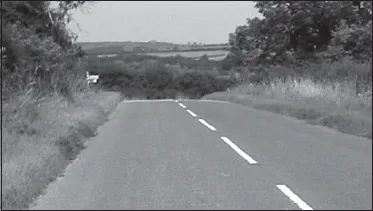
In performance, all text is spoken except the lines in bold in the box at the very start of the script. The dates that run throughout the piece serve to mark shifts in direction. They are usually followed by a lengthy pause. Images are similarly projected on a screen behind me. Unlike in the written text, they have a sense of duration, and last as long as I see fit. All the images were taken during my walk. However, in the live performance, I also use additional images such as found photographs of artists and thinkers whose lines are cited in the text. Thank you to Nick Strong for helping to prepare these images for publication. (CL)
Mourning Walk: 29.07.04
Market Harborough to Cottesmore
Lane–Field–Road
18 miles
On 29 July 2004, to mark the ninth anniversary of my Dad’s death, I walked eighteen miles as the crow flies from the town of Market Harborough in Leicestershire to the village of Cottesmore in Lincolnshire. At the end of the journey I performed a ritual in a field. I have nothing to say about that. Certain things ought to be kept secret.
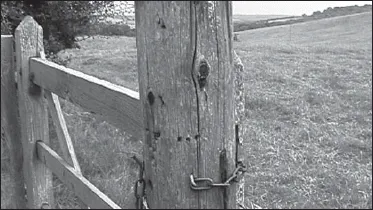
October 1981
In Autumn 1981 my Dad spent ten weeks at an RAF camp in Cottesmore. He was on a course, learning how to fix Tornado fighter planes – the newest form of military jet. He used to work on Phantoms. Once he came home with a MacDonald Douglas holdall bag that an American pilot had left behind in the cockpit. He was very proud of it, and we were impressed. We’d seen nothing like this before. It looked great. Green silk; lightweight; pure style.
But today, I’m sitting at a table trying to do my French homework. I’m bored – I don’t get this. I look over at the table and see my father working at something himself. He’s got a pen, a geometry set and a calculator – and it looks like he’s thinking. This is strange; I’m not used to it. I guess this is what he does at Cottesmore. He seems to like it. Normally, when he comes home from work he’s tired and wants to sleep before he makes dinner. My mother only cooks on the weekend. She works in the NAAFI shop at St Athan and doesn’t finish work until 6 p.m. On Wednesday afternoons, I stop in and see her at work. I have a job delivering papers to the Officers’ mess. She’s always pleased to see me and often buys me a chocolate bar. My presence breaks the routine. My Mum hates her job. There’s nothing strange about that. Everybody I know hates working on the camp.
According to an American poet:
The chain of memory is resurrection
The vector of space is resurrection
Direction is resurrection
Time is the face of recognition.1
The vector of space is resurrection
Direction is resurrection
Time is the face of recognition.1
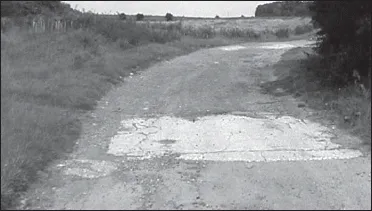
I chose this walk after reconstructing my Dad’s journey with the help of my Mum. We think he probably took the M4 from Cardiff to Bristol; the M5 from Bristol to Worcester; the A46 from Worcester to Leamington Spa; the A426 from Leamington to Lutterworth; the A4304 from Lutterworth to Market Harborough via Husband’s Bosworth; the A6003 from Market Harborough to Oakham; and finally the B668 from Oakham to Cottesmore.
Although I wasn’t following the route exactly – the road from Market Harbrough to Oakham is a busy A road – this didn’t bother me unduly. My mum had told me that he liked the countryside between Market Harborough and Oakham, and I imagined him on a Friday afternoon driving through the gentle Wolds of the Welland Valley. He always said that work was an inconvenience between weekends.
October 1994
It’s a dog day today – one of the last in an Indian summer – and my Dad’s taken the day off work to drive me and Melanie, my wife, through the South Wales valleys to Hay-on-Wye to visit the second-hand bookshops. I buy The Confederacy of Dunces by John Kennedy Toole and something on psychoanalysis. We have lunch and a pint in a pub. Later that night, we watch Aston Villa beat Inter Milan on ITV. I wonder if he knew that he was ill as he walked around Hay.
Saturday, 29 July 1995
My father died at home, in his bed, at about 7.30 a.m. on the hottest day of a hot summer. When I walk to town to buy food for lunch later that day, my trousers stick to my leg. I’ve never experienced heat like this before in Britain. I don’t want to move and the sun is hurting my eyes. I feel sick. I’m at the junction of Stalcourt Avenue and the Beach Road. I can see the comprehensive school – the one I went to – in the distance. It’s about 200 yards away. Melanie’s with me – she’s wearing a dress straight out of the 1950s. It’s got big red and green flowers on it. We’re both hot, we’re both shocked, we both feel unreal. My Dad’s gone – they took his body out of the house this morning. Because of the heat, I never see his face again. We buried him on a Friday.
Wednesday, 29 July 2004
Melanie and my son Immanuel drive me to a village just north of Market Harborough. This is where I start my walk. It’s a hot day – the hottest day of a wet summer. I feel relieved to get started. The thought of doing the walk has made me anxious for the past week, and I’ve begun to suffer from insomnia again, waking at 4 a.m. But today the sun is in the sky; the wheat is in the field; and the light is strong. And I’m wishing I had more of a language for landscape.
If I am walking, I almost physically feel the current of time slowing down in the gravitational field of oblivion. It seems to me then as if all the moments of our life occupy the same space, as if future events already existed and were only waiting for us to find our way to them at last, just as when we have accepted an invitation we duly arrive in a certain house at a given time. And might it not be that we also have an appointment to keep in the past, in what has gone before and is for the most part extinguished, and must go there in search of places and people who have some connection with us on the far side of time, so to speak?2
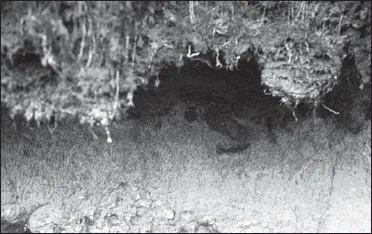
The land between Market Harborough and Cottesmore dates from the Jurassic period, a layer of rock that runs invisibly through the centre of England from Dorset to East Yorkshire.
A geological mapping of the route: Market Harborough – Lower Jurassic – Clay/Silt; Medbourne – Marlstone Rockbed/Lower Lias; Oakham – Middle Jurassic – Inferior Oolite; Cottesmore – Lower Lincolnshire Limestone.
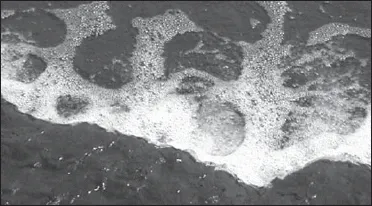
The Welland River marks the county boundary between Northamptonshire and Leicestershire. From there, the Welland runs to the Wash, and then into the North Sea. This is important for me. I’ve always lived by the coast, and feel landlocked in the Midlands. When a dreamer of reveries has swept aside all the preoccupations which were encumbering his everyday life, when he has detached himself from the worry which comes to him from the worry of others, when he is truly the author of his solitude, that dreamer feels that time is suspended. There is no longer any yesterday and no tomorrow. Time is engulfed in the double depth of the dreamer and the world.3 Walking is a technique of solitude, a way into reverie. The walker is not a sleepwalker but a daydreamer. There’s a crucial difference here that demands attention. The sleepwalker is dead to the world; he has no engagement with it; he’s immersed in the unconsciousness of sleep. The daydreamer by contrast is alive to the environment, and recreates it through his imagination. He’s open to the shock of things. When I walk, I go back and forth in an infinite journey between memory and imagination.

Summer 1972
I’m sitting on the steps of a terraced house in Glencolyer Street, just off the Limestone Road in South Belfast. The ‘Troubles’ are all around me, all in me, but I don’t know that yet. My Mum’s in the kitchen with my new baby brother, Gareth. I’m waiting for my Dad to come home from work. I’m expectant – it’s his payday and he always brings me a comic. He arrives. I’m happy. He runs his hand through my hair and I smell the leather on his jacket. He gives me the comic. I look at it and reject it. It’s not the one I want. There’s an immediate change of atmosphere. He takes the comic back, and tells me that I’m getting nothing. I panic. I change my mind. I do want it, after all. But it’s too late. It’s gone. I never see that comic. And to this day, I don’t know what it was. This was my first lesson in disappointment.
December 2005: After the Walk
I’m looking for something on landscape in the journal Performance Research. I scan the page of contents on the back cover of a 1997 volume called Letters from Europe, and start to look for two articles, ‘From Logos to Landscape: Text in Contemporary Dramaturgy’ and ‘Text as Landscape’. As I do so, I come across, quite by chance, a contribution from the Northern Irish artist Alistair MacLennan in the section of the journal that deals with contributions from artists and creative writers.4 His piece is called ‘MAEL 69/96 to Commemorate All Those Killed As a Result of the Northern Irish Troubles’. The tribute is simple and minimalist. It reminds me of the Vietnam War memorial in Washington D.C. On the top left-hand column of the left-hand page, there is a thumbnail image of a dead bird, quite possibly a swallow. The rest of the eight pages then list in alphabetical order the names of those killed in the ‘Troubles’. I pay particular attention when I get to the letter L, and more specifically to the name Lavery. Five Laverys have been killed in Northern Ireland since 1969: John Lavery (1971), John Lavery (1991), Martin Lavery (1974), Martin Lavery (1992) and Sean Lavery (no date).
The name Lavery is an old Ulster name and crosses the sectarian divide. But, with the exception of Sean Lavery, all the Laverys listed in MacLellan’s monument have a Protestant ring to them. The Christian names are the give away. I wonder, as I read these names, what would have happened to my family if we had stayed in Belfast and not moved to Llantwit Major in 1976. I also wonder if I’m related to any of the dead.
Unlike my Mum who suffered from it, my Dad, as far as I know, was never homesick for Northern Ireland. He seemed to have no attachment to the place, although he did run around the garden once when Northern Ireland beat Spain in Seville during the 1982 World Cup.
A botanical map of my journey:
Fox Glove, Milk Thistle, Borridge, Dandelion, Dog-Rose, Bracken, Furze, Ling, Tussock Grass, Violet, Meadow-rue, Bird’s Foot Trefoil, Burnet, Sorrel, Gentian, Meadow Saxifrage, Clover, Hay-rattle, Rock-Rose, Buttercup, Cuckoo-Flower, Ragged Robin, Self-Heal.
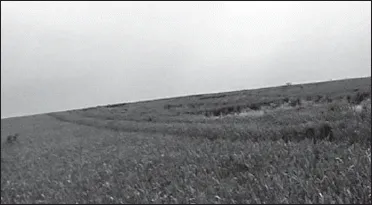
August 1992
I’m coming down the stairs at home sometime in the late morning. My parents have just come back from Greece, and my brother is getting a bollocking. He’s forgotten to water my Dad’s tomato plants – and he’s ‘killed a bumper crop’. Melanie is still in bed asleep. When I tell her about it she laughs. The phrase ‘a bumper crop’ became a comic memory for my family, and on the night my father died, we laughed about it again, trying to keep him alive in language and memory.
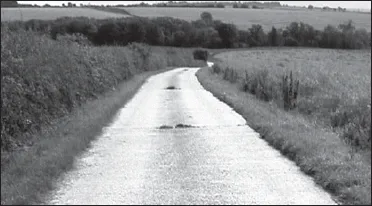
June 1995
My dad was diagnosed with cancer in early June 1995, about a week after my birthday, which falls on 31 May – the same day as Clint Eastwood’s. Melanie had bought me a new pair of shoes as a present. I remember throwing them from the upstairs window into the garden. I think it was a Monday. At the time, I was tutoring X, which meant I had to wait until Friday before we could go and visit my Dad. Mela...
Table of contents
- Cover
- Dedication
- Title Page
- Copyright
- Content
- Introduction: It’s (Not Really) All About Me, Me, Me
- Part 1: Carl Lavery
- Part 2: Phil Smith
- Part 3: Dee Heddon
- Sources
- Biographical Notes