eBook - ePub
Available until 23 Dec |Learn more
Communication Skills
Stepladders to Success for the Professional
This book is available to read until 23rd December, 2025
- 210 pages
- English
- ePUB (mobile friendly)
- Available on iOS & Android
eBook - ePub
Available until 23 Dec |Learn more
About this book
Essential reading for young professionals on the first rung of their career ladders, this second edition is an up-to-date and invaluable guide to improved communication skills, designed to develop the ambitious individual's prospects in their chosen profession. Tackling a broad range of different communication skills in careful detail, the book also contains guidance for the ongoing development of these skills, and is useful for professionals at every level of competence in communicating. Ellis promotes reflection and participation through exercises, encouraging not just passive reading, but active engagement.The volume has wide coverage – from making presentations, producing a concise CV and negotiating and asserting to debate on current issues of the real effectiveness of e-mail and PowerPoint versus face-to-face communication: issues very relevant to the contemporary work place. Drawing from experiences in his own successful communications training and consultancy business, Ellis bases his advice on the most recent developments in communications research, and clarifies with examples of current professional practice, making Communication Skills the essential aid to career advancement.
Frequently asked questions
Yes, you can cancel anytime from the Subscription tab in your account settings on the Perlego website. Your subscription will stay active until the end of your current billing period. Learn how to cancel your subscription.
No, books cannot be downloaded as external files, such as PDFs, for use outside of Perlego. However, you can download books within the Perlego app for offline reading on mobile or tablet. Learn more here.
Perlego offers two plans: Essential and Complete
- Essential is ideal for learners and professionals who enjoy exploring a wide range of subjects. Access the Essential Library with 800,000+ trusted titles and best-sellers across business, personal growth, and the humanities. Includes unlimited reading time and Standard Read Aloud voice.
- Complete: Perfect for advanced learners and researchers needing full, unrestricted access. Unlock 1.4M+ books across hundreds of subjects, including academic and specialized titles. The Complete Plan also includes advanced features like Premium Read Aloud and Research Assistant.
We are an online textbook subscription service, where you can get access to an entire online library for less than the price of a single book per month. With over 1 million books across 1000+ topics, we’ve got you covered! Learn more here.
Look out for the read-aloud symbol on your next book to see if you can listen to it. The read-aloud tool reads text aloud for you, highlighting the text as it is being read. You can pause it, speed it up and slow it down. Learn more here.
Yes! You can use the Perlego app on both iOS or Android devices to read anytime, anywhere — even offline. Perfect for commutes or when you’re on the go.
Please note we cannot support devices running on iOS 13 and Android 7 or earlier. Learn more about using the app.
Please note we cannot support devices running on iOS 13 and Android 7 or earlier. Learn more about using the app.
Yes, you can access Communication Skills by Richard Ellis in PDF and/or ePUB format, as well as other popular books in Education & Adult Education. We have over one million books available in our catalogue for you to explore.
Information
Introduction
The ability to communicate is a vital ladder to all career development. Without sufficient communication skills it is possible that there will be little movement upwards (or increasingly these days, sideways). If you are planning one day to develop your own ‘career’ in self employment then communication skills will be critical to any chances you have of gaining, holding and enlarging your client base. There is considerable evidence to suggest that those who lack communication skills find it difficult to advance their careers. This shouldn’t really surprise us if we consider just how much time we spend communicating with our colleagues, managers, clients and customers and how the quality of that communication will affect our relationship with these.
Surveys of what employers are looking for when they recruit graduates suggest that effective communication skills are very high on their list. However, there is some vagueness as to what communication skills actually refers to-that will be addressed in these pages! Many people-you may know some-are effectively blocked in their careers because they are unable to draft that report, make that presentation or sustain that interview. This book is concerned with providing you, the professional, with approaches, techniques, advice to assist you in your communication skills and so unblock barriers to progress in your profession.
The words profession and professional are rather vague; as far as this book is concerned they refer to the work that someone does which requires special training/expertise, for instance accountancy, teaching, medicine, law, surveying, health and safety, personnel, politics? (there’s one for an argument!) If your particular profession is not in the above list please don’t take offence!
This book is best regarded as a guide like one to the countryside (or the search for that favourite pub!). Dip into it for particular advice on particular issues; for example, how to write that letter of application to go with that CV, browse through it for ideas; it might spark off some thoughts for your next presentation to clients.
As this book is concerned with skills we will take some time to examine how we can develop skills of communication; we’ll present some contemporary research on skills acquisition and development (see chapter 2).
Getting up the stepladder
A stepladder is just that-a means by which you can take certain steps to reach your goal e.g. change that light bulb in the hall. In fact that’s quite a good metaphor: very often in our careers we will need to ‘change light bulbs’, get some new ideas, develop brighter ways of communicating, put new sources of energy into our talk and writing, hence this book.
Developing your self-esteem and reducing stress
If we feel confident about our communication then this tends to increase our self- esteem and, in turn, our feeling of self-worth. There are very many people who have never developed this sense in themselves and consequently find it very difficult to be assertive and confident in their communication with others. These feelings of inadequacy can increase stress-we bottle up our feelings instead of expressing them, and this can do damage to our health. Enhancing your skills in communication should have real benefits to your health. If you look and sound more confident, people may think you are more confident; this can have beneficial consequences for you.
We cannot promise you that by reading this book and acting on its advice you will immediately experience less stress in your life but it may help. It should certainly encourage you to be a more confident communicator. We very much hope that the experience of reading this text and taking the ideas back to your life and work does increase your feeling of esteem.
Careers today
We make much use of this in the book and so a word of explanation. Some years ago, say before the 1970s, careers meant exactly that: gradual and in some ways quite predictable steps upwards-under factotum, factotum, senior factotum, managing factotum etc. These days there are still careers, one can still move from junior doctor to house officer, registrar and consultant but in many organisations there is now a core and a periphery, the core-these are the essential workers-and those on the edge, the periphery who may be engaged job per job, short-term contract by short-term contract etc. Charles Handy has written of the increasing emergence of the ‘portfolio career’ where there are a number of distinct strands within it; this he suggests will more and more replace the traditional career of junior to intermediate to senior to retirement.
Professional competence
We will be dealing with these in chapter 2. We are familiar with the word skill. As professionals you will have gained certain skills, you will also be learning through your professional practise of how to use those skills in order that you achieve competence.
The notion of competence has been much written about: it implies knowledge of the what (for instance, the core professional concepts) and knowledge of the how (the ways in which we put these concepts into practice). This implies that what we do is underpinned in some way with concepts of ‘theory’, in other words our skills are not built up haphazardly; according to the theory of competence we may build up ‘theories’ of how things ‘work’-what is successful, what fails, what could have worked better etc.
Reflective learning
David Kolb in his work in reflective learning suggests that we should move from the experience (that meeting which didn’t come off) to reflection (Why not? Was it the agenda, the timing etc?) to thinking about various concepts and theories, i.e. theories about the effect of peer pressure or groupthink (see page 66).
Following this we should move into active experimentation such as ‘Let’s try this change at the next meeting’, and further reflection on the results. (So how did these changes operate?) His model (1971) follows the pattern in Figure 1.1.
In essence then the experience will, if possible, be followed by some kind of reflection. We have to admit that for most of our professional lives it is very difficult to do this; things happen too fast, we cannot take out time to reflect. ‘Sorry boss, I’ll be late for the meeting, I’m reflecting on that recent memo you sent me’. Such a position is not defensible, it couldn’t work. However, we should make an effort to build in some reflection time into our work.
Communicative competence
The notion of communicative competence rests on a similar foundation of theory, reflection and experimentation. It is pretty clear that few of us actually do much of this experimentation and reflection; most of our communication just happens, we are far too busy coping with work, with life, with crises, with computers and troublesome work colleagues. What Kolb suggests is that we should spare a few minutes from our busy lives to reflect on our communication. We should do this to increase our communicative competence (the ability to do and the knowledge of just how we do it). For instance, we should take a few minutes after that meeting to review it, after that presentation to think of how the audience responded; after that interview to see whether we actually covered the ground we had planned. Doing this is a discipline; it requires time to be set aside for it, it is a time management discipline. This books aims to enhance this discipline. It also aims to enhance your knowledge of the various concepts underlying communication. Hymes (1979) has written about this:
Communication competence refers not only to the ability to perform but also the knowledge of how to perform.
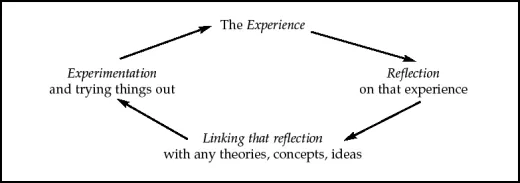
Figure 1.1
It is this ability both to do and to know why one is so doing that, as we saw in professional competence, applies equally strongly to communicative competence.
The reflective practitioner
Kolb’s work lies at the heart of the concept of the reflective practitioner. We can define this as thinking/learning as one works, not just repeating mistakes and going over old ground but stretching our intellectual muscles and moving into different patterns of behaviour. This is increasingly favoured in medical education, teacher training and MBA programmes. The use of reflective diaries is increasingly popular. We hear much about lifelong learning and we realise just how impossible it is for us to continuously train. One of the very best forms of ongoing training, CPD (continuous professional development), is based on these notions of appreciating what we do and how we do it. To some extent it is a habit which we should encourage ourselves in; that habit of self- analysis and reflection before we rush off to our next ‘performance.’
The learning organisation
The reflective individual lies at the heart of this concept. It has become something of a holy grail; we know it must be there but most of us have never seen one-that is a truly learning organisation. The provision of training for all staff cannot guarantee this will happen nor will investment in the latest technology. We have to be able to tap into and mobilise the individual motivation and enthusiasm to do the job better, not to be content with the average, to learn from successes and failure, all of which implies some notion of being reflective.
The concept of a learning organisation needs to be driven and encouraged from the top. Senior staff need to provide an example of learning, of reflective practice and desire for self-development. In the author’s experience it is quite rare when companies are drawing up their training plans for senior staff to be encouraged to draw up their own training and development needs. We can recognise the learning organisation if staff can answer yes to these questions:
• Does the appraisal system encourage reflection and learning from experience?
• Is there a recognition that staff will make mistakes and will actually learn from them? (The important thing is not to engage in a blame culture: ‘It was all your fault’, but to encourage reflection and appraisal so that similar mistakes can be avoided).
• Do staff meetings attempt to encourage this process of reflection and learning or are they forums where people’s confidence is lowered and mutual recriminations abound?
• Does the training budget support internal review, building on individual and team success and, are these given proper recognition in the organisation?
This is not an exhaustive list; there may be many other criteria which apply particularly to your place of work.
You might like to pause at this point in your reading to consider the above list and what might be added to it. Or you might like to think about where you work at present. How many of these questions could your manager or HR director answer with a ‘Yes’?
So many organisations simply stumble on, repeating mistakes; they spend money on training, but they could never be considered learning organisations. Here’s an example from retail.
Every year a large city centre store lays on a Christmas promotion unit; each year they give the management of this to a newly hired graduate to cut his or her teeth on. The staff are hired for the 5-6 weeks before Christmas and then paid off. Every year various panics ensue. The staff are thanked for their work and taken out in the last week for coffee and cake on the company, but at no time is any member of that staff asked their opinions as to how the unit might be made to function more effectively. The only review that takes place is that the graduate trainee manager is asked to write a report. The difficulty here is that very few such aspiring managers are going to be very frank about their shortcomings or those of the staff they have attempted to manage. They will not want to present themselves in a poor light. The temptation is to soften the criticisms and lay the blame for various disappointments on lack of floor space, trouble over deliveries, an unexpected surge in demand for this toy or that article.
What we can say is that there is very little learning that goes on either by individuals (they’re just part-timers) or by managers (I’ll be moving to Lingerie next week) or by the organisation. Many of the problems of this Christmas will occur again next Christmas. If senior staff aren’t interested in learning from the past, one can hardly blame the staff for not being motivated to reflect, to analyse and to seek to enhance the standard of work.
Communication and the learning organisation
You may be asking what has all this to do with a book on communication skills? Developing a learning culture has everything to do with communication. This culture will just not happen by itself, it has to be engendered and nurtured. It requires communication through recognition of the individual, effective presentation of the ideals of the learning organisation, sensitive and well conducted appraisals and meetings; it may mean developing a mentoring system for individuals where they can receive one to one assistance (see page ... for more details) Above all it lies in the communication of values that praises individual learning and the use of initiative; that recognises that the individual member of staff is the most precious asset to any organisation and that the establishment and nurturing of a learning culture requires communication on an organisational, team and individual level of the highest order.
We hope that in reading this book and reflecting on the various concepts of communication that it contains that you too will feel more able and motivated to reflect on your success and failures and by doing so this will enhance your self-awareness of your strengths and deficit areas of communication. This analysis should in turn assist your professional career. In short, the hope is that you will become an individual who learns and who will, because of this, enhance the learning culture of any organisation you decide to join or the one you eventually form!
References
C Handy, The Future of Work, Penguin, 1984.
D Hymes, Communicative Competence, Penguin,1979.
D Kolb, Organisational Psychology, Prentice Hall, 1971.
Further reading
M Pedler, J Burgoyne & T Boydell, The Learning Company, McGraw Hill, 1991.
Skills development
This book is concerned with the skills of communication and how these skills are developed. We’ve already noted that skills should be built on some degree of understanding of theory, the key concepts underlying the communicative competence approach. In this section we explore some methods by which you can maintain and enhance these skills.
Motivation to learn
Before we go on to look at some models of skill development we should say at the start that perhaps the most crucial aspect of any skills acquisition and development is motivation. Just think how much you concentrated on getting that driving licence, how much you wanted to pass that test? Would you have developed the skills of driving (or passing the driving test) if there had not been that motivation to get a licence?
A hunger to gain a skill will enormously help you acquire t...
Table of contents
- Cover
- Title page
- Copyright
- Contents
- 1 Introduction
- 2 Skills development
- 3 Interpersonal skills
- 4 Your audience
- 5 Listening and interviewing
- 6 Being interviewed
- 7 That favourite – the telephone!
- 8 Assertiveness
- 9 Negotiation
- 10 Communication in groups
- 11 Communicating in and out of the Chair
- 12 Communicating on your feet
- 13 The ingredients of effective writing
- 14 The process of writing
- 15 Specific types of writing
- 16 Creativity in your communication
- 17 Keeping up the progress