This book is available to read until 23rd December, 2025
- 300 pages
- English
- ePUB (mobile friendly)
- Available on iOS & Android
eBook - ePub
Available until 23 Dec |Learn more
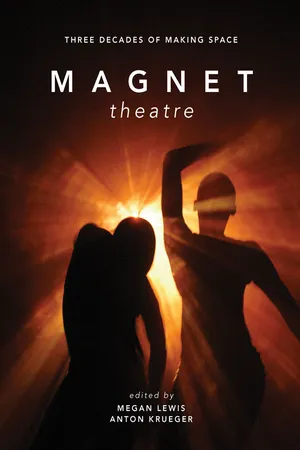
Magnet Theatre
Three Decades of Making Space
About this book
Cape Town's Magnet Theatre has been a force in South African theatre for three decades, a crucial space for theatre, education, performance and community throughout a turbulent period in South African history. Offering a dialogue between internal and external perspectives, as well as perspectives from performers, artists and scholars, this book analyses Magnet's many productions and presents a rich compendium of the work of one of the most vital physical theatre companies in Africa.
Frequently asked questions
Yes, you can cancel anytime from the Subscription tab in your account settings on the Perlego website. Your subscription will stay active until the end of your current billing period. Learn how to cancel your subscription.
No, books cannot be downloaded as external files, such as PDFs, for use outside of Perlego. However, you can download books within the Perlego app for offline reading on mobile or tablet. Learn more here.
Perlego offers two plans: Essential and Complete
- Essential is ideal for learners and professionals who enjoy exploring a wide range of subjects. Access the Essential Library with 800,000+ trusted titles and best-sellers across business, personal growth, and the humanities. Includes unlimited reading time and Standard Read Aloud voice.
- Complete: Perfect for advanced learners and researchers needing full, unrestricted access. Unlock 1.4M+ books across hundreds of subjects, including academic and specialized titles. The Complete Plan also includes advanced features like Premium Read Aloud and Research Assistant.
We are an online textbook subscription service, where you can get access to an entire online library for less than the price of a single book per month. With over 1 million books across 1000+ topics, we’ve got you covered! Learn more here.
Look out for the read-aloud symbol on your next book to see if you can listen to it. The read-aloud tool reads text aloud for you, highlighting the text as it is being read. You can pause it, speed it up and slow it down. Learn more here.
Yes! You can use the Perlego app on both iOS or Android devices to read anytime, anywhere — even offline. Perfect for commutes or when you’re on the go.
Please note we cannot support devices running on iOS 13 and Android 7 or earlier. Learn more about using the app.
Please note we cannot support devices running on iOS 13 and Android 7 or earlier. Learn more about using the app.
Yes, you can access Magnet Theatre by Megan Lewis, Anton Krueger, Megan Lewis,Anton Krueger, Mark Lewis in PDF and/or ePUB format, as well as other popular books in Literature & Drama. We have over one million books available in our catalogue for you to explore.
Information
Chapter 1
Plotting the Magnetic Field: Origins and Trajectories
Cape Town-based Magnet Theatre functions as a nationally recognized theatre institution; not only in terms of its aesthetic originality and excellence, but also because of the company’s investments into cultural development and training. Over the course of almost three decades, the company has been ‘making space’ in South Africa: for creativity, innovation and embodied work, as well as for collaboration, community and cultural dialogue. Since Magnet Theatre’s first productions – Cheap Flights (1987) and The Show’s Not Over ‘Til the Fat Lady Sings (1991–93) – the company has gained an international reputation for its original repertoire of performance events that emphasize the primacy of the human body. From its inception in Johannesburg in 1987 to the establishment of its own theatre space in Cape Town in 2011, Magnet Theatre has been dedicated to what it sees as its role of exploring sociopolitical issues through personal, unconventional and highly physical theatrical expressions that energize audiences by shifting bodies, feelings and ideas (magnettheatre.co.za). Furthermore, the company is committed to training young artists, and to cultivating theatre in under-represented communities. To this end, Magnet has also played a vital role in cultural interventions within the broader South African community; guided by a spirit of theatrical research, artists who have worked with Magnet have remained deeply committed to social development. Their interventions into multiple communities have reached tens of thousands of people.
To understand the impact and particularity of Magnet’s work, we’d like to plot the magnetic field – the trajectories of their influence and influences – by framing the sociopolitical and historical context within which Magnet has functioned over the past three decades. Next, we briefly summarize the various sections and chapters of this book. We then trace the company’s origins in terms of co-artistic directors Mark Fleishman and Jennie Reznek’s personal and professional journey since their meeting in 1987, situating Magnet within the broader South African theatrical landscape before mapping how this unique and innovative company resonates within discourses and practices of physical theatre, devised work, workshop theatre and performance as research (PaR).
Our primary resources for the explorations of the company have been personal interviews with Magnet members and key collaborators.1 Extracts from these conversations are woven between more analytical, academic analyses of Magnet’s work to form the multi-voiced substance of this project. As editors, we have curated many different voices in this collection to tell Magnet’s story, engaging in a dialogue with internal and external perspectives: between reflections by performers and artists involved with Magnet, and scholarly articles responding to Magnet’s many productions since 1987. In the spirit of Magnet’s ‘acts of storying, sounding, moving, feeling and relating’ (Fleishman 2009: 126), we have curated a variety of voices so that Magnet’s multi-textured nature is represented, pairing established scholars alongside more junior ones, and professional academics alongside fieldworkers and facilitators. We have deliberately ended this collection with the voices of two of Magnet’s young graduates, giving the voice of the next generation of South African theatre-makers the proverbial last word.
Historical Context
Over the span of Magnet’s existence as a company, South Africa has undergone an historic transition. In 2014, South Africa celebrated its 20th year as a democracy, having made the momentous political transition from the racially segregated apartheid regime in 1994. Since Nelson Mandela’s election as the country’s first black president, the young democracy has wrestled with what it means to be a truly multicultural society. Theatre artists have been at the forefront of this cultural transition, offering creative interventions that probe, question and (re-)imagine cultural identities as they tackle the viscous endeavours of memory and history in the postcolony (Mbembe 2011).
Apartheid came into being with the National Party’s election to power in 1949, which solidified Afrikaner hegemony. Afrikaners (settlers of predominantly Dutch and French Huguenot descent) and Anglo-South Africans (settlers of predominantly British ancestry) had been battling for control of South Africa since the colonial era. South Africa’s diverse indigenous populations had themselves been disputing control of contested territories, and, upon the arrival of the Europeans, they were relegated to second-class status. Imagined within the racial hierarchies of the state as a totalized mass, black and brown indigenous peoples were afforded few, if any, rights under apartheid law, while white citizens reaped the benefits of the country’s imbalanced system of privilege. Apartheid hierarchized individuals along racial lines while its laws regulated bodies and behaviour: segregating public spaces, schools and workplaces; instituting a system of regulations that determined where an individual was permitted to live, work or travel based on their racial classification; and forbidding cross-racial contact from the boardroom to the bedroom.
When Magnet was formed in 1987, the country was at the height of an extended state of emergency. The African National Congress (ANC) was a banned organization whose aim had been declared as wanting ‘to make the townships within South Africa ungovernable.’ The state responded with an increasingly militarized clamp down. In 1990, Prime Minister P. W. Botha’s successor, F. W. de Klerk, lifted the state of emergency, unbanning the ANC and other organizations. He released Nelson Mandela from his life sentence in prison and began the process of a negotiated transfer of power. Between 1990 and 1994, the legal apparatus of apartheid was gradually abolished, and with Mandela’s election to the presidency, South Africa emerged into democracy.
The Aims and Structure of this Collection
This collection documents Magnet Theatre’s work and ethos through a thick curation of scholarly investigation, first-hand interviews and visual material. Providing a deep analysis by means of a visual and verbal archive of past productions, the essays and interviews collected here reflect on the impact of almost 30 years of creative and cultural labours by a unique theatre company during a shifting and contested time in South African history. Our goal has been to provide an archive of performance practices easily accessible to the lay reader, as well as critical theory that would be of interest to theatre scholars. Furthermore, in using Magnet as an example, the book hopes to address questions of how theatre can serve as a vital site of cultural production, reflection and practice. While all of Magnet’s works are listed in the ‘Production History’ section, not all of them are analysed in the same detail. Rather, seminal productions such as Medea (1994–96), Cargo (2007), Inxeba Lomphilisi – The Wound of a Healer (2010–14), Die Vreemdeling [The Stranger] (2010) and Every Year, Every Day, I Am Walking (2006–present) have been selected as the focus of the essays in this collection, since these works represent decisive turning points in Magnet’s trajectory, and serve as prime examples of the integration of praxis and theory, which is at the heart of the company’s methodology.
Interwoven between the scholarly chapters are the voices of Magnet ‘insiders:’ performer Faniswa Yisa; director Mandla Mbothwe; former Jazzart collaborator Jay Pather; fieldworker Zwelakhe Khuse; writer Frances Marek; administrator Margie Pankhurst; designers Craig Leo and Illka Louw; musician Neo Muyanga; and former students – Magnet’s next generation of theatre-makers and artists – including Nolovuyo Sam and Thando Doni. These reflections collectively paint a portrait of Magnet’s style, approach, ethos and larger impact on South African culture through each interviewee’s personal perceptions. Individually, they narrate the multiple stories of Magnet’s many collaborators.
The critical sections of the collection have been organized into three scholarly rubrics: ‘Concepts: Making Space for Ideas;’ ‘Collaboration: Making Space for Embodied Practice;’ and ‘Community: Making Space for Cultural Interventions.’
In Part One – ‘Concepts: Making Space for Ideas’ – Mark Fleishman, Miki Flockemann and Anton Krueger investigate how a profound complexity of thought – exercised intellectually as well as physically – permeates all of Magnet’s work. Beyond Magnet’s primary objective of creating a repertoire of original African productions lies a less obvious objective: to engage with a spirit of theatrical research.
In ‘Making Space for Ideas: The Knowledge Work of Magnet Theatre,’ Magnet’s co-artistic director Mark Fleishman chronicles and elucidates how the work of Magnet Theatre links practice with the production of knowledge, both with respect to the content of individual productions and projects, as well as the methodologies and processes developed through its theatrical work. Fleishman reflects on two research foci around which productions and projects have been created and pursued over Magnet’s history: remembering in the postcolony and migration.
Since 2001, Magnet artists have explored the possibility that particular practices of dramaturgy and performance might be one way of intervening in the problematic process of remembering in South Africa. Over a period of eight years, Magnet created a series of performance projects that engaged with key ‘sites of memory’ (Fleishman 2013) in and around the city of Cape Town in attempts to put back together (to ‘re-member’) the fractured social body: Robben Island (a place of banishment and incarceration); District Six (an evacuated apartheid-era working-class city district); The Bleek and Lloyd collection of /Xam records (an ethnographic archive at the University of Cape Town); and the archive of slavery at the Cape (a dispersed collection of trial records, household inventories, legal and bureaucratic documents and physical sites). The productions created from these ‘sensitive sites’ (Roth & Salas 2001: 3) include: 53 Degrees (2002–03); Onnest’bo (2002–06); Rain in a Dead Man’s Footprints (2004–05); and Cargo (Fleishman 2013). In making each of these works, Magnet faced two fundamental and interconnected problems related to the themes of time and silence: how to ‘find an appropriate image in the present for something that has past’ and how to make the archive ‘speak in unspeakable ways’ (Fleishman 2011: 12).
Since 2006, the company’s second focus – migration – has yielded four separate performance interventions, framed around three simultaneously conceptual and actual routes (Cape to Cairo, the N2 and the N7): Every Year, Every Day, I Am Walking; ingcwaba lendoda lise cankwe ndlela [the grave of the man lies next to the road] (2009); Inxeba Lomphilisi – The Wound of a Healer; and Die Vreemdeling. These works were simultaneously theatrical and pedagogical, involving public performances as well as cultural interventions as part of outreach programmes, including educational workshops around the pressing issues of xenophobia and migration. Fleishman discusses his particular performance-led dramaturgy and also explores how making theatre can become a means of scholarly enquiry.
In her chapter, ‘“Being There”: The Evolution of Performance Aesthetics from Medea (1994–96) to The Magnet Theatre “Migration” Plays (2012),’ Miki Flockemann, drawing on Geertz’s notion of the practice of ‘thick description’ to read cultural events, examines Magnet’s performance aesthetic that encourages spectators to get close to a sense of ‘being there.’ Flockemann explores the evolution of Magnet’s performance modality in relation to the landmark production of Medea, which coincided with the first democratic election in 1994. This collaborative production with Jazzart Dance Theatre is read in relation to in-house productions of the ‘migration’ plays: Every Year, Every Day, I Am Walking and Inxeba Lomphilisi – The Wound of a Healer. Every Year, Every Day, I Am Walking indirectly anticipated the xenophobic eruptions of 2008, and subsequent productions have continued to generate fresh unsettlements of recognition and ‘being there.’ As a companion piece, Inxeba Lomphilisi offered an insider perspective on the legacies of internal migration, and has taken the evolution of thick theatre aesthetics to another level as Flockemann examines how these innovative performance modalities unlock audience responses at the moment of performance. In this way, Magnet makes space for spectators to feel they can almost grasp the inscrutable otherness of the experience being performed.
In his chapter, ‘The Implacable Grandeur of the Stranger: Ruminations on Fear and Familiarity in Magnet Theatre’s Die Vreemdeling,’ Anton Krueger considers ways in which South Africa could be described as a nation of strangers, marginalized minorities awkwardly pasted together. Krueger explores how Magnet Theatre’s approach to intercultural work sidesteps the potential bigotry of ethnicism, as well as the compromise of homogeneity. Following Fleishman’s goal of ‘reassembling the social’ (Latour 2005) and expanding what is considered as the collective, Krueger argues that Magnet’s ‘creative explorations have inculcated a growing awareness of cultural inclusivity while avoiding demands for conformity’ (p. 130). Drawing on works by Zygmunt Bauman, Georg Simmel and Julia Kristeva, Krueger considers seemingly paradoxical notions of inclusivity and unfamiliarity as explored in a number of Magnet Theatre productions. Part of Magnet’s longevity attests to their successful navigation of cross-cultural work, which guards against any easy assimilation or the forced enculturation of difference. The problematics of cultural exchange and a suspicion of reactive syncretism inform all of these continuing investigations.
In this first section, the deep conceptual investigativ...
Table of contents
- Cover Page
- Title Page
- Copyright
- Contents
- Chapter 1 Plotting the Magnetic Field: Origins and Trajectories
- Production History
- PART ONE – Concepts: Making Space for Ideas
- PART TWO – Collaboration: Making Space for Empbodied Practice
- PART THREE – Community: Making Space for Cultural Interventions
- Index
- Back Cover