This book is available to read until 23rd December, 2025
- 160 pages
- English
- ePUB (mobile friendly)
- Available on iOS & Android
eBook - ePub
Available until 23 Dec |Learn more
Street Fashion Moscow
About this book
Few cities in the world offer the diversity of stunning visuals that can be found on the streets of Moscow, from famous landmarks like Red Square to the Boulevard Ring and Kamergersky Lane and the residential areas beyond the Garden Ring. For this book, former Moscow resident Elena Siemens traveled them all as an urban flâneur, taking photographs of contemporary fashion in action and setting it alongside explorations of modern and historic representations of fashion and beauty as seen in a wide variety of products of Russian culture. Through her photos and analysis, Siemens considers the question of how contemporary Russians understand their post-Soviet identity and express it through the ways they present themselves in public.
Frequently asked questions
Yes, you can cancel anytime from the Subscription tab in your account settings on the Perlego website. Your subscription will stay active until the end of your current billing period. Learn how to cancel your subscription.
No, books cannot be downloaded as external files, such as PDFs, for use outside of Perlego. However, you can download books within the Perlego app for offline reading on mobile or tablet. Learn more here.
Perlego offers two plans: Essential and Complete
- Essential is ideal for learners and professionals who enjoy exploring a wide range of subjects. Access the Essential Library with 800,000+ trusted titles and best-sellers across business, personal growth, and the humanities. Includes unlimited reading time and Standard Read Aloud voice.
- Complete: Perfect for advanced learners and researchers needing full, unrestricted access. Unlock 1.4M+ books across hundreds of subjects, including academic and specialized titles. The Complete Plan also includes advanced features like Premium Read Aloud and Research Assistant.
We are an online textbook subscription service, where you can get access to an entire online library for less than the price of a single book per month. With over 1 million books across 1000+ topics, we’ve got you covered! Learn more here.
Look out for the read-aloud symbol on your next book to see if you can listen to it. The read-aloud tool reads text aloud for you, highlighting the text as it is being read. You can pause it, speed it up and slow it down. Learn more here.
Yes! You can use the Perlego app on both iOS or Android devices to read anytime, anywhere — even offline. Perfect for commutes or when you’re on the go.
Please note we cannot support devices running on iOS 13 and Android 7 or earlier. Learn more about using the app.
Please note we cannot support devices running on iOS 13 and Android 7 or earlier. Learn more about using the app.
Yes, you can access Street Fashion Moscow by Elena Siemens in PDF and/or ePUB format, as well as other popular books in Art & Photography. We have over one million books available in our catalogue for you to explore.
Information
Beyond the Garden Ring
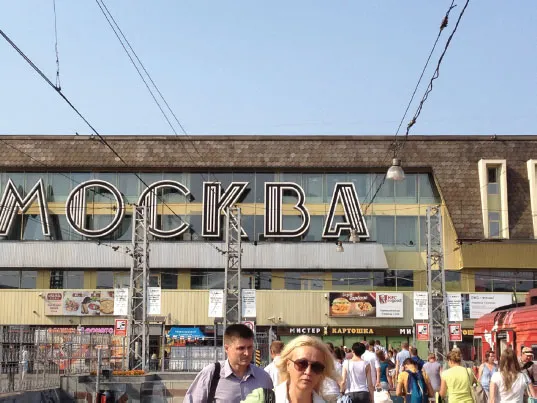
A giant circular avenue, the Garden Ring encompasses the many streets and squares of central Moscow. With six to eight traffic lanes, this Ring (also known as the ‘B’ Ring) is the oldest of the city’s several beltways connecting the centre to the suburbs. In contrast to the historic Boulevard Ring, the Garden Ring is defined by Soviet-era architecture, sparsely interrupted by an occasional pre-Bolshevik revolution landmark. This Ring’s other distinctive feature is an abundance of traffic of every known variety – cars, buses, trolleybuses, trams, trains and the metro. Moscow’s metro – its first line dating from the 1930s –
is an architectural wonder, as well as the most convenient and fastest way to navigate Russia’s highly congested capital. The metro has its own Circle line, partially tracing the Garden Ring; its radial lines take commuters to the distant suburbs populated by masses of residential high-rises. The commuters’ dress code is varied and depends on the time of day: suits and heels in the morning, and sportswear and rucksacks during the day.
is an architectural wonder, as well as the most convenient and fastest way to navigate Russia’s highly congested capital. The metro has its own Circle line, partially tracing the Garden Ring; its radial lines take commuters to the distant suburbs populated by masses of residential high-rises. The commuters’ dress code is varied and depends on the time of day: suits and heels in the morning, and sportswear and rucksacks during the day.
The modern city was a favourite subject of the early Russian avant-garde. In his 1914 poem ‘The Street’, Vladimir Mayakovsky acknowledges various manifestations of modernity, including an advertisement (‘before me a pop sign leaped’), trolleys (‘Trolleys, tired of walking, crossed their electric glittering spears’) and a streetlight (‘The sky was gazing into the white gaslight its blind basilisk face’) (Mayakovsky 1971). Aleksandr Rodchenko, who abandoned painting in favour of photography, also admired ‘trams, automobiles, light and space advertisements, ocean liners, airplanes’, as well as ‘multistorey buildings’ (Rodchenko 2005: 209). His Balconies series (1925) captures Moscow alternately from a high-floor window, the roof and the ground looking up. According to Rodchenko, the traditional perspective derived from painting fails to adequately record ‘the street with its rushing automobiles and scurrying pedestrians’ (Rodchenko 2005: 209).
For his daily photographic expeditions around Moscow, Rodchenko wore a long leather coat, a pair of motorcycle gloves and sturdy boots. He bought his boots a half size bigger than necessary. ‘Perhaps, he saw himself as an explorer on his way to the North Pole’, Alexander Lavrentiev writes in his book on Rodchenko (Lavrentiev 1992: 144). His wife Varvara Stepanova, who charted the routes of Rodchenko’s travels around Moscow, was a prominent avant-garde artist in her own right. Along with the artist Lyubov Popova, she designed innovative theatre costumes; their ‘geometrically cut overalls’ allowed freedom of movement and were worn by actors both on stage and in everyday life (Bartlett 2010). In 1923, Stepanova and Popova went to work for a Soviet textile factory in Moscow, where they proposed to replace the traditional floral fabric motifs with ‘minimalist triangles, circles and rectangles, composed with a compass and ruler’ (Bartlett 2010). Dissatisfied with their work, factory management asked the two artists ‘to make their avant-garde constructivist designs more acceptable for the mass public’ (Bartlett 2010).
Vladimir Tatlin – the creator of the legendary leaning Monument of the Third International (1919−1920) – also designed clothes and various practical everyday objects. In ‘Looking at Tatlin’s Stove’, Christina Kiaer quotes Tatlin’s description of his sportswear suit: ‘This clothing is made with the advantage of being warm, not restricting movement, being hygienic, and lasting longer’ (Tatlin, quoted in Kiaer 2008: 148). Hoping to attract the ordinary consumer, Tatlin wore his own designs in his everyday life. Despite his best efforts, he did not succeed in convincing the authorities to mass produce his clothes. The inventive avant-garde architecture by Tatlin and others was also dismissed as irrelevant and bourgeois. As evidenced by the blocks of uniform high-rises in Moscow’s suburbs, the Soviet-era construction favoured the ‘new rationalism’ aesthetics that originated in the 1960s. In Russian Architecture of the Soviet Period, Andrey Ikonnikov writes that the ‘new rationalism’ divided buildings into ‘functional types’, while considerations of style came second and ‘depended on the purpose of the structure’ (Ikonnikov 1987: 28).
Eldar Ryazanov’s hit romantic comedy Irony of Fate (1975) includes an animated prologue, in which Soviet authorities veto any architectural deviations from the ‘norm’, insisting instead on populating Moscow and the entire Soviet Union with uniform high-rises. As Irony of Fate unfolds, a similar Soviet high-rise becomes the setting of a love story – one of the film’s many ironies and possibly the chief reason it has remained popular to this day. More recently, Boris Mikhailov’s photography has captured a much darker side of life in the Soviet-built environment in Russia and beyond. Commenting on his By the Ground series (1991), Gilda Williams writes that between Rodchenko’s two chosen perspectives – a bird’s-eye view and a worm’s view – Mikhailov more frequently employs the latter one. This allows him ‘to show the bleak failure of the Soviet social experiment as a low, dark expense’ (Williams 2001: 100). According to Mary Warner Marien, Mikhailov’s photographs ‘remain controversial because of what some perceive as the camera’s cynical, cold-eye stare at helpless people’ (Marien 2006: 422). One critic has described Mikhailov’s Case Studies series (1997), chronicling post-Soviet devastation, as ‘an example of the pornography of power’ (Marien: 422).
The residential area near the Yugo-Zapad...
Table of contents
- Cover Page
- Title Page
- Copyright
- Contents
- Foreword
- Street Fashion Moscow
- Red Square and Surroundings
- Gorky Park to the Hermitage Gardens
- Winter on the Boulevard Ring
- Beyond the Garden Ring
- Acknowledgements
- References
- Back Cover