This book is available to read until 23rd December, 2025
- 146 pages
- English
- ePUB (mobile friendly)
- Available on iOS & Android
eBook - ePub
Available until 23 Dec |Learn more
About this book
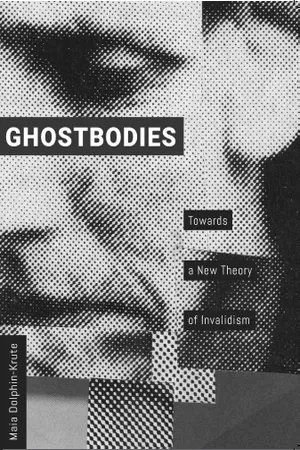
How is illness represented in today's cultural texts? In Ghostbodies, Maia Dolphin-Krute argues that the illusive sick body is often made invisible – a ghost – because it does not always fit society's definition of disability. In these pages, she reflectively engages in a philosophical discussion of the lived experience of illness alongside an examination of how language and cultural constructions influence and represent this experience in a variety of forms. The book provides a linguistic mirror through which the reader may see his or her own specific invalidity reflected, enabling an examination of what it is like to live within a ghostbody. In the end, Dolphin-Krute asks – if illness is not what it seems, what then is health?
Frequently asked questions
Yes, you can cancel anytime from the Subscription tab in your account settings on the Perlego website. Your subscription will stay active until the end of your current billing period. Learn how to cancel your subscription.
No, books cannot be downloaded as external files, such as PDFs, for use outside of Perlego. However, you can download books within the Perlego app for offline reading on mobile or tablet. Learn more here.
Perlego offers two plans: Essential and Complete
- Essential is ideal for learners and professionals who enjoy exploring a wide range of subjects. Access the Essential Library with 800,000+ trusted titles and best-sellers across business, personal growth, and the humanities. Includes unlimited reading time and Standard Read Aloud voice.
- Complete: Perfect for advanced learners and researchers needing full, unrestricted access. Unlock 1.4M+ books across hundreds of subjects, including academic and specialized titles. The Complete Plan also includes advanced features like Premium Read Aloud and Research Assistant.
We are an online textbook subscription service, where you can get access to an entire online library for less than the price of a single book per month. With over 1 million books across 1000+ topics, we’ve got you covered! Learn more here.
Look out for the read-aloud symbol on your next book to see if you can listen to it. The read-aloud tool reads text aloud for you, highlighting the text as it is being read. You can pause it, speed it up and slow it down. Learn more here.
Yes! You can use the Perlego app on both iOS or Android devices to read anytime, anywhere — even offline. Perfect for commutes or when you’re on the go.
Please note we cannot support devices running on iOS 13 and Android 7 or earlier. Learn more about using the app.
Please note we cannot support devices running on iOS 13 and Android 7 or earlier. Learn more about using the app.
Yes, you can access Ghostbodies by Maia Dolphin-Krute in PDF and/or ePUB format, as well as other popular books in Medicine & Linguistics. We have over one million books available in our catalogue for you to explore.
Information
Chapter 1
Ghosts
In beginning the search for ghostbodies, it would seem appropriate to begin in a place that is full of ghosts: Twin Peaks. The television show is full of murdered girls and evil spirits, David Lynch at the prime of his other worldly explorations. But there is one character, very much alive, who may come to serve as the quintessential ghostbody: Leo Johnson.
Leo is a small time crook, a drug dealing, violent, wood-chopping truck driver. Young, strong, married to a younger, beautiful wife, Shelly. Caught up in a group of other small time crooks, Leo is shot by one, one night in his home. The shooting leaves him alive but brain injured and near comatose, his wife left to care for his now drooling, stuttering, paralyzed body. He still looks exactly the same, with no visual evidence left of the shooting. Meaning that despite his now being in a wheelchair, Leo’s body remains whole, unmarked, his face unchanged (though his expressions certainly are). Leo Johnson is the most visible invisible ghostbody.
The injury, obviously, is what leaves him as a ghostbody. Leaves him as a being, a conscious being, being in a body that seems to be mostly unconscious. Given the lack of speech and facial expressions, it is difficult to tell just how much “thinking” is going on, but let’s assume a certain level of awareness is maintained, that Leo is at least aware of the not-working-ness of his body. He has become, then, trapped. Trapped within a physical form, as opposed to the trapped within eviction from physical form of the standard ghost. Hence the etymology of ghostbody as word: ghost making body, body making ghost, neither gone nor separated but indeed disembodied.
Crippled, too, is the word to use for Leo, given its historical relationship as the failure of the kind of hyper masculinity he had been performing; men are crippled when they can no longer perform as men. Here is the first sign of a gendering of the ghostbody, in that Leo is first and foremost crippled, and maybe, secondarily, an invalid, the latter word generally reserved (historically) for the feminine injured. Here, the feminine role is reserved for Shelly, who acts as a caretaker. Really only for his body, though, given the aforementioned external lack of access to his mind. The caretaking, therefore, consists of the hyperphysical only, of feeding, cleaning, and caring for the physical form. It is this continuous insistence on the physical, on the solidity, and very presence of Leo’s body that turns his body into a constant reminder of what it once was capable of. Shelly tries to use his body as purely an object, hoping to let him just sit there while she collects his disability checks. But Leo, or Leo’s body, doesn’t make this easy for her. He twitches, moves his chair, begins uttering a single word or two. These starts and stops, these stutters, are like his body’s way of turning a key, trying to turn on again. They terrify Shelly, who, despite Leo’s lack of physical ability, is terrified that he will “wake up” only to hurt her. What scares Shelly is the possibility that Leo will go from ghostbody to ghost and body, with the ghost being reunited with its body, “awake” again. It is Leo’s body itself that insists on attempting this possible return.
Before going any further, it is necessary to take a moment to address the stereotypes implicit in this kind of imagery and word use. Like the equation of paralyzed with severely brain damaged or the use of “severely” as some sort of known, negative, quantity. Any perpetuation of this language here is only as it exists as an accurate description of this specific and fictional image. It will not continue.
Leo Johnson as ideal or quintessential ghostbody is deviant in multiple ways. First that he himself is deviant, as a criminal. Identifying Leo and with Leo as ghostbody is to locate and align this deviance within the ghostbody, to draw parallels between the two states of being. Leo is deviant as a criminal, so it follows naturally that he would deviate, commit a wrongdoing, by becoming a ghostbody. Whether this wrongdoing is his fault is debatable. He was, deliberately, involved with the person who shot him, but his body, as experiencing the injury and producing physical repercussions, is incapable of being at fault. It was only doing what it could do upon being shot. Every body is incapable of being at fault in the face of physical fact. Of course none of this is or could actually be Leo Johnson’s fault. He is a fictional creation, and as such has advantages over the nonfictional ghostbody. Namely, his visibility, immediately apparent and his immediate apparentness. Leo exists as an image, an image of an injured body, in a wheelchair, “consciousness” removed. It is a complete image, fully seeable, Leo (as ghostbody) apprehended at once. This immediate apprehension stands in direct relation to his deviation, as criminals too must be apprehended. This immediate apprehension is rare, so few other ghostbodies being able to present themselves as quickly and completely. Leo, though, doesn’t have to present himself but is himself presented; he is a presentation of an idea of an injured and disabled man. It is an extreme presentation, extreme again because of its completeness. Leo has been physically changed, mentally (we are left to assume), the entirety of his day-to-day existence radically altered. Other ghostbodies are not always like this, in that there are varying degrees of not working, and varying points from which to start this not-working-ness. In other words, what makes a ghostbody of one person may not make another.
Despite these differences, Leo Johnson is still most definitely a ghostbody and can be spoken of as such. Or spoken through, taking advantage of his visibility to say: the ghostbody is the not working (or ill or injured) body, the memory of the body, and the possibility of a return to the body.
The suddenness of Leo’s injury makes the first of these statements perfectly clear, in making clear the ability of illness or injury to leave a person as a ghostbody. Leave, as in take leave, be no longer present in the body, and leave as in to leave a trace behind. Bodily change is an inherently durational experience. A body, a left body, a possessed body, and a body during the leaving. The traces left are physical as well as mental, and sometimes but not always, invisible. The traces, as a physical record, exist as a current experience, as well as an experience of the knowledge of a time before recording; a memory of a body. The recording, as inscription, and the physically written connotations of that are a reminder of the possibility of erasure. Or, in a ghostbody, the kind of re-recording of healing or cure needed to make the return to a pre-recorded body. The ghostbody is a body of experience, experiencing and remembering, being reminded of, those experiences, over an unknown duration.
The experience of all of this experiencing in that it is an experiencing of physical change accompanied by some level of physical and mental stress is an experience of being not at ease. The unease of the ghostbody, and the ghost looking for its body, is the unease of disease. Disease, literally, not at ease. Disease here is one point of recognition, a recognition of the becoming of a ghostbody. Disease can be a locatable thing, a thing within the body, an identifying mark of the ghostbody. But the leaving of the disease is itself disease, under the name of chronic illness. Chronic illness is like a perpetual leaving of disease, a constant cycle of recording, partial erasure, and reinscription. It is simply another possible point for the becoming of the ghostbody, perhaps the exact opposite of Leo’s becoming through injury. Some ghostbodies are made long before any recognition of them as such, genetically inscribed diseases a kind of silent haunting. All of these becomings are generally recognized in medical settings or at least made official there. An emphasis here on “re”cognition, as it takes a first noticing of the becoming of the ghostbody to get that body to a medical office at all. And once there, the ghostbody will appear in its, perhaps original, form, with long white hospital gowns making ghosts of bodies daily.
Chapter 2
Haunting
Everyone, it seems, has something they won’t or can’t watch. Horror movies, gory scenes of violence that must be peeked at, watched through hands covering one’s eyes. Ironically, it seems, nonfictional violent images can be stared at, discussed openly. That’s just the news. But the abject cousin of the news, horror movies (and ghost stories) necessitate a different kind of guarded, partial watching. In a situation of being unable to watch, of refusing to witness, perhaps that “situation exists because there is guilt at the very heart of sight” (Didi-Huberman 2003: 133). The guilt of horror movies is the guilt that comes from enjoying the abject, being able to enjoy it as a distant image on the screen. With the abject, and even a distant representation of it, there is death. Our own death, and the fragility of the human body, translated into images of horror that cannot, should not, be viewed or enjoyed in their entirety. Because what happens when these images are witnessed, turned to, and faced? Lot’s wife has illustrated the consequences of this for hundreds of years, as a “grave from the moment she turns” (Harries 2007: 104). Really, though, she is a grave before she turns, her own grave. We are all our own graves, carrying the inception of our deaths from the moment of birth, and the knowledge of that. All that paralyzed Lot’s wife was a direct acknowledgment of the fact of death.
The destruction of Sodom and Gomorrah is an admittedly blatant example of this kind of witnessing. But if those complete images of abjection that are available via horror movies and their related media can only be viewed partially (particularly given their standing as always already partial representations), then how should incomplete, momentary, or mostly invisible images of abjection be approached? There is, of course, a long history of one approach, the approach of photography. The promise of photography as a documentary tool, creator of a visual index of difference, should not be trusted. Ghostbodies can rarely be captured on film, precisely because of this capturing. Photography, as a tool used to document as many physical differences as the eye can see, has effectively killed, not captured, ghostbodies. The eye, of course, cannot see very far, but the deeper photographic probing of MRI and other medical imaging machines continues to fall into the same failure that photography does, as it allows the viewer to “forget that representation [is] a form of time” (Didi-Huberman 2003: 117). A particular, frozen form of time, a time always being viewed as the present, as a current truth, despite its inherent standing as the past. Or, if not a current truth, at least as a true representation of the thing it presents. A self-perpetuating cycle sets itself up, of capture (death), past, viewing, misrepresentation, seeking of the same. Ghostbodies shatter the validity of the moment of capture, even regardless of the rest of the cycle. The way to witness a figure whose wholly visible form may only ever be partial is not to picture it, to form a representation of it, at all, but to let the figure appear. To appear, to make itself visible, to appear itself. The ghostbody, as a ghost, exists as a specific kind of appearance, that of the apparition.
An apparition is a ghost, a visible and sensible manifestation of the ghostbody, in addition to being a particular kind of time. Or, more specifically, a particular kind of feeling in time. An apparition, as a ghost, is scary. It is a moment of fright in time, of being startled. It is as much the feeling of fright as it is the feeling of its passing. An initial moment of shock comes from a feeling of incomprehension. What is this thing, this ghost, that is alive (as it exists in real time), but not alive, or as alive, as it should be? This ghostbody, that looks like it should work, but doesn’t? Or the ghostbody that is always more visible than not, marked by some non-bodily apparatus, but that goes unnoticed until it makes itself known? The ghostbody is always shocking, but why should this shock pass? If one has just witnessed the apparition of the ghostbody, the appearance of a nonworking body that contains all of the signs of one’s own death, shouldn’t that witness join Lot’s wife? There is something of a deliberate choice in a feeling of fright that exists only as a moment, a choice of being not afraid. That choice happens in the realization of the ghostbody as ghost, and self as alive or nonghost. The ghostbody is made other, made not scary by its official designation as ghost and complete removal from the land of the living. Most people don’t believe in ghosts.
(Again, differently)
The way to picture a figure whose wholly visible form is only ever momentarily visible is not to picture it at all, but to let it appear. To appear, as to make itself visible, and to appear itself. The appearing-itself of the ghostbody takes the form of an apparition, that hauntingly bodily form of all ghosts. An apparition is not just a kind of figure, but a kind of time. A moment, the specific moment of appearance, like that moment of the photograph. But the photograph goes on to exist as a very different kind of duration, under a different kind of control. The moment of the photograph is made by the photographer, who assumes, or assumes that he can see, the figure’s presence in front of the lens. Whether or not that figure is truly captured, the photograph persists, lasts. For the viewer, the image of the photograph exists as long as it is before them, and can be revisited, reseen, at will. The duration and time of the photograph is at the discretion of the viewer.
The moment of the apparition is not just an image in time, but a feeling in time. The feeling of fright in time, of being startled. A momentary shock, in which the feeling of its passing is just as strong as the fright itself. That which is apparent, always already appeared, is never really that startling. The shock of the startle is the start itself, the beginning of the realization of what has appeared. That which is most startling is that which appears and disappears at its own will, that which cannot be fully fathomed or captured by the gaze but is forced upon it. Appears itself.
At this point, it is important to make, and make clear, a distinction: looking at an image of a ghost and witnessing an apparition are two separate processes. The image is in the viewer’s control, can be turned over, turned off, put away. The apparition cannot. The apparition, as ghost, is, of course, a person. Not an image or object, but a subject, with the ability to return the gaze turned towards it. Reflect, return, set up the cycle in which the object gazed at is/becomes “the object that is gazing at me” (Zizek 1991b: 125). The object of the apparition is the object of my own death and abjection, gazing at me from and through the ghostbody. As much as one sees a ghost, one is also seen by the ghost, seen seeing oneself. The seeing of the ghost is a demonstration, literally that which the monster shows, that the witness’ mortality is as nebulous as the ghosts’.
Haunting, again
To begin again, or begin differently, it is necessary to take a step back in time. To notice that, as a moment in the present, something had to have already happened to allow for the startling that happens now. Even before any appearance, some groundwork was laid which would give that appearance the capability to shock. Shock, as a state of being, is a confrontation with the unexpected. In the case of the ghostbody, it is the unexpectation, the denial of the possibility, of a body that does not work, and which, in its not-working-ness, is disgusting, alarming, disturbing. The groundwork, the precondition, of shock is disgust. Disgust, that thing which is the reversal of taste, is in bad taste. That thing which is revolting, repugnant. In all of its forms is a refusal, that prefix always containing a reversal, a forced return. A looking away, a looking back at one’s self (and only one’s self), a shutting out by removing the gaze, in an attempt to remove, move again, the thing that has disgusted. Move again, because the disgustingness of the ghostbody and its continual replacement, attempted removal from oneself, is never more than a successful displacement: the object(s) of death may be moved, never the thing itself.
The thing that has disgusted here is no thing, necessarily, but a quality of a state of being. That state being the body of the uncanny. The visible state of being that turns the ghostbody to object, that “object that cannot be swallowed” (Lacan 2007: 96), which is difficult to swallow. Difficult to swallow as in difficult to accept, as it is the object that threatens to swallow the I. The quality of the abject death-made object, apparent object. As such, the ghostbody is the unheimlich body, whose appearance necessitates the Heimlich maneuver. That continuous refusal of disgust extends to and stems from the ghostbody; its appearance must be forcibly removed, as it is the body whose lack of control causes (in multiple senses) vomiting. That body which must be controlled from outside, as its insides threaten to overflow and erupt. Whose inevitable eruption must be hidden from view, quarantined off in hospital and nursing home rooms, accessible only to those trained in the treatment of abjection.
That overflow is not metaphorical, not entirely, as there is real matter at stake. Matter which is displaced, misplaced, by the ghostbody’s uncanny orifices, which can no longer maintain a proper flow, a system of control. A system for keeping that matter in its proper, invisible place. That displaced matter (which the ghostbody itself is entirely made up of) is matter out of place. The ghostbody is the body out of place. Out of place, as having come from a different place, a more dead than alive place that hovers over (or beneath?) ordinary life. Out of place, as in not in the right place, as in refusing to be put in place. Which, of course, assumes or acknowledges that there is something there, in the eyes of ordinary life, to be admonished, disciplined. In a sense there is, in the sense that, as sensible disgust, in the wrong place at the wrong time, the ghostbody is the trespassing body.
Being in (a being in) the wrong place at the wrong time assumes that there is a right place, a proper time. The proper place for the ghostbody is its invisibility, in its consent to keeping itself hidden. This consent is easier to maintain at some times than others. The critically or suddenly ill ghostbody understandably seeks treatment at a hospital, remains there, being seen only to those who visit it (unable to perform its own visitations). But what about the ghostbody who is deemed “well” enough to live among the ordinarily living? “Well,” it would seem, in the ghostbody’s ability to keep its death mask on, keep hidden any threat of the abject that its treatments and medical routines signify. As the ghostbody moves among the everyday world, there are gaps in its hiding. The ghostbody has accidents. The ghostbody can be loud, volatile, smelly. The ghostbody has lab tests, stool samples, which must be kept refrigerated for periods of time. The ghostbody must live with, must keep, some of its matter perpetually out of place. The ghostbody is beside itself. The ghostbody is a haunted house, which haunts its house.
It is within these gaps in hiding that the apparition occurs, is made manifest. The specter of abjection is always already there. It is not made present by the noticing of others, but by the ghostbody itself, which lets it slip. It is this slippage, the threat of the appearance of abjection, which is and constitutes, the haunting. That threat is scarier and more threatening than the thing itself that startles. As in any horror movie, when what is shown is shown offstage, so as to create a scary atmosphere. This works only because it is scarier to contemplate the threat than experience it. Once it is experienced, it can be fathomed, had. That having does not happen, cannot happen, in the moment immediately after being startled, but in the future afterwards.
Spread
If the ghostbody is only made visible to others through these glimpses, what about those witnesses who repetitively glimpse? Those in close relationships to the ghostbody, who, in the repetition of these glimpses, see not slippages themselves, but a kind of accumulation. Literally, a mass or amass.
An accumulation of sightings and of things, objects that are tantamount to the ghostbody, which extend it. Apparatus of illness, those that extend the ghostbody towards ability and health. But, it would seem, these are dangerous things. For as illness spreads it (must, surely) contaminate. The ghostbody, as one object and image of illness, is itself a contaminant.
Concentration
But this is a quiet, nonlethal contamination. It is a contamination not of illness but of augmentation, the changes illness brings. An augmentation to the relationships of the ghostbody, wherein those closest, those who care for the ghostbody, must now accommodate it, on a variety of levels. This accommodation is made possible only at the point at which the accumulation (of the very fact and presence of the ghostbody) becomes a concentration. A critical mass, a point at which the presence of the accumulation cannot be denied, as well as a focus on that thing above all other things. A fuzzy kind of concentration, where illness is paid attention to, never in just one spot or time, but in the pervasiveness of its seep.
Distillation
If illness, if the ghostbody, is seeping into other people, other spaces, how can this be a safe contamination? It is safe precisely in its quality as an amassed mass; it is things. Things, though related to illness, that are still just objects. Objects that can...
Table of contents
- Cover Page
- Title Page
- Copyright
- Contents
- Preface
- Introduction
- Chapter 1 Ghosts
- Chapter 2 Haunting
- Chapter 3 Haunted
- Chapter 4 Exorcism
- Chapter 5 Grief
- Chapter 6 Invalid
- Chapter 7 Historical fiction
- Chapter 8 Conclusion
- Afterword/Acknowledgments
- Appendix A
- Bibliography
- Back Cover