![]()
Section III
Pedagogical City
![]()
Chapter 8
Writing transparadiso: Across and beside
Jane Rendell
![]()
Introduction
transparadiso, comprising architect-trained artist Barbara Holub and architect/urban designer Paul Rajakovics, based in Vienna, but working internationally, have, over the past 10–15 years, produced a complex assembly of artefacts and events—art installations, performance pieces, videoworks, urban interventions, master plans, design competition entries and completed works of architecture and urban design—often with other professionals, clients, planners, user groups and urban citizens.
In the text that follows, in the spirit of my site-writing practice (Rendell 2010), I attempt to write transparadiso. In so doing I pick up on many of the dominant moods and modes of their operation—two of them evident in their name that includes the prepositions: trans—across and para—beside. My intention is to write across and beside the different facets of their methodology that continually experiment with combining attitudes to urbanism held by art, architecture and planning: always critical, astute and questioning, but also playful. Acknowledging the importance of threes in understandings of transitional space and transversality in the work of D. W. Winnicott, André Green and Félix Guattari, the text is trivalent: the first two texts are placed beside or ‘para’ to one another, positioning the voice of a theorist/philosopher in parallel with that of a practitioner;1 my own voice comes in as a third, writing across the space of relation between the other two. The three voices are distinct and do not attempt to define or explain each other, rather they allow for different associations and connections to be made by the reader.
Transitional Space
This potential space is at the interplay between there being nothing but me and there being objects and phenomena outside omnipotent control. […] I have tried to draw attention to the importance both in theory and in practice of a third area, that of play which expands into creative living and into the whole cultural life of man. This third area has been contrasted with inner or personal psychic reality and with the actual world in which the individual lives and which can be objectively perceived.
(Winnicott 1967)2
Jemandsland 1997/2011: In 1997 Paul Rajakovics was invited by ACMA Milano to lead an architecture workshop in Gorizia (Italy) on the issue of the border. Together with his students he collected drawings of the residents of Gorizia and Nova Gorica (Slovenia) as a response to three questions on the future of the two cities. The visions turned out to be quite traumatic so that he decided to continue to work on the project, but with young people. One year later he returned with his partners (Bernd Vlay and Margarethe Müller) to Gorizia and continued the project spremembazione. In a casting party four young Italians and four young Slovenians were invited to show their favourite places. As the final event, spremembazione managed to remove the border at the Piazzale della Transalpina in front of the train station. For the duration of a cross-border badminton game the video camera was placed on a pedestal replacing the fence. On 1 May 2004, the EU-border was lifted as Slovenia joined the EU. The fence in front of the train station was removed and a circle was placed there instead. Over time, flower pots were added, installing a new barrier…
The focus of the theory of object relations created and developed by the Independent British Analysts is the unconscious relationship that exists between a subject and his/her objects, both internally and externally (Kohon 1986: 20).3 In continuing to explore the internal world of the subject, their work can be thought of as a continuation of Sigmund Freud’s research, but there are also important differences, particularly in the way that the instincts are conceptualized and the relative importance assigned to the mother and father in the development of the infant. Exploring the concept of an object relation to describe how bodily drives satisfy their need, Freud theorized the instincts as pleasure-seeking, but Ronald Fairbairn, an influential member of the Independent Group, suggested instead that they were object-seeking, that the libido is not primarily aimed at pleasure but at making relationships with others. For Melanie Klein too, objects play a decisive role in the development of a subject and can be either part-objects, like the breast, or whole-objects, like the mother. But whereas for Freud, it is the relationship with the father that retrospectively determines the relationship with the mother, for Klein, it is the experience of separation from the first object, the breast that determines all later experiences.4
Following on and also developing aspects of Klein’s work, D. W. Winnicott introduced the idea of a transitional object, related to, but distinct from, both the external object, the mother’s breast, and the internal object, the introjected breast. For Winnicott, the transitional object or the original ‘not-me’ possession stands for the breast or first object, but the use of symbolism implies the child’s ability to make a distinction between fantasy and fact, between internal and external objects (Winnicott 1953: 89, 94; 1969: 711–716; 1991). This ability to keep inner and outer realities separate yet inter-related results in an intermediate area of experience, the ‘potential space’, which Winnicott claimed is retained and later in life contributes to the intensity of cultural experiences around art and religion. Winnicott discussed cultural experience as located in the ‘potential space’ between ‘the individual and the environment (originally the object)’. In Winnicott’s terms, for the baby this is the place between the ‘subjective object and the object objectively perceived’ (Winnicott 1967: 371).
Paramedics
In German, the word Klinik signifies a hospital for inpatients. The term is derived from the Greek word klinein, which means ‘lying down’. What in English is called ‘clinic’ is in German designated as Ambulatorium, which is derived from the Latin ambulare, ‘to walk around’.
(Danto 1998: 287–300)
On Invitation Only: The Indikatormobil is a flexible tool for operations in the urban context situated between urban and artistic interventions—a tool for ‘Direct Urbanism’. It offers the possibility to include tactile aspects of urban planning into urban planning and urban design transgressing conventional genres. The Indikatormobil operates upon request or invitation as well as taking the initiative to trace urban ‘emergencies’ and to develop interventions according to the specific context. Parallel to transparadiso’s exhibition at the MAK, Vienna, transparadiso held a MAK nite: they invited special guests to a dinner ‘on invitation only’ in the main hall of the MAK. The non-invited regular visitors of the MAK nite were guided to the courtyard, where the Indikatormobil parked. In that very cold night the guests outside were offered a Russian soup (borschtsch) and hot wine, and they were welcomed by ‘Asyl in Not’, an organisation taking care of immigrants seeking asylum. A live-video-conference between the main hall of the MAK and the Indikatormobil in the courtyard enabled communication between the selected dinner guests inside and the other guests outside.
Leading figures for the Austrian Social Democrats, such as Victor Adler and Otto Bauer, put forward proposals for a project of economic and social regeneration, combining culture and politics in a new way. In Vienna, where the Social Democrats had the majority between 1918 and 1934, psychoanalysis played a key role in the process of radical reform, which aimed to create an urban environment that responded to the needs of children and workers’ families (Danto 1998: 287–300). In 1918, in his speech in Budapest, and in other speeches and writings, Freud had sanctioned the development of free, psychoanalytic, out-patient clinics, including the Poliklinik in Berlin, which opened in 1920, and the Ambulatorium in Vienna, which opened in 1922 (Kadyrov 2005: 467–482), to which he gave moral and financial support (Danto 1998: 287–300).
Wilhelm Reich, an Austrian ‘Freudo-Marxist’ and key member of the Vienna clinic in the 1920s, was radicalized by the experience, and in his subsequent work considered social conditions to have an influence on neurosis. He later aimed to make psychoanalysis more accessible by ‘setting up free clinics throughout Vienna, even turning the back of a van into a mobile clinic that he would take into working class neighborhoods, dispensing therapeutic advice about emotional problems along with a political message about how sexual misery and family breakdown posed the need for socialism’ (Brenner 1999). This practice of mobile psychoanalysis, where help is offered point to point from a moving vehicle, offers a psychic equivalent to the paramedic who comes to the site of the medical emergency equipped to give aid, and reminds me of Gilles Deleuze’s comments concerning how theory can be used like a tool.
In a fascinating conversation between philosophers Deleuze and Michel Foucault that took place in 1972, Deleuze reveals quite directly, though certainly abstractly, how he comprehends a ‘new relation between theory and practice’. Rather than understanding practice as an application of theory or as the inspiration for theory, Deleuze suggests that these ‘new relationships appear more fragmentary and partial’ (Foucault and Deleuze 1977: 205), and discusses their relationship in terms of what he calls ‘relays’: ‘Practice is a set of relays from one theoretical point to another, and theory is a relay from one practice to another. No theory can develop without eventually encountering a wall, and practice is necessary for piercing this wall’ (1977: 206). For Deleuze, theory is ‘not for itself’: ‘A theory is exactly like a box of tools. […] It must be useful. It must function. And not for itself. If no one uses it, beginning with the theoretician himself (who then ceases to be a theoretician), then the theory is worthless or the moment is inappropriate’ (1977: 208). Deleuze notes that in its encounter with ‘obstacles, walls and blockages’, theory requires transformation into another discourse, presumably practice, to ‘eventually pass to a different domain’ (Deleuze 1977: 206).
It is this possibility of transformation—the potential for change following the relay from theory to practice and back again—that interests me. transparadiso, like many conceptual artists before them, are practitioners highly versed in theoretical discourse, but they do not see themselves as ‘theoreticians’; however, in reflecting critically upon the procedures they employ and the ideological questions raised by a close attention to methodology, to practice after conceptualism is to perform a kind of theory. The practice of transparadiso offers them a kind of theoretical ‘tool kit’—arriving on site they are prepared to provide ‘help’ in a given situation—offering space and time for tricky issues to be aired, and inviting questions to be played out and tested in different domains. It is not the way of transparadiso to put forward immediate quick-fix solutions to long-term problems. Instead their process is more like the slow and fluctuating process of psychoanalysis with all its loops, blockages, dead-ends and detours, involving conversations that might start casually in the ‘back of a van’, yet provide strategies that work their way towards the future over a much longer term, sometimes with intended consequences, at other times unexpected and surprising.
Transference
The analytic object is neither internal (to the analysand or to the analyst), nor external (to either the one or the other), but is situated between the two. So it corresponds precisely to Winnicott’s definition of the transitional object and to its location in the intermediate area of potential space, the space of ‘overlap’ demarcated by the analytic setting.
(Green 1978: 180)
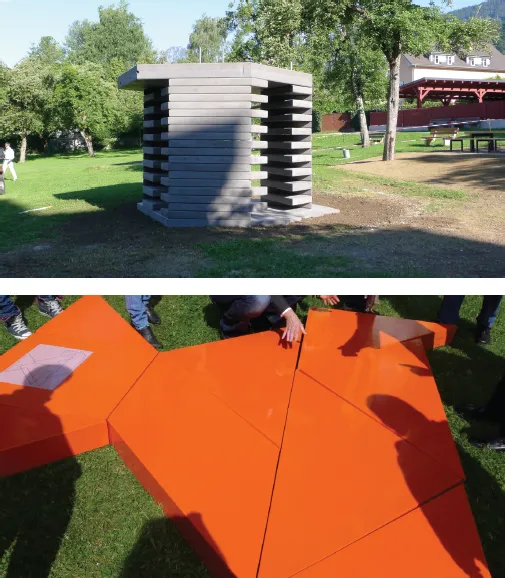
Commons come to Liezen: Liezen’s town park was previously and is still today an orchard serving as a common. A pavilion was erected there that functions first of all as a storage space for large-scale tangram pieces. The pieces were sold as a limited edition of art objects and as part of a collective work of art. As they were sold, the pavilion emptied out. The proceeds went directly back to Liezen and to the local population, and were earmarked for events which took place in the pavilion. Months before the pavilion was built, transparadiso invited the public to play tangram. While people were playing, they could discuss vital topics concerning the city and its future (see Figures 1 and 2).
Figures 1 and 2: transparadiso, Commons come to Liezen, 2011. Images: transparadiso, 1992.
The ‘setting’ is a term used to describe the conditions within which the psychoanalytic encounter occurs. Following Freud, these conditions include ‘arrangements’ about time and money, as well as ‘certain ceremonials’ governing the physical positions of analysand (lying on a couch and speaking) and analyst (sitting behind the analysand on a chair and listening) (Freud 1958: 126, 133). Coined by Winnicott, ‘as the sum of all the details of management that are more or less accepted by all psychoanalysts’ (Nissin Momigliano 1992: 33–34), the term has been modified by others. In the work of José Bleger the setting comprises both the process of psychoanalysis, and the non-process or frame, which provides a set of constants, or limits, to the ‘behaviours’ that occur within it (Bleger 1967: 518). And in terms of its spatial configuration, Jean Laplanche considers the setting to be a double-walled tub (Laplanche 1999: 226),5 and for André Green it is a casing or casket that holds the ‘jewel’ of the psychoanalytic process (Green 2005: 33).6
Green has drawn attention to the setting not as a static tableau, but as a psychoanalytic apparatus, not as a representation of psychic structure, but as an expression of it. For Green, the position of the consulting room between inside and outside relates to its function as a transitional space between analyst and analysand, as does its typology as a closed space that is different from both inner and outer worlds, ‘The consulting room […] is different from the outside space, and it is different, from what we can imagine, from inner space. It has a specificity...