This book is available to read until 23rd December, 2025
- 185 pages
- English
- ePUB (mobile friendly)
- Available on iOS & Android
eBook - ePub
Available until 23 Dec |Learn more
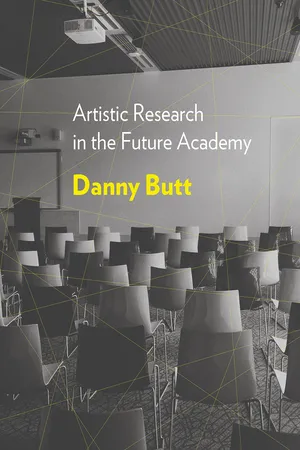
Artistic Research in the Future Academy
About this book
The rapid growth of doctoral-level art education challenges traditional ways of thinking about academic knowledge and, yet, as Danny Butt argues in this book, the creative arts may also represent a positive blueprint for the future of the university. Synthesizing institutional history with aesthetic theory, Artistic Research in the Future Academy reconceptualizes the contemporary crisis in university education toward a valuable renewal of creative research.
Frequently asked questions
Yes, you can cancel anytime from the Subscription tab in your account settings on the Perlego website. Your subscription will stay active until the end of your current billing period. Learn how to cancel your subscription.
At the moment all of our mobile-responsive ePub books are available to download via the app. Most of our PDFs are also available to download and we're working on making the final remaining ones downloadable now. Learn more here.
Perlego offers two plans: Essential and Complete
- Essential is ideal for learners and professionals who enjoy exploring a wide range of subjects. Access the Essential Library with 800,000+ trusted titles and best-sellers across business, personal growth, and the humanities. Includes unlimited reading time and Standard Read Aloud voice.
- Complete: Perfect for advanced learners and researchers needing full, unrestricted access. Unlock 1.4M+ books across hundreds of subjects, including academic and specialized titles. The Complete Plan also includes advanced features like Premium Read Aloud and Research Assistant.
We are an online textbook subscription service, where you can get access to an entire online library for less than the price of a single book per month. With over 1 million books across 1000+ topics, we’ve got you covered! Learn more here.
Look out for the read-aloud symbol on your next book to see if you can listen to it. The read-aloud tool reads text aloud for you, highlighting the text as it is being read. You can pause it, speed it up and slow it down. Learn more here.
Yes! You can use the Perlego app on both iOS or Android devices to read anytime, anywhere — even offline. Perfect for commutes or when you’re on the go.
Please note we cannot support devices running on iOS 13 and Android 7 or earlier. Learn more about using the app.
Please note we cannot support devices running on iOS 13 and Android 7 or earlier. Learn more about using the app.
Yes, you can access Artistic Research in the Future Academy by Danny Butt in PDF and/or ePUB format, as well as other popular books in Education & Art General. We have over one million books available in our catalogue for you to explore.
Information
Chapter 1
The Transformation of the University
Eric Ashby described the modern idea of the Anglophone university as a hybrid, with a “heredity derived from Germany, Britain, and America.”1 The assumption of a stable form among all universities is a recent phenomenon and a suppression of the many varieties of institution past and present; however, the Anglo-US model for the university is – through the forces of colonialism and globalization – now the default model for the university worldwide outside of Europe. While every culture has had its forms of knowledge and higher learning – the twelfth-century European recovery of Greek philosophy took place through translations from Arabic kept by Islamic scholars2 – it is the European university form that has either displaced, incorporated or settled atop other traditions of learning through the capitalist mode of exchange.3 To make an analogy, the European nation state is now the globalized form of the nation: its borders and external interfaces are relatively harmonized globally along the European model, but this masks sometimes radical heterogeneity in arrangements within any particular state. Similarly, how universities understand themselves and how they are organized is diverse within a shared logic and structure. Far from a utopian unbroken lineage stretching back to the twelfth century, universities can be seen as what Foucault calls “heterotopias,” distinguishable as an exceptional zone from a broader society, yet an assemblage of institutional forms that overlay and interpenetrate each other historically and geographically.4 The emergence of the singular university platform was always a partial enterprise, based from the start on competing agendas between various institutional and political interests; often awkwardly appending new initiatives to historical institutional formations with uneven effects, and for less than laudable motives. Derrida describes the paradox of the university as precisely that it has been founded, always by political forces external to the university, and the foundings of the universities reflect the political and intellectual situations of their time and situation.5
“Defining the university is a difficult task,” notes Riddle, making the mandatory qualification of every historian of the university.6 As such, this chapter does not seek to account for a totalizing definition of the university, but instead reviews figures, syntheses, resonances in some of the well-known and lesser-known histories of the development of universities.7 Its purpose is to establish the historical lineage in which the institutional forces opening the university towards artistic practices can be discerned, with the suggestion that the emergence of research-based studio art programmes may turn out to be one more of the historical points where new forms of the university emerge as older ones slip away. Artists worry that the normalizing force of the university will suppress creative practices; and on the other side of the coin, traditionalists are concerned that the unruly forces of the creative arts will disrupt the university’s academic integrity. In tracking the university’s mongrel heritage, we can move with Foucault towards understanding artistic research as a dynamic disruption that points towards both possibility and repression.
History of the European University
In his History of Universities, Perkin claims that the history of the European university can be told in five stages:
1. the rise of the cosmopolitan European university and its role in the destruction of the medieval world order at the Reformation (twelfth century–1530s);
2. the “nationalization” of the university by the emerging nation states of the Religious Wars, and its decline during the eighteenth-century Enlightenment (1530s–1789);
3. the revival of the university after the French Revolution and its belated but increasing role in Industrial Society (1789–1939);
4. the migration of the university to the non-European world and its adaptation to the needs of developing societies and the anticolonial reaction (1538–1960s); and
5. the transition from elite to mass higher education and the role of the university and its offshoots in post-industrial society (1945–present).8
Perkin describes the opportunistic and multidimensional character of the origin of the university in schematic terms:
In the mutually destructive strife between empire and papacy, power was “up for grabs” and fractionated out in a hierarchy of competing authorities: king and archbishop, duke and abbot, free county and free city, manorial lord and parish priest. In the interstices of power, the university could find a modestly secure niche, and play off one authority against another. Unintentionally, it evolved into an immensely flexible institution.9
Universities emerged from the western European urban schools (studia) of the twelfth century. They formed in response to the demand for an educated elite and to serve the complex needs of church and state in the economically thriving cities after the end of the German and Viking invasions. Such training for the emerging professions of the clergy, medicine and law would be the basis of the European university for many years.10 The seven liberal arts of university teaching consisted of the trivium (Latin grammar, rhetoric and dialectic); and the quadrivium (music, arithmetic, geometry and astronomy) – success in these arts qualified one as a magister, “a master qualified to teach others and to proceed to the higher faculties of theology, law, or medicine.”11 The largest and most influential studia received imperial or papal charters to become studia generalia, which trained the masters in the higher faculties and were open to all in Christendom. Such charter institutions could also receive jus ubique docendi, the right of its masters (in guilds) to teach anywhere in the Christian world; and permission for those teaching and learning to retain their church income.
The first major universities of Paris and Bologna were established schools that grew without close direction from public authorities, and in the twelfth century they became influential models for other universities to follow. A decisive moment is the establishment of a Parisian school by Peter Abelard, a Breton canon whose followers used the recently recovered Greek philosophy to establish scholasticism as a tool for “understanding the visible world of men and things and the invisible worlds of Christian revelation and Platonic ideas.”12 Derrida places the birth of the professor at the symbolic moment where the charismatic Abelard turns his back on military glory to develop the new “army” of scholars. These universities would become the intellectual centre of Christianity, receiving scholars from all over northern Europe.13
In the thirteenth century, the Parisian “House of Sorbonne” would provide the model of the residential college that would later be copied by Oxford and Cambridge and eventually become the foundation for the liberal undergraduate education of today.14 Meanwhile, the founding of the University of Bologna established a unique funding model where for over two centuries groups of students organized to pay teachers on the basis of their performance. This legacy of autonomy is still reflected in the Italian system to this day. While a full account of global university development would need to account for the influence of French and Italian systems throughout their respective colonies, it is the development of the English and German models that I concentrate on within this chapter, due to their eventual fusion in the US graduate school that has become the dominant model for university research.
Once public authorities saw the power held by the universities, they wasted little time in actively taking on powers to regulate privileges to teach and learn. The University of Naples was established by Emperor Frederick II in 1224, and in 1229 Pope Gregory IX founded the first papal university at Toulouse, “at the request of the secular government” to “assist in the eradication of heresy.”15 These were the first public universities, with Naples considered the first “state” university: Frederick II barred his own subjects from studying elsewhere, while retaining a healthy industry of foreign students, all the while denying them equal rights. State intervention into the previously cosmopolitan form would be repeated elsewhere, with even the University of Paris losing its autonomy as it came under the control of the French Parliament: Louis XI demanded an oath of allegiance in 1470, resulting in the expulsion of over 400 scholars, and the crown confiscated their possessions. The university became particularly critical in reproducing the Protestant social order. Queen Elizabeth, for example, enabled the founding of Trinity College in Dublin (1592) in part to stop her subjects traveling to continental Europe where they would become “infected with Popery.”16 While the spread of the Protestant ethic and secular power in the absolutist territorial states in the late sixteenth and early seventeenth century certainly produced an ever-growing demand for university-educated lawyers, the religious nature of the University was still central to its mission. Indeed, the Reformation prompted a new demand for clergy, and the religious wars required ideological support on both sides.
The English Universities
The development of the English university form is instructive when understanding the contemporary university. Oxford emerged around 1167 in the classical European pattern, out of an arts studium, after English students were expelled from France. After riots in 1209, Cambridge was born from a splinter group migrating to a new location. Backed by king and pope, these two universities would squash the founding of any competition through to the nineteenth century.17 This politically-backed duopoly accrued large endowments in their colleges, which remained the source of academic authority and power on the French model; and “Oxbridge” became the main distributors of the Parisian residential college model to the rest of the English-speaking world, as well as becoming two of the most powerful brands in academic life.
The ethos at Oxbridge provided liberal education as the production of cultivated men to serve church and state, rather than intellectuals advancing knowledge or the economy. As Ashby succinctly describes it, “it was assumed that it was more important for university graduates to b...
Table of contents
- Cover Page
- Title Page
- Copyright
- Contents
- Acknowledgements
- Introduction
- Chapter 1: The Transformation of the University
- Chapter 2: The Art School
- Chapter 3: Artistic Research: Defining the Field
- Chapter 4: Science and Critical Suppression
- Chapter 5: Critique, Artistic and Aesthetic
- Conclusion: Exiting Artistic Research
- Bibliography
- Index
- Back Cover