This book is available to read until 23rd December, 2025
- 168 pages
- English
- ePUB (mobile friendly)
- Available on iOS & Android
eBook - ePub
Available until 23 Dec |Learn more
About this book
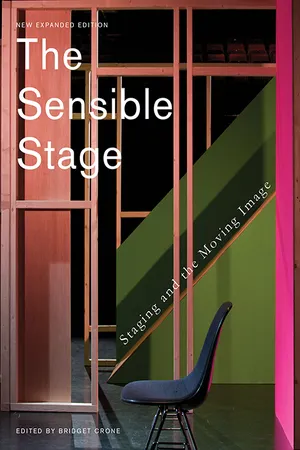
Exploring the use of live performance and the moving image in contemporary art practice, The Sensible Stage brings together essays that examine how elements from theater and cinema are integrated into art, often in order to question the boundaries and mediations between the body and the image. Opening with a discussion between prominent philosopher Alain Badiou and Elie During, this book offers a unique mixture of theoretical, creative and discursive reflections on the meeting of stage and screen.
This revised and expanded edition includes two new chapters that offer an updated look at how these ideas continue to develop in contemporary art practice.
This revised and expanded edition includes two new chapters that offer an updated look at how these ideas continue to develop in contemporary art practice.
Frequently asked questions
Yes, you can cancel anytime from the Subscription tab in your account settings on the Perlego website. Your subscription will stay active until the end of your current billing period. Learn how to cancel your subscription.
At the moment all of our mobile-responsive ePub books are available to download via the app. Most of our PDFs are also available to download and we're working on making the final remaining ones downloadable now. Learn more here.
Perlego offers two plans: Essential and Complete
- Essential is ideal for learners and professionals who enjoy exploring a wide range of subjects. Access the Essential Library with 800,000+ trusted titles and best-sellers across business, personal growth, and the humanities. Includes unlimited reading time and Standard Read Aloud voice.
- Complete: Perfect for advanced learners and researchers needing full, unrestricted access. Unlock 1.4M+ books across hundreds of subjects, including academic and specialized titles. The Complete Plan also includes advanced features like Premium Read Aloud and Research Assistant.
We are an online textbook subscription service, where you can get access to an entire online library for less than the price of a single book per month. With over 1 million books across 1000+ topics, we’ve got you covered! Learn more here.
Look out for the read-aloud symbol on your next book to see if you can listen to it. The read-aloud tool reads text aloud for you, highlighting the text as it is being read. You can pause it, speed it up and slow it down. Learn more here.
Yes! You can use the Perlego app on both iOS or Android devices to read anytime, anywhere — even offline. Perfect for commutes or when you’re on the go.
Please note we cannot support devices running on iOS 13 and Android 7 or earlier. Learn more about using the app.
Please note we cannot support devices running on iOS 13 and Android 7 or earlier. Learn more about using the app.
Yes, you can access The Sensible Stage by Bridget Crone in PDF and/or ePUB format, as well as other popular books in Media & Performing Arts & Theatre Stagecraft & Scenography. We have over one million books available in our catalogue for you to explore.
Information
Chapter I
A Theatre of Operations: A Discussion between Alain Badiou and Elie During
ELIE DURING: Let’s start with a major question. If one grants that a politics of theatre exists, is it possible to speak of a politics of ‘theatre without theatre’? A lot has been said about avant-garde theatre abolishing the stage or the separation it implies. In some cases an avant-garde abolished the stage by promoting it as a ‘physical concrete site’, ‘a unique site without borders or barrier of any sort’, in which the placement of bodies is more important than the text, and which forms ‘the theatre of action itself’ (Artaud). One can also speak of the abolishing of the auditorium rather than the stage. In any case, what this action marks is the emergence of a new spectator who is no longer a simple spectator but also an actor or actant participating in a kind of collective creation. It is clear that contemporary performance has been heavily influenced by this gesture in the various spaces it constructs whether inside galleries or on their thresholds. But what then remains of the ‘public’ that is traditionally associated with the idea of theatre? In your opinion, is the suppression of the stage or its transfiguration capable of opening a new space, a site for the emergence of a collective subject?
ALAIN BADIOU: The relation between the stage and the public has always been a torturous problem for theatre. Think of Molière’s meditations on the duality of the public (the nobles and the bourgeois, the court and the town) or of Brecht’s concept of the dialectical division of the audience, of Agit-prop theatre in the Soviet Union, or Vilar’s idea of a ‘popular’ theatre and the vogue of happenings about 50 years ago like the more contemporary fashion of ‘street theatre’. In Greece, theatre was already a political instrument, or to be exact a function of the State. Wealthy citizens were obliged to pay for theatrical performances through a kind of tax. This is the source of the persistent idea that theatre has a political, democratic and even revolutionary function. In reality, as I have argued ever since my essay ‘Rhapsody for the Theatre’, theatre is bound to the State; it is a public mediation between the state and its exterior – the crowd, gathered together. And just as circulation occurs in both directions (from power towards the crowd and from the crowd towards power), theatre is entirely ambiguous. It is the point at which a certain audacity of the State encounters the intellectual resources of what is collective, gathered together and public. Louis XIV himself funded Molière’s materialist adventures, and in France popular theatre just like street theatre is still funded by the State. I don’t think abolishing the stage radically changes this situation. It is merely a formal transformation and the theatre has seen many of those. Why would a crowd which does not revolt against flagrant injustice actually constitute itself as a collective subject through the grace of a theatrical summoning? The ambiguity of the situation of theatre can only continue. Theatre is an art and art will always be a site divided between subversion and institution, contemplative passivity and active rupture, the State and the crowd, creation and the market. An important work displaces these frontiers but it cannot abolish them.
ED: But then if the political virtue of theatre resides in its position, the question arises of what remains of that position in performance art. If we define ‘theatre without theatre’ as a form of pure theatricality, a modality of the presence of bodies freed from representation, performance comes down to the organization, according to an intention to create art, of an immediate experience of being-together. Consequently is there not a risk that performance will fall into a degraded form of ‘ethical’ theatre consecrated to revealing either the performativity at work in social exchange or – by staging suffering or mistreated bodies – increasing awareness of the vulnerability of beings and the relation between beings? In fact, just to focus a little, could we return to what constitutes for you the specificity of theatre?
AB: I think that there is theatre as soon as there is a public exhibition, with or without a stage, of a desired combination of bodies and languages. The exhibition of the body alone we will name ‘dance’ and of language alone ‘reading’, even if no written text pre-exists. Theatre is the intersection of the two. Moreover it displays elements external to the languages’ / bodies’ duality such as images, screens and activities (painting, sculpting or throwing objects, etc.), but these elements simply introduce new dimensions of the body (violence, nudity, sex, imaged deformations, etc.) or of language (soundscapes of all types, mixes of languages, music, etc.). In this framework an insistence on a particular aspect of theatricality, like the contemporary impact on theatre of all the forms of dance or an emphatic use of violence on bodies, would in fact express ideological demands like those you mention: focusing on the fragile life of bodies, on threats to the entirety of what is conceived as ‘natural’, hostility to any strict coding of individual life, dissipation of the frontier between public and intimate life, etc.. The problem is that these demands simply reflect contemporary subjectivities rather than presenting a genuine movement for their transformation. What needs to be found – whilst accepting the formal transformations – is a more affirmative element, or rather, to take up Brecht’s terms, a didactic element. The question of the relation between theatrical action, performance and politics cannot be reduced to the radicality of gestures. It supposes that all of this be integrated within a larger vision of the challenges of the contemporary epoch.
But before one even gets to that point, perhaps it is not so easy to ‘exit’ theatre or internally annul it. In fact, theatre cannot be reduced to the stage and its perspective or to the interpretation of a pre-existing given (a text or a protocol for improvisations…). Theatre is a complex ordering system whose material series is not set in stone: texts of course, but also bodies, costumes, the set, the site, music, light… This set is neither closed nor for that matter infinite. But it is in this set that the theatre-Idea must pass; that is, what theatre makes truth out of in the pure present of the material ordering itself. Suppose that someone does nothing more than imperceptibly emphasize everyday gestures to the point of being apparently indiscernible from the ‘audience’ in which he is operating given that these gestures could just as easily be the ‘natural’ gestures of an audience member. It would be a case of theatre and not of the absenting of theatre. Why? Because the underlying idea – that every relation to the body can support a performance – can only be transmitted in the present of its material ordering; thus the terrestrial ‘passage’ of the idea will be co-extensive with its immediate activation. It is for exactly the same reason that Duchamp’s first ready-mades could not escape the status of the visual arts (painting, sculpture, etc.). In these arts, the passage of the idea is co-extensive with the showing of a material form with a contour, however blurred the latter may be. As soon as the display of an indeterminate object can be perceived as the display of the latter’s contour, as a local staging of its materiality, the display has a ‘plastic’ relation to the idea. However an indeterminate corporeal action, once it is grasped as deliberate or ‘working’, enters into the ‘scenic’ arts; it enters dance, mime or theatre. No doubt one could in the end reduce the ideal types of the visual arts (leaving out pure music for the moment) to a transcendental aesthetic. If the displaying gesture that indicates the idea organizes the primacy of space (or the contour) over time one has a case of ‘plasticity’. If the display organizes the evident primacy of time over space, one has ‘theatre’. In both cases the subordinate term (time or space) is not suppressed but organized by the other term. I have always seen this in the use of videos as an intervention, whether they are theatrical (incorporated within a display in the present moment, in a slice of time) or ‘plastic’ (abandoned to their repetitive destiny in a museum room and thus primarily placed in space). The intellectual effect is not the same because the idea that arises in the two cases (if an idea arises) is not presented in identical transcendental systems. So I would quite willingly posit that in principle the most indiscernible performance of everyday gesture remains theatrical in the sense in which Duchamp’s readymade remains plastic. When it is a question of determining the artistic register or the formal genre, the gesture and its placement are more important than the exceptional or indeterminate, invented or repeated nature of ‘what is’ shown by the gesture in its site.
ED: To sum up, in what is paradoxically designated as ‘theatre without theatre’, the reference to theatre is not merely residual: perhaps it is due to an essential dimension of all performance which is that of thinking in relation if not to a text to be interpreted at least to instructions or statements to be performed, that is, complemented or used as rules which can then be revised. Without such a relation what is it that is performed? What would distinguish performance from the execution of a task in somebody’s ordinary life even if that somebody be an artist? The theatre-Idea passes via a material ordering which implies statements, even if they be invisible or inaudible. Only in the limit case of the happening with spontaneism is there an aim to emancipate performance from such rules. But it is not because room is made for chance and improvisation that something like an instruction is not implicitly at stake: ‘let the party begin!’ is still a statement – the zero degree of the script. Between the idea and the act there is the statement. Hence George Brecht’s ‘events’ and some of Allan Kaprow’s ‘activities’ evoke a kind of restricted theatre (in the sense of ‘restricted action’). Speech and the text are reduced to instructions or minimal declarations which are not necessarily performatives in the linguist’s sense. Could this be compared to Beckett’s theatre and his singular montage of gestures and statements?
AB: This is an entirely different register, but one of considerable importance. It’s a question of knowing whether the theatre of representation has been succeeded or not by a theatre of operations. In more general terms it’s a question of whether the display of the theatre-Idea ceded its place to the construction of that idea, such that the codes of that construction are themselves visible or shown? In my opinion, the question of the place of ritual, of improvisation, of chance, and that of a spatial relation which is either orientated or not between what is shown and the audience, all of this comes down to discussing – in reference to the most recent experimentation – the relationships between the visible and the invisible in theatrical (or non-theatrical) action.
Here I call ‘invisible’ the instructions or statements which you rightly identify as being ‘between’ the idea and the act. For a long time these instructions were half hidden – because they were only present during the rehearsals – or half visible – inasmuch as the Brechtian director wanted to reveal or explain them in the programme. In order to complete the passage from a theatre of display to a theatre of construction (or process) there must definitely be a revision of the nature and place of instructions. The first form of that revision was for just over a century the increasing importance of the director. At the frontier of the visible and the invisible he was the man of instructions (or axioms of performance). Performance, along with the invasion of the stage by schemas drawn from dance or corporeal practices, clearly indicates the end of the century of the director. But that end should in no way be confused with the end of theatre. This is like believing that the end of metaphysical construction in its limited classical schema – implying a theology – is the end of philosophy. The end of the idea of a director of the world is in no way the end of any idea of the world. Theatre has existed for a long time without the separated figure of the director and it will continue without it.
The entire question lies in knowing what will then localize the instructions, however random the latter might be. My feeling is that they will become more and more abstract and not corporeal or collective. We are headed, and this is my prophecy, towards an austere theatrical mathematics.
ED: Let’s enter into the detail of this large-scale history: the emergence of a theatre of construction, then of a theatre of process which would seem to find its logical development in the idea of a ‘theatre without theatre’. At the turn of the century a revolution occurred in theatre which in a certain way prefigured the turn of visual arts towards performance. You often underline the importance of Meyerhold, and not only for the ‘new theatre’. In what manner does Meyerhold form an event for you rather than, say, Stanislavsky? What exactly did he change in the idea of theatre?
AB: Stanislavsky, whose work is nevertheless incredibly complex, was mainly interested in what I would call the constructive invariables of theatre: at the centre, the construction of the character. The temporal dynamic of the actor is fundamental. As always, the theatre idea is submitted to time, but within a constructive and organized vision of the effects which bring about its manifestation. With Meyerhold it is the collective present which becomes decisive. It is not temporality which is constructive but the artificial display of the present as action. Theatre must primarily indicate how it fuses an active conception of thought with material sequences that frame and exhibit the present as fiction. What’s more, the evolution of this fiction has indicated its fragility and division since the active present can just as easily be that of the crucified body, of mystical dialectics (the sublime and the abject), as that of the didactic of choices, of the organized staging of conditions that surround the absolute present of a decision. Indeed, Artaud and Brecht indicate two different ways of being faithful to the Meyerhold event. But in both cases there is performance since no invariant of the type ‘character’ can be separated from the artifice of a present such as that delivered immediately and collectively by theatre. There is also performance in that all of the tenses of action count equally. We know that for Brecht every scene must be organized according to an energy which makes it comparable to the entire play. Nor can the mystique of cruelty, of the unbearable real, ‘expect’ the systematic and referential construction to which Stanislavsky was attached. It’s true that with Meyerhold the passage of ideas in theatre no longer had to occur via representational mediation. The route was open for performative exercises.
ED: These exercises are often described today according to the paradigm of the game: from Wittgenstein’s language games to notions of interactivity and participation tied to happenings and media art. It’s as though what is expected of games or of play – and yet they have always formed one of the fundamental dimensions of theatre – is that they loosen theatre up… But on the side of the game there is also ceremony and then ritual. Finally there is the feast. How can the theatrical apparatus integrate or evoke these different figures of performance?
AB: I believe that theatre has always oscillated between two extremes. On the one hand there is the public taking sides, its commitment, a kind of tendency towards collective fusion whose more or less secret paradigm is the orgy. On the other hand there is the distance and contemplative passivity of a silent and captivated public who attend a ceremony whose paradigm is often celebration, of a religious character. To put it in your terms: the feast and the ritual, or the farce and the tragedy, Aristophanes and Aeschylus; or in the language of the romantic authors, the grotesque and the sublime. When Boileau tells us he does not recognize ‘the author of The Misanthrope in the ridiculous sack in which Scapin wraps himself’, he is simply telling us that a genius like Molière circulates freely between the two extremes. Say that it is the sublime of ornamented, statuesque and rarefied bodies that dialectically corresponds to the living abjection of dancing sexed and provocative bodies. Do happenings and new technologies really affect this situation? I don’t think so. They introduce new liberties, of course, tied to the contemporary ideology – which is materialistic and democratic. They serve a tendency which I would term vitalist, and which moreover refers in philosophy to Deleuze: performance as a pure immanent becoming opposed to representation or reflection. However, one can easily recognize in this figure the ‘orgiastic’ tendency present since the very origin.
ED: This tendency that you have identified is inseparable from the promotion of the body or of certain dimensions of the body (which could be, if need be, that of the artist-performer, exhibited in its naked presence). Under what conditions can the body be the bearer of new forms and significations?
AB: I summed up what I believe to be the dominant ideology today, after the death of God and under the abstract sovereignty of the market, with the formula ‘there are only bodies and languages’. The replacement of the space of the stage, which supposes a privileged axis of vision and thus a kind of transcendence, by the immediacy of the body and its nomadic delocalization, is quite simply the artistic projection of that ideology. This projection is quite normal and its consequences must be explored. However it is highly questionable whether it can be seen itself as a subversion or a radical aesthetic because it is first of all, quite simply, an ideological contemporaneity. Here we have a possible milieu for the invention of forms and significations, just as the stage was able to form the possible milieu for the Brechtian rupture but one must not confuse the new sites of invention with the invention itself.
ED: Even so, the celebration of the immediacy of the body is not the only orientation in performance. But it is true that representatives of this tendency, Kaprow in the first line, primarily reproach theatre for the artificial nature of its apparatus. Of course one can always respond to this by pointing out that artifice is always present in one form or another up to and including the modes of presentation of the performing body. The heritage of pantomime, of the theatre of marionettes, of the Balinese theatre dear to Artaud, of the scenic discipline of Oskar Schlemmer or the biomechanical exercises of Meyerhold is still evident in certain contemporary compositions. With the intervention of prostheses and machines these compositions contradict the celebration of the presence of bodies traversed by Life. In your opinion what is at stake in this re-evaluation of artifice as means for art?
AB: A crucial question has emerged here. Whatever its site, closed or open, scenic or nomadic, close to or distant from itself, theatre is always a public meditation on the relation or non-relation between artifice and life. Every text in the theory of theatre, from Aristotle to Brecht or Grotowski via Diderot or Meyerhold, deals with this question. The actor or performer is at the centre of this meditation because he or she is the focal point of the conjunction-separation of the two. The actor is the living being who sacrifices, or on the contrary, exhibits vital spontaneity at the service of a collective effect. The problem is always one of either dissimulating artifice under the norm of the natural, or displaying artifice such that the received forms of the natural can be criticized, or showing that any ‘nature’ is an artificial construction, or even ‘naturalizing’ artifice. I think this last tendency is the most frequently investigated today. The force of technology and its side effects is such that it is tempting to theatricalize it by showing both its prominence and its ultimate defeat via its absorption by life. A kind of monstrous equivalency has been established between vital organs and metallic chimera, thus proposing a new type of unstable equilibrium between artifice and life. Some of David Cronenberg’s films explore the same d...
Table of contents
- Cover Page
- Title Page
- Copyright
- Dedication
- Contents
- Acknowledgements
- Introduction
- Chapter I
- Chapter II
- Chapter III
- Chapter IV
- Chapter V
- Chapter VI
- Chapter VII
- Chapter VIII
- Chapter IX
- Chapter X
- Chapter XI
- Chapter XII
- Contributors
- Back Cover