eBook - ePub
Available until 23 Dec |Learn more
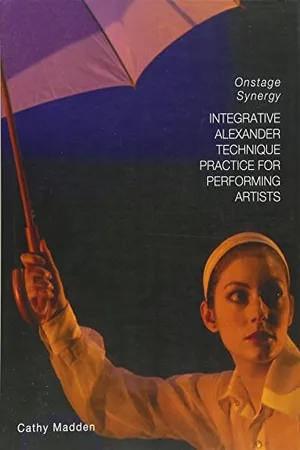
Integrative Alexander Technique Practice for Performing Artists
Onstage Synergy
This book is available to read until 23rd December, 2025
- 400 pages
- English
- ePUB (mobile friendly)
- Available on iOS & Android
eBook - ePub
Available until 23 Dec |Learn more
About this book
An educational method used to improve performance, the Alexander Technique teaches people to replace unnecessary muscular and mental effort with consciously coordinated responses, maximizing effectiveness while also relieving, if necessary, any chronic stiffness or stress. Integrative Alexander Technique Practice for Performing Artists presents the empirical research of Cathy Madden, a teacher and coach with more than thirty-five years of experience with the technique. She addresses common concerns, such as concentration, relaxation, discipline-specific techniques, warm-ups, performer/audience relationships, stage fright, and critical responses, and explores the role of the senses, emotions, learned behavior, human consciousness studies, and neuroscience in the application of the techniques.
Frequently asked questions
Yes, you can cancel anytime from the Subscription tab in your account settings on the Perlego website. Your subscription will stay active until the end of your current billing period. Learn how to cancel your subscription.
No, books cannot be downloaded as external files, such as PDFs, for use outside of Perlego. However, you can download books within the Perlego app for offline reading on mobile or tablet. Learn more here.
Perlego offers two plans: Essential and Complete
- Essential is ideal for learners and professionals who enjoy exploring a wide range of subjects. Access the Essential Library with 800,000+ trusted titles and best-sellers across business, personal growth, and the humanities. Includes unlimited reading time and Standard Read Aloud voice.
- Complete: Perfect for advanced learners and researchers needing full, unrestricted access. Unlock 1.4M+ books across hundreds of subjects, including academic and specialized titles. The Complete Plan also includes advanced features like Premium Read Aloud and Research Assistant.
We are an online textbook subscription service, where you can get access to an entire online library for less than the price of a single book per month. With over 1 million books across 1000+ topics, we’ve got you covered! Learn more here.
Look out for the read-aloud symbol on your next book to see if you can listen to it. The read-aloud tool reads text aloud for you, highlighting the text as it is being read. You can pause it, speed it up and slow it down. Learn more here.
Yes! You can use the Perlego app on both iOS or Android devices to read anytime, anywhere — even offline. Perfect for commutes or when you’re on the go.
Please note we cannot support devices running on iOS 13 and Android 7 or earlier. Learn more about using the app.
Please note we cannot support devices running on iOS 13 and Android 7 or earlier. Learn more about using the app.
Yes, you can access Integrative Alexander Technique Practice for Performing Artists by Catherine Madden in PDF and/or ePUB format, as well as other popular books in Media & Performing Arts & Performing Arts. We have over one million books available in our catalogue for you to explore.
Information
Part One
Performing Artists’ Foundation for Using the Alexander Technique
Chapter 1
An Actor Began This
Imagine that you are an actor having trouble with your voice. You consult all the voice and speech teachers and medical people you know, and still the trouble persists. Then imagine that an important theater invites you to perform your one-person show on its stage... in two weeks. What do you do?
What Australian actor F. Matthias (F.M.) Alexander (1869–1955) did was to consult his doctor. The doctor told him not to speak until the performance two weeks later. F.M. did as he was told and began his evening of solo Shakespeare in full voice. Sometime during the performance, he lost his voice and apparently ‘croaked’ his way to the finish.
He returned to his doctor, who couldn’t explain what had happened. Alexander asked, ‘Is it not fair, then, to conclude that it was something I was doing that evening in using my voice that was the cause of the trouble?’ (Alexander 1984: 8). After all, he had had his voice at the beginning of the performance, just not at the end. The doctor agreed, yet wasn’t able to give Alexander any more guidance.
Although this was bad news for Alexander, it would become good news for us, as it sent him on a journey of discovery that resulted in what we now call the Alexander Technique. Fairly early in this extended exploration (which is thought to have taken seven to nine years), Alexander’s voice improved. However, he continued to investigate, as it became evident that his work offered more than voice improvement. While he was discovering more effectiveness in his own behaviors, his friends noticed how he was changing and wanted him to share what he was doing. And so he experimented with teaching others what he was himself learning.
Alexander’s initial experiments revolved around the act of communicating. He wanted a process he could use on his own while acting. He had little use for a passive technique that could be done to him, nor anything utilized separately from his acting process. He needed something that would work in action. This quality of the Alexander Technique – that it can be used while you are in action or activity – sets it apart from many other psychophysical techniques, particularly for those of us who are professional communicators.
What does it do for performers?
Michel Saint-Denis is the acting teacher probably responsible for the inclusion of the Alexander Technique in many acting training courses. He designed the programs at RADA, Juilliard and the Comédie-Française. In his book Training for the Theatre, he says:
‘The Alexander Technique, invented by F. Matthias Alexander and described in his book The Use of the Self, is a method by which the student can free himself of postural bad habits and become aware of the meeting point of his body and mind. At the same time the Technique corrects the alignment of his body and his coordination in general’.
(Saint-Denis 1982: 105)
Performers have been advocates for the Alexander Technique throughout its history. Anecdotes about its effectiveness come from all the performing arts. When a physician who was also a professional musician came to my studio in pain from how he was playing, his first words were ‘I don’t believe in all this hooey hooey stuff, but my musician friends say that this works, so show me’. Some months later, he reported that he had said to a fellow surgeon who complained of back pain during a long surgery, ‘I told you to study the Alexander Technique. My back doesn’t hurt’.
In an interview with Jean-Louis Rodrigue, Trisha Brown said, ‘The Alexander Technique helps to integrate the individual dancer plus all the systems that he or she has been exposed to’ (quoted in Rodrigue 1986: 5). Evangeline Benedetti, former cellist of the New York Philharmonic, said in an article for Direction magazine, ‘The Alexander Technique has become an integral part of my playing and performing. My playing has become easier, my movements more graceful, the ability to express myself musically has become more immediate and supple’ (Benedetti 1991: 305). Performers know that something about this process works!
Performer’s Chronicle
I was a guest pianist in a singing class at the University and you asked if I’d like a turn as well. I definitely felt a change, but what was more profound was I heard a difference in the sound of my playing, actually hearing the arm weight rest into the piano bed and the resulting warmer, richer sound we all strive for. (J.C.)
My personal story
In graduate school at Washington University in St. Louis, my first experience of the multifaceted usefulness of the Alexander Technique occurred when I played Cordelia in a university production of King Lear, with Morris Carnovsky as Lear. Carnovsky was one of the original members of the Group Theatre, had played Lear all over the world and was an alumnus of Washington University. Given this amazing opportunity, I worked diligently to prepare for the role. Performing with Carnovsky was as powerful an experience as I had imagined, and I was proud of my work and grateful for having played Cordelia.
A few months after the show closed, Marjorie Barstow came to the university to teach a workshop. I asked her to help me with one of Cordelia’s monologues – the recognition speech. In the play, when I began this monologue, I moved my hand toward Carnovsky, who as Lear was sleeping in front of me:
Oh my dear Father, restoration hang 25
Thy medicine on my lips, and let this kiss
Repair those violent harms that my two sisters
Have in thy reverence made!
I had always wanted my hand to move toward his face in a way that carried all of Cordelia’s love with it. And I could never quite get my hand to do what I wanted – no matter what I said to myself, it looked stiff. As Marjorie Barstow helped me to use the Alexander Technique to speak the monologue, my hand did what I had always wanted it to do. (This is the increase in physical range/flexibility Saint-Denis refers to.)
I continued to speak:
Had you not been their father, these white flakes 29
Had challenged pity of them.
Suddenly my voice was responding to my ideas about the text and its expression. I had done okay with this while performing the role, and now my voice was working more than okay. (This is Saint-Denis’s increase in vocal range/flexibility.)
Was this a face 30
To be opposed against the warring winds?
To stand against the deep dread-bolted thunder?
Suddenly I realized that some of the words meant something more, something different than what I had thought. I was experiencing more of what Cordelia was doing with her words and actions. (This is an instance of ‘the meeting place between mind and body’.)
In the most terrible and nimble stroke 34
Of quick, cross lightning? To watch – poor perdu! –
With this thin helm?
(Shakespeare 1974 IV, vii)
At this point, I was so overwhelmed that I could not continue. I had had strong acting moments before, but how they happened was always a bit of a mystery. This was no mystery – I consciously used the Alexander Technique, and all that I had done on the role and this monologue was working beautifully. Moreover, I was also expanding my understanding and expression in real time.
The experiences that created my career choice
My ‘Cordelia experience’ verified for me that the Alexander Technique was incredibly useful in doing work I cared about. Due to the circumstances surrounding the production of King Lear, I had worked on the role for six months, pouring every ounce of what I knew into this preparation. With the Alexander Technique, my ability to carry out the results of my research and rehearsal increased exponentially. While I felt some sorrow that I had not known how to do this during production, my overwhelming experience was joy at finding a technique that – at last – helped me integrate all my tools toward my desired end.
Since ‘having a day job’ is a reality for most young performing artists, my elation in discovering the Alexander Technique grew into a decision to learn how to teach it. I described this choice to people this way: ‘Actors work so hard to do something that they care about. They deserve to know this work’.
In an interview with Marjorie Barstow for the ‘Nebraska Oral History Project’ – which I had access to because my theater company created a play based on the histories – she was asked how she had decided to study and teach the Alexander Technique. I was fascinated to learn that her initial motivation was similar to mine – though her art form was dance:
‘I got involved in it just because I was interested in the fact that many people in the performing arts – after they have studied a fairly long time, it seemed to me – in those days they did not continue to improve the way they should for the amount of time they spent and I was trying to answer that question. And I couldn’t. I could never answer because it never seemed logical to me. I figured that the more a person studied there ought to be a little more improvement that I could see. And when I came across the Alexander work I felt, “Well maybe this is something I’d like to know about”’.
(DePutron & Barstow 1980)
I remained artistic director for Washington Street Players Place, a small theater company in Lincoln, Nebraska, throughout my studies with Barstow. We had weekly workshops in which my focus was the application of the Alexander Technique to theater techniques of all kinds. Theater artists need a wide range of skills: I loved to dance and had taken dancing classes throughout my childhood. As a theater student, I took more dance classes, as well as singing lessons and vocal training of all kinds. Due to personal friendships in undergraduate school at Penn State University, I spent a lot of time with musicians, took music history courses so as to become more fluent in their language, and attended many recitals. Unknowingly, I was building the background, skills and language I would need to work with performing artists of all kinds.
While my home base has always been the theater, my experience coaching other performing artists dates back to my first Alexander Technique studies. At Washington University in St. Louis, I began working with a small group of musicians at about the same time I started to learn the Alexander Technique. I wasn’t teaching them the Alexander Technique per se, but rather Performance Skills – acting skills for musicians. We all realized that they needed more information about how to relate to an audience. Their lack of knowledge often showed up as discomfort that limited their technique and ultimately affected their enjoyment of performing. As they learned new ways to think about performance and being with their audience, they played more consistently at their optimal musical level. They and their audience also had a better experience! This showed me that coordination in non-theater performers was affected by an understanding of performer/audience communication skills – or a lack thereof.
The simple start
The Alexander Technique provides us with keys to cooperating with our magnificent design, beginning with a constructive process for cooperating with the relationship between head and spine that is inherent in vertebrate coordination. The next chapter introduces the processes that ameliorate your ability to perform as you desire. These simple ideas, which begin with talking about head and spine in movement, create conditions in you that have profound implications for your work.
Chapter One – An Actor Began This
Performance Practice – Key Learning
F.M. Alexander’s journey that led to what we now call the Alexander Technique began with a desire to do something in his life – he wanted to recite Shakespeare. One of my practices at the start of every class and workshop is to renew my desire to use this psychophysical process, and also to ask my students to consider what desires have led them to the class. The desire to do something is the first step in the Alexander Technique. You may desire to keep a journal to record your Performance Practice explorations.
One
Identify situations in which you might choose to use the Alexander Technique. (e.g. actors might use the Alexander Technique for a particular warm-up exercise; musicians might use the Alexander Technique to play scales; dancers might use the Alexander Technique when doing pliés, etc.). Consider skills you want to build, as well as others that somehow aren’t working for you. You might also have ideas or performance concepts you want to explore – focus, preparation and so forth.
Two
How do these choices relate to your g...
Table of contents
- Cover Page
- Title Page
- Copyright
- Contents
- Dedication
- Acknowledgements
- Introduction
- Part One:Performing Artists’ Foundation for Using the Alexander Technique
- Part Two: Alexander Technique Revivification of the Journey of Performing
- Part Three: Onstage Synergy
- Appendix One: AT Rehearsals Reference Guide
- Appendix Two: Finding an Alexander Technique Teacher
- Appendix Three: Performance Chroniclers
- Appendix Four: Keynote Address, Alexander Technique and Performing Arts Conference
- Works Cited
- Index