eBook - ePub
Available until 23 Dec |Learn more
Across the Art/Life Divide
Performance, Subjectivity, and Social Practice in Contemporary Art
This book is available to read until 23rd December, 2025
- 256 pages
- English
- ePUB (mobile friendly)
- Available on iOS & Android
eBook - ePub
Available until 23 Dec |Learn more
Across the Art/Life Divide
Performance, Subjectivity, and Social Practice in Contemporary Art
About this book
Martin Patrick explores the ways in which contemporary artists across media continue to reinvent art that straddles both public and private spheres. Examining the impact of various art movements on notions of performance, authorship, and identity, Across the Art/Life Divide argues that the most defining feature of contemporary art is the ongoing interest of artists in the problematic relationship between art and life. Looking at underexamined forms, such as stand-up comedy and sketch shows, alongside more traditional artistic media, he situates the work of a wide range of contemporary artists to ask: To what extent are artists presenting themselves? And does the portrayal of the "self" in art necessarily constitute authenticity? By dissecting the meta-conditions and contexts surrounding the production of art, Across the Art/Life Divide examines how ordinary, everyday life is transformed into art.
Frequently asked questions
Yes, you can cancel anytime from the Subscription tab in your account settings on the Perlego website. Your subscription will stay active until the end of your current billing period. Learn how to cancel your subscription.
No, books cannot be downloaded as external files, such as PDFs, for use outside of Perlego. However, you can download books within the Perlego app for offline reading on mobile or tablet. Learn more here.
Perlego offers two plans: Essential and Complete
- Essential is ideal for learners and professionals who enjoy exploring a wide range of subjects. Access the Essential Library with 800,000+ trusted titles and best-sellers across business, personal growth, and the humanities. Includes unlimited reading time and Standard Read Aloud voice.
- Complete: Perfect for advanced learners and researchers needing full, unrestricted access. Unlock 1.4M+ books across hundreds of subjects, including academic and specialized titles. The Complete Plan also includes advanced features like Premium Read Aloud and Research Assistant.
We are an online textbook subscription service, where you can get access to an entire online library for less than the price of a single book per month. With over 1 million books across 1000+ topics, we’ve got you covered! Learn more here.
Look out for the read-aloud symbol on your next book to see if you can listen to it. The read-aloud tool reads text aloud for you, highlighting the text as it is being read. You can pause it, speed it up and slow it down. Learn more here.
Yes! You can use the Perlego app on both iOS or Android devices to read anytime, anywhere — even offline. Perfect for commutes or when you’re on the go.
Please note we cannot support devices running on iOS 13 and Android 7 or earlier. Learn more about using the app.
Please note we cannot support devices running on iOS 13 and Android 7 or earlier. Learn more about using the app.
Yes, you can access Across the Art/Life Divide by Martin Patrick in PDF and/or ePUB format, as well as other popular books in Art & Art General. We have over one million books available in our catalogue for you to explore.
Information
CHAPTER ONE
Art and How to Live It:
Artists Performing Themselves (and Others)
What I’m trying to describe is that it’s impossible to get out of your skin and into somebody else’s. And that’s what all this is a little bit about. That somebody else’s tragedy is not the same as your own.
—DIANE ARBUS, C. 19701
Becoming aware that the body is merely a tool of the soul is a great achievement. I feel like an astronaut in the spacesuit of my own body; I’m a trapped soul. [...] I think the Song of a Skin Bag by the Chinese Master Xu Yun, a treatise on the transience and fleeting nature of the body, made many things clear to me. The body serves as an outfit, an address.
—PAWEL ALTHAMER IN CONVERSATION WITH ARTHUR ZMIJEWSKI, 19972
She is that outsider who experimentally drifts into other people’s lives and slips on their skins.
—CRITIC GUY TREBAY ON ARTIST NIKKI S. LEE, 20043
I’ve got to lose this skin I’m imprisoned in Got to lose this skin I’m imprisoned in [...].
—“LOSE THIS SKIN”, THE CLASH, 1980 (WRITTEN AND PERFORMED BY TYMON DOGG)4

Performance-related artworks that tested perceived limits and crossed numerous thresholds while generating a high amount of creative uncertainty (both on the part of the artist and the audience) became a characteristic approach within the visual arts throughout the 1960s–80s – from proto-psychedelic “happenings” to austere conceptual events to politicized art collectives. “Live art” became an elastic term not only signifying “live” (as in live performance), but art as a mode of living experience, subsequently framed, refined and (re-)produced for the art context – to live art. But this acted as an undercurrent to a prevailing emphasis (particularly in terms of the art market) upon objects, images and constructions.
Many artists emerging in the wake of postmodernism began to reinvent live art by straddling public and private realms, with increasing entanglement in late capitalist settings (for instance, the spectacular biennale exhibition and the burgeoning globalized art world). Mediation of the live event asserted itself even more strongly: video works (and now streaming video) since the 1990s bridged a gap between the original event and its later circulation and dissemination. The same period saw an increase in ambiguity concerning any political positioning or subjective locus of the artist’s identity. In a climate shaped by both art as commodity and its filtering through virtual circuits, the constructed persona of the artist became a significant, foregrounded aspect of contemporary creative practice.
In this chapter, I argue that the performative approaches of a loose amalgam of artists since the 1990s are linked by a notion of the artwork as a well-documented temporal event, unfolding from constructed (and often reconstructed) personae deriving from a personalized hybrid of the artist’s autobiography, aesthetic, and politics. The artists I am turning my attention towards enact an extended, transformative burlesque of artistic authenticity; a quest to show that what is meaningful must be gotten at through carefully elaborated yet often absurd procedures, often in dialogue with the surrounding public sphere. What does it mean to don a second skin, an artfully conceived carapace to forge ahead and contend with the world? The artists discussed here – Pawel Althamer, Bob Dylan, Gelitin, Rodney Graham, Ragnar Kjartansson, Nikki S. Lee, William Pope.L, Tony Tasset, Ronnie van Hout, and Gillian Wearing – ask this, as well as many other provocative questions.
Intriguingly, such actions coincided with artists also occupying several roles (and perhaps wearing several masks) at once. A common trait among many of these otherwise dissimilar artists from a diversity of backgrounds and artistic contexts is their hesitancy to make one singular, definitive project, but instead an inquisitive series of provisional statements, shrugs with exclamation points. In turn, these artists in their practices assert how an effective body of work may be comprised of multiple performative fragments rather than any assumed totality, thus acknowledging how partial and half-obscured our glimpses of the world tend to be. In the artists I examine, a wild humour and silliness often coexists with a faux madness and extreme, raucous behaviour.
In Mikhail Bakhtin’s study Rabelais and His World (1984, first published 1965), the literary theorist writes: “Fear is the extreme expression of narrow-minded and stupid seriousness, which is defeated by laughter. [...] Complete liberty is possible only in the completely fearless world”.5 In his writing, Bakhtin details the historical power of the “grotesque” to transform “all that was frightening in ordinary life into amusing or ludicrous monstrosities”.6 While it might seem anachronistic to be inspired by theoretical material written to interrogate the literature of the Middle Ages and Renaissance in relation to my reading of various contemporary artists, many of Bakhtin’s points are resonant with the chaotic climate of more recent years and the creative approaches of the artists under review here. Critic Gregory Volk has noted Bakhtin’s influence on artist William Pope.L, for example:
Importantly, carnival life does not seek to transcend normal life. Instead, both exist together, and one moves between the two, entering a “topsy turvical” (to borrow a term from Vladimir Nabokov) carnivalized situation in order to experience rampant eccentricity and radical freedom and then returning to one’s normal life – perhaps shaken, perhaps deepened – with some sense of the wisdom that one gained.7
One weakness of the art of “identity politics” that emerged in the 1980s and 1990s was its pronounced reductive literalism, which tended to keep “identity” from being read as “identities”; multiple yet correspondingly involved in many interwoven textures, mixing vibrantly with the paths of other people and experiences. Identity was often represented as singular, bounded, and self-reflexive, without incorporating the exterior world except in an adversarial, confrontational way. This was undoubtedly highly significant in many instances, but left little room for continued pursuit of similar methodologies without a major rethink as surrounding contexts changed – and not always for the better. This is not to in any way dismiss many of the best artists and projects of that time, but to call attention to how comparatively fragile and combustible such uneasy aesthetic positioning became. The power of several of the artists discussed here is in their concerted reworking and reassessment of how to conduct an art which both enacts and questions the inexplicable, unstable, even unlocatable strangeness of identity.
Superman – in the form of an African American artist wearing a dishevelled version of the iconic garb – crawling slowly, flattened to the ground, along a busy avenue. An Icelandic pop musician and video artist hanging around in a gallery during the Venice Biennale, strumming a guitar, drinking lager and occasionally making an amateurish painting. A Korean émigré to the US has herself photographed as she all but melts into a number of highly circumscribed subcultures. A Polish sculptor travels with selected groups wearing shiny gold spacesuits, jet passengers traversing assorted national borders.
Such an eclectic list is an intentional compression of some of the artistic approaches, projects and modalities to which I plan to turn my attention. While there is a marked diversity in terms of geographical locales, cultural backgrounds, and other demographic factors, the artists cited above add new relevance and revised meanings to one of the most integral themes of contemporary art: the blurring and questioning of the art/life divide. The attacks and skirmishes relating to this elusive borderline have occurred with such force and for so long that they have formed a ubiquitous and paradigmatic discourse throughout many histories of modern and contemporary art. From collectives to communes, one can, in a revisionist manner, turn over a lot of soil dating from the mid-to-late twentieth century to uncover the roots of the present.
I would argue that many aspects evident in recent contemporary artworks draw upon well-mapped historical trajectories, but have moved into a more difficult to define zone of experiences. By examining artists’ construction of personae, which problematize notions of the individual and selfhood, and such characters’ movement between fields of interrogation – performance and performativity, the carnivalesque and grotesquery, authorship and the mutability of identity – I assert the importance of such life/art practices in illuminating and recording experiential knowledge.
“Living Art”: Artists Inhabiting the Gallery
Ragnar Kjartansson was Iceland’s representative for the Venice Biennale in 2009. Recalling an earlier era of durational performance practice, he spent the course of the six-month-long exhibition in the pavilion space (off-site from the grandiose Giardini in a still grandiose palazzo) garbed in a bathrobe, strumming an acoustic guitar, chatting with visitors and making the occasional painting of fellow artist/model Pall Haukur Bjornsson amidst some formidable consumption of lager and cigarettes. Empty glass bottles cluttered the space; near an old-school turntable was a stack of LPs, not so current hits including The Freewheelin’ Bob Dylan (1963).
During the exhibition, the artist commented, “I think, secretly, it’s what every artist wants to do, just to sit and think and smoke and think”.8 As the retro kitschness of the set-up becomes almost too much to bear, it is also relevant to mention Kjartansson’s parallel life as a contemporary pop musician (albeit of the cultish Icelandic sort), and further that Kjartansson’s band, Trabant, in its very name harkened back to a less than supercharged vehicle manufactured in former East Germany.9
Just as pop music functions via a mix of novelty and the familiar, the art historical lineage from which Kjartansson’s well-publicized work can be traced involves many artists who also chose to “live” in the gallery: from Ben Vautier to Linda Montano, Chris Burden to Tracey Emin. And in the Venice installation’s knowingly portentous titling, The End (2009), one might ask: the end of what? Is this simply another staging of the slightly bloated finale of painting read both as farcical and as the beginning of something else; and, relatedly, does it offer up the performative event as the go-to genre of the scattered site/biennale circuit? Such a mode of practice is a staple “post-medium” of these events, often in tandem with video works (which filled the anteroom of Kjartansson’s installation).
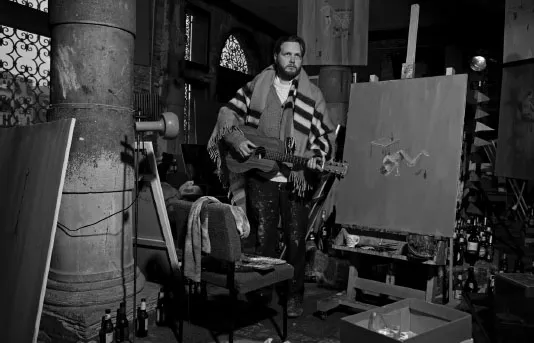
1.1 Ragnar Kjartansson, The End – Venezia (November 2009). Performed at the Icelandic Pavilion at the 53rd Venice Biennale, Italy, 14 June – 22 November, daily for six hours. Commissioned by the Center for Icelandic Art. Photo: Rafael Pinho.
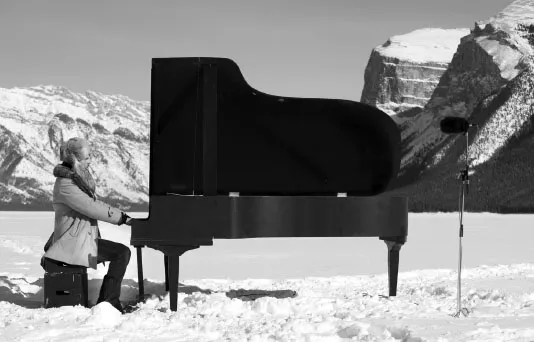
1.2 Ragnar Kjartansson, The End – Rocky Mountains (2009). Five-channel video. Duration: 30-minute loop. Commissioned for the Icelandic Pavilion at the 53rd Venice Biennale, Italy. Produced in collaboration with The Banff Centre, Canada, and the Stephan and Adriana Benediktson Fellowship for Icleandic Artists.
Here the pictorial and the performative combine as a finely calibrated and premeditated conceptual attack, each part working in tandem to deftly produce a slacker art accessible for a visual arts and pop cultural savvy twenty-first century audience.
But the slacker character is simply another invented persona as Kjartansson is a highly industrious citizen of the international art circuit, preserving an outward impression that “I’ve just fallen into this cool gig”. Kjartansson has taken on various guises in his performative videos: the dapper singer of the elongated phrase “sorrow conquers happiness” in front of an eleven-piece orchestra in the piece God (2007); or another performance entitled Sounds of Despair (2009), in which he screams/moans a loud chant while wearing a tuxedo and taped to a gallery pilaster. The atmosphere conjures some inside joke that viewers have been allowed to join in, perhaps not as equal participants but empathic onlookers. The eminently quotable artist commented: “Life is sad and beautiful, and my art is very much based on that view. I love life; I love the despair of it”.10 Whether made up as a Viking or a folk singer, Kjartansson cultivates a stance more reminiscent of television sketch comedies than the quasi-torturous rituals of artists like Marina Abramovic´ or Vito Acconci.
Kjartansson is indebted to such figures as conceptual artist and gallerist Tom Marioni or the performance artist Linda Montano. A trained musician, Marioni’s art has incorporated durational frameworks in both actual performances and performative drawings. For example, he has used the brushes of jazz drumming to repetitively create a soundscape from which emerges a highly distinctive residual image. He has also created performative works in which marks traced the acts of leaping and walking.11 Marioni founded and operated the Museum of Conceptual Art (MOCA) in San Francisco.
An early alternative space, Marioni described its ethos in the following manner:
It was simple no dance or theatre or painting or object sculpture. It’s a long story. It was a one horse operation, no money changed hands and nothing was ever sold and it was open and free to the public. It was socialist because nothing that was installed into the building could...
Table of contents
- Cover Page
- Copyright
- Title Page
- Contents
- INTRODUCTION
- CHAPTER ONE: Art and How to Live It: Artists Performing Themselves (and Others)
- CHAPTER TWO: Unfinished Filliou: On the Fluxus Ethos, Origins of Relational Aesthetics, and the Potential for a Non-Movement in Art
- CHAPTER THREE: Autobiographical Voices and Entangled Identities: On Monologues and Memoirs; Comedians, Celebrity, and Camouflage
- CHAPTER FOUR: Intervals, Moments, and Events: Performative Tactics and the Reinvention of Public Space
- CHAPTER FIVE: Reenactments, Remixing, and Restaging the Contemporary
- CHAPTER SIX: Social Practices and the Shifting Discourse: On Collaborative Strategies and “Curating the Social”
- CHAPTER SEVEN: Emergent Notions of Subjectivity and Authorship: How Might We Occupy the Present?
- ACKNOWLEDGEMENTS
- NOTES
- BIBLIOGRAPHY
- INDEX
- Back Cover