- English
- ePUB (mobile friendly)
- Available on iOS & Android
eBook - ePub
About this book
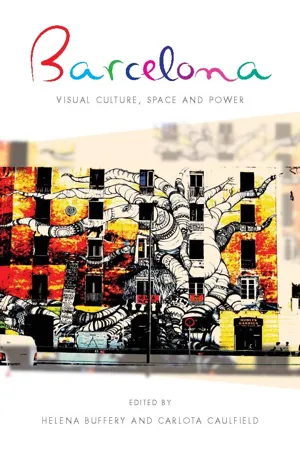
Barcelona: Visual Culture, Space and Power offers a unique approach to the history of the avantgarde in Barcelona, as well as its legacy in the post-war period. It presents the relationship between environment, identity and performance as explored by countercultural artists and communities from the 1960s to the present day.
Information
Publisher
University of Wales PressYear
2014Print ISBN
9781783160457
9780708324806
eBook ISBN
9781783161430
Part I
Avant-Garde Histories and Catalonia
Chapter 1
Breaking Boundaries: A Journey through the Catalan Avant-Garde1
The primary aim of this chapter is to provide an introduction to twentieth-century Catalan avant-garde movements and groups through a history of visual poetry. This has the advantage both of widening recognition of experimental aesthetic practices beyond Catalonia’s most famous names – Salvador Dalí (1904–89), Joan Miró (1893–1983) and Antoni Gaudí (1852–1926) – and of situating their work within the unique and complex fabric of contemporary Catalan culture. Just as a visual poem may be defined simply as an interdisciplinary artistic creation that blurs the distinction between art and text, so this chapter ranges across names associated with the visual and the verbal, from Joan Salvat-Papasseït (1893–1919) to Joan Brossa (1918–98), Joaquim Torres-García (1874–1940) to Guillem Viladot (1922–99). As well as exploring their links to international figures, movements and places, it seeks to uncover the influence of local synergies, networks and contexts, drawing not only on the poetic genealogies traced by individual practitioners, but also on extant research into Catalan sociocultural history. As many of the writers cited in this volume have testified, the vicissitudes of modern Catalan history placed enormous limitations on the sustainability of cultural movements and practices, above all in the city of Barcelona, subjected to martial law and military rule for such a significant proportion of the late nineteenth and twentieth centuries (see also Davidson, 2011). Indeed, if we recognize with Willard Bohn ‘that the crisis of the sign exemplified by visual poetry is closely linked to a crisis of culture’ (2001, p. 17), it is perhaps the regularity of these cultural crises that contributed to the diversity of visual poetic activity produced in and around this urban space. Thus, while this chapter will provide a comprehensive overview of visual poetic practices, ultimately it will not reconstruct an alternative Catalan avant-garde tradition. Instead it proposes both a historical journey and one that traverses a particular cultural space: the Barcelona that fostered such a great variety of artists and artistic practices and its relationship with the rest of the Catalan-speaking territories, Spain, Europe and the international avant-garde.
The contemporary visual poem is an ancient poetic form reinvented by the twentieth-century avant-garde. One of the names most frequently mentioned as a forefather is the Greek Simias of Rhodes (third century BC), famous for his axe and egg pattern poems; yet it is perhaps the syllogistic poems of the great thirteenth-century Mallorcan writer Ramon Llull (1232–1315) which are key to tracing the ancestry of contemporary Catalan visual poetry. If Stéphane Mallarmé (1842–98) is considered the father of modern visual poetry, it is Guillaume Apollinaire (1880–1918), composer of Calligrammes, who was to become its founder-figure in the twentieth century. The Italian Futurists played a key role, too, above all Filippo Tommaso Marinetti (1876–1944), whose parole en libertà announced the destruction of syntax and the birth of a poetic imagination without restrictions. Marinetti’s ‘words at liberty’ were particularly influential in Catalonia, resulting in visual poetry becoming a common poetic practice there, with notable experimenters such as Joan Salvat-Papasseït. Then there were the Dadaists Tristan Tzara (1896–1963) and Kurt Schwitters (1887–1948), who extended typographical experimentation on the page beyond the calligramme form. Though Dadaism – like surrealism – was not fully embraced by Catalan avant-garde poets in the early decades of the twentieth century, after World War II both would have a powerful impact on creativity, as shall be seen in the case of Dau al Set.
The post-war period saw the emergence of numerous other avant-garde movements influential in the development of contemporary visual poetics, including lettrisme, spatialism, signalism, mail art, minimalism, arte povera, fluxus and concrete poetry. Yet it was above all the latter two that would govern the direction taken by Catalan visual poetics in the 1960s. At a time of repression and cultural paralysis after the Spanish Civil War, it was the neo-surrealist Joan Brossa who was to become the champion of the avantgarde in Catalonia, along with two other seminal proponents and practitioners of visual poetry: Guillem Viladot and J. Iglésias del Marquet (1932–89). In their wake came a revitalization of visual and experimental poetry in Catalonia from the 1970s onwards. The impact of new technologies in the 1980s and 1990s changed production and reception, with Barcelona becoming an unavoidable reference point on the map of contemporary experimental poetry during these decades. The visual poets showcased at the end of the present volume – J. M. Calleja, Xavier Canals and Gustavo Vega – represent the vitality of contemporary Catalan visual poetry, and reveal a lineage made up of both local Catalan and international traditions. Heirs of Simias of Rhodes, Llull, Mallarmé, Apollinaire, Marinetti, Salvat-Papasseït, Tzara, Schwitters, Brossa and Viladot, they create powerful and original visual poems, and have produced an important body of critical works fundamental to the study of visual poetry in Spain. Like them, the journey reproduced in these pages takes its cue from the twentieth-century Catalan poet J. V. Foix’s famous line from Sol, i de dol (Alone, and in Mourning): ‘M’exalta el nou i m’enamora el vell’ (Terry, 1998, p. 44) (I’m exalted by the new, enamoured of the old).
Barcelona and Modernity
In the first third of the twentieth century Catalan culture was characterized by a pioneering spirit; Catalonia was undergoing a vertiginous process of industrialization and national redefinition, and creativity became synonymous with modernity. The city of Barcelona, in particular, was the centre of radical intellectual, political and cultural activities in Spain. To understand the peculiarities of the Catalan avant-garde it is essential to place it in historical context, tracing its relationship with the dominant movements of the time, namely Modernisme and Noucentisme (1900-ism). With a large and growing number of wealthy upper-class sponsors of the arts, a booming industry and burgeoning Catalan national pride, Barcelona emerged as the cradle of Modernisme, a movement of ‘extraordinary projection and intensity in Catalonia’ which ‘takes on at least such a sharp and transcendental personality as that of … Liberty, Secession, Art Nouveau, Jugendstil or the Modern Style’ (Bohigas, 1968, p. 225). Intellectuals associated with Modernisme promoted not only architecture but fields as diverse as sculpture, painting, furniture, jewellery, music, literature and the graphic arts. Many Modernista artists expressed explicitly their aspirations to achieve a Catalan national style. The best known exponent of Modernisme internationally – now one of the central symbols of the Barcelona brand – is Antoni Gaudí, who continued to work in Barcelona until his death in 1926, even though he had by then fallen out of favour with the changing aesthetic tastes of the times. Later he would be reclaimed by the surrealists for what Salvador Dalí described as his ‘edible architecture’ (1933, p. 74). Another pioneer figure was Apel·les Mestres (1854–1936), a writer, draughtsman and musician who made his name as an illustrator. His conception of books as total art objects led him to be considered a poeta-artista; it is his alphabet with anthropomorphic letters – created by using a clown in different poses – that is most admired by contemporary Catalan visual poets (Canals, 1999b, p. 17).
By 1906, artists and intellectuals associated with Noucentisme had begun to attack what they considered the aesthetic excesses of Modernisme, advocating a return to a Mediterranean classicism based on sound judgement and civility (or seny). Coined by the essayist, philosopher and art critic Eugeni d’Ors (‘Xènius’, 1881–1954), Noucentisme ‘was founded on concepts such as structure, rhythm, harmony and order, and presented as an exercise in organization as opposed to the emotionalism and spontaneity of modernista art’ (Suàrez and Vidal, 2006, p. 227). The leading ideologue of the movement, Xènius disseminated his ideas in a Glosari [sic] that was published daily in the main conservative Catalan organ La Veu de Catalunya. Other important literary figures of the time included Josep Carner (1884–1970), Jaume Bofill i Mates, ‘Guerau de Liost’, (1878–1933) and Carles Riba (1893–1959). If the perceived conservatism of Noucentisme has at times received harsh criticism in Catalan cultural histories, and made it the bugbear of self-appointed iconoclasts such as Dalí, other critics have recognized that Catalonia would not be what it is today without the movement. Indeed, Geoff West insists that ‘the avant-garde in Barcelona needs to be seen against the background of noucentisme, at certain times emerging from it, at others provoked by it’ (2007, p. 71). In order to understand this, it is instructive to explore the development and reception of Futurism in Catalonia.
Futurisme in Catalonia
The spirit of the vanguard took hold very early in Catalonia, and local artists and writers made significant and diverse contributions to avant-garde movements between the two world wars. However, it should not be forgotten that they were working within a language and a tradition that had suffered numerous historical setbacks and still had to be ‘discovered, systematized and established, besides being constantly justified to locals and outsiders alike’ (Borràs, 2006, p. 2). As pinpointed by Laura Borràs, it is this that resulted in contradictions and paradox; for ‘[b]y identity they had to collaborate in the reconstruction of the culture of the country’, while the rules and essence of the avant-garde dictated the need to ‘fight against the institutional culture with decision and by definition’ (2006, p. 2).
If the term ‘avant-garde’ was first used in Spain by the Modernista Jaume Brossa (1875–1919), ‘who in 1892 applied it to the radical wing of Catalan Modernisme’ (Resina, 2004, p. 546), then Futurisme was actually the creation of the Mallorcan poet, essayist, educator and social visionary Gabriel Alomar (1873–1941) who employed it for the first time in a conference at the Ateneu Barcelonès on 18 April 1904. One result of Alomar’s ideas was the short-lived magazine Futurisme, which appeared in Barcelona in 1907; for Resina, he provided ‘an important link between modernistes and the small group of Catalan Futurists’ (2004, p. 546) who were active between 1916 and 1924 (see also Bohn, 1986, pp. 17–18, 85–145; Hart, 1998; Díaz-Plaja, 1932; Higgins, 1987). The Italian writer Marinetti took the term coined by Alomar and published his First Futurist Manifesto in Le Figaro in 1909. As Catalan writers reacted against the political hegemony of Castile by seeking to strengthen ties with Italy and France, it is, perhaps, unsurprising that they ‘experimented with Italian Futurism and drew heavily on French literary Cubism’ (Bohn, 1986, p. 85). Indeed, Futurism became synonymous with the avant-garde in Catalonia up until World War I (Resina, 1997, p. 17; Canals, 1999b, p. 18). Among the earliest practitioners in Catalonia were Josep-Maria Junoy (1887–1955), J. V. Foix (1894–1987), Joaquim Folguera (1893–1919) and Salvat-Papasseït. The Catalan Futurists did not form a homogeneous group ‘but rather a sporadic and transitional one’ (Borràs, 2006, p. 3) which laid down a bridge to ‘a new aesthetics that demanded a radical restructuring of art involving its most basic elements’ (Bohn, 1986, p. 90). Terms like ‘psychotype’, ‘words at liberty’, ‘figurative poetry’, ‘ideograms’ and ‘calligrams’ thus became central to the subsequent development of visual poetry in Catalonia.
As in the case of Switzerland, Spain’s neutrality during World War I attracted numerous foreign artists to the country. Like Zurich, Barcelona became a safe haven for many European artists and avant-garde figures; among them the pugilist poet Arthur Cravan (Fabian Lloyd, 1887–1918?), who arrived in the winter of 1915. In 1916, Ricciotto Canudo, poet and the first film theorist, settled in the city along with Valentine de Saint-Pont (1875–1953), poet and author of the Manifesto futurista della Lussuria (1913). The painters Robert and Sonia Delaunay (1885–1941, 1885–1979) were also there, and in 1917, the same year that Pablo Picasso (1881–1973) returned to Barcelona, the French Dadaist-surrealist painter and poet Francis Picabia (1879–1953) arrived in the city. At the time, the art dealer and gallery owner Rafael Dalmau (1867–1937) was the foremost promoter of the avant-garde in Spain, comparable in impact to dealers like Ambroise Vollard in Paris and Alfred Stieglitz in New York (Robinson, 2006, p. 305). Thanks to Dalmau, an exhibition of cubist art had been held in Barcelona’s Dalmau Galleries in 1912. He also exhibited paintings by Picasso and works by the Uruguayan painter of Catalan origin Joaquim Torres-García (1874–1940), founder of Constructive Universalism (West, 2007, p. 71). The Uruguayan Futurist painter and illustrator Rafael Barradas (1890–1929) settled in Barcelona in 1914 and became part of the growing circle of avant-garde Catalan artists and poets. In 1917, Dalmau organized an exhibition of work by Torres-García and Barradas in the Dalmau Galleries, whereas Miró held his first one-man show there in 1918.
Even so, while Barcelona was undoubtedly the central nexus of avantgarde activities in Spain during this period, it was ultimately unable to provide the setting for the kind of sustained activities generated in other modern metropolises, such as Paris. In part, this was due to the harsh political and socio-economic conditions that came with the end of World War I, culminating in Miguel Primo de Rivera’s coup in 1923 and the subsequent repression of Catalan culture. Yet it was also part and parcel of the Noucentista model for the continuing revival of the Catalan language and culture, which meant that even the more radical, Futurist and cubist-inspired writers such as Salvat-Papasseït and Junoy reined in their work to meet the more conservative trends and tastes of their contemporaries (Epps, 2006). However, as Resina has explored convincingly in relation to the former poet (1997, pp. 5–53), these writers’ trajectories help to reveal the impact of local context – such as the typographic techniques used in the anarchist press of the period – on avant-garde practice and sensibilities. Furthermore, they point to the emergence of a network of artists and activities that reached beyond the confines of the city, whose traces can be found in the avant-garde magazines of the time.
Avant-Garde Magazines
Avant-garde literary magazines played a fundamental role during these years, the most important being Troços (Pieces, 1917–18), founded by Junoy. As described by West, the magazine included a ‘mixture of art criticism and verse, often calligrammatic and related thematically to the visual arts. Editorship of Troços later passed to the poet J. V. Foix, who changed its spelling to Trossos’ (2007, p. 71). In it appeared texts by Apollinaire, Foix, Philippe Soupault (1897–1990), Pierre Reverdy (1889–1960) and Tristan Tzara; whereas Torres-García and Miró contributed illustrations. The magazine became a model for later avant-garde organs, as did those of Salvat-Papasseït, notably Un enemic del poble (An Enemy of the People, eighteen issues, 1917–19). The latter publication’s subheading, ‘F...
Table of contents
- Half Title
- Title Page
- Copyright
- Contents
- Series Editors’ Foreword
- Acknowledgements
- List of Illustrations
- List of Contributors
- Introduction: ‘Butterflying Barcelona’
- Part I: Avant-Garde Histories and Catalonia
- Part II: Butterflying Barcelona: The Environment
- Part III: Performing Barcelona
- Works Cited
Trusted by 375,005 students
Access to over 1.5 million titles for a fair monthly price.
Study more efficiently using our study tools.
Frequently asked questions
Yes, you can cancel anytime from the Subscription tab in your account settings on the Perlego website. Your subscription will stay active until the end of your current billing period. Learn how to cancel your subscription
No, books cannot be downloaded as external files, such as PDFs, for use outside of Perlego. However, you can download books within the Perlego app for offline reading on mobile or tablet. Learn how to download books offline
Perlego offers two plans: Essential and Complete
- Essential is ideal for learners and professionals who enjoy exploring a wide range of subjects. Access the Essential Library with 800,000+ trusted titles and best-sellers across business, personal growth, and the humanities. Includes unlimited reading time and Standard Read Aloud voice.
- Complete: Perfect for advanced learners and researchers needing full, unrestricted access. Unlock 1.5M+ books across hundreds of subjects, including academic and specialized titles. The Complete Plan also includes advanced features like Premium Read Aloud and Research Assistant.
We are an online textbook subscription service, where you can get access to an entire online library for less than the price of a single book per month. With over 1.5 million books across 990+ topics, we’ve got you covered! Learn about our mission
Look out for the read-aloud symbol on your next book to see if you can listen to it. The read-aloud tool reads text aloud for you, highlighting the text as it is being read. You can pause it, speed it up and slow it down. Learn more about Read Aloud
Yes! You can use the Perlego app on both iOS and Android devices to read anytime, anywhere — even offline. Perfect for commutes or when you’re on the go.
Please note we cannot support devices running on iOS 13 and Android 7 or earlier. Learn more about using the app
Please note we cannot support devices running on iOS 13 and Android 7 or earlier. Learn more about using the app
Yes, you can access Barcelona by Helena Buffery,Carlota Caulfield in PDF and/or ePUB format, as well as other popular books in Social Sciences & Art General. We have over 1.5 million books available in our catalogue for you to explore.