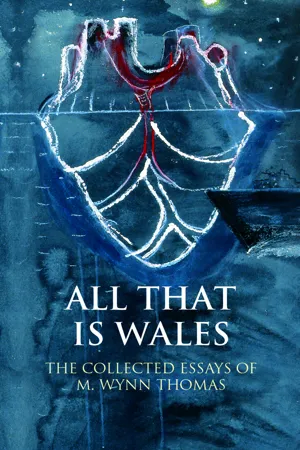
Wales may be small, but culturally it is richly varied. The aim in this collection of essays on a number of English-language authors from Wales is to offer a sample of the country's internal diversity. To that end, the author's examined range – from the exotic Lynette Roberts (Argentinean by birth, but of Welsh descent) and the English-born Peggy Ann Whistler who opted for new, Welsh identity as 'Margiad Evans', to Nigel Heseltine, whose bizarre stories of the antics of the decaying squierarchy of the Welsh border country remain largely unknown, and the Utah-based poet Leslie Norris, who brings out the bicultural character of Wales in his Welsh-English translations. The result is a portrait of Wales as a 'micro-cosmopolitan country', and the volume is prefaced with an autobiographical essay by one of the leading specialists in the field, authoritatively tracing the steady growth over recent decades of serious, informed and sustained study of what is a major achievement of Welsh culture.
- 320 pages
- English
- ePUB (mobile friendly)
- Available on iOS & Android
eBook - ePub
About this book
Trusted by 375,005 students
Access to over 1.5 million titles for a fair monthly price.
Study more efficiently using our study tools.
Information
Publisher
University of Wales PressYear
2017Print ISBN
9781786830890
9781786830883
Edition
1eBook ISBN
9781786830913
1
THE SCARLET WOMAN: LYNETTE ROBERTS
Lynette Roberts and Keidrych Rhys were married in Llansteffan on 4 October 1939. The very same month her poem ‘To Keidrych Rhys’ was published in Wales, the brash harlequinade of a literary journal established and edited (up to this particular number) by Rhys, her colourful, buccaneering, incorrigibly errant new husband. ‘I have seen,’ she there declared with a bardic claim to omnipresence that later, no doubt, she would have recognised made her unconscious kin to the ancient Taliesin, legendary poet-prophet of her adopted country,1
light birds sailingA ploughed field in wineWhose ribs expose grave treasuresInca’s gilt-edged mine; …I have seen, the mountain of pumasHarbour a blue-white horse.The tinsel-rain on dogs coatZebra shoes at night.2
It reads like an ecstatic epithalamium, while its title, ‘To Keidrych Rhys’, seems also to turn it into a gift-giving ritual: a bride’s ceremonial public display of her lavish dowry. That dowry, as the poem makes clear, is all the exotica of her ‘foreign’ imagination. And it is this largesse, in all its richness, that is again flaunted in the ‘Poem’ she published in the next (Winter) issue of Wales:
For my house is clothed in Scarlet.Scarlet my household, Scarlet my mind, spiced herbed and cherished, all alcoves wineLaughter in corners, winks on air chasing shadows on ceiling bruins in lair.Plush lacquered incense, open flowers on wall, frothed milk bread and honey to overcome fallsSo come myth children, no longer fear, the winter is impotent under my careFor my house is clothed in Scarlet.3
Roberts had already lived an extraordinary life, peripatetic, adventurous and not just international but intercontinental. From the beginning, the solid privileges and comforts that were hers thanks to her Welsh Australian father’s career as manager (and later director) of Argentina’s Western Railways had been offset by his rather louche, freewheeling personal conduct.4 A family life supportive enough but rather rickety and improvisatory had been permanently destabilised by the early death of her mother. Thus partly, perhaps, in self-defence, Roberts early developed a restless, daring, unconventional spirit of her own. Resilience and adaptability had been hard-wired into her. As a girl, she’d survived sleazy boarding houses; as a young woman in Buenos Aires, she’d acted as her father’s companion on formal occasions while also holding her own ‘soirées’ for artists and intellectuals; in London, she’d dabbled in bohemia yet acquired diplomas for interior decoration, completed Constance Spry courses in flower arranging, and run her own florist business.
There is therefore, in retrospect, something rather poignant about this defiant poem by a gutsy autumn bride about to start her married life at the outbreak of war in a damp, cold, bleakly windy corner of rural Wales, in a tiny stone cottage with an earthen floor. At least she had her ‘myth children’ to comfort her and to nourish her imagination, and from these she was to draw some of her solace in the challenging years ahead. But at times it was hard. ‘I feel chequered with energy’, she noted in her journal in the spring of 1940: ‘Full of positive red squares and black negative ones. What shall I do?’ (DLR, 8). And later that March, she recorded, ‘The wind was cold. I drew my scarlet cape around me and walked leisurely, as village people do’ (DLR, 9). It was an early attempt to adapt herself to her locality; to adopt its normalities (that leisurely walk) for camouflage, but without entirely repressing her creative energies – that defiantly scarlet cape which she took to wearing on all her walks became a blazon of her quietly scandalous internal difference, as did the ‘scarlet letter’ of Hester Prynne in Nathaniel Hawthorne’s celebrated novel. The poetry of the next few years was to show her devising strikingly original strategies of adaptation that would guarantee the creative survival of her singular identity.
In the same, October, issue of Wales that saw the publication of his new wife’s ‘study in scarlet’, Keidrych Rhys published a poem of his own, ‘The Van Pool, Tichrig’. Which ‘Van’ he had in mind isn’t entirely clear – fan (ban in its original, un-mutated, form) being simply the Welsh for ‘peak’. A ‘peak’ is y fan (‘f’ in Welsh being the ‘v’ sound in English), and the Brecon Beacons peaks that loom over Keidrych Rhys’s native district of the Ceidrych valley are known in Welsh as Bannau (plural of ban) Brycheiniog – the Breconshire peaks. But there is one b/fan adjacent to the localities identified in Rhys’s poem that stands out in popular imagination as in cultural memory, along with the pool at its base. The latter is known as Llyn y Fan Fach (‘the lake of the small peak’, a neighbouring peak being named Y Fan Fawr [‘the great peak’]). Attached to the spot is a well-known and greatly loved legend; that of the Lady of the Lake. She it is who lived under the pool’s waters until she was wooed ashore by the entrancing rhymes of a young shepherd, whom she duly agreed to marry. Together they had several sons, but she had warned her human husband at the outset of the strange unbreakable conditions on which their unlikely alliance was based, and when, somewhat unthinkingly, he broke each of these in turn over a period of years, she sadly gathered about her all the cattle she had brought out of her native depths as dowry and departed back to the waters from which she had briefly emerged.
Whether Rhys, who wrote several poems about the ‘Van pool’, actually had that specific lake and its legend in mind is immaterial. What is significant is that Lynette Roberts was to become enchanted by it. Noting this, critics and commentators have, unfortunately, been led so suppose that ‘Hal-e-bant, Fan Fach’, in the poem ‘Plasnewydd’, is an allusion to the tale. It is not. ‘Fan’ (abridgement of ‘Fanny’) was a very common name for a Welsh sheepdog, and in her Carmarthenshire diary Roberts specifically mentions that her great friend and neighbour, Rosie Davies, had two sheepdogs, ‘Fan and Tips’ (DLR, 64). The phrase in the poem is therefore a record of the everyday instruction to a sheepdog, Fan (fach, ‘little’, being simply here a form of endearment akin to ‘dear’), to hal e bant, ‘send [or shoo] him [cow, sheep or naughty cat, “pussy drwg”] away.’ After all, for the incomer Roberts the mundane minutiae of Llanybri constituted a new exotica.
No, the significance of the Llyn y Fan legend probably went much deeper with Roberts than that. Could she have failed to recognise key aspects of herself in the tragic, seductive figure of that fey, faery lady? In that denizen of a strange, alien, beguiling world? Didn’t that instinctive early gesture of presenting herself to her husband and his world at the very moment of her marriage as a ‘scarlet woman’, a visitor from a distant, foreign, scandalously opulent world, come to rhyme eerily in her ears with the story of the ill-fated Lady? Might it therefore not prove prophetic of a similar fate for herself? And might not her poetry bear witness to her predicament? What follows is a reflection on precisely such possibilities.
* * *
The poem with which Lynette Roberts announced her mature arrival as ‘Welsh’ poet to the world could scarcely have been more different than ‘To Keidrych Rhys’. Her first collection, Poems (1944), opens with ‘Poem from Llanybri’, a title that designedly and deservedly represents Roberts as grounded in her adopted village. In it, she – who had lived in the village for less than two years – confidently presents herself as an insider, a native well versed in local customs and thoroughly (even nonchalantly) au fait with the patois; indeed as someone already ‘authorised’ to act as the confident voice of her community and to speak on its behalf. Hers is an impressive impersonation – for such it surely is – of cultural authority. But fully to appreciate its performative aspects and to value its complex, hard-earned, achievement one needs to acquaint oneself with writings by Roberts of an entirely different kind and place: those related to her earliest years in Argentina. It is, after all, no coincidence that the collection that opens with ‘Poem from Llanybri’ draws to a conclusion with a suite of poems about South America, before ending with a return to Cwmcelyn. As she noted in July 1941, ‘I have a backward glance at the Argentine[,] my father and Mechita [where she was born]. I start a series of poems which were written here in Tygwyn but they are a South American group’ (DLR, 218).
‘Here are cucumbers in flower, tomatoes and sweet-corn,’ she noted in her journal on 13 July 1941, ‘but in my home – the South American home – we have bee-like humming-birds, flamingos wandering in the paddock, white peacocks, and the sun’s resilient rays’ (DLR, 37). No doubt sensitised anew by such nostalgic recollection, her eye was caught just two days later by the scarlet that seemed always to take her back in imagination to Argentina, prompting her to plan a ‘Poem on Moorhen and its scarlet garters’ (DLR, 8).5 She had nevertheless settled into her Welsh village with impressive resolution, had already grown to love aspects of life there, had started to master, through hard physical labour, some of the important skills and crafts of subsistence country living, and had begun to investigate her physical surroundings with a formidably ‘scientific’ analytic and forensic thoroughness even while appreciating its aesthetic and compositional aspects, brilliantly registering its characteristic forms, colours and textures with an artist’s subtlety and sensitivity.
With the passing of time, she obviously came to feel real solidarity with the locals, and in particular to value the ‘sisterhood’ of women, strengthened by wartime conditions when, as she discovered through her own experience, they were left to survive traumas, from childbirth to bombing, while struggling to keep body and soul together not only for themselves but for their whole families. It was this practical experience of tough woman-power that led her, on VJ day, to declare angrily that ‘War will continue until women become freed from slavery … it will exist until they become no longer the slaves of men but their leaders towards a preservation of life’ (DLR, 69). And her campaigning identification with her subjugated gender, implicit in many of the poems in her 1944 collection, strengthened her inclination to identify with the Welsh as a subjugated people (DLR, 69). Her poetry was designed to promote liberation on both fronts.
Yet the value of Llanybri lay for her in its abiding, irreducible ‘foreignness’. To the last, she remained what sociologists would label ‘a participating observer’. To the very end she had to work hard to ‘read’ the locality–indeed omnivorous reading became an indispensable means, alongside constantly heightened observation, of gaining a clarity of understanding. And clarity was, for her, not just a passion but a consuming craving. She demanded of herself exactness of verbal and perceptual definition – her writing was underpinned by an obsession with classification and categorisation that led to her autodidact’s love-affair with all the ‘ologies’ – anthropology, mythology, etymology, entomology, geology, mineralogy, ornithology, lepidopterology and several more. Her appetite for clarity understandably made her impatient of the vague ‘Celtic Twilight’ maunderings of Ernest Rhys, that irrepressible veteran of the 1890s (as well as unlikely friend of Whitman, Yeats and Pound) who turned up on her doorstep like a cheerful, irresponsible tramp.6
Her taste for dispassionate precision was no doubt in part inherited from her engineer father – she inclined to treat poems not as organic secretions but as complex functional assemblages, rather as he must have viewed railways. But it may also have owed something to her early exposure to the clarity of Argentinian light, particularly in the region of the Andes. She commented with characteristic exactitude on the contrasting light of Wales, when mist and soft rain suddenly lifted and creatures, things and objects, caught in a ‘magnesium light’, stood out as if elementalised, washed clean of all superfluities:
The rain, the continual downpour of rain, may also compensate us indirectly, by giving us that pure day which precedes it … During those intervals the rain water is reflected back to us through a magnetic prism of light … Here, then, in Wales, we frequently get three concentrations of light, where normally most countries only have two. This third eye, or shaft of light, gives us the same privilege as many of our scattered islands hold, which are devoted to the Saints. That light magnifies, radiates truth, and cleanses our dusty spirits. (DLR, 130)
She also valued the way the slow tempo and leisurely rhythm of life in a rural community enhanced awareness of every detail of ordinary living (DLR, 64). And then there was the contrast with the ‘rich, mellow tones of English farmhouses’, that meant she, like other English visitors, felt ‘estranged and left singularly apart’ (DLR, 128). She even felt that, in its clear-cut geometrical forms and simple colours, the village of Llanybri resembled a Cubist painting: ‘the sharp outline of the whitewashed farms and houses as they stand against the skyline; the way in which the walls project geometrical planes of light that resemble the still life-life models of squares and cubes’ (DLR, 127).
Like Hopkins, Roberts revered the sacred quiddity and inscape of bird, stone, leaf and flower, and, again like him, she came to believe that the strict-metre poetry of traditional Welsh barddas was perfectly consonant in its ‘hardness’ and disciplined exactitudes of sound and metre with the society and landscape to which it was truly ‘native’. She came to view traditional Welsh rural crafts and architecture in the same ‘light’. There was percipience in her early comment that the poetic form of the Welsh englyn – which she proceeded to approximate in English – was ‘itself like the village, like a piece of quartz’ (DLR, 5).
The foreignness of Llanybri was, then, indispensable to her creativity. While empathising strongly with a village community in which ‘every home [is] a separate unit of the nation’s culture’ (130), she was aware of the secretiveness and peasant tricksiness of her neighbours. ‘The continual subjugation of the Welsh by conquerors has made them distrustful of strangers’, she noted sympathetically: ‘They have grown accustomed to using their wits’ (DLR, 69). Even as the village genuinely became a deeply loved home, it was not entirely ‘my home’, which was still ‘the South American home’. In the summer of 1941 she could still feel ‘lonely and homesick for the Argentine’ (DLR, 37), recalling the pampas, the Incas’ mountain grave, her railway-engineer father, the great River Plate region, the convent where she was educated, and Mechita where she was born. ‘I had the strong desire’, she frankly admitted, ‘to leave the village and go to South America.’ A year earlier, she had confessed to feeling ‘cramped and barred from life’, ‘tired of reading The Western Mail every day. The only news from the outside world. I’m tired of reading the poems of puny poets and want to do something. Something. I don’t know what’ (DLR, 9). The fall of France in the summer of 1940 had prompted a revealingly impassioned response:
I felt like running off to France and selling my British status. And I c...
Table of contents
- Cover
- Title Page
- Copyright Page
- Dedication
- Contents
- Series Editors’ Preface
- Acknowledgements
- Introduction: Microcosmopolitan Wales
- Chapter 1. The Scarlet Woman: Lynette Roberts
- Chapter 2. Margiad Evans and Eudora Welty: A Confluence of Imaginations
- Chapter 3. ‘A Grand Harlequinade’: The Border Writing of Nigel Heseltine
- Chapter 4. ‘There’s words’: Dylan Thomas, Swansea and Language
- Chapter 5. ‘A huge assembling of unease’: Readings in A Man’s Estate
- Chapter 6. Outside the House of Baal: The Evolution of a Major Novel
- Chapter 7. ‘Yr Hen Fam’: R. S. Thomas and the Church in Wales
- Chapter 8. R. S. Thomas: ‘A Retired Christian’
- Chapter 9. Vernon Watkins: Taliesin in Gower
- Chapter 10. ‘Dubious affinities’: Leslie Norris’s Welsh–English Translations
- Chapter 11. ‘Staying to mind things’: Gillian Clarke’s Early Poetry
Frequently asked questions
Yes, you can cancel anytime from the Subscription tab in your account settings on the Perlego website. Your subscription will stay active until the end of your current billing period. Learn how to cancel your subscription
No, books cannot be downloaded as external files, such as PDFs, for use outside of Perlego. However, you can download books within the Perlego app for offline reading on mobile or tablet. Learn how to download books offline
Perlego offers two plans: Essential and Complete
- Essential is ideal for learners and professionals who enjoy exploring a wide range of subjects. Access the Essential Library with 800,000+ trusted titles and best-sellers across business, personal growth, and the humanities. Includes unlimited reading time and Standard Read Aloud voice.
- Complete: Perfect for advanced learners and researchers needing full, unrestricted access. Unlock 1.5M+ books across hundreds of subjects, including academic and specialized titles. The Complete Plan also includes advanced features like Premium Read Aloud and Research Assistant.
We are an online textbook subscription service, where you can get access to an entire online library for less than the price of a single book per month. With over 1.5 million books across 990+ topics, we’ve got you covered! Learn about our mission
Look out for the read-aloud symbol on your next book to see if you can listen to it. The read-aloud tool reads text aloud for you, highlighting the text as it is being read. You can pause it, speed it up and slow it down. Learn more about Read Aloud
Yes! You can use the Perlego app on both iOS and Android devices to read anytime, anywhere — even offline. Perfect for commutes or when you’re on the go.
Please note we cannot support devices running on iOS 13 and Android 7 or earlier. Learn more about using the app
Please note we cannot support devices running on iOS 13 and Android 7 or earlier. Learn more about using the app
Yes, you can access All That Is Wales by M. Wynn Thomas in PDF and/or ePUB format, as well as other popular books in Literature & English Literary Criticism. We have over 1.5 million books available in our catalogue for you to explore.