- 160 pages
- English
- ePUB (mobile friendly)
- Available on iOS & Android
eBook - ePub
Bram Stoker
About this book
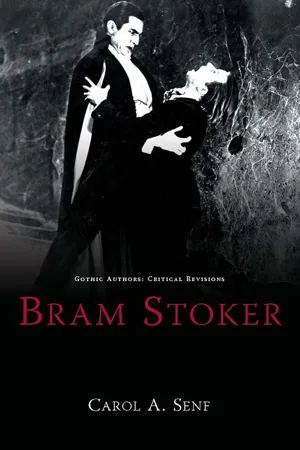
This study of Bram Stoker focuses on Stoker as a Gothic writer. Identified with Dracula, Stoker is largely responsible for taking the Gothic away from medieval castles and placing it at the center of modern life. The study examines Stoker's contribution to the modern notion of Gothic and thus to the history of popular culture and demonstrates that the excess generally associated with the Gothic is Stoker's way of examining the social, economic, and political problems. His relevance today is his depiction of problems that continue to haunt us at the beginning of the twenty first century. What makes the current study unique is that it privileges Stoker's use of the Gothic but also addresses that Stoker wrote seventeen other books plus numerous articles and short stories. Since a number of these works are decidedly not Gothic, the study puts his Gothic novels and short stories into the perspective of everything that he wrote. The creator of Dracula also wrote The Duties of Clerks of Petty Sessions in Ireland, a standard reference work for clerks in the Irish civil service, as well as The Man and Lady Athlyne, two delightful romances. Furthermore, Stoker was fascinated with technological development and racial and gender development at the end of the century as well as in supernatural mystery. Indeed the study demonstrates that the tension between the things that can be explained rationally and the things that cannot is important to our understanding of Stoker as a Gothic writer.
Information
Print ISBN
9780708323069
9780708323854
Subtopic
English Literary Criticism1
Gothic Material in The Snake’s Pass, The Watter’s Mou’ and The Shoulder of Shasta

Dracula is unquestionably a Gothic masterpiece because Stoker perfected his craft while he worked as business manager for the Lyceum and wrote in his spare time. William Hughes notes in Beyond Dracula that eight novels were ‘thus completed effectively on a part-time basis, the research and writing often effected on tour or in breaks between productions or rehearsals’: The Snake’s Pass (1891), The Watter’s Mou’ (1894), The Shoulder of Shasta (1895), Dracula (1897), Miss Betty (1898), The Mystery of the Sea (1902), The Jewel of Seven Stars (1903) and The Man (1905).1
Even though Stoker had little time to polish them, these novels demonstrate growing skill with narration, establishing both setting and mood and weaving together elements from different genres, including romance, invasion narrative, science fiction, Westerns, adventure tales, travel literature, temperance literature and the Gothic. This chapter explores the three novels that lead up to Dracula.
The Snake’s Pass
His only novel set in Ireland, Stoker’s first novel was serialized in The People (20 July–30 November 1890) and later published by Sampson Low, Marston and Co. Revealing his interest in using Gothic materials to comment on social and political problems faced by people back home, The Snake’s Pass is a first-person narrative by a young Englishman, Arthur Severn, who travels to Western Ireland on a holiday and falls in love with the land and Norah Joyce.2 Before they can marry, however, he and a college friend, Dick Sutherland, must rescue her and her father from the Irish usurer, Black Murdock, who has gained control over her father’s property This novel, which Phyllis A. Roth characterizes as a romance in Bram Stoker, ‘uses a conventional romance pattern’ but also ‘foreshadows the tales of mystery and horror to come’.3 It also adapts Gothic elements to explore complex social issues, including the relationship between England and Ireland and the need to improve Ireland’s economy in the decades following the Great Famine and the subsequent emigration of much of its remaining population.
Joseph Valente, Nicholas Daly and David Glover comment on Stoker’s interest in Ireland in The Snake’s Pass.4 Although Valente explores Stoker’s treatment of Ireland, he spends relatively little time on The Snake’s Pass, objecting to its adherence to the ‘generic conventions of the “metropolitan marriage’”.5 Daly and Glover compare it to its predecessors, Glover here revealing Daly’s influence:
Indeed, as Nicholas Daly has suggested, one of the novel’s precursors may have been Dion Boucicault’s comic melodrama, The Shaughraun (1874), a play which also unites an English hero and an Irish heroine against a rapacious local moneylender-although … the gombeenman was already a well-developed fictional type by this date.6
Of particular interest to this study is Glover’s observation that The Snake’s Pass ‘detaches the Gothic component… and domesticates it’, a strategy Stoker uses again in Dracula, which is also set in a modern world, where trains run on time, grisly stories appear in newspapers and characters use telephones and telegrams to share information.7 Stoker prepares for this juxtaposition of the mysterious and the ordinary in The Snake’s Pass, and Black Murdock, the Gombeen Man (a usurious moneylender), is a more or less realistic predecessor for Dracula.
More important than the moving of the Gothic component from the medieval past to the industrial present and from a distant land to his own country is Carol Margaret Davison’s observation in ‘The ghost of genres past’ that Stoker moves into uncharted ground when he uses the Gothic to explore social concerns:
What has received precious little attention, to date, is the corollary of the unusual pairing of social realism and the Gothic: raising the ghost of the Gothic within the realist tradition haunts the certainties – both aesthetic and ideological – of that nascent form.8
Indeed, this blurring of Gothic excess with contemporary social concerns distinguishes Victorian Gothic from its predecessors.
Paul Murray observes in From the Shadow of Dracula that Stoker was thinking about social problems as he wrote, so much so that he sent a copy to the prime minister, William E. Gladstone, an acquaintance and frequenter of Irving’s Beefsteak Room.9 Not only was Gladstone interested in Home Rule for Ireland during the 1880s and 1890s, he was also interested in the ‘oppressive role of the “gombeen man”, or moneylender, in Irish rural life’.10 Moreover, Murray comments on Stoker’s hope that science and technology might solve the social issues he depicts:
Dick Sutherland, an engineer … hopes for government measures to reclaim the Bog of Allen, the kind of developmental idea which characterized Stoker’s thinking about Ireland and derived from the thinking of mid-nineteenth-century Irish nationalists such as Thomas Davis.11
Such interest in science and technology is woven skillfully with a number of Gothic elements and results in a novel that uses Gothic excess to highlight social issues. Stoker’s increasing skill is evident in the extent to which he has moved beyond Gothic conventions and stereotypes.
Among the most striking Gothic elements are the emphasis on nature’s mysterious power, the looming presence of the past, a persecuted maiden, a villain and supernatural powers that threaten to dwarf human characters. Unlike Gothic novels that use fragmented narratives to increase readers’ awareness of mystery (Frankenstein, Dr Jekyll and Mr Hyde, Wuthering Heights and Dracula, to name a few), The Snake’s Pass uses a straightforward chronological narrative. Indeed, the primary mystery is that Arthur, the first-person narrator, is an English tourist who is unfamiliar with the landscape, the people and their customs.
The novel opens with Severn’s description of a location that might have come straight from Burke’s Philosophical Inquiry into the Origin of Our Ideas of the Sublime and the Beautiful (1757).12 Severn observes the steep precipices and ‘almost primal desolation’ (p. 9) of the landscape, commenting on its eerie quietness:
Earth, sea and air all evidenced the triumph of nature, and told of her wild majesty and beauty. The air was still – ominously still. So still was all, that through the silence, that seemed to hedge us in with a sense of oppression, came the booming of the distant sea, as the great Atlantic swell broke in surf on the rocks or stormed the hollow caverns of the shore. (p. 10)
While nature’s power is a standard component of Gothic literature, Severn has more reason than most to acknowledge its power, having lost his parents at sea: ‘I was only a very small boy when they were lost in a fog when crossing the Channel’ (p. 11).
Arthur and his Irish driver Andy Sullivan confront a powerful storm that forces them to seek shelter in Mrs Keligan’s sheebeen:
The storm seemed to sweep through the valley in a single instant – the stillness changed to a roar, the air became dark with the clouds of drifting rain. It was like the bursting of a waterspout … and came so quickly that I was drenched … before I could throw my mackintosh round me. (p. 14)
The equally mysterious shebeen is a place that, according to Roth, ‘captures both local color and country customs’ and introduces Severn and Stoker’s English readers to the strangeness of Irish life.13
Although Severn’s difficulty in understanding the conversation he overhears is another reminder that Ireland was strange and uncanny to most English readers, the primary indicator of strangeness is the bog. Both setting and symbol, as well as a place often associated with the Irish, the bog is evidence of Ireland’s impoverished state because it is unsuitable for agriculture (though the peat can be cut and used for fuel). It would have been hard for Stoker to choose anything more indicative of Ireland for, as Hughes observes in Beyond Dracula, the bog represented Ireland in the minds of English people:
The bog … is, in English prejudice, an overt signifier of Irish topography, and the source of derogatory racial stereotypes – the bog dweller, the ‘bog trotter’. In The Snake’s Pass it is an especially rich symbol, one which encodes a reading of Irish problems and British solutions into the fabric of a supposedly local issue. As Arthur is informed when he takes shelter in the … shebeen, the shifting bog has become closely identified with Murdock and his activities through the myth of its creation – a version of the expulsion of the snakes from Ireland by St Patrick in which the King of the Snakes transforms himself into the shifting bog.14
Furthermore, because bogs are inherently unstable, they evoke danger. They are also dark places where mystery might lurk beneath the surface, and Stoker links several Irish characters (notably Norah and Murdock) with the uncanny geographical region.
Sutherland, whom Murdock has hired to study the bog, initially describes it as ‘more treacherous than either [quagmire or quicksand]. You may call it, if you are poetically inclined, a “carpet of death!”’ (p. 59). Indeed, several people face death in the bog, and the novel culminates in its sweeping Murdock out to sea:
For a while the superior size and buoyancy of the roof sustained it, but then it too began slowly to sink … And then came a mighty roar and a gathering rush. The side of the hill … seemed to burst. Murdock threw up his arms … Then came the end of the terrible convulsion. With a rushing sound, and the noise of a thousand waters falling, the whole bog swept … down the mountain-side – to the entrance of the Shleenanaher — struck the portals with a sound like thunder, and piled up to a vast height. And then the millions of tons of slime and ooze, and bog and earth, and broken rock swept through the Pass into the sea. (p. 230)
This passage fulfills Sutherland’s intimation that the bog is a looming and overwhelming presence. Reinforcing its mysterious nature, Andrew Maunder explains in Bram Stoker that it encapsulates the ‘uncanny and Gothic elements of the landscape’ and that Arthur ‘comes back to it as a central reference point, a symbolic representation of the monstrous and the “unfathomable”’.15 Nevertheless, while Hughes and Maunder see it as a Gothic symbol, Murray reminds readers that Stoker would have seen it as literal though nonetheless horrifying: ‘Much of the background to the novel was real enough. Bog-slides were well documented in Irish records as far back as the eighteenth century: rare and unexpected occurrences, they were mysterious and terrifying to the local people.’16 Emphasizing the bog as a real place, chapter V, ‘On Knockanacar’, includes several scientific explanations for geological phenomena, evidence that Stoker often contemplated real problems even when he employed Gothic details.
In addition, Stoker links Norah and Murdock with the bog. While there is nothing especially Gothic in the fact that Andy Sullivan frequently compares Norah to the bog, it reinforces her identification with Ireland, both mysteries to Severn at the beginning of the novel. On the other hand, Stoker reinforces the Gothic power of the bog and Murdock by linking them together. Indeed, Murdock is connected both to the bog and to the powerful King of the Snakes, his rapacious appetite resembling that of the uncanny being who demanded the yearly sacrifice of a baby. Commenting on his oppression, the peasants speculate that the bog is the form the King of the Snakes took when St Patrick ordered the snakes out of Ireland, and Maunder describes him as a reincarnation of the King of the Snakes. The conflation of past and present, legend and history, human and geography reminds readers that Stoker builds up elements to produce an overwhelming sense of Gothic power.
Murdock’s character reveals that Stoker may have been thinking of the Gothic villain when he created him. For example, Arthur’s first glimpse of him peeking in the shebeen window marks him as dark and Other: ‘Pressed against the empty lattice where the glass had once been, I saw the face of a man – a dark, forbidding face it seemed in the slight glimpse I caught of it’ (p. 30). Not only is Murdock introduced as he is looking in at a group of comrades, he is also, like other Gothic villains, more animal than human. Sutherland refers to him as ‘that human-shaped wolf’ (p. 87), others refer to him as the King of the Snakes reincarnated. Furthermore, while he is not an aristocrat living in a ruined castle, he is presented as above the law. Allison Millbank observes in ‘“Powers old and new”: Stoker’s alliances with Anglo-Irish Gothic’ that he ‘is the classic Gothic villain with omnivorous desires for power and represents also the Gothic usurper’.17 And Stoker demonstrates that Murdock uses the law to his own advantage.18 He also anticipates Dracula, being briefly presented as thirsting for blood: ‘An’ so ye think to baffle me! Do ye? Well! I’ll have that money out – if I have to wade in yer blood’ (p. 212).
Commenting that Murdock sometimes appears as a sexual predator, in Beyond Dracula Hughes quotes a contemporary review that ‘coyly suggests that Murdock entices Norah out onto the bog “for the purpose of possessing himself of her person”’.19 In general, however, Murdock is among the least sexual of Gothic villains, being more interested in Phelim Joyce’s land than Norah’s body.
Although Murdock may remind readers of other Gothic villains (Varney, Manfred or Uncle Silas, to name a few), Stoker’s genius is that he uses Gothic excess to point to social ills. Murray observes:
If Black Murdock’s roots lie partly in the symbolism of the snake, they also derive from the social conditions of nineteenth-century Ireland. Eviction was a fact of life in the landlord-tenant conflict that had convulsed the country in the years before The Snake’s Pass was written. There were those who had over-extended themselves by borrowing money at high interest to buy the land of evicted tenants and, in most cases, found themselves without sufficient means to continue farming. Moneylending at exorbitant rates flourished and Black Murdock was representativ...
Table of contents
- Cover
- Title
- Copyright
- Contents
- Acknowledgements
- Introduction: Tracing the Gothic through Stoker’s Short Stories
- 1 Gothic Material in The Snake’s Pass, The Watter’s Mou’ and The Shoulder of Shasta
- 2 Dracula: Stoker’s Gothic Masterpiece
- 3 Ongoing Work with the Gothic in Miss Betty, The Mystery of the Sea and The Jewel of Seven Stars
- 4 Gothic-tinged Romances: The Man, Lady Athlyne and The Lady of the Shroud
- 5 Stoker’s Return to the Gothic in Famous Impostors and The Lair of the White Worm
- Notes
- Bibliography
Trusted by 375,005 students
Access to over 1.5 million titles for a fair monthly price.
Study more efficiently using our study tools.
Frequently asked questions
Yes, you can cancel anytime from the Subscription tab in your account settings on the Perlego website. Your subscription will stay active until the end of your current billing period. Learn how to cancel your subscription
No, books cannot be downloaded as external files, such as PDFs, for use outside of Perlego. However, you can download books within the Perlego app for offline reading on mobile or tablet. Learn how to download books offline
We are an online textbook subscription service, where you can get access to an entire online library for less than the price of a single book per month. With over 1.5 million books across 990+ topics, we’ve got you covered! Learn about our mission
Look out for the read-aloud symbol on your next book to see if you can listen to it. The read-aloud tool reads text aloud for you, highlighting the text as it is being read. You can pause it, speed it up and slow it down. Learn more about Read Aloud
Yes! You can use the Perlego app on both iOS and Android devices to read anytime, anywhere — even offline. Perfect for commutes or when you’re on the go.
Please note we cannot support devices running on iOS 13 and Android 7 or earlier. Learn more about using the app
Please note we cannot support devices running on iOS 13 and Android 7 or earlier. Learn more about using the app
Yes, you can access Bram Stoker by Carol A Senf in PDF and/or ePUB format. We have over 1.5 million books available in our catalogue for you to explore.