- English
- ePUB (mobile friendly)
- Available on iOS & Android
eBook - ePub
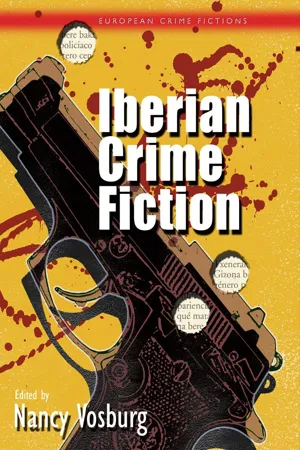
Iberian Crime Fiction
About this book
Iberian Crime Fiction is the first volume in English to provide an extensive overview of crime fiction in Spain and Portugal. While the origins of peninsular crime fiction are traced in Nancy Vosburg's introductory chapter to the volume, the essays focus on specific topics that provide readers with a sense of the development of the genre in the second half of the 20th-century and current trends in the 21st-century. Patty Hart, whose The Spanish Sleuth introduced English-speaking readers to early crime fiction in Spain, provides a summary account of the development of the crime novel from the 1950s through the 1980s, highlighting the major authors and works that set the stage for the boom that followed the establishment of the novela negra tradition in the 1970s. This tradition, spearheaded by Manuel Vazquez Montalban, is the subject of a separate essay by Maria Balibrea that analyzes the socio-political conditions that gave rise to the novela negra. NancyVosburg studies the emergence of a feminine/feminist crime novel in the 1980s and 1990s and the subversion of masculine codes associated with crime fiction, while Stewart King analyzes crime fiction from the Catalan, Basque, and Galician autonomous regions of Spain, focusing on the political realities that resulted in a different use of the genre as a vehicle of regional nationalism. David Knutson traces contemporary trends in Spanish crime fiction, beginning in the 1990s and up to the present. Paul Castro's essay documents the emergence of crime fiction in Portugal and the major works/authors through to the present.
Information
1
Introduction to Iberian Crime Fiction
Murder, mayhem and criminal acts of all varieties have been present in the literature of the Iberian Peninsula since its earliest inception (reflected in the twelfth-century epic poem Cantar de Mío Cid, for instance), but crime fiction, or género policíaco, as we know it today, does not arise on the peninsula until the mid-nineteenth century, a few years after Edgar Allen Poe published ‘Murders in the Rue Morgue’ (1841) and when a police force identifiable as such was created in Spain. While Spanish Romantic writers such as the Duque de Rivas, with his ‘Una antigüalla de Sevilla’ (1843, A Seville Antique), and José Zorrilla, with ‘Un testigo de bronce’ (1845, A Bronze Witness), experimented with crime fiction in verse, Pedro Antonio de Alarcón is generally credited with writing the first crime story in Spain, the 1853 El clavo (The Nail).1 As the story begins, it appears to be a tale of unrequited love between the magistrate/detective, Zarco, and a mysterious woman named Blanca.2 By the time a murder is discovered, readers anticipate that Zarco’s investigation will inevitably lead him back to Blanca, who drove a nail through her previous husband’s head. The story is narrated by his friend and companion, Felipe, who has flashes of intuition that foreshadow the outcome. While readers are in the know about ‘who done it’ because of the way the narrative is set up, Alarcón’s story nevertheless presents the logical steps that Zarco takes in his investigation, making it an early precursor to the modern detective novel. The story also includes an interesting twist, unusual for its time, as the magistrate/ detective discovers his own role in the chain of events, which forces him to assume some of the responsibility for the crime.
After the 1887 appearance of the British sleuth Sherlock Holmes in A Study in Scarlet, imitative works abounded in Spain in penny novels and melodramas.3 But the genre received a literary boost when the grande dame of Spanish narrative at the turn of the century, Doña Emilia Pardo Bazán, wrote a detective novella, La gota de sangre (1911, The Drop of Blood), featuring the amateur sleuth Señor Selva. The protagonist, a wealthy, bored dandy and a suspect in a murder that has occurred outside his home, keeps one step ahead of the local police force when he investigates and solves the crime in order to prove his own innocence. One of the most interesting aspects of this novella is the depiction of the institutional police force, which is shown to be backward, unscientific and thus incapable of carrying out a rigorous murder investigation, a theme which, as Hart documents, recurs even in contemporary detective fiction and is particular to Spain.4 Additionally, the novella is innovative in its metafictional aspects, as Señor Selva, an avid reader of detective fiction, engages in frequent self-reflection about his actions and methods.5 And, perhaps most important of all, Pardo Bazán seems much more interested in exploring the motives for the crime than in the means by which the detective discovers the murderer.
Despite the impetus given to the genre by the renowned Pardo Bazán, crime novels were still considered a low-brow form of literature and publicly disdained or dismissed by writers and intellectual readers in Spain in the early decades of the twentieth century. There were a handful of penny novels featuring Spanish sleuths in the 1920s and 1930s, although translations of the British ‘cozy’ mysteries were more popular. The Catalan novelist Mercè Rodoreda published Crim, a parody of the English cozy novel, in 1936, which suggests that she already considered crime fiction a dead genre. Yet, even during the Spanish Civil War (1936–9), three detective novels set in Spain and featuring a Spanish police inspector named Venancio Villabaja were written by E. C. Delmar (pseudonym of Julian Amich Bert): El misterio del contador (The Mystery of the Book-keeper), Piojos grises (Gray Lice) and La tórtola de la puñalada (The Stabbed Turtle Dove).6 In general, the detective novels of this period, including Delmar’s, were imitative of the British cozy mysteries or reworkings of American and English plots.
In Portugal, detective fiction started even more slowly than in Spain, and as Paul Castro points out in his chapter in this volume, was essentially born in parody. Portugal’s greatest naturalist/realist writer, Eça de Queiroz, co-wrote with Ramalho Ortigão O Mistério da Estrada de Sintra (The Sintra Road Mystery), published in 1870 and considered the first Portuguese detective novel. As Castro notes in his chapter, ‘O Mistério was essentially designed as a hoax. It was, therefore, the first instance of the playfulness that has often characterized the detective fiction genre in Portugal.’
Despite the relatively late appearance of detective fiction in Spain and Portugal, as compared with Great Britain, France and the US, crime fiction enjoys a great popularity in contemporary Iberian literature, with crime novels often topping the best-seller lists in both countries. In this volume, the contributors, all of whom have published articles or books on Iberian crime fiction and have participated in international conferences on the topic, have attempted to identify and explain the high points in the development of the genre, while simultaneously exploring the ways in which the crime novel serves as a vehicle for exploring issues of national concern.
Patricia Hart of Purdue University was the first Hispanist to publish a volume in English on Spanish detective novels, The Spanish Sleuth, in 1987. In chapter 2, she considers the somewhat late appearance of crime fiction in Spain. She traces the development of the crime novel as it began to pick up more literary impetus in the 1950s, primarily with the works of Mario Lacruz. Her essay provides an overview of the development of Spanish crime fiction from Lacruz’s El inocente (1953, The Innocent) to the 1990s.
In chapter 3, Mari Paz Balibrea, of Birkbeck College, University of London, focuses specifically on the novela negra, the Spanish manifestation of the hard-boiled detective novel made popular in the US from the 1930s to the 1950s by such authors as Dashiel Hammett and Raymond Chandler. As Balibrea shows, Manuel Vázquez Montalbán, with twenty-three novels in his Pepe Carvalho series, is considered Spain’s greatest practitioner of the novela negra phenomenon. He was the most significant and most influential writer of the genre from the 1970s until his death in 2003.
In chapter 4, Stewart King of Monash University in Australia explores the ways in which detective fiction in the Spanish autonomous regions with their own distinct languages (Catalonia, Galicia and the Basque Country) is used as a vehicle to promote national identity in these regions and to explore their unique cultural differences compared with the Castilian-dominated centre. King has chosen a representative author from each of the three autonomous regions to demonstrate the concerns of writers from the peripheral regions of Spain.
Nancy Vosburg, of Stetson University in the US, dedicates chapter 5 to the emergence of a large body of women’s crime fiction which began in 1980s Spain. As Vosburg reveals in her analyses of women’s crime fiction, issues of gender in the masculine-dominated crime genre become of paramount importance as women writers challenge the assumptions of both genre and gender in a rapidly changing society. The chapter also underscores the ways in which women’s crime fiction gives us a measure of women’s status, and the obstacles they continue to face, in the new egalitarian nation.
David Knutson of Xavier University completes the study of Spanish crime fiction in chapter 6 with his essay on contemporary trends in the genre. Knutson traces the continued presence of some of the writers who pioneered the genre in Spain, and considers new authors who have continued the tradition of the hard-boiled novel, but who bring in more contemporary themes such as anti-globalism, the environment and divergent views of the past, the present and the future. He also demonstrates how contemporary practices of crime writing blend with other cultural trends, such as the continuing interest in historical fiction, particularly the focus on the aftermath of the Spanish Civil War.
The final essay (chapter 7) is dedicated to Portuguese crime fiction, and is written by Paul Castro, currently the Leverhulme Early Career Fellow at the University of Leeds in Great Britain. Castro traces the development of the genre in Portugal from its earliest inception, the 1870 O Mistério de Estrada de Sintra by Eça de Queiroz and Ramalho Ortigão, to the present. The chapter concludes with a discussion of contemporary trends in Portuguese crime fiction, which have many points in common with the current trends in Spain while remaining true to Portuguese national character.
Acknowledgements
I would like to thank all of the contributors to the volume as well as Stetson University for providing me with a sabbatical leave to compile this volume.
Bibliography
Alarcón, Pedro Antonio de, El clavo (Alicante: Biblioteca Virtual Miguel de Cervantes, 1999).
Hart, Patricia, The Spanish Sleuth: The Detective in Spanish Fiction (London and Toronto: Associated University Presses, 1987).
Landeira, Ricardo, El género policíaco en la literatura española del siglo XIX (Alicante: La Universidad de Alicante, 2001).
Pardo Bazán, Emilia, La gota de sangre, in Federico Carlos Sainz de Robles (ed.), Emilia Pardo Bazán: Obras completas (Madrid: Aguilar, 1957), pp. 994–1014.
2
Crime Fiction since the Spanish Civil War
Introduction
‘A murder occurs; many are suspected; all but one suspect, who is the murderer, are eliminated; the murderer is arrested or dies.’1 Thus W. H. Auden defined the murder-mystery genre in 1948 in his landmark Harper’s article, ‘The guilty vicarage’. ‘There is Concealment (the innocent seem guilty and the guilty seem innocent) and Manifestation (the real guilt is brought to consciousness).’2 Auden’s pronouncements are an excellent point of departure for this discussion of Spanish detective fiction from the 1940s to the 1980s, with its late, and sporadic, emergence. Whether murder stories take place in a cosy closed room in a village or on urban mean streets, novels describing them in any form were extremely rare in Spain before the late 1970s.
In his 1948 essay, Auden declared that the most satisfactory traditional mystery story requires a reader with a sort of low-grade, semi-permanent sense of social guilt from which the reading of an ordered, formulaic detective story provides temporary relief. He contrasts it with reading Dostoevsky’s Crime and Punishment, whose ‘effect on the reader is to compel an identification with the murderer which he would prefer not to recognize’, or Kafka’s The Trial, where
the aim of the hero’s investigation is not to prove his innocence (which would be impossible for he knows he is guilty), but to discover what, if anything, he has done to make himself guilty. K, the hero, is in fact, a portrait of the kind of person who reads detective stories for escape.3
Auden believed that the driving force behind being able to understand Kafka, Dostoevsky or Agatha Christie was the same: a reader must dwell in a psychological ‘guilty vicarage’, from which detective novels offered escapism with an imaginary possibility of setting the ‘vicarage’ right.
The successful resolution of a cozy mystery, writes Auden, is ‘the phantasy of being restored to the Garden of Eden’.4 By contrast, discovering the murderer and putting him or her in the hands of the Spanish criminal justice system – perhaps for garrotting – did not return early Spanish pulp readers to Eden. Before the free elections of 1977, detective stories with happy endings usually had to be set in a real or imagined somewhere else.
Most observers of the genre agree that to have a methodical, prescriptive type of novel such as the detective story, with its nostalgia for the bourgeois order, you must have a bourgeoisie and civic order. As Ernest Mandel points out in Delightful Murder: A Social History of the Crime Story, ‘In feudal and despotic societies, torture was the main means of “proving” crimes and unmasking criminals. Innocents died under torture in horrible pain.’5 If a society lacks confidence, a detective story that puts the universe right cannot play out satisfactorily. Such a story is unconvincing where the police or the courts may employ torture, rather than science, to arrive at predetermined conclusions. In 1841, when Edgar Allan Poe published ‘Murders in the Rue Morgue’, the Parisian civil and detective police force, the Sûreté (a model for Scotland Yard and the FBI) had already been in existence for thirty years. In Spain, by contrast, the Spanish Inquisition had been out of commission for only seven years and, indeed, Fernando VII had actually garrotted the last heretic – schoolteacher Cayetano Ripoll – in Valencia on 26 July 1826. When we also recognize the fact that Spanish literacy rates were low throughout the nineteenth and early twentieth century, the question to ask is not why were there no novels of cozy, comforting ratiocination springing forth at that time but, rather, why ever would there be?
As Ernest Mandel has pointed out, the detective story reflects and summarizes the historical progress won by the revolutionary bourgeoisie.6 Given this, it is unsurprising that in the 1920s and 1930s native Spanish sleuths appeared infrequently, mostly in penny literature. In the confusion of the pre-war years and the destruction of the civil war itself (1936–9), only a few books were published.7 Forty years of Francoist military dictatorship did little to diminish the population’s distrust of the state’s ability to detect and punish crime. Therefore, it is not surprising that during the 1940s the few Spaniards who wrote detective novels – usually using English-sounding pseudonyms – set their tales outside Spain, finding that readers still preferred foreign locales for detectives, and the cozy over the hard-boiled,...
Table of contents
- Cover
- Title
- Copyright
- Contents
- 1 Introduction to Iberian Crime Fiction: Nancy Vosburg
- 2 Crime Fiction since the Spanish Civil War: Patricia Hart
- 3 In Search of a New Realism: Manuel Vázquez Montalbán and the Spanish Novela Negra : Mari Paz Balibrea
- 4 Detecting Difference/Constructing Community in Basque, Catalan and Galician Crime Fiction : Stewart King
- 5 Spanish Women’s Crime Fiction, 1980s–2000s: Subverting the Conventions of Genre and Gender : Nancy Vosburg
- 6 Spanish Crime Fiction: 2001 and Beyond : David Knutson
- 7 Five Cases from 130 Years of Portuguese Detective Fiction, 1870s–2000s : Paul M. Castro
Trusted by 375,005 students
Access to over 1.5 million titles for a fair monthly price.
Study more efficiently using our study tools.
Frequently asked questions
Yes, you can cancel anytime from the Subscription tab in your account settings on the Perlego website. Your subscription will stay active until the end of your current billing period. Learn how to cancel your subscription
No, books cannot be downloaded as external files, such as PDFs, for use outside of Perlego. However, you can download books within the Perlego app for offline reading on mobile or tablet. Learn how to download books offline
We are an online textbook subscription service, where you can get access to an entire online library for less than the price of a single book per month. With over 1.5 million books across 990+ topics, we’ve got you covered! Learn about our mission
Look out for the read-aloud symbol on your next book to see if you can listen to it. The read-aloud tool reads text aloud for you, highlighting the text as it is being read. You can pause it, speed it up and slow it down. Learn more about Read Aloud
Yes! You can use the Perlego app on both iOS and Android devices to read anytime, anywhere — even offline. Perfect for commutes or when you’re on the go.
Please note we cannot support devices running on iOS 13 and Android 7 or earlier. Learn more about using the app
Please note we cannot support devices running on iOS 13 and Android 7 or earlier. Learn more about using the app
Yes, you can access Iberian Crime Fiction by Nancy Vosburg, Nancy Vosburg,Nancy Vosburg in PDF and/or ePUB format, as well as other popular books in Literature & European Literary Criticism. We have over 1.5 million books available in our catalogue for you to explore.