- English
- ePUB (mobile friendly)
- Available on iOS & Android
eBook - ePub
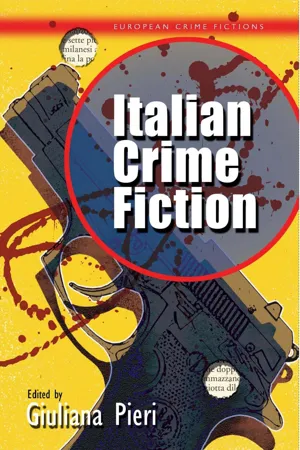
Italian Crime Fiction
About this book
Iberian Crime Fiction is the first volume in English to provide an extensive overview of crime fiction in Spain and Portugal. While the origins of peninsular crime fiction are traced in Nancy Vosburg's introductory chapter to the volume, the essays focus on specific topics that provide readers with a sense of the development of the genre in the second half of the 20th-century and current trends in the 21st-century. Patty Hart, whose The Spanish Sleuth introduced English-speaking readers to early crime fiction in Spain, provides a summary account of the development of the crime novel from the 1950s through the 1980s, highlighting the major authors and works that set the stage for the boom that followed the establishment of the novela negra tradition in the 1970s. This tradition, spearheaded by Manuel Vazquez Montalban, is the subject of a separate essay by Maria Balibrea that analyzes the socio-political conditions that gave rise to the novela negra. NancyVosburg studies the emergence of a feminine/feminist crime novel in the 1980s and 1990s and the subversion of masculine codes associated with crime fiction, while Stewart King analyzes crime fiction from the Catalan, Basque, and Galician autonomous regions of Spain, focusing on the political realities that resulted in a different use of the genre as a vehicle of regional nationalism. David Knutson traces contemporary trends in Spanish crime fiction, beginning in the 1990s and up to the present. Paul Castro's essay documents the emergence of crime fiction in Portugal and the major works/authors through to the present.
Information
Publisher
University of Wales PressYear
2011Print ISBN
9780708324325
9780708324318
eBook ISBN
9781783164813
1
Introduction
In Italy, crime fiction had a relatively late and slow start. The so-called gialli, which take their name from the distinctive yellow cover of the crime series by the Milanese publishing house Mondadori in the 1930s, consisted at the time of vast quantities of translated British, French and American detective and noir novels. The immense popularity enjoyed by this genre led Italian novelists to try their hand at writing their own crime fiction during the 1930s and the early 1940s. Italian readers, however, still showed a marked preference for foreign crime fiction: a trend that continued in the immediate post-war decades. Despite this xenophilia, Italian crime fiction has been growing steadily in importance and, since the late 1980s, has been enjoying unprecedented popularity. The success of the gialli, now a short-hand term for any type of detective fiction and more widely any story that has a mystery element, has transformed the Italian literary scene at the turn of the new millennium and has been sustained by a number of prestigious Italian publishing houses and increasing critical interest. Detective novels, procedural novels, noir fiction and true crime writing are all testimony to an unquenched appetite of the Italian public for home-grown crime fiction which extends also to cinema and television, with a plethora of film adaptations and television series and the often close involvement of Italian crime writers in the scriptwriting and production of these series.
The present volume is the first study in the English language to focus specifically on Italian crime fiction, weaving together a historical perspective and a thematic approach, with a particular focus on the representation of space, especially city space, gender and the tradition of impegno, the social and political engagement which characterized the Italian cultural and literary scene in the post-war period and resurfaced as the leading element in the work of the new generation of Italian crime writers in the 1990s. Although a number of studies have been published in Italy on the history of this literary genre, most have been rich in history and poor in analysis.1 They have approached the development of crime fiction by providing their readers with a first mapping of the chief Italian contributors to the crime genre but have overlooked the socio-historical and literary elements present in what is by now a substantial body of works. One of the reasons behind these critical shortcomings in the analysis of the Italian gialli is linked to the way in which crime fiction, and especially the home-grown variety, has been viewed by the Italian literary establishment until very recently. If not with open hostility, it would be fair to say that Italian crime fiction has been systematically met with indifference and suspicion by literary critics who, even when confronted with established writers such as Carlo Emilio Gadda or Leonardo Sciascia, whose work is analysed in chapter 4, have treated their crime fiction as an example of the subversion of the genre and reinstated their overall negative view of this popular genre. Whilst in the post-war period, British, American and French literary critics and theorists were engaged in studies of the crime fiction traditions of their respective countries, Italian critics for decades ignored home-grown examples.2 Giuseppe Petronio, who has worked extensively on the Italian giallo, as late as 1978 pointed towards the bias against this popular narrative form in Italy.3 Petronio emphasized especially the prejudice and snobbism of the Italian academic and literary establishment against the detective novel.4 This attitude changed very little in the following decade when Italian critics still seemed to view the giallo in terms of the literature versus popular literature binary, with the implicit denial of proper literary status to the latter. Antonio Gramsci had posed a similar question, in 1930, in a long note on crime fiction, in which he had argued that: ‘in detective fiction there have always been two strands: a mechanical one focused on the plot, and an artistic one’.5 Gramsci, by shifting the focus on to the issue of artistic merit, unwittingly paved the way for the dismissal of this popular genre in Italy. Italian culture in the post-war period was still primarily dominated by the so-called critica idealista which focused on purely literary and stylistic matters and was thus not best suited to analyse a genre which thrives on its connections with socio-historical and political issues. Besides, as Umberto Eco noted in 1964, when it came to popular culture, Italian critics were overall sceptical about applying the same critical tools that were used for the study of high-brow literature to its more popular counterpart.6 The lack of critical interest in Italian crime fiction had, however, one positive result: it made Italy more open to seminal foreign works on the theory of crime fiction which would eventually influence a veritable renaissance of crime fiction in Italy in the last decade of the twentieth century.
The year 1980 was in many ways a turning point for the fortunes of Italian crime fiction. Umberto Eco, after having spent the previous two decades writing a number of influential essays on the theory and practice of popular fiction, published his first novel, The Name of the Rose, a historical crime novel, which became a best-seller in Italy and abroad, and, many would argue, marked the beginning of a rebirth of novel writing in Italy. Eco’s work on mass culture, popular literature, semiotics and postmodernism gave strong theoretical credentials to his own open defence of the choice of the crime genre in his novel.7 The year 1980 saw also the publication of a collection of several seminal essays on the theory of crime fiction by two Italian literary critics, Renzo Cremante and Loris Rambelli, which had never appeared in Italian translation before.8 This collection, which fostered a reappraisal of the theoretical underpinnings of this popular genre, included Edmund Wilson’s ‘Who cares who killed Roger Ackroyd?’, W. H. Auden, ‘The guilty vicarage’, and essays by, among others, G. K. Chesterton, Richard A. Freeman, J. L. Borges, Tzvetan Todorov and Gadda. Todorov’s ‘The typology of detective fiction’ was particularly influential in Italy: this was the proof that one could apply the same stringent analytical models of high literature to a genre that was still viewed by the majority of literary critics as unworthy of literary status. Yet, when Todorov claimed that in high literature the mark of quality is to break the canon (whilst in mass literature the best novel is that which does not go beyond the canon, otherwise from roman policier it becomes literature), he reinforced, at least in the eyes of Italian literary critics, the fundamental oppositional view of literature proper versus popular literature as mere entertainment.9 The question that critics should have been posing at the time, and should certainly do in the new millennium, is whether we still need to redefine this genre or whether we can simply accept that in our postmodern age the boundaries between different literary genres are constantly being crossed and re-defined. As Italo Calvino noted in the essay ‘Cibernetica e fantasmi’, the value of an artistic work is that it is able to give shape to the ghosts that lie dormant in every society.10 Calvino, voicing one of the central principles of postmodern narrative, argues that the emphasis should not be placed on the author but on the act of reading; the reader’s reaction is the ultimate test of the actual significance of an artistic work. Leaving aside the complex theoretical implications inherent in the analysis of texts from the point of view of the reader’s response, Calvino shifts the focus towards the impact of the literary work on its readers and the dialogue that the writers are able to establish with their readership. If we were to look at Italian narrative, especially in the post-war period but also in the interwar years, as Jane Dunnett argues in chapter 2, from Calvino’s perspective with the aid of book sales figures, the Italian literary scene would appear as almost entirely dominated by Italian and foreign crime fiction, with a marked upsurge of interest in this genre since the early 1990s, as will be discussed in chapters 5 and 6 in particular. The chapters in this book, in highlighting the contribution of Italian crime fiction to the most important social and often political debates of the time, as well as showing the literary and stylistic innovations brought about by Italian crime writers, argue strongly in favour of reinserting Italian crime fiction into the nation’s literary canon. They consider the Italian giallisti as some of the most interesting protagonists of the renewal of Italian narrative in the second half of the twentieth century.
The case of established writers such as Gadda, Sciascia and Antonio Tabucchi (see chapter 4) is revealing since their openly declared and obvious engagement with this literary genre has overall been marginalized by literary critics, who have often discussed the use of crime fiction by these writers with a degree of unease and as an ‘aberrant’ example rather than as a central narrative model especially suited to convey complex philosophical, ethical and moral issues. As the new generation of Italian crime writers who started their literary career in the 1990s shows, the blueprint of the new Italian giallo is a complex mix of the narrative and thematic models provided by these established literary figures and the work of a number of writers who can be considered the real founding fathers of Italian post-war crime fiction, namely Giorgio Scerbanenco (whose work will be discussed in chapter 3) and Loriano Macchiavelli who had a great impact on the bourgeoning Bologna school (see chapter 5). The common thematic focus of the new generation of crime writers who emerged in Italy in the 1990s is a new commitment to the portrayal of the new Italy. Crime writers held up the mirror and showed their readers a country that was striving to leave behind the violence and social and political turmoil that characterized the so-called Leaden Years; a country that struggled, after the fall of the Berlin wall, with the faltering of its long-standing communist and socialist past ideologies, and that was confronted, in the early 1990s, with the political and administrative scandals of Tangentopoli and Mani Pulite and some of the worst mafia killings in recent memory.11 In the course of the 1980s and 1990s, Italy was also transformed by continual and consistent immigration which has turned a country of migrants into one of mass immigration confronted with the new challenges of a global, multi-ethnic and multicultural society. These transformations affected big and small urban centres and paved the way for the Italian provinces to become as effective an object of scrutiny as the old metropolis of the foreign and home-grown noir tradition. In the postmodern world, crime fiction has been transformed by Italian writers into a new powerful vehicle to express Italy’s discontents and to deal with the new challenges posed by the social and political changes of the new millennium. One of the strongest messages to come from Italian crime fiction is the need to re-engage with the time-honoured tradition of impegno, the social and political commitment that we strongly associate with Italian post-war literature and culture. As we shall see in this volume, this is the common denominator of most contemporary crime writers in Italy, and is especially evident in the writers associated with the Bologna School, whose work is analysed in chapter 5, and in the work of Andrea Camilleri, Marcello Fois and Gianrico Carofiglio (see chapter 6). Italian women crime writers also emerge from the analysis in this volume as central protagonists in this renewed impegno; their stance is often less overtly political but more firmly ethical than their male counterparts. In their investigation of the many forms of violence towards women in contemporary society, these writers show that Italy still retains all the marks of a patriarchal society.
The overt social and political critique that can be found in the work of contemporary giallisti echoes the socio-political and often ethical and philosophical commitment of more established writers. The result is a body of works that, when viewed without the artificial distinction between high and popular literature, shows a remarkable insight into Italy’s post-war history, tracking its societal and political troubles and changes as well as often also engaging with metaphorical and philosophical notions of right or wrong, evil, redemption and the search for the self.
Notes
1The only studies specifically dedicated to Italian crime fiction are: Loris Rambelli, Storia del giallo italiano (Milan: Garzanti, 1979); Massimo Carloni, L’Italia in giallo. Geografia e storia del giallo italiano contemporaneo (Reggio Emilia: Diabasis, 1994); Luca Crovi, Delitti di carta nostra. Una storia del giallo italiano (Bologna: Punto Zero, 2000); Luca Crovi, Tutti i colori del giallo. Il giallo italiano da De Marchi a Scerbanenco a Camilleri (Venice: Marsilio, 2002); and Maurizio Pistelli, Un secolo in giallo. Storia del poliziesco italiano (1860–1960) (Rome: Donzelli, 2006), the only volume to focus on the nineteenth-century beginnings of the genre in Italy.
2Some of the initial interest in the genre was within broader studies on crime fiction. See for instance: Alberto del Monte, Breve storia del romanzo poliziesco (Bari: Laterza, 1962). Ernesto G. Laura, Storia del giallo. Da Poe a Borges (Rome: Studium, 1981).
3Giuseppe Petronio, ‘Sulle tracce del giallo’, Delitti di carta, 1 (1997), 54–9.
4G. Petronio and U. Schulz-Buschhaus (eds), Trivialliteratur? (Trieste: Lint, 1979).
5‘in questa letteratura poliziesca si sono sempre avute due correnti: una meccanica, d’intrigo, l’altra artistica’: Antonio Gramsci, ‘Sul romanzo poliziesco’, in Letteratura e Vita Nazionale (Torino: Eiunaudi, 1974), p. 116.
6Eco noted this attitude in the reception of his book Apocalittici e integrati, explaining that of one of his critics ‘vede con molto sospetto questo uso degli strumenti della cultura Alta per spiegare e analizzare la cultura Bassa’ (views with great suspicion the use of instruments of high culture in order to explain and analyse low culture), in Apocalittici e integrati (Milan: Fabbri, 1964; Bompiani, 1988), p. vi.
7See Eco’s postscript in The Name of the Rose Including the Author’s Postscript, trans. William Weaver (New York: Harvest Books, 1994). On Eco and...
Table of contents
- Cover
- Title
- Copyright
- Contents
- Acknowledgements
- Notes on Contributors
- 1 Introduction: Giuliana Pieri
- 2 The Emergence of a New Literary Genre in Interwar Italy: Jane Dunnett
- 3 Founding Fathers: Giorgio Scerbanenco: Jennifer Burns
- 4 Literature and the Giallo: Gadda, Eco, Tabucchi and Sciascia: Joseph Farrell
- 5 The Mysteries of Bologna: On Some Trends of the Contemporary Giallo: Luca Somigli
- 6 Crime and the South: Mark Chu
- 7 Italian Women Crime Writers: Giuliana Pieri and Lucia Rinaldi
- 8 Milano nera: Representing and Imagining Milan in Italian Noir and Crime Fiction: Giuliana Pieri
- 9 Annotated Bibliography: Lucia Rinaldi
Trusted by 375,005 students
Access to over 1.5 million titles for a fair monthly price.
Study more efficiently using our study tools.
Frequently asked questions
Yes, you can cancel anytime from the Subscription tab in your account settings on the Perlego website. Your subscription will stay active until the end of your current billing period. Learn how to cancel your subscription
No, books cannot be downloaded as external files, such as PDFs, for use outside of Perlego. However, you can download books within the Perlego app for offline reading on mobile or tablet. Learn how to download books offline
Perlego offers two plans: Essential and Complete
- Essential is ideal for learners and professionals who enjoy exploring a wide range of subjects. Access the Essential Library with 800,000+ trusted titles and best-sellers across business, personal growth, and the humanities. Includes unlimited reading time and Standard Read Aloud voice.
- Complete: Perfect for advanced learners and researchers needing full, unrestricted access. Unlock 1.5M+ books across hundreds of subjects, including academic and specialized titles. The Complete Plan also includes advanced features like Premium Read Aloud and Research Assistant.
We are an online textbook subscription service, where you can get access to an entire online library for less than the price of a single book per month. With over 1.5 million books across 990+ topics, we’ve got you covered! Learn about our mission
Look out for the read-aloud symbol on your next book to see if you can listen to it. The read-aloud tool reads text aloud for you, highlighting the text as it is being read. You can pause it, speed it up and slow it down. Learn more about Read Aloud
Yes! You can use the Perlego app on both iOS and Android devices to read anytime, anywhere — even offline. Perfect for commutes or when you’re on the go.
Please note we cannot support devices running on iOS 13 and Android 7 or earlier. Learn more about using the app
Please note we cannot support devices running on iOS 13 and Android 7 or earlier. Learn more about using the app
Yes, you can access Italian Crime Fiction by Giulana Pieri,Giuliana Pieri in PDF and/or ePUB format, as well as other popular books in Literature & Italian Literary Criticism. We have over 1.5 million books available in our catalogue for you to explore.