- English
- ePUB (mobile friendly)
- Available on iOS & Android
eBook - ePub
About this book
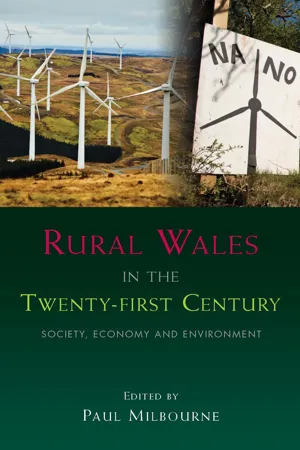
The book explores the complex and shifting geographies of rural Wales in the twenty first century. It draws on a broad range of recent academic and policy research to provide the most comprehensive and critical account of the spaces, places and environments of rural Wales to date. The book highlights recent processes of change as well as important continuities with the past. It also indicates the ways in which the contemporary geographies of rural Wales are bound up with rather complex connections between society, culture, economy and environment. The book consists of 16 specially commissioned chapters written by human geographers and sociologists with considerable expertise in rural studies. It is structured around five main themes. The first is concerned with society and community and explores changing rural demographics, the cultural impacts of in-migration, alternative communities and community action in rural Wales. The second theme is economy and employment, with chapters on labour markets, the eco-economy, migrant workers and market towns. The focus of the third theme is farming and food and the changing agri-food agenda in Wales. Welfare and services constitutes the fourth theme of the book with attention given to poverty and community responses to service provision in rural areas. The final theme of the book is environment, which is explored through discussions of environmental sustainability and the post-productivist turn in forestry. The book uses these accounts of the social, economic and environmental geographies of rural Wales to provide a broader critique of rural geography and rural studies in the UK and other developed countries.
Information
Topic
Physical SciencesSubtopic
Economic Theory1
Introducing the Geographies of Rural Wales
Introduction
The completeness of the traditional rural society – involving the cohesion of family, kindred and neighbours – and its capacity to give the individual a sense of belonging are phenomena that might well be pondered by all who seek a better social order. (Rees, 1950: 170)
This book on the geographies of rural Wales begins with the last sentence of a previous book on the Welsh countryside published more than sixty years earlier. Alwyn Rees’s Life in a Welsh Countryside provided a thick description of economic and social life in the rural community of Llanfihangel-yng-Ngwynfa in Powys and is widely acclaimed as the seminal community studies text. In addition to making connections between past and present geographical research on rural Wales, this particular sentence from Rees’s book has been selected to illustrate something of his emotional attachment to the traditional forms of Welsh rurality he was researching and his sadness about the changing nature of life in this rural community. Indeed, Rees’s unease at the creeping pace of urbanization and its perceived detrimental impacts on people’s senses of place in Llanfihangel is plain to see in the concluding passages of the book. Life in a Welsh Countryside tells us much about the stability of Welsh rural life in the first half of the twentieth century, but it also illustrates some of the dynamics of rural communities during this period, particularly the out-migration of young people in search of work opportunities in the industrializing towns. These themes of continuity and change have continued to represent significant features of life in the Welsh countryside through to the twenty-first century.
Since the publication of Rees’s book, new generations of researchers have done much to open up the social, cultural, economic, political and environmental spaces of rural Wales, and have used key themes emerging from this work to advance broader geographical understandings of rural spaces, places and environments. Staff and Ph.D. students in the colleges of the old University of Wales have played a prominent role within these developments. The fact that four of these universities – Aberystwyth, Bangor, Lampeter and Swansea – are associated with significant rural hinterlands may have something to do with this interest in ‘the rural’. As Carter (1996) states in his foreword to a new edition of Life in a Welsh Countryside, the academic environment within which Rees found himself in the Department of Geography and Anthropology in Aberystwyth in the 1940s was one in which ‘there was a developing tradition that geography should turn its attention more to its own environment, to life in the Welsh countryside’ (1996: 3). Key individuals who have worked and studied in these (and other) universities in Wales in the subsequent period have also used rural Wales as a case study in their research on a diverse range of themes, including community and locality, counter-urbanization, governance, agri-food systems, housing, poverty and sociocultural change. In doing this, research in rural Wales has helped to shape the broader trajectories of rural geography and rural studies in the UK and further afield.
This book is intended to showcase recent geographical work on rural Wales. Its breadth of coverage is deliberately wide, with the book’s contributors addressing the economic, social, cultural and environmental geographies of rural Wales. All the contributors are based in universities within Wales and many have long-standing working relations with the other contributors. Indeed, several of us have worked together during the last few years within the Wales Rural Observatory, a programme of government-funded rural research on rural Wales. There is also another common thread that connects the contributors to this book. Most of us have worked with a rural geographer who, unfortunately, is not able to contribute a chapter to this book. Dr Bill Edwards, who worked for more than thirty years in geography at Aberystwyth University, was a critical friend of rural Wales, enjoying its wild landscapes as well as conducting considerable research on its social and community spaces. Sadly, Bill was taken from us in 2007 and his loss as both a friend and a colleague was the primary motivation behind this book project – to bring together a group of his colleagues, co-researchers and academic friends to produce a book on the geographies of rural Wales that would reflect Bill’s research interests.
This introductory chapter is divided into three sections. The first provides a critical review of the changing geographies of rural Wales based on analysis of materials from policy reports produced in the early years of the twentieth century, the community studies of the 1930s and 1940s and some more recent academic research on the changing nature of rural Wales. The second section sets out the key aims of the book and provides an overview of the career of Bill Edwards. The chapter finishes with a discussion of the key themes of the book and individual chapters.
The changing geographies of rural Wales
For much of the nineteenth and twentieth centuries many rural communities in Wales were characterized by net out-migration and population losses. Commenting on the state of rural Wales on the eve of the First World War, the Welsh Land Enquiry Committee considered that ‘perhaps the most striking feature of rural conditions … is the marked tendency of the population to immigrate [sic] from the country districts to the towns’ (1914: 167). Its report utilized local statistical data to highlight the scale of this out-migration in particular rural districts. Between 1851 and 1911, for example, the population of Anglesey fell by 11 per cent, Montgomery lost 17 per cent of its residents and Radnor’s population shrank by 9 per cent. Discussing the reasons behind this out-migration to the towns, the committee pointed to the multiple attractions of urban places:
The reason is not far to seek. It is the superior draw of town life. In industrial centres wages are much higher, hours shorter, and social possibilities more attractive. Above and beyond these, is the feeling that industrial life offers more frequent opportunities for rapid industrial advancement. (ibid.: 171)
The condition of the rural housing stock was also mentioned as a secondary cause of out-migration with the informants used by the committee highlighting overcrowding within most rural properties, ‘extortionate rents charged for slum property’, the lack of housing for the working classes and speculation in slum property. The committee viewed these housing problems in serious terms, suggesting that without significant policy intervention the welfare of large numbers of rural dwellers would be damaged: ‘We have given overwhelming testimony showing that the state of a large proportion on inhabited cottages in Wales is such that it should not be tolerated if proper regard is to be had for the physical and moral welfare of the population’ (ibid.: 273).
Out-migration largely involved young people and relocations to the industrializing towns of Wales, particularly those in the south Wales valleys, with additional movements to English cities close to the border. In other cases, out-movement took the form of emigration, with the committee reporting significant numbers of migrants travelling to the US, Canada, Australia and New Zealand. As Roberts, in a later book on the state of rural Wales, comments in relation to population out-movement in the early years of the twentieth century:
Many fled the squalor of the countryside for the towns and for growing industries, others seasonally oscillated between summer work in the fields and winter occupation in works and mines. Some of the younger people, abandoning hope of any real and permanent improvement of their lot and home, sought further afield, and became pioneers of a colonist movement that has still been maintained. (1930: 79)
When we examine the texts emanating from the community studies undertaken in different parts of rural Wales by Alwyn Rees’s doctoral students in the 1940s and 1950s, these processes of out-migration are still present. Jones Hughes’s study of Aberdaron, on the Llŷn peninsula, highlighted movements of working-age residents to Merseyside to work in the docks and in domestic service, with the peak population of the community recorded in the mid-nineteenth century. In Aberporth, Jenkins reported that ‘a considerable number of its younger people have left’ (1960: 9) for the south Wales valleys and the US, and Owen’s study of the Merioneth community of Glan-llyn indicated that ‘it has experienced severe depopulation during the past hundred years or so; the population in 1949 numbered less than half that of 1821’ (1960: 188).
It is possible, though, to see the beginnings of new types of population movement within these rural community studies. For example, Jenkins noted the arrival of newcomers in Aberporth who had come to work in the newly created Ministry of Supply Establishment in the area, commenting that ‘this has brought a large increase in the number of English speakers and introduced into the population a new element whose position is quite different from that of the long-established English’ (1960: 8). In Tregaron, there was evidence of return migration amongst those who had worked in the coal industry in south Wales and in dairying in London, while on the Llŷn, Jones Hughes pointed to a population and economic turnaround linked to working-class tourism from English industrial cities:
Coastal hamlets such as Aber-soch, Llanbedrog, Morfa Nefyn and Tudweiliog have doubled their population in this century; they have become secluded resorts for the industrial workers from Lancashire and the English Midlands … On the plateau overlooking the Bay, chapels and isolated farmsteads have been submerged in a sprawl of building. Occupying the choicest sites are the homes of retired sea-captains, and these are interspersed with large Victorian-style boarding houses. More recently have appeared rows of detached and semi-detached bungalows together with less permanent summer chalets and caravan sites. (1960: 142, 143)
The Llŷn study also revealed the economic importance of tourism to the area, with Jones Hughes stating that ‘tourism is to-day the most lucrative source of income and the boarding-house keeper the most representative householder’ (ibid.: 139). Similarly, in Aberporth it was noted that ‘there is no unemployment and, in addition to regular occupations, the holiday trade is an extra source of income: 27 per cent of Aber-porth’s households “take visitors” during the summer season’ (1960: 28).
Within these early policy reports and academic books on rural Wales we also witness frequent reference to the cultural significance of rurality to Welshness as well as the tensions between modernity and rural ways of life. Writing in the foreword to Roberts’s 1930 book on rural Wales, Jones argued that ‘it is the country rather than in places where the more rapid movement of life brings of necessity frequent changes that we must expect the inherited tradition to be most strongly reflected’ (1930: foreword). In addition, Gruffudd’s research on rurality and Welsh nationhood in the inter-war years highlights how ‘the rural becomes almost a liminal zone which is seen as occupying a ground between tradition and modernity and the societies they represent’ (1994: 61–2).
Rural spaces emerge as sites of cultural and political significance in other ways during this period. In his 1991 book Fighting for Wales, Gwynfor Evans, Plaid Cymru’s first MP, wrote about the importance of the land and natural resources of rural Wales to the development of Welsh nationalism. He describes a series of symbolic events that took place during the 1940s and 1950s. The first was the seizure of 65,000 acres of land around Epynt (in the Brecon Beacons) by the War Office in 1940 to create a military artillery range, which involved the eviction of residents from sixty farms in a largely Welsh-speaking rural area. Evans highlights how Plaid Cymru became involved in the local campaign to oppose this scheme, although ultimately ‘the state triumphantly steam-rollered the opposition. The community was eliminated. The families were evicted, their homes becoming artillery targets’ (1991: 50).
Evans goes on to describe the ‘land grabbing’ attempts of other UK Government agencies in the 1950s, beginning with the actions of the Forestry Commission:
In 1950 the Forestry Commission published an outrageous plan to plant one and a quarter million acres of Welsh land: another brazen example of the establishment’s attitude towards Wales. Once again Plaid campaigned to expose the consequences and to rouse local and national opposition. (72)
In the same year, Plaid opposed a plan by another government agency, the Electricity Board, to develop a massive hydroelectric scheme in Gwynedd. Both campaigns of opposition were successful, with Evans arguing that ‘in those pre-green days when the English parties gave no thought to the environment the main burden of the defence fell on Plaid Cymru’s shoulders’ (73).
Perhaps the best-known political campaign was the opposition to the proposed flooding of Cwm Tryweryn in Merioneth to provide drinking water for the people of Liverpool. The proposal from Liverpool Corporation followed previous successful schemes to flood populated valleys in rural Wales to supply water for the populations of Merseyside, Cheshire and Birmingham. Following a long campaign, involving rallies and debates in the House of Lords, the Tryweryn Valley was flooded to provide a reservoir for the city of Liverpool. According to Evans, while ‘Plaid Cymru lost the fight [and] the Valley was drowned, the community scattered, the water seized’ (100), the campaign contained broader symbolic value:
Plaid Cymru made water a national issue, important not only in itself but as symbolising the humiliating political and economic position of Wales. It hammered home the fact that one of the richest Welsh natural resources was being exploited without benefit to the Welsh people and that this was possible because of the nation’s complete lack of political freedom. Liverpool made a profit of millions from the sale of water taken from Wales free, gratis and for nothing. (ibid.)
The rural turnaround
Since the 1970s there has been a population turnaround in many parts of rural Wales. Between 1981 and 2001, for example, the rural population increased by 73,500 people or 8.3 per cent and rural growth levels through the 1980s and 1990s were higher than for Wales as a whole. Such growth has largely resulted from the migration of new groups to the Welsh countryside. Indeed, most rural districts continue to record larger numbers of deaths than births. Beyond this aggregate demographic shift, though, lies a more complex picture, with parts of rural Wales continuing to experience net losses of population. This is particularly the case in north-western areas of rural Wales, with Anglesey recording depopulation across the 1990s. The out-movement of young people from rural places, highlighted by the earlier studies, also remains a feature of recent demographic trends, with almost all rural districts recording net out-movements of their younger populations during the last couple of decades.
Migration has brought new groups into many rural communities in Wales, as well as introducing new forms of social and cultural change. Of particular note has been the significant number of English migrants who have relocated to rural Wales during the last few decades. While earlier studies focused on the socio-economic impacts of increasing numbers of second and holiday homes in particular parts of the Welsh countryside (see Bollom, 1978; Coppock, 1977), more recent attention has focused on the sociocultural implications of permanent relocations to rural Wales, particularly cultural and linguistic tensions present within Welsh-speaking rural communities. As Jones (1993) wrote in her ethnographic account of life in a mid Wales valley:
The discovery of a different language and culture can be a traumatic experience for English incomers to rural Wales, and their responses are often emotional beneath a surface rationality. The problem for Welsh-speaking Wales is equally traumatic, as they see their fragile cultural heartlands overwhelmed by such a flow of incomers that absorption becomes impossible and Englishness dominates, whether the newcomers join existing local activities or practice a kind of cultural apartheid. (325)
Day et al.’s study of English migrant experiences in north Wales also highlights how many migrants underestimate the distinctiveness of Welsh culture in rural areas. Other research on migration to Welsh rural communities has identified the interplay between different scales of identity construct – national-scale constructions of English and Welsh identities, regional dimensions of Welsh identity and more localized identity formations – bound up with English migration to rural Wales (see Cloke and Milbourne, 1992; Cloke ...
Table of contents
- Half title
- Title page
- Copyright
- Dedication
- Acknowledgements
- Contents
- Contributors
- 1: Introducing the Geographies of Rural Wales
- Part 1: Society and Community
- Part 2: Economy and Employment
- Part 3: Farming and Food
- Part 4: Welfare and Services
- Part 5: Environment
Trusted by 375,005 students
Access to over 1.5 million titles for a fair monthly price.
Study more efficiently using our study tools.
Frequently asked questions
Yes, you can cancel anytime from the Subscription tab in your account settings on the Perlego website. Your subscription will stay active until the end of your current billing period. Learn how to cancel your subscription
No, books cannot be downloaded as external files, such as PDFs, for use outside of Perlego. However, you can download books within the Perlego app for offline reading on mobile or tablet. Learn how to download books offline
Perlego offers two plans: Essential and Complete
- Essential is ideal for learners and professionals who enjoy exploring a wide range of subjects. Access the Essential Library with 800,000+ trusted titles and best-sellers across business, personal growth, and the humanities. Includes unlimited reading time and Standard Read Aloud voice.
- Complete: Perfect for advanced learners and researchers needing full, unrestricted access. Unlock 1.5M+ books across hundreds of subjects, including academic and specialized titles. The Complete Plan also includes advanced features like Premium Read Aloud and Research Assistant.
We are an online textbook subscription service, where you can get access to an entire online library for less than the price of a single book per month. With over 1.5 million books across 990+ topics, we’ve got you covered! Learn about our mission
Look out for the read-aloud symbol on your next book to see if you can listen to it. The read-aloud tool reads text aloud for you, highlighting the text as it is being read. You can pause it, speed it up and slow it down. Learn more about Read Aloud
Yes! You can use the Perlego app on both iOS and Android devices to read anytime, anywhere — even offline. Perfect for commutes or when you’re on the go.
Please note we cannot support devices running on iOS 13 and Android 7 or earlier. Learn more about using the app
Please note we cannot support devices running on iOS 13 and Android 7 or earlier. Learn more about using the app
Yes, you can access Rural Wales in the Twenty-First Century by Paul Milbourne in PDF and/or ePUB format, as well as other popular books in Physical Sciences & Economic Theory. We have over 1.5 million books available in our catalogue for you to explore.