eBook - ePub
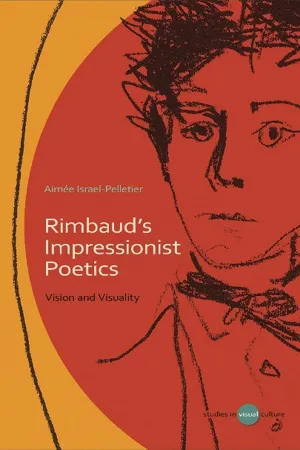
Rimbaud's Impressionist Poetics
Vision and Visuality
- English
- ePUB (mobile friendly)
- Available on iOS & Android
eBook - ePub
About this book
In the mid-nineteenth century, Arthur Rimbaud, the volatile genius of French poetry, invented a language that captured the energy and visual complexity of the modern world. This book explores some of the technical aspects of this language in relation to the new techniques brought forth by the Impressionist painters such as Monet, Morisot, and Pissarro.
Information
Impressionism and the New Look
I have been setting up the argument that Rimbaud’s poetry can be profitably discussed in the context of Impressionist aesthetics and that to read his later work as an experiment in the representation of reality is not counterintuitive when the work is situated in its contemporary context. From the Poésies to the Illuminations Rimbaud’s work charts a trajectory that reflects discussions that preoccupied writers and artists in the 1860s and 1870s. Rimbaud’s work is an example of the sea change in realism. We see a progression in his work from, on the one hand, a relative confidence in the representational capacity of language to secure meaning and reference and do this from a stable and fixed perspective to, on the other hand, a concern with the representation of sensations and perceptions as mobile and striking. Rimbaud’s experimentation with poetry plays out in a series of attempts to apprehend modernity in a style that captures the liveliness of sensations and, particularly, of visual perception. One might argue that any classification by literary or artistic movement is too limited. Clearly, the work is always more than any narrow characterization of it. But, in arguing for Rimbaud’s place among the Impressionists, I believe that we establish a foundation for a reading that is culturally specific and informed by the salient aesthetic and ideological currents of a hugely consequential time. His work is engaged in the issues that galvanized this period. It is also a model for the way art was called upon to negotiate with and account for the massive changes taking place at the time. Kristin Ross has brilliantly exploited this socio-historical approach in her work on Rimbaud by focusing on the political landscape of the Commune.1 I frame Rimbaud’s work in a broader cultural context examining his engagement with the discourses on modernity, capitalism, visuality and Impressionism taking place in the later 1860s and early 1870s.
Art critics have divided Impressionism into roughly two periods: Early Impressionism, 1867–74, and the mature period from 1874, the year of the first Impressionist exhibit, to 1886, the date of the eighth and last. After 1886, new elaborations like neo-Impressionism and pointillism make their appearance, causing what some describe as a crisis of Impressionism. Around the mid-1880s, as Paul Tucker writes:
Each member’s style underwent some form of change . . . The divisive formal strategies, which had stood out so boldly against the hegemony of contemporaneous Salon art, had become familiar . . . Impressionism had not completely lost its capacity to irritate conservative critics, but its edge had been blunted by time, exposure, and historical circumstances.2
It is with the earlier period, from 1867 to 1874, when Impressionism was emerging, that I situate Rimbaud’s Impressionist experiment.3 Politically speaking, this was a time of transition. With a conservative monarchist majority in the government, the republicanism that emerged after the Commune was in many ways more rigid and repressive than the Second Empire had been. Writers, artists and intellectuals had to deal with the paradox. Political instability was felt as a real and constant threat. As Jane Mayo Roos writes, in the decade that followed the catastrophe of 1870–1,
The country strove to regain a sense of order and control. In the tense postwar atmosphere, the idea of change and reform became emotionally and politically charged . . . Caricatures of the period vividly convey the ambivalence of the country’s politics . . . the press was full of images that referred directly to the continued legacy of the ancien régime . . . Not until 1879, when the parliament swung to the left, and a ‘republic of republicans’ replaced what had been called the ‘republic of the dukes,’ was it at all clear that the new government would survive.4
This is the general context against which Impressionism defined itself. It reflected that political instability. And it saw itself as transgressive, proclaimed itself the aesthetic avant-garde and went about the business of interpreting modern life. Rimbaud’s most innovative poems and his writerly concerns resonate with the work and artistic concerns of many Impressionist painters. The Illuminations, on which I will focus in this chapter, parallels the experiments of Impressionist painters in their attempts to free art from old-established techniques and aims.
From the Poésies to the Illuminations, Rimbaud works away from the rigidity of Parnassian versification and explores ways to ‘free’ the verse form. It is this metrical looseness or dislocation that made Verlaine’s poetry appealing to him. In the Poésies Rimbaud lightens metrical forms by introducing various rhyming and syllabic irregularities but does not go far enough. His attempts are foiled by a keen interest in saying something, an urgency for his poetry to ‘mean’. In the Derniers vers, as I argued in chapter 1, he pushes further this exploration of a more free metric and comes up with some of the most evocative and daring uses of ‘vers libre’. He then qualifies this experiment in the Derniers vers as misguided and denounces it in Une saison en enfer. The Illuminations is a response to the perceived failure of the Derniers vers. The Illuminations returns to the terrain of the Poésies but revamped by new techniques and a nuanced cosmopolitanism. I argue in this chapter that in the Illuminations Rimbaud challenges the view that meaning is linear and stable and allies himself more directly and freely to a poetics of Impressionism. He affirms that sensations, the external world and the experience of modern life are the privileged subjects of art and that includes poetry. David Evans has written perceptively of the progression from the Poésies to the Illuminations but from a different angle. He uses musical metaphors to study Rimbaud’s manoeuvering of versification and traditional poetic forms to show how his work evolves.5 Evans studies the relationship between, on the one hand, fixed metric form and the notion of aesthetic absolute and, on the other hand, the challenges mounted against this outdated world view. For Evans, Rimbaud explores how far he can disrupt formal techniques and still call a poem a poem. My own approach here parallels Evans’s but uses images and the topos of Impressionism to suggest that this evolution is less a linear progression than a return to the initial impulses of the poet that informed the Poésies. I see the Illuminations as an experiment to find the least reductive poetic form, the form that best preserves the experience of being in the world as if for the first time, innocent yet engaged. Like sound, visual language resists reduction and reflects a poetics that works against the static, fixed, absolute concepts which are implied in the old world view.6
Impressionism is an avant-garde practice and a set of values regarding modern life. It is a term used to talk about specific aims and qualities that manifest themselves in certain works at a certain period in France as this practice evolved in the work of its varied practitioners. Broadly speaking, Impressionism represents the nexus around which some of the concerns raised by realism were addressed. Its aims and fundamental processes are founded on an imperative based on faith in republican values of freedom, subjective vision and confidence in the new. Republicanism was not shared by all the Impressionists at all times. But at certain times, and in differing degrees, it was understood that freedom from the old prescribed ways of doing art was needed to respond artfully to the changes taking place in society. The Salon, Beaux-Arts training and government financial support for the arts were deemed in need of reform. A new approach was also needed to express the new realities in a new style.7 Formal qualities, style and technique, and the subject of contemporary life were seen as the embodiment of this new republican ideal reflected in Impressionist works, in their radical new look and in the discourse that grew around them.
However, Impressionist works can be hard to identify. The Impressionists were a varied group whose work was far more diverse than a simple definition would suggest. Do we count Manet, Pissarro, Caillebotte, Cézanne and Degas among the Impressionists? Impressionist paintings are not uniform. They reflect a range of experimentation over time and across works. They do not, necessarily, at all times reflect the values and formal qualities secured by iconic paintings like Monet’s or Renoir’s 1869 paintings at La Grenouillère, Sisley’s A Turn in the Road (1873), or Monet’s Harbor at Le Havre at Night (1873). Maybe we ought to avoid the term Impressionism and call these artists the new painters of modern life, as T. J. Clark’s example suggests we do. Whatever satisfaction we may derive in wrestling with the term, I find it possible nonetheless to acknowledge the distinct styles of these painters and still recognize in their works a set of common concerns that we can identify as Impressionist. Impressionism is above all an experimental practice and, therefore, displays various ‘takes’ on the problem. So, in referring to Rimbaud’s Impressionism, I am suggesting there is more at stake than superficial resemblances, more than surface effects. There is a whole range of conditions, concerns and aims to take into account. Meyer Shapiro writes:
Impressionism has become a vaguer term as the works of the painters who were called the Impressionists have become better known. After designating the style of a small band of French artists . . . perhaps no more than eight or nine . . . If common features lead us to bracket these painters rigidly as a group, we will fail to recognize their great differences from each other, even in the 1870s when they chose to exhibit together under one name . . . By the mid-1880s certain of them had diverged enough to raise doubts as to the rightness of the common label, with its connotations of the sketchy and formless in art.8
Paul Smith addresses the questions, ‘Who and what were the Impressionists’, in a similarly irresolute way:
One familiar answer is that they were a group of painters, some of whom first met between 1860 and 1862 at an informal studio, the Académie Suisse, and the rest of whom shared time together between 1862 and 1864 in the studio of the painter Charles Gleyre at the École des Beaux-Arts. Monet, Camille Pissarro, and Paul Cézanne (who met at the Académie Suisse) and Auguste Renoir, Alfred Sisley, and Frédéric Bazille (who met Monet at Gleyre’s) are said to have united in opposition to the conservative, classical training and, under the example of the landscapists Eugène Boudin and Johan Barthold Jongkind, went to paint nature in the open air in a novel, bold, and ‘sketchy’ manner.9
Smith adds that while the artists he names above formed ‘the core of the 55 painters who showed their work at the eight Impressionist exhibitions between 1874 and 1886, this is not justification enough to designate them “the Impressionists”’. The Impressionist artists, he asserts, ‘have to be defined by a mix of many factors, which differed from artist to artist’ (pp. 10–11). Most art critics agree with Smith’s view. Robert L. Herbert settles the complication by suggesting that Impressionism ‘refers to the work of a group of avant-garde painters who made common cause and who were associated together by their contemporaries’.10 And Richard Shiff confers the title of Impressionist ‘on anyone who associates with the group; and, by principle of commutation, such an individual’s style becomes exemplary of the group style (unless it is radically deviant)’. Shiff continues in earnest:
Given a strict application of this criterion of professional affiliation and personal sympathy, Degas remains an impressionist, even though some nineteenth-century critics claimed that his style necessarily excluded him; and Cézanne must be included even though, for many twentieth-century viewers, his style appears antithetical to impressionism.11
It is true that these Impressionist artists did not paint the same way as their predecessors and neither did they often paint like each other. Zola writes: ‘Chacun d’eux, d’ailleurs, a heureusement pour lui sa note originale, sa façon de voir et de traduire la réalité à travers son tempérament.’12 Yet, as different as they are, art critics generally agree, they shared certain ideas and traits. I will call on some of the most dominant of these traits to discuss Rimbaud’s poetry.
Major among these is the belief that classical training with its emphasis on ‘correct’ drawing and its valuation of historical topics and mythology as appropriate subject matter had to give way. As Herbert points out, the Impressionists helped destroy the whole academic system. After 1870, few significant artists grew out of the old system. Being the first avant-garde in the history of art, Impressionism mounted a head on assault against the established traditions of art. It attacked the institutions by breaking the rules governing subject matter and technique. The Impressionists also shared a certain ‘look’, such as the lighter palette, the looser brushstrokes, strikingness, a predilection for effects of light and a resistance to absorptive effects. We can also speak about their general aims and procedures. What brings the Impressionists together is a set of values regarding the representation of modern life by means of formal qualities that embody those values. Edmond Duranty calls on those who uphold traditional art to step aside. He opens a paragraph in La Nouvelle peinture with: ‘Laissez faire, laissez passer.’13 The Impressionists were fascinated by the new, that is, by new social formations, new social freedoms, new technologies, the increasing accessibility of popular leisure, entertainment and travel. And even when they did not buy into it, like Degas, they did make it the subject matter of their work. Or, as in Manet, they problematized the modern by quoting the past alongside it. Around modernity then they created a set of expectations that put faith in the new and valorized it above other values like tradition, conventions and the art forms of the past. Impressionism took it as a given that artistic practice had to change to respond to this changing material reality. Men, women and institutions could be seen trying to figure out what it meant to live in a time of expanding opportunities and shifting relationships. The Impressionists could also agree that artistic expression needed to be truthful. And they understood that truth in representation was a matter of subjective vision, temperament and point of view.
In 1867, Edmond Duranty recognizing the experimental and audacious work of the ‘new painters’, as he called them, expressed concern about their future as avant-garde artists. He asks: ‘Sont-ils arrivés d’eux-mêmes à ce rendez-vous d’une même route et s’y maintiendront-ils par l’instinct ou par la volonté?’14 Most did not stay the course in the strictest sense. Renoir found it hard to defend Impressionism and succumbed to pressure from critics unfavourable to it. By the 1880s, he looked to the Renaissance and to the eighteenth century to reframe the issues of colour and form. Monet went from a frankly engaged interest in modern life and figure painting in the 1870s to the exploration of the saturated effect that lead him eventually to the formidable paintings of the late 1890s and 1900s. Caillebotte collapsed under a set of pressures both from within and from outside Impressionism. He undermined his own work and made it his project to support the work of others. Pissarro took up pointillism essentially to prove his mettle in a ‘more difficult’, ‘serious’ and ‘scientific’ form. He returned to an Impressionism energized and invigorated by Monet’s brilliant efforts in the 1880s to reframe the discourse on Impressionism. In short, Impressionism changed as one could expect an experimental art to do.
It is precisely because of its experimental nature and because it was the site of heated debates that contemporary discourse on Impressionism is important to consider in an attempt to grasp what it was. Lecomte-Hilmy has shown in her study of the lexicon used in the contemporary press that it was not the painters themselves who established the parameters of the discourse on Impressionism. Rather, it was the reviewers and the public, both those favourably disposed and those who were not. Impressionist art responded to that discourse and sought to advance itself in reaction to it. Impressionism was a discourse as well as a practice. The discourse helped frame the way the art was perceived, how it would be recognized and how it might be put into practice. If Manet, Degas and Caillebotte are not always referred to as Impressionists, this is due in large measure to the discourse gen...
Table of contents
- RIMBAUD’S IMPRESSIONIST POETICS
- Contents
- Series Editors’ Preface
- Acknowledgements
- Note on Editions of Rimbaud’s Work
- Introduction
- Language and Visual Realism in the Poésies
- Unsettled Terrain: Realism and Impressionism 1860s–1870s
- Impressionism and the New Look
- Vision, Visuality, Affect
- After Poetry
- Notes
- Select Bibliography
Trusted by 375,005 students
Access to over 1.5 million titles for a fair monthly price.
Study more efficiently using our study tools.
Frequently asked questions
Yes, you can cancel anytime from the Subscription tab in your account settings on the Perlego website. Your subscription will stay active until the end of your current billing period. Learn how to cancel your subscription
No, books cannot be downloaded as external files, such as PDFs, for use outside of Perlego. However, you can download books within the Perlego app for offline reading on mobile or tablet. Learn how to download books offline
Perlego offers two plans: Essential and Complete
- Essential is ideal for learners and professionals who enjoy exploring a wide range of subjects. Access the Essential Library with 800,000+ trusted titles and best-sellers across business, personal growth, and the humanities. Includes unlimited reading time and Standard Read Aloud voice.
- Complete: Perfect for advanced learners and researchers needing full, unrestricted access. Unlock 1.5M+ books across hundreds of subjects, including academic and specialized titles. The Complete Plan also includes advanced features like Premium Read Aloud and Research Assistant.
We are an online textbook subscription service, where you can get access to an entire online library for less than the price of a single book per month. With over 1.5 million books across 990+ topics, we’ve got you covered! Learn about our mission
Look out for the read-aloud symbol on your next book to see if you can listen to it. The read-aloud tool reads text aloud for you, highlighting the text as it is being read. You can pause it, speed it up and slow it down. Learn more about Read Aloud
Yes! You can use the Perlego app on both iOS and Android devices to read anytime, anywhere — even offline. Perfect for commutes or when you’re on the go.
Please note we cannot support devices running on iOS 13 and Android 7 or earlier. Learn more about using the app
Please note we cannot support devices running on iOS 13 and Android 7 or earlier. Learn more about using the app
Yes, you can access Rimbaud's Impressionist Poetics by Aimée Israel-Pelletier,Aimée Israel-Pelletier in PDF and/or ePUB format, as well as other popular books in Literature & History of Art. We have over 1.5 million books available in our catalogue for you to explore.