- English
- ePUB (mobile friendly)
- Available on iOS & Android
eBook - ePub
About this book
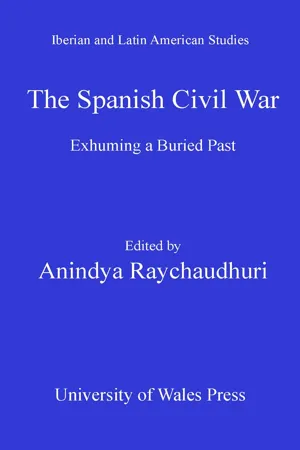
This book features cutting, edge, interdisciplinary research on the legacy of the Spanish Civil War by established and new scholars from across the world.
Information
Print ISBN
9780708325780
Subtopic
European HistoryChapter 1
Franco, the Catholic Church and the Martyrs1
Franco’s dictatorship was the result of a civil war, and in this long, bloody dictatorship resides the distinguishing feature of the history of twentieth-century Spain when compared to other capitalist countries in Europe. It is true that Spain, unlike other countries, never had the chance to benefit from an international democratic intervention to block the authoritarian outcome of the war, which is a key factor for understanding the long duration of the dictatorship. But it is worth emphasising, above any other consideration, the winning side’s commitment to vengeance and its denial of pardon and reconciliation, as well as to hang on to the power provided by arms for as long as possible. The military, the Catholic Church and Franco made peaceful coexistence fairly difficult for several decades.
It is difficult to understand the long duration of this dictatorship unless one takes into account the repression, the army’s rallying around Franco and the international context of the cold war that played into the regime’s hands. But the Catholic Church’s contribution was also considerable. The twentieth century has seen no other authoritarian regime, fascist or otherwise, and there have been some of varying colours and intensity, in which the church has taken on such blatant political responsibility for, and policing of, the social control of the citizens as in Spain. Certainly not the Protestant Church in Nazi Germany or the Catholic Church in fascist Italy. And in Finland and Greece, after their civil wars, the Lutheran and Orthodox churches signed alliances with the right-wing winning sides, defending patriotism, traditional moral values and patriarchal authority in the family. Yet, in neither of these cases were there any calls for vengeance and bloodshed as strong or as tenacious as was the case with the Catholic Church in Spain. It is true that no other church had been persecuted so cruelly and violently as the Spanish Catholic Church. But, once the war was over, the memory of so many martyrs gave strength to resentment instead of pardon and encouraged vengeance among the clergy (see Casanova, 2005 and Raguer, 2007).
Three basic ideas sum up my thoughts on this issue. First, the Catholic Church became involved and steeped in the ‘legal’ system of repression organised by Franco’s dictatorship after the civil war. Secondly, the Catholic Church endorsed and glorified this violence, not only because the blood of its thousands of martyrs cried out for vengeance, but also, and above all, because this authoritarian outcome cancelled out, at a stroke, the major ground won by laity prior to the military coup in July 1936 and gave it a powerful authority and monopoly beyond its dreams. Finally, the symbiosis between religion, nation and the Caudillo was decisive for the survival and maintaining of the dictatorship following the defeat of the fascist powers in the Second World War.
The fall of the monarchy in April 1931 was a genuine disaster for the church. It hated the republic, its system of parliamentary representation, anti-clerical legislation, people power, in which Catholic values no longer held sway. It mobilised the population, giving shelter under the ideological umbrella of Catholicism to a mass movement of the dominant classes, the most conservative sectors, who were concerned about their own order as well as that of the church, although in the history of Spain, during the republican period as well as afterwards, order and the church had always gone together, and would continue to do so.
The Crusade
During 18–19 July 1936 a military uprising, supported by right-wing civilians and militia organisations, erupted in Spanish Morocco and rapidly spread to metropolitan Spain. From the outset, the church and most Catholics placed all of their considerable resources at the disposal of the insurgent military. The military did not have to ask the church for its support, which it offered gladly, nor did the church have to take its time in deciding. Both parties were aware of the benefit of the role played by the religious element: the military because they wanted order, the church because it was defending the faith.
The Spanish Civil War has gone down in history, and in memory, for the way it dehumanised its adversaries and for the horrific violence that it generated. If we go by the meticulous research carried out in the last few years, at least 150,000 were killed during the war: close to 100,000 in the zone controlled by the military rebels and somewhat fewer than 60,000 in the republican zone. Figures aside, we are fully aware of the principal manifestations of this terror in the ‘two cities’, one ‘heavenly’, the other ‘earthly’, evoked by the bishop of Salamanca, Enrique Pla y Deniel, quoting Saint Augustine (Moreno, 1961, pp. 688–708). The entrance of the church onto the stage, far from reducing the violence, increased it, blessing it on the one hand and kindling the popular feeling that had broken out against the clergy at the same time as the defeat by the military uprising on the other.
The church was delighted with this ‘providential’ uprising, as it was termed by Cardinal Primate Isidro Gomá in the report he sent to the Secretary of State of the Vatican, Cardinal Eugenio Pacelli, on 13 August 1936. It was all the more delighted that it was arms that ensured ‘material order’, eliminated the unfaithful and restored ‘freedom’ (cited in Andrés-Gallego and Pazos, 2001, pp. 80–9).
The clergy’s complicity with this military and fascist terror was absolute and did not need republican anti-clericalism to make itself known publicly. From Gomá to the priests who lived in Zaragoza, Salamanca or Granada, all were aware of the massacres, heard the shots, saw how people were dying, with the relatives of prisoners or the missing coming to them in desperation, seeking help or charity. The clergy’s usual response to all this was silence, either voluntary or imposed by superiors, or else accusation or denunciation. This is how Franco’s church emerged, which identified with him, admired him as the Caudillo, as an envoy sent from God to re-establish the consubstantiality of traditional Spanish culture with the Catholic faith.
On 1 July 1937, the Spanish Catholic hierarchy officially signed its blood pact with the cause of General Franco, in the ‘Carta colectiva de los Obispos españoles a los de todo el mundo con motivo de la Guerra de España’.2 Written at Franco’s request by Cardinal Isidro Gomá, it was endorsed by all the Spanish bishops, except two: one Basque (Mateo Múgica) and one Catalan (Françesc Vidal i Barraquer) (Moreno, 1961, pp. 726–41).
There was nothing new in the letter that had not already been said by many bishops and priests in the previous twelve months since Franco’s rising. But the letter, immediately translated into several languages, had a great impact worldwide. The publicity the letter received led to greater acceptance of this Manichaean version of the Spanish war, in which the armed plebiscite of the National Movement embodied the virtues of Christian tradition, and the republican government represented all the vices inherent in Russian Communism.
As well as propagating the lie that the military rising had put a stop to a definite plan for communist revolution, while speaking of the calm and justice that reigned in ‘national’ territory, the bishops included another matter of capital importance, which is still, more than seventy years later, the official position of the Spanish Catholic Church hierarchy. The church, they said, was the ‘innocent, peaceful, defenseless’ victim of the war and, ‘rather than perish totally at the hands of communism’, had supported the national cause, which safeguarded the ‘fundamental principles of society’ (Moreno, 1961, pp. 726–41).
The Carta colectiva won the support of some 900 bishops in thirty-two countries. Its unconditional endorsement of the national cause served as a definitive argument for Catholics and conservatives throughout the world, largely because of its shameless silence about the exterminating violence that Franco’s side had set in motion since the first moment of the rising. The Carta demonised the enemy, and put a seal of approval on the sponsorship of the war as a ‘holy crusade’ against the republic’s assault on the church and the nation.
Both Franco and the church were strengthened by the letter. The conversion of the war into a religious affair, disregarding the political and social aspect, gave Franco licence to go on killing. Franco’s then director of propaganda, Javier Conde, said that the letter had ‘achieved more than all the rest of us in the propaganda area’ (Bolado, 1995, p. 159).
Victory and totalitarianism
On 27 March 1939, the Francoist army entered Madrid, and three days later, on 1 April, the war came to an end. Franco’s victory in the war meant the absolute triumph of Catholic Spain. Catholicism once more became the official state religion. All the republican measures that were cursed by the church and the right wing were repealed. From that moment, the church was to enjoy a long period of well-being, with a dictatorship that protected it, showered it with privileges, defended its doctrines and crushed its enemies.
After the war, the victors settled scores with the losers, endlessly reminding them of the killings of priests and the profanation of churches, while ignoring the bloody cleansing that the right had practised in the war and went on practising afterward.
For some time, fascism and Catholicism were compatible, in statements and daily practice, in the projects promoted by the rebels and in the form of government and way of life imposed by the winning side. Fascism was ‘a virile protest against an absurd democracy and rotten liberalism’, wrote Eloy Montero in 1939, in his book Los estados modernos y la nueva España (cited in Botti, 1992, pp. 102–3). The Jesuit, Constantino Bayle, wrote in a similar vein when the war was at its height, delighted by the fact that fascism was the name given to the overthrow of the parliamentary system and universal suffrage, the elimination of political parties and trade unions, the ‘abomination’ of democracy, the ‘eradication’ of the ‘poison seed of Judaeo-Masonry’. If this was fascism, then ‘the National Uprising, the Government of Franco, and the whole of Christian Spain’ were fascist (Bayle, 1937, p. 326).
The Spain that the victors constructed was a territory particularly suited for this harmonisation of the modern authoritarian current with glorious tradition. The feeling of uncertainty and fear caused by the reform measures of the republic, the anti-clericalism and expropriation and destruction following the military coup was used by the military, the church and reactionary forces to mobilise and obtain a social base willing to respond to what were interpreted as clear symptoms of de-Christianisation and national disintegration. The army, the Falange and the church represented these victors, and from them came the upper echelons of government, the system of local power and the faithful servants of the administration. These three bureaucracies vied with each other to increase their spheres of influence, and recent research has noted these rivalries in many towns and villages in Spain. But, for a certain period – too long for thousands of citizens – they were united in what Santos Juliá called ‘the common exaltation of military, fascist and Catholic values: order, leadership and religion’ (Juliá, 1999, p. 155).
When this harmonisation between Catholicism and fascism could no longer be defended so easily abroad, the dictatorship was forced to shed its fascist appearances and highlight the Catholic base, the essential identification between Catholicism and Spanish tradition. The regime that resulted from the war had nothing to do with fascism, said Franco in an interview with United Press in November 1944, because fascism did not include Catholicism as a basic principle. In previous years, however, the military, traditionalists and the church never tired of saying just the opposite: if fascism was nationalism and there was no difference between Spanish and Catholic nationalism, then there was no contradiction between fascism and Catholicism.
On 18 July 1945, nine years after the military uprising that sparked the civil war, Franco increased the presence of Catholics in his government. He kept Ibáñez Martín in education and appointed Alberto Martín Artajo minister of foreign affairs. Martín Artajo, a former CEDA politician and deputy, was a 40-year-old lawyer, chairman of Acción Católica and a prominent member of the Asociación Católica Nacional de Propagandistas. A protégé of Angel Herrera, the founder of the ACNP who became a priest and later a cardinal, Martín Artajo offered Franco the collaboration of the Catholics. Herrera, Martín Artajo and the bishop primate Enrique Pla y Deniel were convinced that it was now time for the Catholics to take on political responsibilities in such difficult times for their Spain and their regime. Martín Artajo had previously said this to Franco during a long conversation that they had on 1 May 1945. Martín Artajo also knew Luis Carrero Blanco, under-secretary of the Cabinet, chief of operations of the Spanish navy who, according to Paul Preston, ‘shared all Franco’s political prejudices’. Martín Artajo and Carrero Blanco had taken refuge in the Mexican embassy in Madrid together during the ‘red’ months of the second half of 1936 (Preston, 1993, p. 539).
In short, the former politicians of the CEDA and prominent members of the ACNP played a decisive role in the institutionalisation of the victors’ new state of Spain. The church and the Caudillo worked hand in glove together for almost four decades. Spanish Catholicism came out on top from this exchange of favours with a murderous regime, constructed on the ashes of the republic and vengeance on the defeated. The Church of the Crusade, Franco’s church, the church of vengeance appealed to traditional religious values, primitive even, and tried to reconvert Spain, its Spain, with the most repressive and most violent measures in the history of contemporary Spain.
The church hierarchy, Catholicism and the clergy were, of course, not immune to the socio-economic changes that began to challenge the Francoist dictatorship political machine in the early 1960s. Catholicism was forced to adapt to this evolution with a series of internal and external transformations that have been studied by various authors. This secularisation coincided with general reform trends emerging from the Second Vatican Council. Catholic opinion and practice began to expand, with young priests who departed from the traditional ideology, workers of the JOC (Catholic Working Youth) and the HOAC (Workers’ Brotherhood of Catholic Action) actively working against Francoism, and Christian sectors who toiled away with Marxists on the future society that would follow the overthrow of capitalism.
Priests and Catholics talking about democracy and socialism and criticising the dictatorship and its highly repressive manifestations – all this was new for Spain and it naturally produced a reaction in wide Francoist circles, used as they were to a church that was servile and supportive of the dictatorship. But it would be grossly overstating it to conclude that most of the clergy, and the Bishops’ Conference, set up in 1966, abandoned Francoism in those last few years and embraced the democratic cause. It would be more correct to say, as Frances Lannon mentioned some time ago, that the Spanish Catholic Church had discovered that ‘essential ecclesiastical interests – particularly in its own institutional security, in Catholic education and in moral influence – could be better secured in a pluralistic regime than in a widely hated dictatorship’ (Lannon, 1987, p. 225). This idea was also recently expressed by William J. Callahan: it was a question of reforming what was necessary but at the same time preserving ‘everything that could be saved from the privileged relationship that the Church maintained with the regime’ (see Lan...
Table of contents
- Cover
- Half Title
- Title Page
- Copyright
- Contents
- Series Editors’ Foreword
- List of Illustrations
- Acknowledgements
- Contributors
- Introduction
- Chapter 1: Franco, the Catholic Church and the Martyrs1
- Chapter 2: American Women and Anti-fascism in the Spanish Republican Relief Campaigns, 1936–1939
- Chapter 3: Forgotten Names, Remembered Faces – The Bookshop Manager
- Chapter 4: At Their Most Vulnerable: The Memory of British and Irish Prisoners of War in San Pedro de Cardeña1
- Chapter 5: The Tragic Exodus: Málaga, February 1937
- Chapter 6: (Per)Forming Historical Memories of the Spanish Civil War: Leaving Monuments for Magazines
- Chapter 7: The Spanish Civil War and the Politics of Affectivity in the New Millennium: La guerra de esquelas as an Act of Memory
- Chapter 8: Battles of the Past: The Siege of the Alcázar of Toledo in Collier’s Weekly
- Chapter 9: Dust to Dust: Symbolism of Earth in the Memorialisation of the Spanish Civil War
- Chapter 10: ‘Grieving in a New Way for New Losses’: British Elegies on the Spanish Civil War
- Chapter 11: ‘It’s the Art of Always Falling on Your Feet!’ Exile, Communism and Memories of the Spanish Civil War in the Writing of Jorge Semprún1
- Chapter 12: Remembering the Spanish Civil War in Fiction: Dulce Chacón’s La voz dormida and Ángeles Caso’s Un largo silencio
- Chapter 13: Dangers and Insights: Auden’s ‘Spain’
- Chapter 14: Inspired Neglect? Three Fascist Artists of the Spanish Civil War
- Chapter 15: A New Reality: Anarchism and Visual Culture in Twentieth-century Spain
Trusted by 375,005 students
Access to over 1.5 million titles for a fair monthly price.
Study more efficiently using our study tools.
Frequently asked questions
Yes, you can cancel anytime from the Subscription tab in your account settings on the Perlego website. Your subscription will stay active until the end of your current billing period. Learn how to cancel your subscription
No, books cannot be downloaded as external files, such as PDFs, for use outside of Perlego. However, you can download books within the Perlego app for offline reading on mobile or tablet. Learn how to download books offline
Perlego offers two plans: Essential and Complete
- Essential is ideal for learners and professionals who enjoy exploring a wide range of subjects. Access the Essential Library with 800,000+ trusted titles and best-sellers across business, personal growth, and the humanities. Includes unlimited reading time and Standard Read Aloud voice.
- Complete: Perfect for advanced learners and researchers needing full, unrestricted access. Unlock 1.5M+ books across hundreds of subjects, including academic and specialized titles. The Complete Plan also includes advanced features like Premium Read Aloud and Research Assistant.
We are an online textbook subscription service, where you can get access to an entire online library for less than the price of a single book per month. With over 1.5 million books across 990+ topics, we’ve got you covered! Learn about our mission
Look out for the read-aloud symbol on your next book to see if you can listen to it. The read-aloud tool reads text aloud for you, highlighting the text as it is being read. You can pause it, speed it up and slow it down. Learn more about Read Aloud
Yes! You can use the Perlego app on both iOS and Android devices to read anytime, anywhere — even offline. Perfect for commutes or when you’re on the go.
Please note we cannot support devices running on iOS 13 and Android 7 or earlier. Learn more about using the app
Please note we cannot support devices running on iOS 13 and Android 7 or earlier. Learn more about using the app
Yes, you can access The Spanish Civil War by Anindya Raychaudhuri in PDF and/or ePUB format. We have over 1.5 million books available in our catalogue for you to explore.