eBook - ePub
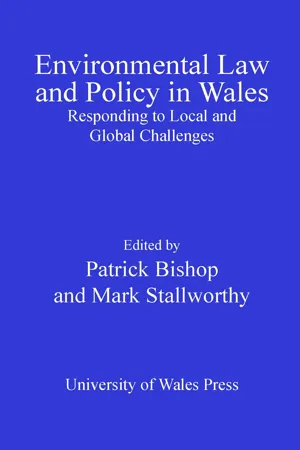
Environmental Law and Policy in Wales
Responding to Local and Global Challenges
- English
- ePUB (mobile friendly)
- Available on iOS & Android
eBook - ePub
Environmental Law and Policy in Wales
Responding to Local and Global Challenges
About this book
This book examines Welsh perspectives on the search for sustainable law and policy solutions to modern environmental threats.
Information
Chapter 1
Introductory: expressing Welsh law perspectives on environmental protection

Those concerned to see a coherent and effective development of environmental law (especially including policy makers and legal advisers as well as researchers, teachers and students) share a broad awareness of two critical features. First, there is the wide-ranging nature of those problems that can be viewed as ‘environmental’ in character; second, those law and policy fields with which environmental lawyers are required to engage are both multi-faceted and polycentric.
A 2009 article in the Journal of Environmental Law by Elizabeth Fisher et al. marked a notable contribution to a maturing environmental law discourse. The authors generally posed the question of why environmental law continued to be ‘so darn difficult as an intellectual enterprise’, and sought more specifically to classify the main methodological challenges they saw as confronting all engaged within this sub-discipline’s broad jurisprudential church.1 The challenges were organized within four main interconnecting strands, namely interdisciplinarity, policy dynamics, governance fragmentation and jurisdictional multiplicity.
To a greater or lesser extent, the various chapters in this collection represent exemplars of the methodological challenges highlighted by Fisher et al. A few non-exhaustive examples may serve as illustrations. The concept of behavioural change, integral to Stallworthy’s analysis (chapter 9) of climate law in Wales, requires an interdisciplinary engagement with aspects of behavioural economics and cognitive psychology. Further, the legal response to climate change has occurred across numerous jurisdictional levels, including the international community, the European Union, the UK and Wales. Such jurisdictional multiplicity is not unique to the legal response to climate change; the control and eradication of bovine tuberculosis considered by Bishop (chapter 6) is the subject of EU, UK and Welsh legislation and thus a central feature of such a crowded law and policy arena is governance fragmentation. Indeed, such fragmentation is arguably an inevitable consequence of devolution whereby various competencies are divided between London and Cardiff. However, this may be justified on the premise that it is desirable that decisions be taken as close as possible to those affected on the ground, as illustrated by Jenkins’s (chapter 8) discussion of sustainable communities and the importance of public engagement at the local and community level.
Although not explicitly considered by Fisher et al., it is possible to add a fifth methodological challenge, namely the extensive diversity of legal instruments that may be used to tackle environmental problems. Those interested in contract are generally firmly embedded in the law of obligations; similarly, an administrative lawyer’s centre of gravity will be located in institutional structures and relations, and principles of judicial review. We could continue with a plethora of further examples. The essential point is that environmental lawyers are faced with a myriad of distinct legal instruments, borrowed from, inter alia, public law, property law, EU law, international law and criminal law. Further, while one might be tempted to think of environmental law as predominantly a branch of public law (broadly defined), Wilde’s historical evaluation (chapters 3 and 4) of nuisance serves as a useful reminder that, even in a regulatory era, private law mechanisms are not moribund. The nature of the various mechanisms available to policy makers and legislatures is equally diverse, including traditional ‘command-and-control’ regulation supported by sanctions for non-compliance; economic instruments such as taxation designed to discourage environmentally damaging activities; and non-regulatory approaches such as those designed to ‘nudge’ actors towards beneficial conduct.2 Thus, in the post-modern legal world characterized by a diminishing regulatory monopoly on the part of the state,3 environmental lawyers are faced with a regulatory landscape in which the distinctions between formal and informal mechanisms in law and policy have become blurred. The foregoing analysis is encapsulated by Lee’s analysis (chapter 7) of the food strategy for Wales as a soft law instrument.
Accordingly, as editors we present in this volume not only illustrations of the fundamental challenges that confront environmental lawyers, but also a range of responses to such challenges from within the Welsh environmental academy. There follows a brief tour d’horizon of the kinds of problems that fall within the categories identified above, which we in turn challenged contributors to take into consideration in their work here.
First, from an interdisciplinary perspective, environmental lawyers confront a wide range of ethical and regulatory choices, often in areas dominated by complexity and knowledge gaps. This requires working with mixes of both traditional and emerging principles, and related lessons and obstacles presented from other, non-legal perspectives.
Second, in respect of policy dynamics, in which optimum solutions often appear contingent and subject to continual review, environmental lawyers must work with regulatory responses, which variously reflect either established or more radical alternative instrumental and normative influences. In each respect, intradisciplinary tensions can be said to arise, including on such questions as rationale, purpose and efficacy.
Thence, Welsh perspectives can be most readily identified in relation to the remaining challenges: those of governance fragmentation and jurisdictional multiplicity. Regarding the third element, fragmentation, this is reflected in the deployment of evolving regulatory regimes, and the wider engagement of actors, through public–private partnerships and otherwise. To these ends legal categories are not closed, and methods rely on soft as well as hard law approaches, just as use is made of supplemental, extra-legal techniques geared towards meeting policy objectives. An important element lies in the harnessing of expanding public law understandings and approaches, manifested in greater formalization of legal inputs. These occur typically through proceduralized, rather than substantive, controls, alongside cognate developments relating to information and transparency, public participation and access to justice.
The fourth, and perhaps most prescient, challenge before the writers contributing here relates to the quandaries that result from jurisdictional overload, a condition complicated somewhat by the impetus, charted in this present volume, towards addressing environmental issues from a Welsh perspective. Both vertical and horizontal issues require resolution, as distinct levels of jurisdiction seek to impose themselves (or indeed shy away from) environmental problems. Yet such interrelationships remain ‘under-explored and scholarly debate on the proper methodology for undertaking such analyses remains virtually non-existent’.4 This demands an engagement with a complex of interjurisdictional connections, as the conditions for conflict arise and call for resolution.
At a basic level, an interjurisdictional analysis might address the question of the extent to which Welsh environmental law and policy is different from its English counterpart. It is submitted that a more interesting question is the extent to which a divergent approach is desirable. Morrow (chapter 2) charts the development of devolution in Wales and acknowledges that the process is one of evolution, not revolution. Nevertheless, the devolution settlement in Wales, both prior and subsequent to the ‘yes’ vote in the referendum to determine whether or not to activate the powers contained in Part IV of the Government of Wales Act 2006, unquestionably opens windows of opportunity for distinctive Welsh approaches. However, in the context of environmental protection, such openings may be narrower than might otherwise be the case, on the basis that the impetus for a significant proportion of environmental legislation is provided by the EU. An illustration of the tendency towards homogeneity as a result of EU action is provided by Warren’s analysis (chapter 5) of nature conservation, noting that Wales is similar to the rest of the UK in the way it addresses habitat and species protection, partly because of the influence of European and international commitments which take effect at a UK level.
Yet despite such limitations on autonomy one may acknowledge that policy makers in Wales are able to adopt a distinctive, even unique, approach to environmental protection. It does not automatically follow that, merely because divergence is possible, Welsh policy makers ought to strive for it. Even in a climate of streamlined and enhanced law-making powers for the National Assembly, it might continue to be the case that Welsh environmental law and policy is not inherently dissimilar to the rest of the UK. To this end Stokes (chapter 10) adopts a cautionary tone, warning that over-enthusiastic legislative activity on the part of the National Assembly might lead to less credible policy formulation.
The above challenges are very much ‘live’, in the sense that answers to environmental problems by reference to the logic of greater centralization have often proved out of reach. That said, although international environmental law frameworks are beset by the realities of interstate division and conflict, as politically conceived state interests are prioritized, indications of positive progress do exist. Thus, first, they can contribute to agenda setting, albeit that progress generally requires elaboration and delivery at national (and, in the EU’s case, supranational) levels. Second, there have been notable success stories: for instance in relation to the development of international mechanisms to address damage to the ozone layer. This demonstrated that especially where geopolitical conditions are right (there, for instance, including a restricted specific goal, the ready availability of alternative technologies and multilateral willingness to commit to both financial support and trade sanctions) even at this level success can be achieved. Otherwise, it is typically at regional levels of governance, and below, that workable legal mechanisms to meet environmental threats are more likely to be found.
So the chapters that follow are situated within and across a variety of legal categories, and explore a range of applicable techniques. In these specific contexts, it is argued that, in the search for effective approaches, it is crucial that policy makers be aware of the possibilities and limitations of legal mechanisms. Furthermore, in the face of the complexities and value conflicts that often characterize environmental problems, tools of risk assessment in the field of environmental degradation have developed more nuanced characteristics (such as ‘best environmental techniques’ within ‘integrated pollution prevention and control’) than a crude adoption of cost–benefit analysis might otherwise suggest. Indeed the modern predilection for target setting (long-term) and problematic juxtaposition with day-to-day politics (short- to medium-term) is also now beginning to be translated into legal terminology, and questions of juridification will also increasingly arise here.
Meanwhile, new ‘environmental’ principles have emerged, from the frankly amorphous and practically unworkable ‘polluter pays’ to the highly contested but nevertheless cogent (especially within an EU framing) idea of ‘the precautionary principle’ and the principle of ‘restoration at source’. More problematic, given its chameleon-like potentialities for policy makers, is the principle of ‘sustainable development’, but even such ubiquity is tending to alter the terms of debate.
Foundational questions for legal discussion in the field of the environment are ultimately about where balances between recognized interests are to be struck. Environmental laws, whether in their instigation or in their elaboration and interpretation, are underpinned by powerful, purposive elements that reflect decision makers’ choices. This poses immense challenges for environmental lawyers, conceived in Tim Jewell and Jenny Steele’s admonition by reference to whether an ‘ “assimilation” ...
Table of contents
- Cover
- Half Title
- Title Page
- Copyright
- Contents
- Foreword
- Preface
- Contributors
- Chapter 1: Introductory: expressing Welsh law perspectives on environmental protection - Patrick Bishop and Mark Stallworthy
- Chapter 2: Debatable ground: the devolution settlement and environmental law in Wales - Karen Morrow
- Chapter 3: Nuisance law in industrial Wales – local and national conflicts (part one): copper smelting in a pre-regulatory era - Mark Wilde
- Chapter 4: Nuisance law in industrial Wales – local and national conflicts (part two): oil refining, the common law and regulation - Mark Wilde
- Chapter 5: Nature conservation in Wales - Lynda M. Warren
- Chapter 6: Badgers, bovine tuberculosis and the role of science in the formulation of Welsh environmental and agricultural policy - Patrick Bishop
- Chapter 7: The Food Strategy for Wales: a soft law instrument? - Robert Lee
- Chapter 8: Sustainable communities in Wales: developing a new governance approach to local sustainable development in Wales’s most deprived areas - Victoria Jenkins
- Chapter 9: Climate change law in Wales: realizing the value of participation - Mark Stallworthy
- Chapter 10: Made in Wales: devolving and evolving environmental policy making - Elen Stokes
- Bibliography
Trusted by 375,005 students
Access to over 1.5 million titles for a fair monthly price.
Study more efficiently using our study tools.
Frequently asked questions
Yes, you can cancel anytime from the Subscription tab in your account settings on the Perlego website. Your subscription will stay active until the end of your current billing period. Learn how to cancel your subscription
No, books cannot be downloaded as external files, such as PDFs, for use outside of Perlego. However, you can download books within the Perlego app for offline reading on mobile or tablet. Learn how to download books offline
Perlego offers two plans: Essential and Complete
- Essential is ideal for learners and professionals who enjoy exploring a wide range of subjects. Access the Essential Library with 800,000+ trusted titles and best-sellers across business, personal growth, and the humanities. Includes unlimited reading time and Standard Read Aloud voice.
- Complete: Perfect for advanced learners and researchers needing full, unrestricted access. Unlock 1.5M+ books across hundreds of subjects, including academic and specialized titles. The Complete Plan also includes advanced features like Premium Read Aloud and Research Assistant.
We are an online textbook subscription service, where you can get access to an entire online library for less than the price of a single book per month. With over 1.5 million books across 990+ topics, we’ve got you covered! Learn about our mission
Look out for the read-aloud symbol on your next book to see if you can listen to it. The read-aloud tool reads text aloud for you, highlighting the text as it is being read. You can pause it, speed it up and slow it down. Learn more about Read Aloud
Yes! You can use the Perlego app on both iOS and Android devices to read anytime, anywhere — even offline. Perfect for commutes or when you’re on the go.
Please note we cannot support devices running on iOS 13 and Android 7 or earlier. Learn more about using the app
Please note we cannot support devices running on iOS 13 and Android 7 or earlier. Learn more about using the app
Yes, you can access Environmental Law and Policy in Wales by Patrick Bishop,Mark Stallworthy in PDF and/or ePUB format, as well as other popular books in Politics & International Relations & Environmental Law. We have over 1.5 million books available in our catalogue for you to explore.