- English
- ePUB (mobile friendly)
- Available on iOS & Android
eBook - ePub
About this book
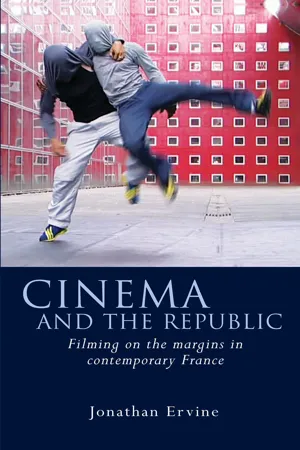
This book analyses contemporary French films by focussing closely on cinematic representations of immigrants and residents of suburban housing estates known as banlieues. It begins by examining how these groups are conceived of within France's Republican political model before analysing films that focus on four key issues. Firstly, it will assess representations of undocumented migrants known as sans-papiers before then analysing depictions of deportations made possible by the controversial double peine law. Next, it will examine films about relations between young people and the police in suburban France before exploring films that challenge cliches about these areas. The conclusion assesses what these films show about contemporary French political cinema.
Information
Subtopic
Art GeneralChapter One
Cinema and the Republic

Any exploration of contemporary political cinema in France needs to address the specificity of the political and cinematic context in which French films are produced. France’s Republican ideals play a major role in determining how groups such as immigrants and banlieue residents are perceived and treated, and there are contrasting ways in which the Republic itself is represented as either a source of inclusion or exclusion. It is also important to ask to what extent the structure of the French film industry influences films about immigrants and banlieue residents. These two categories of often marginalised figures have increasingly been given a voice via contemporary political films in France although this can sometimes be a complicated and challenging process. However, how they are conceptualised is gradually shifting as it is increasingly acknowledged that it is becoming ever more difficult to define the specificity of French cinema in an age of globalisation.
The French Republic: inclusion and exclusion
There are many ways in which republicanism shapes how immigrants and banlieue residents interact with the French state and, indeed, several different articulations of republicanism. Although a largely unquestioning adherence to republican values traverses the mainstream political left and right in France, their differing political standpoints mean that they do not necessarily cherish the same elements.1 Due to the left’s being associated with defending the least well-off groups in society, they would traditionally be expected to see the egalitarian thrust of French republicanism as a means of establishing a basis for ensuring that vulnerable groups are not disadvantaged. From a more right-wing and non-interventionist perspective, republican egalitarianism could be seen as creating a framework that precludes the according of any perceived privileges to less well-off groups and, therefore, theoretically rules out the introduction of any meaningful antidiscrimination measures.
In addition to the differences between left- and right-wing conceptions of republicanism, other divisions also exist within these currents. Régis Debray’s famous article ‘Êtes-vous démocrate ou républicain?’ (Are you a democrat or a republican?) demonstrates that those on the French left do not hold a universally shared vision about the importance of constitutionally based republicanism.2 Debray’s landmark work charts how the 1980s saw some on the French left start to favour a more pragmatic approach that drew on elements of the more British or American multicultural approach as a means of identifying difference and resolving inequalities.3 In other words, people who shared Debray’s broadly left-wing political standpoint did not necessarily see strict adherence to ideological foundations of republicanism as the correct way to deal with issues such as racial difference and racial inequality.
Despite such divisions, republicanism largely remains a shared language used by state institutions in France that minority groups, and indeed all citizens, need to adopt when framing demands for rights.4 As Loomba argues in her discussion of Spivak, those who feel oppressed are often required to speak ‘in voices borrowed from their masters’.5 One of the benefits of this approach is that it provides marginalised people with a means of making their case in a manner that means that it is more likely to be listened to by those in power In assessing the extent to which contemporary political films in France have succeeded in articulating a counter-hegemonic discourse on social and racial exclusion, it is thus important to compare the ways in which directors have sought to engage with republican principles and how they represent France’s republican ideals. A key issue is the extent to which the directors’ focus on republicanism is mirrored by an awareness of republicanism that is displayed by the protagonists of their films.
One of the most important elements of republicanism that influences the status of minority groups is the notion of the single and indivisible nation. This concept can be traced back as far as the French Revolution, which ‘established the nation as the guarantor of the common good’.6 However, several analysts argue that the notion of a single and indivisible nation is an artificial construct that masks the diversity that exists within French society and, therefore, creates a false sense of unity.7 Even if the image of a single and indivisible nation may be somewhat illusory, it nevertheless forms a crucial ideological basis for framing concepts of rights based on a notion of cultural homogeneity. It means that rights are theoretically granted to individuals as citizens rather than as members of groups or communities within a nation, whether these groups are constituted on the basis of nationality, race, religion, gender, sexuality or other criteria. In principle, there are no subalterns but merely individual citizens and non-citizens.8
The concept of a multicultural society where diverse groups coexist is incompatible with French republicanism’s insistence that new arrivals in France must adapt to the norms and traditions established by the Republic. Debray characterises multiculturalism largely as a form of pragmatism that he associates with les Anglo-saxons (that is, the Americans and the British) and that lacks the ideological and intellectual gravitas of French republicanism.9 However, if the French state does not seek to recognise differences between citizens (at least in theory), an insistence on the key distinction between being a national and being a foreigner is crucial when it comes to determining what rights people have in terms of political participation and access to employment.10 Jennings’s discussion of Schnapper does, however, suggest that determining citizenship on the basis of nationality is arguably tokenistic or, worse still, a means of creating a hegemonic and exclusionary structure within a theoretically egalitarian society.11 Recent decades have seen several other significant challenges to conventional republican notions of citizenship based on nationality (as opposed to residency or participation), notably due to the emergence of the mouvement beur in the early to mid-1980s. They also resurfaced in the 1990s due to the rise in profile of the sans-papiers movement, and have remained pertinent due to the focus on the renewal of the French left (and especially social movements) following the public sector strikes of 1995.12
As the discussion above demonstrates, debates about republican conceptions of citizenship provide examples of how the supposedly single and indivisible nation has been seen by some as exclusionary rather than inclusionary. Whilst Jennings accepts that multiculturalism is ‘un-French’ because ‘it sanctions unequal rights’ and ‘places . . . groups before individuals’, he acknowledges that it provides a means of challenging the way republicanism constructs a hegemonic system that alienates or excludes those who do not easily fit into its universalist framework.13 Within this theoretically egalitarian paradigm, republican universalism can also obscure racial issues, or make them hard to assess. In an illuminating study of the history of the French nation and French national identity, Silverman argues that the way in which republican universalism eliminates difference results in many people in France seeing racism as external to – rather than part of – society.14 In her study of racism in a variety of different European contexts, Lentin goes further by stating that a consequence of the way French republicanism deals with difference is that ‘racialisation is . . . stripped of its continual power to exclude and violate’.15 Despite Lentin’s criticisms of republicanism, it should be noted that Rosello and Silverman argue that expressing one’s dissent within a republican context provides more than merely a strategic means of framing demands; it also facilitates attempts to expose the failings of this very system.16
Failings and contradictions often become apparent when republican principles are examined in the light of recent practices by several French governments. Kiwan shows that several have embraced aspects of equal opportunities in a way that contradicts the principles of republican egalitarianism and also suggests that the Republic is not achieving its desired unifying effect.17 Significantly, she identifies numerous government measures introduced in the period 2002–5 (that is, during the term of a right-wing government) that set out to facilitate the integration of minority groups. Nevertheless, she also observes that this has coincided with increasingly strict policies on the wearing of religious symbols in schools. This has led to a paradoxical situation whereby ‘on one hand, the French government has been working towards giving greater public visibility to France’s “minorities” through equal opportunities and anti-discrimination initiatives, yet on the other hand, it has been working towards ensuring the “invisibility” of minorities in schools and public life’.18 Whilst Kiwan’s research shows a recent example of elected representatives of France’s republican nation-state adopting a surprisingly pragmatic approach, Knapp and Wright observe that thinkers such as Tocqueville were able to observe as early as the mid-1800s that ‘the rules in France are rigid, but their implementation is often flexible’.19
Assessing the efficacy of the aforementioned measures aimed at tackling discrimination remains problematic due to the fact that the universalist ethos of French republicanism makes the collection of racial and ethnic data by researchers an arduous and potentially illegal task. Despite this, ‘testing’ is a method that has often provided anecdotal evidence of discrimination. ‘Testing’ has long been used by anti-racist groups such as SOS-Racisme and involves, for example, comparing what happens when groups of white and non-white young people try to get into bars or nightclubs. Similarly, experiments have been conducted involving job applications where almost identical CVs have been submitted as part of applications for the same job except with names changed so as to suggest French or non-French descent, or the address changed from one in a city centre location to one on a suburban housing estate. In analysing cases of alleged police violence to see if there is a potential racial element, Mucchielli has employed another technique: establishing figures based on cases reported in the French media in which the origins of the victims of the alleged police misconduct were known.20 This demonstrates that whilst republican universalism can make discrimination hard to identify due to its focus on individual citizens rather than groups, the ingenuity of researchers and campaigning groups can nevertheless uncover evidence of potential discrimination.
Cinematic frameworks: cultural hierarchies?
Just as republicanism establishes a political framework that influences how groups such as banlieue residents and immigrants have to ground their rights claims in order to be heard, there is also a largely state-defined framework that influences the possibilities open to film-makers in France. This means that there are potential cultural hierarchies that need to be considered alongside those of a sociopolitical nature, notably due to how the structure of the French film industry shapes the commercial and economic context in which films are produced. Despite being primarily interested in films from an artistic rather than a commercial perspective, I will also analyse the ways in which the content, distribution and reception of certain films has been influenced by commercial and economic issues.
France has a long tradition of state support for film production that can be traced back to events such as the creation of the Centre national de la cinématographic (CNC, National Centre for Cinematography) in 1946. This led to the introduction of a tax on cinema tickets that is reinvested in the French film industry. The appointment of André Malraux to lead the newly created Ministry of Culture in 1959 resulted in further forms of state support, such as the avance sur recettes (funding for films provided as an advance on box office receipts). In order to counter the rise of television, taxes on television companies’ revenues have helped to fund France’s cinema industry since 1984.21
Despite the existence of these support mechanisms, many films in France are produced on small budgets and struggle to achieve widespread commercial distribution. On occasion, this can be a consequence of the issues that these films set out to address. On the one hand, films can be used to construct and promote positive images of a nation and effectively reinforce hegemonies. Higson states that films can play an almost commercial role in presenting a country to the outside world (and its own residents) by creating ‘a distinctive brand name’.22 On the other hand, films can also challenge received ideas and create counter-hegemonic discourse by depicting images that a country might not want the rest of the world to see. Tarr argues that films about people such as banlieue residents and immigrants ‘constitute a challenging intervention to narratives of the nation in contemporary French cinema [and] construct very different images of France from those which have conventionally dominated France’s cinematic exports’.23 O’Shaughnessy’s discussion of Serge Le Péron’s definitions of reality and the real makes a similar point concerning the much talked about retour au réel (return to the real) associated with post-1995 political film-making in France. Whilst ‘reality is that which we already know, a stabilised, normative and totalising social order’, O’Shaughnessy goes on to state that ‘the real is that which is normally unseen but hurts’ and that ‘cinema’s role is to bring this uncomfortable and disruptive real to visibility’.24 This means that it is important to go beyond ‘distinctive brand names’ and delve deeper to uncover more unsettling visions. This is precisely what happens in...
Table of contents
- Cover
- Title
- Copyright
- Contents
- Series Editors’ Preface
- Acknowledgements
- Introduction
- Chapter One: Cinema and the Republic
- Chapter Two: The Sans-papiers on Screen – Contextualising Immigrant Experiences in Film
- Chapter Three: Double peine: The Challenges of Mobilising Support for Foreign Criminals via Cinema
- Chapter Four: Challenging or Perpetuating Clichés? Young People and the Police in France’s Banlieues
- Chapter Five: Challenging Stereotypes about France’s Banlieues by Shifting the Focus?
- Conclusion
- Notes
- Bibliography
Trusted by 375,005 students
Access to over 1.5 million titles for a fair monthly price.
Study more efficiently using our study tools.
Frequently asked questions
Yes, you can cancel anytime from the Subscription tab in your account settings on the Perlego website. Your subscription will stay active until the end of your current billing period. Learn how to cancel your subscription
No, books cannot be downloaded as external files, such as PDFs, for use outside of Perlego. However, you can download books within the Perlego app for offline reading on mobile or tablet. Learn how to download books offline
Perlego offers two plans: Essential and Complete
- Essential is ideal for learners and professionals who enjoy exploring a wide range of subjects. Access the Essential Library with 800,000+ trusted titles and best-sellers across business, personal growth, and the humanities. Includes unlimited reading time and Standard Read Aloud voice.
- Complete: Perfect for advanced learners and researchers needing full, unrestricted access. Unlock 1.5M+ books across hundreds of subjects, including academic and specialized titles. The Complete Plan also includes advanced features like Premium Read Aloud and Research Assistant.
We are an online textbook subscription service, where you can get access to an entire online library for less than the price of a single book per month. With over 1.5 million books across 990+ topics, we’ve got you covered! Learn about our mission
Look out for the read-aloud symbol on your next book to see if you can listen to it. The read-aloud tool reads text aloud for you, highlighting the text as it is being read. You can pause it, speed it up and slow it down. Learn more about Read Aloud
Yes! You can use the Perlego app on both iOS and Android devices to read anytime, anywhere — even offline. Perfect for commutes or when you’re on the go.
Please note we cannot support devices running on iOS 13 and Android 7 or earlier. Learn more about using the app
Please note we cannot support devices running on iOS 13 and Android 7 or earlier. Learn more about using the app
Yes, you can access Cinema and the Republic by Jonathan Ervine in PDF and/or ePUB format, as well as other popular books in Media & Performing Arts & Art General. We have over 1.5 million books available in our catalogue for you to explore.