eBook - ePub
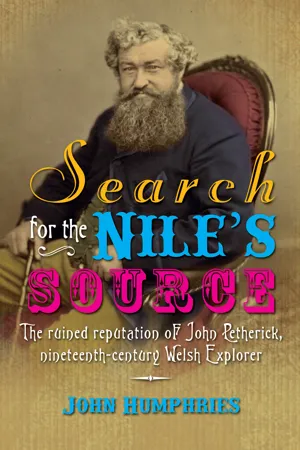
Search for the Nile's Source
The Ruined Reputation of John Petherick, Nineteenth-Century Welsh Explorer
- English
- ePUB (mobile friendly)
- Available on iOS & Android
eBook - ePub
Search for the Nile's Source
The Ruined Reputation of John Petherick, Nineteenth-Century Welsh Explorer
About this book
This experimental volume of literary criticism offers various interpretations of the work of the poet Menna Elfyn, and gives an outline of our relationship with literature and our reading habits. It is an attempt to provide a fresh interpretation of the work by experimenting for the first time in Welsh with the epistolary method of criticism, through a series of fictional letters. This is also the first extended study of Menna Elfyn's poetry: addressed to the poet's work in particular, but also looking at contemporary issues such as interpretation, performance and the marketing of literature in contemporary Wales. Academic practices are vigorously challenged by walking the line between 'fact' and 'fiction' to create a multi-vocal and readable criticism reflecting the complex and multifaceted nature of the reading process.
Information
CHAPTER 1
From Merthyr to the Pyramids
THE ELDEST OF SEVEN SURVIVING CHILDREN, John Petherick was born in 1813 in a ‘smoke-tinted house’ behind Merthyr Tydfil’s Penydarren Ironworks where his father was a works agent. Following the well-beaten money trail from tin-mining in Cornwall to iron-making in Merthyr, his father and grandfather, both also John, migrated from Camborne to what was once the isolated valley home of a handful of poor Welsh farmers and ragged sheep but by the start of the 19th century was a boom town created by coal and ironstone. When Petherick was christened at St Tydfil’s Parish Church on 13 June 1813, his father was one of an elite cadre of managers employed to run this industrial colossus on behalf of four powerful ‘iron families’. As agent at Penydarren for William Forman and his absentee partner Alderman Thompson (Member of Parliament for Westminster), Petherick Senior dealt with the Crawshays at Cyfarthfa, the Guests at Dowlais and the Hills at Plymouth who from their mansions on the hill presided over a community where prosperity and poverty were only ever feet apart. In sharp contrast to the crabbed terraces clinging to the valley sides, the Petherick household had fine furniture, cut-crystal glasses, and paintings on the walls.
Nothing, however, could have shielded the younger Petherick from the turbulence of this frontier town. While never suffering the bleak circumstances of contemporaries, he did lose an infant brother and sister to the disease that assailed Merthyr, the fear and desperation that regularly stalked the town pressing upon the young man’s adolescent consciousness, albeit in the company house on the other side of the tracks.1 Just a few feet from his home, the road rose steeply towards the lava flows of Dowlais Top, the fire and brimstone of rapacious industry choking the valley. At the Cinder Hole, trams tipped red-hot waste from the coke ovens over man-made precipices ablaze with a thousand fires. Fanned by high winds, sheets of flame and clouds of acrid smoke spewed into the valley below, accompanied by the clanging hammers and the confused din of the massive machinery at the beating heart of the Black Domain.
Life could be short and brutal, but the inhabitants were fiercely independent with ‘great strength … dark minds … strong passions and vigorous vices’ – the Merthyr Guardian fretting over the ‘little bastards’ flooding the streets. Not surprisingly, Petherick emerged from the rough and tumble of early 19th century Merthyr with a reputation for having a heavy hand and strong conviction that physical explanation was sometimes necessary in an argument.
To control such people, the ironmasters had truck. The company shop – the only means of supplying isolated communities during the early days of the iron boom – was used to enslave workers in a monstrous cycle of debt and credit that left them beholden to their employers. ‘If the masters had not had some hold over such a set of men and were to make them entirely independent by giving them complete control over their high wages, they would work just when and how they liked, and the capital embarked in the works would be at their mercy’ was how one ironmaster justified this iniquity.2
Despite a huge influx of migrant workers from the surrounding countryside and from other parts of Britain, the predominant language of Merthyr in the first part of the 19th century was Welsh. Like his father, the younger Petherick almost certainly spoke it, even though an increasing number of people were persuaded to believe that Welsh was a barrier to progress and synonymous with illiteracy. His first encounter with the language was at Mr Shaw’s school for infants at Turnpike Cottage, and afterwards at Taliesin Williams’s school on the Glebeland where pupils devoted part of their studies to copying the Welsh language manuscripts of their headmaster’s illustrious father, Edward Williams – best known by his Bardic name, Iolo Morganwg.3 At Taliesin’s, the young Petherick rubbed shoulders with the sons of the 19th century gang masters at the centre of the complex web of trades hired to run the ironworks and collieries. By then part of Merthyr’s emerging middle-class, the ‘butties’ organized the teams of puddlers, shinglers, catchers, balers, moulders, and carriers, without whom production quickly ground to a standstill.
Precisely when he left Merthyr to study as a mining engineer at the Institute of Geology at Breslau University in eastern Prussia (now Poland) is uncertain but evidently the intention was to return and follow his father and grandfather into the iron industry, the only son who did so, if only briefly. All the surviving Petherick siblings would leave Merthyr for other parts of Wales and less demanding occupations as retailers and teachers. A younger brother, James, opted out entirely to live as a recluse. Hating the noise and graft of the ironworks, James is remembered as the ‘Hermit of Mountain Ash’ living in a mountain cottage at Cefn Pennar out of sight of the glowing blast furnaces. Dressed in rustic garb, and carrying a long staff, his fine white beard streaming in the wind, James was a familiar figure among the highways and byways studying the local flora and fauna. Reserved and respectful, he preferred enlightenment to confrontation, quite different from his impulsive elder brother whose impetuosity at Breslau University ended in a duel, and a rapier slash he carried to the grave.4
Petherick was probably fortunate to be at Breslau on 3 June 1831 and not at home where his father was thrust into the centre of the Merthyr Rising. As agent for Penydarren, Petherick Senior knew trouble was brewing. Not only did he employ some of the principal protagonists, he had spied upon them at a protest meeting at the Waun Fair a month previously. A white flag emblazoned with the slogan ‘Reform the Parliament’ was hoisted as speaker after speaker attacked the hated Court of Requests.5 Life on credit had created an army of wage-slaves dreading the bailiff’s knock – in one instance the mattress seized from beneath a dying woman.
Magistrates were locked in a council of war at the Castle Inn when, with the town ready to explode, a detachment of Argyll and Sutherland Highlanders arrived. The testimony of Petherick Senior as to what followed was generally considered the most detailed and accurate account of events, although strangely he was not called to testify at the subsequent trial. But his evidence at the inquest which preceded it helped convict Lewis Lewis (Lewsyn yr Heliwr, or Lewis the Huntsman) and Richard Lewis, immortalized as Dic Penderyn, the working class martyr hanged at Cardiff Prison for stabbing a soldier during the melee.
Petherick Senior was at the window of the Castle Inn alongside the ‘Iron King’ William Crawshay of Cyfarthfa and Josiah John Guest of Dowlais as the mob closed with the Highlanders defending the entrance. The previous day the Red Flag was raised for the first time in Britain by demonstrators ransacking houses to recover property confiscated by the Court of Requests. The Riot Act was read that evening after the Red Flag was shaken in the faces of the magistrates, and the home of a court official set alight. That same night, Petherick Senior was supervising production in the puddling forge at Penydarren when the mob burst in. ‘Why stop the works?’ he pleaded. ‘To get better wages,’ one replied. Another forced him to take the Red Fag, soaked in calf’s blood, as a sign that he supported the uprising. ‘I said if it would please him … I had no objection,’ the man replying, ‘That’s right … you are now sworn in.’6
The Riot Act was read a second time the following morning when two thousand demonstrators besieged the Castle Inn. From a window on the first floor Petherick Senior had a grandstand view of the bloodbath that ensued:
I saw some of the 93rd Regiment proceed in front of the inn along the pavement. They had bayonets fixed. The mob was considerably excited … pressing close upon the soldiers … Major Falls and another officer endeavouring to keep the mob from pressing on the men, begging them to stand off but they only gave way for a moment and came on again. I went into a passage of the inn and heard a soldier complain to an officer that he had been insulted by the mob. The officer said, ‘Do your duty, and hold your tongue … if you do not be quiet and obey orders implicitly I will cut you down.’ I then saw a man elevated on the shoulders of the mob who said they did not want it believed they would be satisfied with bread only … at which moment the mob cried, ‘Caws gyda bara,’ that is ‘Cheese with bread.’ Then the same man said, ‘As well as bread we must have money to buy cheese and shoes and clothes, money to pay rent and for beer …’7
Petherick identified Lewis Lewis clinging to an iron lamp post and shouting in Welsh, ‘Listen boys! They say they have brought the soldiers here for their protection; if every one of you is of my mind we will show they are not a sufficient protection.’ Some carried heavy iron bludgeons while others waved the Red Flag like battlefield colours in the faces of the soldiers before rushing forward propelled violently from behind. The mob drew back and rushed a second time, according to Petherick:
About three or four attacked each soldier … The officer distributed his men among the front rooms, telling them clearly, ‘Recollect men, your orders are not to fire unless commanded by an officer.’ Three or four of the soldiers were lying on the ground (in the street) … the mob (was) certainly getting the better of them. The officer looked a second time through the window and gave the order to ‘Fire’ … when the smoke cleared the mob had begun to retreat and I saw four or five bodies lying in the street opposite the front of the inn, bleeding.8
Petherick counted the bodies of eight or nine rioters in the street strewn with bludgeons and rocks. The mob attacked a final time, firing at the hotel from behind a bank a hundred yards away, the musket balls whistling around Petherick as he dived for cover. After three-quarters of an hour the shooting stopped, and the dead rioters were taken to the hotel stables.
The battle was by no means over. Fearing a general insurrection across the Black Domain, magistrates and soldiers retreated to Penydarren House, home of the Forman family: a fortified redoubt from which the Highlanders would attempt to reclaim Merthyr. For the next eight days the rioters held the town until the Highlanders, reinforced by the Royal Glamorgan Militia and Yeomanry confronted the insurgents at Cefn. Not a shot was fired. The crowd backed off and the insurgency collapsed.
Petherick Senior sympathized with the plight of the rioters, commenting, ‘I am not in distress myself but I know those who are so.’ Recriminations were widespread after Richard Lewis (Dic Penderyn) was hanged pleading his innocence with his last breath, and Lewis Lewis transported to Van Dieman’s Land for life.
Perhaps they were ostracized but the Pethericks left Merthyr two years later announcing the auction of their property in the Merthyr Guardian on 26 October 1833. The family sold almost everything, ranging from ‘a very elegant dinner service … and superior assortment of paintings, prints and books … and an extensive collection of mineralogical specimens.’ Some of the paintings were the work of Petherick Senior, an accomplished self-taught artist drawing his subjects from the 19th century industrial landscape of the valleys.9
Whatever the reason, Petherick Senior quit a well-paid job at Penydarran to become manager of the newly-opened Pyle Ironworks. Within a year the works was in financial difficulties and he returned to Merthyr, not to Penydarren, but as manager of the neighbouring Rhymney Ironworks, another venture in which ‘Billy Ready Money,’ the name the City coined for Petherick’s entrepreneurial former employer, William Forman, had invested. After seven years at Rhymney, he moved finally to the Cambrian Ironworks at Maesteg, later renamed the Llynfi Works. The project was a financial disaster and by the 1851 census Petherick Senior was unemployed and living at 62 Eastgate Street, Bridgend with wife Martha, their last surviving daughter Mary (30), youngest son William (25), and a live-in servant.
After completing his studies at the University of Breslau, the younger Petherick obtained a position as mining engineer for a complex of coalmines owned by the English and German Mining Company in Germany’s Hartz Mountains. By chance, he was living at Dillenburg when Sir Roderick Murchison and his collaborator Professor Adam Sedgwick arrived to study the local geology. Before championing African exploration as president of the Royal Geographical Society, Murchison was a prominent geologist who with Sedgwick shaped the heroic age of modern geology by proposing the fossil record as a means of grouping geological formations, as opposed to the traditionalists who subscribed to a grand cosmological explanation for the formation of the earth’s crust. For this reason they visited Wales frequently, Sedgwick spending one summer in the Cambrian Mountains rock hunting with Charles Darwin before Darwin sailed aboard the Beagle on his historic voyage.10
Sedgwick’s rock-hunting in Wales led him in 1835 to identify the Cambrian period in the geological timescale, followed closely by Murchison’s classification of the overlapping Silurian period. Their next objective was to prove the existence of another geological period – the Devonian – and to demonstrate its universality they had travelled to the Hartz Mountains in Germany’s Rhineland in 1839 where with the assistance of an ‘English miner’ they found evidence to support their theory.
Petherick Junior was the ‘English miner’ mentioned by Murchison in a letter to his wife describing his ‘famous excursion on foot, headed by a little broad-shouldered clever Prussian bergmeister who, booted and spurred, led the way (pipe in mouth, hammer in hand), followed by S [Sedgwick], De Verneuil [a French geologist], myself and an English miner.’ That evening at an inn in Dillenburg, they enjoyed a session around the piano after dining with the ‘young English miner and his sisters’, most probably the innkeeper’s daughters.11
For health reasons, Petherick later quit his job in Germany, travelling first to Switzerland and then France, afterwards returning to Wales, first to work for a short time in the iron industry, before taking the spa waters at Llandrindod Wells. While recovering, he was recommended by a Cardiff engineer named Gallaway as a suitable candidate to fill a commission from Muhammad Ali Pasha, Viceroy of Egypt and the Sudan to search for coal in the desert. The Viceroy was also constructing a railway from Cairo to Suez and Gallaway his recruiting agent in Wales. The young Welsh mining engineer seized the opportunity to escape the Black Domain.
CHAPTER 2
Egypt and the Search for Coal
TEA PLANTERS RETURNING TO CEYLON from home leave and employees of the East India Company comprised most of the passengers aboard the S.S. Great Liverpool departing Southampton for Egypt in 1845. For Petherick, the acute sense of adventure was mixed with foreboding, not knowing for how long he was severing links with Britain, family and friends. Communications with the far reaches of Empire were still protracted, news from Africa taking eight weeks to reach the Times by overseas mail. By the time Petherick returned, the Crimea War was over after great loss of life; nations shaken by political upheaval and revolution; the traditional doctrine that man was the product of divine intervention challenged by Charles Darwin; and America on the verge of civil war over the emancipation of millions of slaves.
Britain had banned the infamous Triangular Trade between itself, West Africa and the Americas in 1806. Moral outrage over the transportation of Black Africans shackled and yoked together like animals, stacked like sacks of flour in wooden hulks had produced one of the undisputed achievements of an era that once subscribed to the notion that slavery was ordained by God. The belief that some had the right to ‘possess, buy, sell, discipline, transport, liberate, dispose of others’ was finally extirpa...
Table of contents
- Half Title
- Title Page
- Copyright
- Contents
- List of Illustrations
- Index to Persons in Narrative
- Chronology
- Introduction
- Chapter 1: From Merthyr to the Pyramids
- Chapter 2: Egypt and the Search for Coal
- Chapter 3: The Missing Years
- Chapter 4: Khartoum, Ivory and Slaves
- Chapter 5: Exploration and Trade
- Chapter 6: The Promise
- Chapter 7: The Journey
- Chapter 8: The Race
- Chapter 9: The Succour Dodge
- Chapter 10: A Very Public Quarrel
- Chapter 11: Unfinished Business
- Conclusion
- Notes
- Appendices
- Select Bibliography
Trusted by 375,005 students
Access to over 1.5 million titles for a fair monthly price.
Study more efficiently using our study tools.
Frequently asked questions
Yes, you can cancel anytime from the Subscription tab in your account settings on the Perlego website. Your subscription will stay active until the end of your current billing period. Learn how to cancel your subscription
No, books cannot be downloaded as external files, such as PDFs, for use outside of Perlego. However, you can download books within the Perlego app for offline reading on mobile or tablet. Learn how to download books offline
Perlego offers two plans: Essential and Complete
- Essential is ideal for learners and professionals who enjoy exploring a wide range of subjects. Access the Essential Library with 800,000+ trusted titles and best-sellers across business, personal growth, and the humanities. Includes unlimited reading time and Standard Read Aloud voice.
- Complete: Perfect for advanced learners and researchers needing full, unrestricted access. Unlock 1.5M+ books across hundreds of subjects, including academic and specialized titles. The Complete Plan also includes advanced features like Premium Read Aloud and Research Assistant.
We are an online textbook subscription service, where you can get access to an entire online library for less than the price of a single book per month. With over 1.5 million books across 990+ topics, we’ve got you covered! Learn about our mission
Look out for the read-aloud symbol on your next book to see if you can listen to it. The read-aloud tool reads text aloud for you, highlighting the text as it is being read. You can pause it, speed it up and slow it down. Learn more about Read Aloud
Yes! You can use the Perlego app on both iOS and Android devices to read anytime, anywhere — even offline. Perfect for commutes or when you’re on the go.
Please note we cannot support devices running on iOS 13 and Android 7 or earlier. Learn more about using the app
Please note we cannot support devices running on iOS 13 and Android 7 or earlier. Learn more about using the app
Yes, you can access Search for the Nile's Source by John Humphries in PDF and/or ePUB format, as well as other popular books in History & Historical Biographies. We have over 1.5 million books available in our catalogue for you to explore.