Demonstrating the timely relevance of Theodore Dreiser, Edith Wharton, Jack London and Henry Adams, this book shows how debates about evolution, identity, and a shifting world picture have uncanny parallels with the emerging global systems that shape our own lives. Tracing these systems' take-off point in the early twentieth century through the lens of popular science journalism, John Bruni makes a valuable contribution to the study of how biopolitical control over life created boundaries among races, classes, genders and species. Rather than accept that these writers get their scientific ideas about evolution second-hand, filtered through a social Darwinist ideology, this study argues that they actively determine what evolution means. Furthermore, the book, examines the ecological concerns that naturalist narratives reflect - such as land and water use, waste management, and environmental pollution - previously unaddressed in a book-length study.
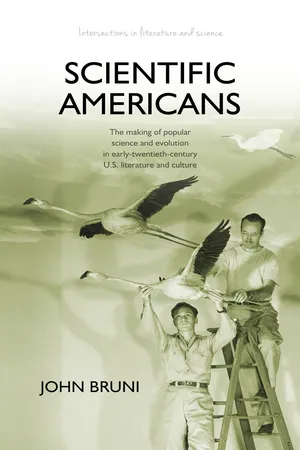
eBook - PDF
Scientific Americans
The Making of Popular Science and Evolution in Early-Twentieth-Century U.S. Literature and Culture
- 258 pages
- English
- PDF
- Available on iOS & Android
eBook - PDF
Scientific Americans
The Making of Popular Science and Evolution in Early-Twentieth-Century U.S. Literature and Culture
About this book
Information
Table of contents
- ToC
- Cover
- Acknowledgements
- List of illustrations
- Introduction
- 1 Popular Science, Evolution and Global Information Management
- I. Reconstructing the social and scientific
- II. Scientific and cultural narratives of expansion
- III. Information and control systems
- IV. Historicizing science
- 2 Dirty Naturalism and the Regime of Thermodynamic Self-Organization
- I. Social regulation and the power of art
- II. Self-organization and energy flows
- III. Ecocriticism and thermodynamics
- IV. Social work and moral parasites
- 3 The Ecology of Empire
- I. The Call of the Wild and the national frontier
- II. Wild Fang and the ideology of domestication
- III. The multiplicity of animal bodies
- IV. Ghosts of American citizens
- V. Where to draw the line? Biological kinshipand legal discourse
- 4 After the Flood: Performance and Nation
- I. Managing life
- II. Business morality and Western water policy
- III. ‘Constitutional restlessness’ and ‘something not ourselves’
- IV. Systems of art: perception and communication
- V. Pure fiction
- 5 The Miseducation of Henry Adams: Fantasies of Race,Citizenship and Biological Dynamos
- I. Evolution as historical process
- II. Thermodynamics and citizenship
- III. The new American as techno-subject
- IV. Beyond evolution: information, control and paranoia
- V. ‘The Rule of Phase Applied to History’
- VI. ‘A Letter to American Teachers of History’
- Conclusion
- I. Henry Adams: ecocritic?
- II. ‘Cyborg politics’ and the technoscientific regime
- III. The American System and global debt
- IV. Biopolitics and posthuman life: the call of Jack London
- Epilogue
- Notes
- Bibliography
- Index
Trusted by 375,005 students
Access to over 1.5 million titles for a fair monthly price.
Study more efficiently using our study tools.
Frequently asked questions
Yes, you can cancel anytime from the Subscription tab in your account settings on the Perlego website. Your subscription will stay active until the end of your current billing period. Learn how to cancel your subscription
No, books cannot be downloaded as external files, such as PDFs, for use outside of Perlego. However, you can download books within the Perlego app for offline reading on mobile or tablet. Learn how to download books offline
Perlego offers two plans: Essential and Complete
- Essential is ideal for learners and professionals who enjoy exploring a wide range of subjects. Access the Essential Library with 800,000+ trusted titles and best-sellers across business, personal growth, and the humanities. Includes unlimited reading time and Standard Read Aloud voice.
- Complete: Perfect for advanced learners and researchers needing full, unrestricted access. Unlock 1.5M+ books across hundreds of subjects, including academic and specialized titles. The Complete Plan also includes advanced features like Premium Read Aloud and Research Assistant.
We are an online textbook subscription service, where you can get access to an entire online library for less than the price of a single book per month. With over 1.5 million books across 990+ topics, we’ve got you covered! Learn about our mission
Look out for the read-aloud symbol on your next book to see if you can listen to it. The read-aloud tool reads text aloud for you, highlighting the text as it is being read. You can pause it, speed it up and slow it down. Learn more about Read Aloud
Yes! You can use the Perlego app on both iOS and Android devices to read anytime, anywhere — even offline. Perfect for commutes or when you’re on the go.
Please note we cannot support devices running on iOS 13 and Android 7 or earlier. Learn more about using the app
Please note we cannot support devices running on iOS 13 and Android 7 or earlier. Learn more about using the app
Yes, you can access Scientific Americans by John Bruni in PDF and/or ePUB format, as well as other popular books in Biological Sciences & Science General. We have over 1.5 million books available in our catalogue for you to explore.