- English
- ePUB (mobile friendly)
- Available on iOS & Android
eBook - ePub
About this book
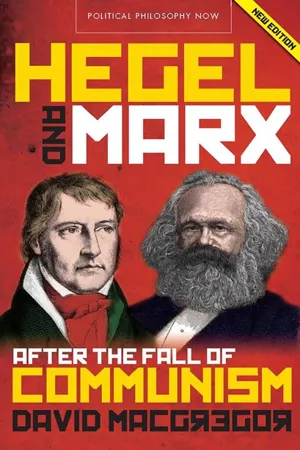
The collapse of the Soviet Empire led many to think communism and perhaps socialism were no longer relevant to the modern world. Hegel and Marx after the Fall of Communism presents a balanced discussion for and against the validity of the arguments of two of the most important political philosophers of all time. It re-interprets their philosophies, and analyses the dynamic between Hegelian and Marxist thought. The final chapter also theorises the possible future for Hegel and Marx in the 21st Century.
Information
Publisher
University of Wales PressYear
2014Print ISBN
9780708314302
9780708314296
Edition
2eBook ISBN
9781783162284
1 • Marx’s Relationship with Hegel
Introduction
This chapter will look at the ways Marx’s relationship with Hegel has been characterized, starting with Marx’s own assessment. We shall also learn how antagonism toward Hegel has affected the presentation of Marx’s connection with him.
First, I survey Marx’s own version of his relationship with Hegel, and then examine the distrust and hostility of many writers, including contemporary Marxists, toward Hegel. Two of the most influential accounts of the Hegel–Marx relationship – those provided by Georg Lukács and Friedrich Engels – are discussed. We shall discover that the presumed disparity between Hegel’s writings as a young man and his mature work has created difficulties for commentators. The young Hegel is seen virtually as a proto-Marx; while the mature philosopher is viewed as a betrayer of the principles of his youth and a supporter of the Restoration. By contrast, Marx’s lifelong partner, Friedrich Engels, did not regard Hegel as a toady of the Prussian state. Although its argument has been widely disputed, Engels’s Ludwig Feuerbach and the End of Classical German Philosophy remains a classic statement on the Marx–Hegel problem. His piece offers a valuable viewpoint on some substantive areas in Hegelian theory.
The second half of this chapter applies Hegel’s dialectic of history, as interpreted by Engels, to the fall of communism in Eastern Europe and the former Soviet Union. I use the beginning of the nuclear era with the bombing of Japan to illustrate Engels’s (flawed) rendering of Hegel’s concept of truth. My key argument throughout this chapter is that the differences between Hegel and Marx have been exaggerated – not least by Marx and Engels. I hope to show that a reconstruction of the relationship between Hegel and Marx can shed light on the world-shaking events after the fall of the Berlin Wall in 1989.
Unlikely testimony
The problem of Marx’s relationship with Hegel has sparked extensive debate. The difficulty is compounded by the fact that we have the testimony of only one of the persons involved. Marx was just thirteen years old when Hegel died in 1831. In a sense Marx’s entire intellectual life was spent in the shadow cast by Hegel, perhaps the greatest member of the German idealist tradition, one of history’s most challenging philosophical dynasties.
Marx’s unsuccessful struggle to escape the mesmerizing influence of Hegel forms part of the puzzling legacy he left to his followers. During the crucial years following the outbreak of the First World War, V. I. Lenin, the founder of Soviet communism, also fell under Hegel’s spell. While building the communist movement that would capture power in the 1917 October Revolution, Lenin secretly grappled with the nature of the Hegelian heritage to Marxism. As Kevin Anderson points out, ‘Lenin was the first Marxist leader or theorist since Marx to undertake the type of serious Hegel studies exemplified in the work he did on Hegel’s Science of Logic from September to December 1914, studies he expanded in 1915 to include other works of Hegel.’1
Most interpreters have taken at face value Marx’s legendary gloss on his connection with Hegel, which appears in the 1873 Postface to the second edition of volume 1 of Capital. Phrases from this famous three-paragraph assessment, written when Marx was fifty-four years old, appear again and again in every commentary on the Hegel–Marx problem. It is worth looking at these paragraphs in detail, keeping in mind the context within which they were written.
In the 1873 Postface Marx was seeking to deflect criticism – including his own self-criticism2 – that he relied too heavily on Hegelian methodology. The ruling empiricism of the mid-nineteenth century put under a cloud any social investigator foolish enough to make a direct appeal to idealist forms of thought. Fourteen years earlier in the Preface to A Contribution to the Critique of Political Economy3 – where he talked about his intellectual growth – Marx concealed his massive late 1850s return to Hegel in the Grundrisse, a work left unpublished in his lifetime that provided the foundations for Capital. As Marx’s biographer, Jerrold Seigel, points out, the three-paragraph account in the 1873 Postface also contains ‘strange and unrealistic’ testimony.4
Marx characterizes his ‘dialectical method’ as ‘not only different from the Hegelian, but exactly opposite to it’. Hegel, says Marx, believes that the ‘process of thinking, which he even transforms into an independent subject, under the name of “the Idea”,’ creates the world, ‘and the real world is only the external appearance of the idea’. For Marx, on the other hand, ‘the ideal is nothing but the material world reflected in the mind of man, and translated into forms of thought’.5
Omitted in this passage is an account of how the material world itself is constructed. Marx seems to be subscribing to a pre-Kantian description of the mind as a passive receptor of sense impressions, a view he decisively rejects elsewhere. Marx must have known that calling his method the ‘opposite’ of Hegel’s led him onto treacherous ground. Dialectic is all about the interaction and union and supersession of opposites.
Marx wants to make it clear that he has escaped the clutches of Hegel’s idealism. ‘I criticized the mystificatory side of the Hegelian dialectic nearly thirty years ago, at a time when it was still the fashion.’ Marx finds much to appreciate in Hegel, whose reputation, he points out, was being slandered in Germany during the period that ‘I was working at the first volume of Capital’. Marx claims that his outrage at ‘the ill-humoured, arrogant and mediocre epigones who now talk large in educated German circles’, and who treated Hegel ‘as a “dead dog,” ’ led him to ‘openly avow[] myself the pupil of that mighty thinker, and even, here and there … [to] coquette[] with the mode of expression peculiar to him’.6
At the very least this is an odd reason to adopt the views of a thinker: because everyone else rejects him. Moreover, as many observers have noted, Marx does more than ‘coquette’ with Hegelianism in Capital. In the past twenty-five years scholars have mined a whole new area on the Hegelian resonances in Marx’s magnum opus. Even a casual glance through volume 1 of Capital confirms that Hegel is indeed a presence. There are allusions to, and direct quotations from, Hegel’s mature writings, including the Encyclopaedia Logic, the Philosophy of Right, and the Science of Logic. Remarkably, all of the references are in a positive, even laudatory vein; none mention a quarrel with Hegel’s idealism. Except for one or two on dialectic method, and another on natural science, the quotations concern relations of property, social class and the labour process. These selections from the corpus of Hegel’s work are of great significance for our study. I want to show that Hegel’s influence on Marx rests precisely on the more solid, materialist relations of property, class and labour.
In his 1873 confessional, Marx contrasts the ‘mystified form’ of Hegel’s dialectic, ‘which seemed to disfigure and glorify what exists’, with the ‘rational form’ it takes in Marx’s own hands. Nevertheless, he blames the ‘mystified’ use of dialectic more on followers of philosophical ‘fashion in Germany’ than on Hegel himself. Hegel is ‘the first to present its general forms of motion in a comprehensive and conscious manner. With him, it is standing on its head. It must be inverted, in order to discover the rational kernel within the mystical shell.’ Obviously for Marx something akin to his own rational dialectic was practised as well by Hegel. ‘In its rational form’, says Marx,
[i]t is a scandal and an abomination to the bourgeoisie and its doctrinaire spokesmen, because it includes in its positive understanding of what exists a simultaneous recognition of its negation, its inevitable destruction; because it regards every historically developed form as being in a fluid state, in motion, and therefore grasps its transient aspects as well; and because it does not let itself be impressed by anything, being in its very essence critical and revolutionary.7
The view that I will develop in this book is that Hegel’s method is very much the same as Marx’s ‘rational dialectic’.8 By approaching the two thinkers in this way we can better understand our own situation after the fall of Soviet communism, and maybe peer into the future.
Guess who’s coming to dinner?
Resolving the complex relationship between Hegel and Marx is certainly made difficult by the unreliable character of Marx’s own statements on the subject. Another obstacle is the distrust and hostility of many toward Hegelian thought. The great German writer Goethe liked to have guests over without informing his family of their identity. One day in 1827 he invited the famous philosopher Hegel to dine. After Hegel’s departure Goethe asked the sister of his daughter-in-law what she thought of the mystery guest. ‘Strange,’ she replied. ‘I cannot tell whether he is brilliant or mad. He seems to me to be an unclear thinker.’9
She was not alone in her negative opinion. After Hegel’s death, the philosopher Schopenhauer – who taught along with Hegel at the University of Berlin in the 1820s – accused him of ‘the greatest effrontery in serving up sheer nonsense, in scrabbling together senseless and maddening webs of words, such as had previously been heard only in madhouses’. Hegel’s philosophy, fumed Schopenhauer, ‘became the instrument of the most ponderous and general mystification that has ever existed, with a result that will seem incredible to posterity, and be a lasting monument of German stupidity’.10
Countless writers have shared Schopenhauer’s opinion, from the noted English philosopher Bertrand Russell to the logical positivist, Karl Popper. The Frankfurt School philosopher Theodor Adorno put it this way:
In the realm of great philosophy, Hegel is no doubt the only one with whom at times one literally does not know and cannot conclusively determine what is being talked about, and with whom there is no guarantee that such a judgement is even possible.11
Among the majority of Marx’s followers today feelings about Hegel range from incomprehension to outright rejection. Terrell Carver complains that ‘the analytical character of Marx’s thought was derived from German idealism, a philosophical tradition alien to most English readers and arguably to the English language itself’.12 For the analytical Marxist school, ‘the idea that [Hegel’s] dialectics constitutes a sound way of reasoning, superior to formal logic for purposes of elaborating social theory, is … false and pernicious’.13 In the opening essay of a recent collection on the future of Marxism Douglas Kellner argues that Hegel is Soviet totalitarianism’s ‘spiritual ancestor’. Like Stalin, Hegel believes ‘that the overcoming of alienation requires total submission to the community, whereby individuals gain their liberty’. Kellner submits that ‘For Hegel, the state was the incarnation of reason and freedom, and it was the citizen’s duty to recognize this and to submit to the dictates of the state.’14
The day after Hegel’s surprise appearance at Goethe’s household, he was invited again for tea. The celebrated philosopher entertained his host with an attractively simple explanation of dialectic as the ‘methodically cultivated spirit of contradiction which lies within everyone as an innate gift and which is especially valuable for discerning truth from falsehood’. Anticipating analytical Marxism, Goethe worried that such expertise might actually be used to ‘turn falsehood into truth and truth into falsehood’.15 Hegel, however, always contended that his method was only common sense. ‘Genuine common sense’, he had remarked thirty years before, ‘is not peasant coarseness, but something in the educated world which freely and forcefully confronts the fetishes of culture with the truth.’16
As we have seen, Marx’s own attitude to Hegel actually grew from intense doubt about Hegel’s version of dialectic. Such distrust characterized the radical German intellectual environment of his youth. While Hegel was alive, competing factions retailed entirely different versions of his philosophy. These solidified into Old Hegelians and Young Hegelians a few years after Hegel’s death. Old Hegelians saw Hegel’s ideas as a form of theology; Young Hegelians pursued the radical elements they thought they found in his philosophy. By the 1840s, however, a new form of Young Hegelianism emerged that rejected the teachings of the master.
This new Young Hegelian movement originated the idea that Hegel had to be stood on his head ‘in order to discover the rational kernel within the mystical shell’, as Marx put it three decades later.17 Marx eagerly embraced the new movement’s leading thinker, Ludwig Feuerbach. Once a student and ardent disciple of Hegel, Feuerbach reacted against the master in the late 1830s. He produced a series of works in the 1840s that badly damaged Hegel’s reputation among intellectuals of the period. According to Feuerbach, the only way to find truth in Hegel’s philosophy was to invert subject and predicate. The idea did not create the world, the material world created the idea.
Hegel as a ‘Young Hegelian’
A troubling complication in the job of untangling the Hegel–Marx connection is the change many writers have traced in Hegel’s own development. The Canadian philosopher Charles Taylor’s influential Hegel claims that around 1800, when he was thi...
Table of contents
- Half title
- Title page
- Copyright
- Dedication
- Contents
- Acknowledgements for the Second Edition
- Preface to the Second Edition
- Introduction
- 1 • Marx’s Relationship with Hegel
- 2 • Dialectics of Youth and Maturity
- 3 • Hegel’s Development, 1770–1801
- 4 • Hegel and Tom Paine in the Age of Revolution
- 5 • Revolution, Despotism and Censorship, 1801–1831
- 6 • Property and the Corporation
- 7 • Labour and Civil Society
- 8 • The State in Time
- Afterword to the Second Edition
- Notes
- Bibliography to the Preface and Afterword
Trusted by 375,005 students
Access to over 1.5 million titles for a fair monthly price.
Study more efficiently using our study tools.
Frequently asked questions
Yes, you can cancel anytime from the Subscription tab in your account settings on the Perlego website. Your subscription will stay active until the end of your current billing period. Learn how to cancel your subscription
No, books cannot be downloaded as external files, such as PDFs, for use outside of Perlego. However, you can download books within the Perlego app for offline reading on mobile or tablet. Learn how to download books offline
Perlego offers two plans: Essential and Complete
- Essential is ideal for learners and professionals who enjoy exploring a wide range of subjects. Access the Essential Library with 800,000+ trusted titles and best-sellers across business, personal growth, and the humanities. Includes unlimited reading time and Standard Read Aloud voice.
- Complete: Perfect for advanced learners and researchers needing full, unrestricted access. Unlock 1.5M+ books across hundreds of subjects, including academic and specialized titles. The Complete Plan also includes advanced features like Premium Read Aloud and Research Assistant.
We are an online textbook subscription service, where you can get access to an entire online library for less than the price of a single book per month. With over 1.5 million books across 990+ topics, we’ve got you covered! Learn about our mission
Look out for the read-aloud symbol on your next book to see if you can listen to it. The read-aloud tool reads text aloud for you, highlighting the text as it is being read. You can pause it, speed it up and slow it down. Learn more about Read Aloud
Yes! You can use the Perlego app on both iOS and Android devices to read anytime, anywhere — even offline. Perfect for commutes or when you’re on the go.
Please note we cannot support devices running on iOS 13 and Android 7 or earlier. Learn more about using the app
Please note we cannot support devices running on iOS 13 and Android 7 or earlier. Learn more about using the app
Yes, you can access Hegel and Marx by David MacGregor in PDF and/or ePUB format, as well as other popular books in Politics & International Relations & European History. We have over 1.5 million books available in our catalogue for you to explore.