- 240 pages
- English
- ePUB (mobile friendly)
- Available on iOS & Android
eBook - ePub
About this book
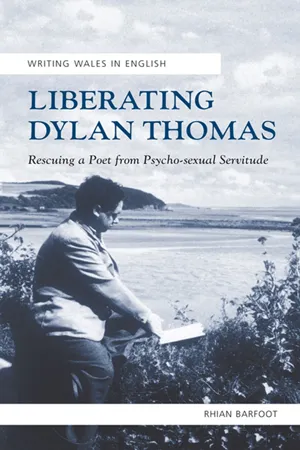
Throughout the history of Thomas's critical reception, psychoanalytic interpretations have been applied that have privileged the psychosexual over the psycho-linguistic elements of his work. The wealth of sexual and pseudo-sexual imagery has acquired a negative charge, and has been used to evidence claims that Thomas was the epiphon of his own disturbed psyche, thus reducing the poetry to the expression of the poet's schizoid neuroses. Avoiding the biography-based approaches that have dominated hitherto, Liberating Dylan Thomas rescues his early poetry from the position of servitude to the discursive mastery of psychoanalysis. Placing the poetry and psychoanalysis together in a mutually illuminating dialogue, this book clearly demonstrates the ways in which the vital connection between post-Freudian psychoanalysis and Thomas's early poetry can be articulated without reductive simplification.
Information
Publisher
University of Wales PressYear
2015Print ISBN
9781783161843
9781783162109
eBook ISBN
9781783161867
Part One
‘[M]aking deadly whoopee’: Dylan Thomas’s Jouissance of Influence
To proceed to a more intelligible exposition of the relation of the poet to the past: he can neither take the past as a lump, an indiscriminate bolus, nor can he form himself wholly on one or two private admirations, nor can he form himself wholly on one preferred period. The first course is inadmissible, the second is an important experience of youth, and the third is a pleasant and highly desirable supplement.
T. S. Eliot, 1919
he brings back into present time the origins of his own person. And he does this in a language that allows his discourse to be understood by his contemporaries, and which furthermore presupposes their present discourse.
Jacques Lacan, 1958
Am I not father too, and the ascending boy …?
Dylan Thomas, October 1935
Chapter 1
‘Every writer’, as Jorge Luis Borges neatly puts it, ‘creates his own precursors. His work modifies our conception of the past, as it will modify the future.’1 And this is certainly true of Dylan Thomas: as the inheritor of a modernism rendered problematic at a time of formal re-entrenchment in British poetry his work illuminates and is illuminated by both his predecessors and contemporaries alike. Yet, when his first slim volume, the laconically titled 18 Poems, appeared in 1934, a modernist lineage was anything but apparent to early reviewers. Indeed, for an audience whose readerly expectations had been nurtured largely on the modish propagandist verse of the preceding three to four years, the impression of sheer originality, created by his stylistically radical and rhetorically innovative writing, made the collection appear as if it were entirely without precedent. This said, however, the reception of 18 Poems was not, as John Ackerman has remarked, unlike the ‘baffled astonishment’that had greeted T. S. Eliot’s iconic poem, The Waste Land, more than a decade earlier.2 Different though their impact and message were, the shared insistence on complexity, innovation and an altogether explosive linguistic experimentation made the work of both these poets, particularly on first appearance, seem unparalleled and utterly unprepared for. And this, I would suggest, certainly goes some way to providing an explanation for the bewildering array of critical reactions to their work.
Although Eliot’s 1917 volume, The Love Song of J. Alfred Prufrock and Other Observations, had won the attention of the London literary avantgarde, it was of course his longer poem, The Waste Land, that launched him as a public figure. Overnight he became known to a readership that extended far beyond the small bohemian coterie in London with which he had been associated since his arrival there in 1914. Yet, ever since its first appearance in 1922, The Waste Land has stimulated a range of amazingly diverse reactions: if some have hailed the poem as the finest example of modernist art, reflecting in its own difficulties the complexity of the modern world, others have been suspicious about a work in which so much remains unclear, and even unfathomable. Similarly, when Thomas first came to the attention of the London literati via journal publication and culminating in the publication of 18 Poems in December 1934, his work stimulated a bewildering array of critical responses. Early publicists and defenders, like Edith Sitwell and Herbert Read, were inclined to statements such as Read’s famous ‘these poems cannot be reviewed; they can only be acclaimed’.3 Though equally vehement in his response, Thomas’s contemporary, Stephen Spender, on the other hand, could see ‘just poetic stuff with no beginning or end, or intelligent or intelligible control’.4 The more common and less extreme reactions that lay between these poles, although generally acknowledging the work to be powerful, original and astonishingly accomplished for a first volume, still tended to refer to the writing as ‘obscure’, ‘incomprehensible’ and ‘baffling’. The parallels with the reception of Eliot’s work are striking and, I would argue, more than merely coincidental to a properly contextualized understanding of Thomas, as a belated, but positive and critically engaged, modernist. However, whilst Eliot’s modernist credentials were firmly established, those of Thomas were most certainly not. If anything, there was a stubborn and insistent inability on the part of early reviewers to conceive of him as anything other than a sui generis writer, ‘a kind of literary naïf”, as John Goodby puts it, ‘who had emerged, Rimbaud-like, from a Welsh literary nowhere, [and] whose hywl [sic] and bardicism were an instinctual, “Celtic” revolt against the urbane, cerebral and socially discursive style of New Country’.5
Only one reviewer of 18 Poems, Desmond Hawkins, appears to have grasped the significance of Thomas’s unique hybrid fusion of Eliot and Auden:
[T]he Audenesque convention is nearly ended; and I credit Dylan Thomas with being the first considerable poet to break through fashionable imitation and speak an unborrowed language, without excluding anything that has preceded him … he is a grateful heir to Eliot’s magical sense of the macabre and to Auden’s textual firmness, but by inheritance rather than by imitation … Airmen and pylons are no longer stewed to a smooth fluency … [Thomas] is at present obsessed with the vocabulary of physiology in its more sinister aspect, and he is apt to repeat certain block-phases of a private code of thought. These are minor faults, however, and they vanish in the achievement of fusing metaphysical poetry into sensuous terms.6
Hawkins’s assertion that Thomas was not in fact, as the vast majority of early reviewers had suspected, a sui generis writer but the ‘grateful heir’ to both Auden and Eliot, will form the basic premise throughout the following discussion of what might well be described as Thomas’s imploded simulacrum of modernism. It will become apparent that the writing must be seen in its proper context, as a positive response to the high modernist poetry of 1918–28. It would certainly be true to say that Thomas’s hybrid tactics do indeed have much to do with his own hybrid identity, or sociocultural displacements, making it possible to read his poetry in a postcolonial way, and revealing hybridity to be transformed into a source of power. But this section of the book will concentrate more specifically on the way in which his unique fusion of the contemporary and the near contemporary is underwritten by an acute sense of belatedness. Distanced as he was from the literary epicentre, Thomas very consciously turned this ‘belatedness’to his own aesthetic advantage.
That writers assimilate and then consciously or unconsciously affirm or deny the achievements of their predecessors is, of course, as Sandra M. Gilbert and Susan Gubar have remarked, a central fact of literary history:
a fact whose aesthetic and metaphysical implications have been discussed in detail by theorists as diverse as T. S. Eliot, M. H. Abrahams, Erich Auerbach, and Frank Kermode. More recently, some literary theorists have begun to explore what we might call the psychology of literary history – the tensions and anxieties, hostilities and inadequacies writers feel when they confront not only the achievements of their predecessors but the tradition of genre, style, and metaphor that they inherit from such ‘forefathers’. Increasingly, these critics study the way in which, as J. Hillis Miller has put it, a literary text ‘is inhabited … by a long chain of parasitical presences, echoes, allusions, guests, ghosts of previous texts’.7
The first and foremost student of what might be described as this kind of literary psychohistory has been Harold Bloom. Applying Freudian structures to literary genealogies, Bloom has postulated that the dynamics of literary history arise from the poet’s ‘anxiety of influence’, that innate fear that he is not his own autonomous creator because the works of his predecessors assume some essential priority over his own works. The ‘anxiety of influence’ is thus Bloom’s metaphor of literary paternity: his paradigm of the sequential historical relationship between poets (and poet-critics) is the relationship of father and son, specifically as defined by Freud. Thus in Bloom’s account a ‘strong poet’ must engage in heroic warfare with his ‘precursor’, for involved as he is in a literary Oedipal struggle a man can only become a poet by somehow invalidating his poetic father.
When Thomas came of age as a poet in the early 1930s the poetic father was, of course, the premature patriarch W. H. Auden. Offering a viable alternative to the increasingly right-wing orientations of Eliot and Pound, Auden became so influential that critics named an entire generation of poets after him. But if the ‘Auden gang’ were busily engaged in slavish imitation of the exalted and newly appointed leader of the literary left, Thomas, who took no reputation for granted, was far more ambivalent in his response.
Bloom’s theory of influence is certainly useful for exploring the psycho-literary history of Thomas’s own poetic development, as long as one jettisons the central premise of a writer’s struggle to the death with his/her most seminal literary ancestors. Thomas’s relationship with his poetic ‘elders’ rather took the form of a sheer delight in ambivalent, exuberant play with their legacy. In this chapter, then, I will place Thomas in dialogue with Lacan and, also, with Julia Kristeva and attempt to read the enigma of his relationship with Auden and Eliot in terms of Kristeva’s ‘imaginary father’, and the Lacanian Oedipal complex [sic], according to which the father, of the third stage of Freud’s Oedipus complex, is transformed from the depriving and identificatory rival that he there is into the legal, symbolic father. He thus becomes enabling rather than disabling, empowering rather than emasculating. And this is what Lacan means by the term ‘paternal metaphor’:
In place of the imaginary phallus (understood as the mother’s illusory object of desire) there is a ‘metaphoric’ substitution of a symbolic identification with the phallus as a signifier of the mother’s desire (that is, as the symbol she lacks). In a word, the child is asked to abandon its identification with the mother’s phallus and to identify with the father who holds the phallus as a legal symbol.8
It would seem, then, that Lacan’s reformulation of his predecessor’s doctrine corresponds with a desire to find a solution to a problem; a problem that, as Mikkel Borch-Jacobsen insists, ‘Freud was already obsessed with but that Lacan was undoubtedly the first to have deliberately confronted’.9 That problem is the problem of identification: the alpha and omega, we might say, of the Oedipus complex – a problem that finds its origins in the mother/child dyad and culminates in the paternal metaphor.
‘[F]ROM THE FIRST DECLENSION OF THE FLESH’: INVENTING THE ‘I’
Lacan’s post-structuralist re-interpretation of the Freudian model of human psychological development is, by now, well known, but a brief and necessarily simplified overview will help establish the context of the present discussion. Lacan proposes a tri-partite schema , which involves the Real, the Symbolic and the Imaginary (RSI). These are the three ‘orders’ that constitute the psyche. The Imaginary is, as the term itself suggests, defined by pre-verbal images, and represents a state of symbiotic unity where the child’s self-identity is wholly defined in terms of his/her biological dependence on the (m)other. The mirror stage, stade du mirroir, is a central feature of this order and highlights the origin of individuation, that is to say, the recognition, the understanding, that one is separate from the mother, and that objets á – sounds, human waste, the ‘mother’s touch’, etc. – are also separate and distinct from the physical self. This discovery creates a sense of lack and, in turn, a desire to re-gain those things that are now felt to be ‘missing’. A successful negotiation of the mirror stage precipitates the child’s interpellation into the propositional and rule bound order of the Symbolic, which is characterized by an acute sense of fragmentation and division. Here the child becomes subject not only to social and cultural norms, but also, and most importantly for Lacan, to the laws of language, all of which are associated with the nom du père, the ‘Law of the Father’. Finally, the Real belongs to that most remote part of the psyche that exists both before and beyond the specular existence of the Imaginary, and the linguistic experience of the Symbolic. A kind of primal, brute materiality, as it were, that contains those strong emotions we might associate with birth, death and sexuality, the Real remains largely inaccessible to the individual, and can be glimpsed only fleetingly in moments of joy and pain, known as jouissance. Importantly, however, it should be understood that Lacan’s three orders are topological rather than chronological categories. In other words, while they are in one sense chronological, they are also, in another co-existent. The speaking subject can never, even after entering the Symbolic stage, truly rid him/herself of the Imaginary, just as he can never entirely escape the pressures of the Real. Thus, for Lacan, self-identity is entirely predicated upon the lifelong conflict between isolation and fragmentation and that innate desire for ‘wholeness’ and unity with the unattainable other.
Thomas’s poetry, like the writings of Lacan and, indeed, Kristeva’s post-Freudian psychoanalytic theory, is much concerned with creation and origins, and hence with conception, birth and infancy. But if Lacan was concerned, exclusively, with the birth of the speaking subject, the multiplicity of twentieth-century births to which Thomas’s poetry implicitly bears witness also entail a gesture towards sexual awareness and, perhaps, most importantly, towards poetic voice; since the poetry invariably uses terms that are interchangeable for adolescence and infancy. This merging of the ostensibly quite disparate processes of physical and poetic development is most clearly apparent in ‘From love’s first fever’ (1934). It is a poem that enacts the progress from a fascination with the stuff of words to awareness of their social and literary provenance and simultaneously tracks the progress from physical self-obsession to mature self-awareness.
One of the many miniature portraits of the artist that he composed in both verse and prose, this poem, by Thomas’s...
Table of contents
- Cover
- Title
- Copyright
- Dedication
- Contents
- General Editor’s Preface
- Acknowledgements
- List of Abbreviations
- List of Permissions
- Introduction
- Part One: ‘[M]aking deadly whoopee’: Dylan Thomas’s Jouissance of Influence
- Part Two: ‘[A]nd I am dumb to tell’: Presenting and Representing the Unrepresentable
- Part Three: ‘Toenails and Tumours’: Re-routing Abjection, From Pessimism to Parody
- Conclusion
- Notes
- Bibliography
Trusted by 375,005 students
Access to over 1.5 million titles for a fair monthly price.
Study more efficiently using our study tools.
Frequently asked questions
Yes, you can cancel anytime from the Subscription tab in your account settings on the Perlego website. Your subscription will stay active until the end of your current billing period. Learn how to cancel your subscription
No, books cannot be downloaded as external files, such as PDFs, for use outside of Perlego. However, you can download books within the Perlego app for offline reading on mobile or tablet. Learn how to download books offline
Perlego offers two plans: Essential and Complete
- Essential is ideal for learners and professionals who enjoy exploring a wide range of subjects. Access the Essential Library with 800,000+ trusted titles and best-sellers across business, personal growth, and the humanities. Includes unlimited reading time and Standard Read Aloud voice.
- Complete: Perfect for advanced learners and researchers needing full, unrestricted access. Unlock 1.5M+ books across hundreds of subjects, including academic and specialized titles. The Complete Plan also includes advanced features like Premium Read Aloud and Research Assistant.
We are an online textbook subscription service, where you can get access to an entire online library for less than the price of a single book per month. With over 1.5 million books across 990+ topics, we’ve got you covered! Learn about our mission
Look out for the read-aloud symbol on your next book to see if you can listen to it. The read-aloud tool reads text aloud for you, highlighting the text as it is being read. You can pause it, speed it up and slow it down. Learn more about Read Aloud
Yes! You can use the Perlego app on both iOS and Android devices to read anytime, anywhere — even offline. Perfect for commutes or when you’re on the go.
Please note we cannot support devices running on iOS 13 and Android 7 or earlier. Learn more about using the app
Please note we cannot support devices running on iOS 13 and Android 7 or earlier. Learn more about using the app
Yes, you can access Liberating Dylan Thomas by Rhian Barfoot in PDF and/or ePUB format, as well as other popular books in Literature & English Literary Criticism. We have over 1.5 million books available in our catalogue for you to explore.