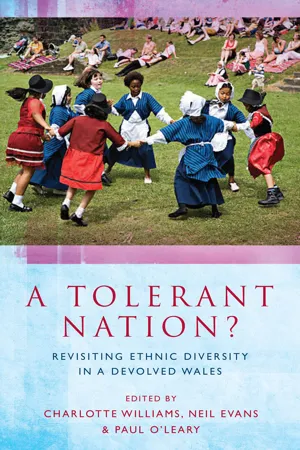
The population of Wales is the product of successive waves of immigration. During the industrial revolution many diverse groups were attracted into Wales by the economic opportunities it offered – notably Irish people, black and minority ethnic sailors from many parts of the world, and people from continental Europe. More recently, there has been immigration from the New Commonwealth as well as refugees from wars and oppression in several parts of the world. This volume engages with this experience by offering perspectives from historians, sociologists, cultural analysts and social policy experts. It provides analyses of the changing patterns of immigration and their reception including hostile and violent acts. It also considers the way in which Welsh attitudes to minorities have been shaped in the past through the activity of missionaries in the British Empire, and how these have permeated literary perceptions of Wales.
In the contemporary world, this diverse population has implications for social policy which are explored in a number of contexts, including in rural Wales. The achievements of minorities in sport and in building a multi-racial community in Butetown, for instance, which is now writing its own history, are recognised. The first edition of this book was widely welcomed as the essential work on the topic; over a decade later much has changed and the volume responds with several new chapters and extensive revisions that engage the impact of devolution on policy in Wales.
- English
- ePUB (mobile friendly)
- Available on iOS & Android
eBook - ePub
About this book
Information
Edition
2Subtopic
British History1
Immigrants and Minorities in Wales, 1840–1990: A Comparative Perspective1
NEIL EVANS
Václav Havel believes that a nation can be judged by the way it treats minorities.2 Wales has often measured itself favourably by this standard and outsiders have also applied the same rule. It is an encapsulation of one of the subthemes of the Welsh idea of the gwerin – the Welsh people were the most upright, God-fearing, radical, moral, philosophical, cultured and tolerant in the world. The principled internationalism of the gwerin receives some academic support from one of the major studies in modern Welsh social history, Hywel Francis and David Smith’s The Fed: A History of the South Wales Miners in the Twentieth Century.3 Here the proletarian solidarity of the miners – most marked in their support for Irish independence in the 1920s and the Spanish Republic in the 1930s – is seen as being rooted in the plural experience of the coalfield: minorities are so well integrated that they contribute more than their mite to the radical tradition.
More recently, a dissenting tradition has arisen from the work of historians who have excavated the tangled history of ethnic conflict in Wales. For instance, Paul O’Leary has unearthed twenty major violent incidents against the Irish between 1826 and 1882.4 Geoffrey Alderman and Colin Holmes have atomized the Tredegar anti-Jewish riots of 1911 and Jon Parry has examined the anti-Irish
disturbances of 1882. He eloquently understates the conclusion of the new line: ‘The Welsh have never been immune to prejudice.’5
I
Riots were not weekly or even annual events in modern Welsh history. However, there is evidence that an ethnic ordering of society was apparent in everyday situations. Migrants to south Wales in the nineteenth century moved along ethnically laid tracks. Until the 1890s, English incomers went predominantly to the ports, while the Welsh headed for the Valleys. Similar segregation was discernible within Swansea. The English and the Irish tended to settle in the town itself, and to form separate communities. The Welsh went for the northern industrial fringe in communities such as Landore and Morriston. Such a distribution implied differences in occupations as well as in residence, for the jobs of the commercial core would be quite different from those of the industrial villages. In the south Wales ports similar hierarchies existed; the best seafaring jobs were the weekly ships to London that allowed the maintenance of family life, and these were dominated by the native-born. Diverse ethnic groups filled the bulk of Cardiff’s tramp trade. This also applied in the coalfield, where those English people who arrived in the Valleys found that the best jobs – coal cutting – went to the native Welsh while they were left with haulage and surface work. The influx of English into nineteenth-century Wales also caused occasional friction, especially in the north Wales coalfield where this was one of the ways in which class solidarity was mobilized.6 There was a tradition of running English managers out of town, culminating in the incident that gave rise to the tragic Mold Riots of 1869. Accusations of favouritism shown to English colliers had formed the background to the conflict. Less evidence of this has come to light in south Wales, but there were occasional suggestions of conflict and hostility.
In 1874 Welsh workers backed locally based trade unions in preference to those from across the border in the ‘Red Dragon’ revolt, and later the Miners’ Federation of Great Britain was often referred to as ‘the English union’.7
The 1911 census showed that quite substantial foreign minorities were located in Wales. As south Wales in the previous decade had attracted incomers at a rate only surpassed within the Western world by the United States, this is not surprising. As far as the male population is concerned, areas of south Wales had high proportions of foreign-born. Cardiff was second only to London, while Swansea came fourth and Newport sixth. Merthyr trailed behind at thirty-fourth and Glamorgan at forty-third. The figures for women were quite different, with Cardiff coming seventeenth, Swansea twenty-first and Merthyr twenty-eighth. No figures were given for Newport and Glamorgan, which had insignificant proportions of foreign-born women. This implies that relatively few incomers emigrated as families, and meant that the potential for conflicts based upon sexual jealousy was always present. In marked contrast with this relative cosmopolitanism within Britain came rural Wales, the counties of which formed a solid phalanx from no. 6 to no. 11 in the table of counties with the highest proportion of native-born in Britain.
While some places in south Wales came to be quite cosmopolitan, they also had distinct cultural hierarchies. The Irish were often perceived as being less inclined to work than the native-born. Nor was the situation much different among the younger generation in the inter-war period. A survey of schoolchildren in different parts of Wales found a prevalence of stereotyped views of foreigners, often based on books and the cinema and which the authors thought offered little hope of fostering international understanding unless educational institutions intervened more directly.
Abercraf, at the head of the Swansea Valley, had diversity thrust suddenly upon it just before the First World War. In the space of a few years about 250 foreign migrants, mainly Spaniards, arrived. They were seen by many of the local populace as part of a devious ploy by coalowners to subvert the Minimum Wage Act of 1912 with cheap foreign labour. Their huts were said to be highly overcrowded, and the people themselves a moral threat. In July 1914 there were protest meetings that called for their expulsion from local pits, and an incident when native miners refused to work if they were allowed underground. M. Esteban defended his compatriots by claiming that the Spaniards were proportionately more unionized than the local miners and appealed to the international solidarity of the Welsh. The ‘moral panic’ in the agitation gives the lie to the claim by the chairman of a protest meeting (and the socialist newspaper Llais Llafur) that there was no hostility to foreigners as such in the campaign. In the end the issue seems to have been swallowed by the outbreak of war, and the growing prosperity that it brought.
Naturally, the bulk of such reactions came in industrial south Wales, but they were not confined to that area. One intriguing case of ethnic conflict occurred in mid-Cardiganshire at the turn of the century. The local lead industry had almost slipped into oblivion by then, but in 1899 a Belgian company bought the Frongoch mine near Ponterwyd. Some of the workers they engaged were Italians, who were placed in specially constructed barracks, and an old English Wesleyan chapel was converted as a Catholic place of worship. The employers sought to foster good feeling between the two sections of the workforce by providing a free tea, after which both communities sang their favourite songs. Yet the reputation of both countries as lands of song did not prove strong enough to overcome animosities that developed in the course of work. The whole enterprise was a marginal one, and the economic pressures exerted by management were intense. Resistance was conducted along ethnic lines with the Italians going out on strike on one occasion, followed by the Welsh on another. Once the Welsh bodily prevented the Italians from entering the mine. In one dispute dynamite was placed near the barracks of the Italians, and near the home of the mine captain. No-one was injured, and care was taken that this was the case, yet it is a scene more reminiscent of the American hard-rock mining frontier and the dynamiters of the Western Federation of Miners than of ‘tranquil’ rural Wales.
Not all settlements of ethnic minorities gave rise to pathological reactions, however. Jews, for instance, settled into Cardiff and formed a distinct but non-ghettoized community that seems to have suffered little overt hostility and to have been typical of the smaller Jewish settlements in British cities. The earliest Jewish settlements in Wales stretch back into the eighteenth century, and Swansea was probably the first town with a Hebrew community. In the late nineteenth century the influx of Jews fleeing East European pogroms pushed small numbers of them into scattered settlements in the Valleys. The chief rabbi visited south Wales and stressed that Jews were a community that had developed in parallel with the general development of Cardiff (and, by implication, of south Wales). A few worked underground but the strictly orthodox would not work the Saturday shift and were sometimes dismissed for this.8
The development of Italian settlements was similar. They came from a concentrated area of the country, Bardi in the Ceno Valley in Emilia-Romagna, escaping rural poverty to find a niche in the development of temperance bars in south Wales. Expanding prosperity drew them from Cardiff and other cities into the Valleys, and they became less clustered than the Italians who settled in England. They offered something new, even exotic, a welcome alternative to the pub. Many challenged the Sunday trading laws to provide a service and a profit – it was one of the more lucrative days of the week for takings. They recruited their labour from home along the padrone system and survived in a marginal trade by self and family exploitation. By 1938 they ran more than 300 cafes in south Wales. Because every cafe needed its catchment area, they never formed a concentrated community, and had few communal institutions. This meant that they were well integrated and formed only a loosely-knit community.9
Less edifying were the reactions to Gypsies. An encampment at Barmouth in 1901 drew the wrath of a local newspaper that demanded that it be cleared away, and in 1914 the Welsh Outlook published an interview with a Gypsy named Eli Burton who stressed that real Gypsies were not thieves, murderers or rapists and stressed the need for education. He argued that every town ought to have a field with proper conveniences and affordable camping fees. A hundred years on many of his descendants are still waiting.
Both world wars provide evidence of conflict and cooperation between ethnic groups in Wales. There was a rapturous early reception for Belgian refugees at the outbreak of the First World War, with crowds turning out on the streets in welcome, and hints that no society hostess was complete without at least one Belgian family to display. Large numbers were dispersed from Cardiff throughout south Wales, and offers of places exceeded the number of refugees. Many went to Swansea, where an existing community of metalworkers from Belgium provided the focus for settlement. Members of the Welsh intelligentsia foresaw a great cultural bonus for Wales because of the presence of so many distinguished writers and artists. Their talents were rapidly drawn upon in order to launch concerts that would finance the refugees’ stay. However, when it became evident that the war would not be over by Christmas, tensions began to emerge. It was felt that Belgians could be either working or, better still, fighting. Yet trade unions were sometimes suspicious of their claims to work. The South Wales Miners’ Federation was cool, but not hostile, when its opinions were sought. It did not oppose the claim of Belgians to jobs, but stressed that unemployment still existed in some areas of south Wales.10
A more sinister aspect of the wartime experience is a generalized hostility to aliens, encouraged by the governmental policies enshrined in the Aliens Act of 1914. The press emphasized the alien presence in south Wales, particularly in reporting court cases. For enemy aliens the situation could be frightening. At Aberystwyth a crowd set upon the septuagenarian Professor Ethé, who had given forty years of service to the University College of Wales. Much of the college and enlightened Welsh opinion was appalled, but this did not prevent him from being forced away from his chair (with a pension) in 1915. There was also an attack on German immigrants in Rhyl.11 The intolerant side of the heritage did not disappear at the end of hostilities. The dislocations of the war and a generalized hostility to ‘foreigners’ provided the backdrop to the anti-black riots in the ports of south-east Wales in 1919.
In the Second World War, evacuees from England played the part that the Belgians played in the First World War. There was an early welcome, and there are many stories of lifelong attachments being formed, which cannot be discounted. In the coalfield, in particular, this seems to have been a fairly smooth process. Yet there were also tensions, as East-Enders and Carmarthenshire farmers experienced culture shock in encounters that they both felt were too close. In north Wales the problems arose from the unsympathetic billeting of Catholic Irish from Liverpool on a highly Protestant Nonconformist population: ‘Bohemian Ideals versus the Puritan Ethic’, as one newspaper headline had it; Catholics were disturbed to find that the Protestant Sunday denied them both their church and the pub! Friction arose mainly out of the attempts by Catholic priests to enter homes to look after the spiritual welfare of evacuees, and the decision of many locals to take children to chapel services rather than to leave them unsupervised or with long walks to Mass. Plaid Cymru was concerned that the whole process was a threat to the Welsh language and culture, an issue that foreshadowed the issue of in-migration of the 1980s. Yet it failed to rally any significant support. Perhaps the friction was exaggerated by the shortage of solid news in the ‘phoney’ war, yet there certainly was some localized concern as the multicultural nature of Britain was forcibly displayed.12
During the war, it was chiefly the Italians who were on the receiving end. In Swansea, on the night that Italy entered the conflict, large crowds roamed the streets and damaged the property of Italian cafe owners. A cafe owner living at Aberdare later remembered having had a window broken during the war and there were also some incidents at Tonypandy. This hostility does not seem to have been long-lasting or even especially widespread. Perhaps Italians were too well established in south Wales for the feelings to be really intense. In Swansea, a suspicion that Italians had been involved in fascist movements and were sympathetic to Mussolini’s regime may have contributed to the outbreak. The deaths of many Italians from south Wales on the liner Arandora Star, which was taking them to wartime exile in Canada when it was sunk by a German U-boat, may have turned public feelings around. Italian and German prisoners of war were put to work in some parts of south Wales, particularly around Bridgend.13
After the war Italian workers were recruited to fill gaps in the workforce, along with other displaced persons from Europe. The census of 1951 showed a quite substantial rise in the numbers of foreign-born in Glamorgan and Monmouthshire as compared with the last pre-war census of 1931. At Llanelli there was some resentment at the Italian presence. Yet a clear legacy of the war was a general sentiment of hostility to fascism. In Cardiff, Butetown suddenly became respectable and a symbol of tolerance to the world, though actual behaviour towards blacks changed less than did the rhetoric. In the South Wales Coalfield there was a debate about the recruitment of black labour in 1948, though much of the comment was against the colour bar.
II
The momentous social changes of the nineteenth and early twentieth centuries were frequently punctuated by antiimmigrant riots, ranging from the first serious attack on the Irish in 1826 to anti-Jewish and anti-Chinese riots in 1911 and the assault on black newcomers in 1919. This ended a tradition of communal violence against outsiders, though this did not mean the end of ethnic violence.14 Does this mean that the troubles of the mid-nineteenth century and early twentieth century were simply problems of adjustment – once the Welsh came to understand their guests they learned to live peaceably with them? There is certainly some mileage in this argument. It seems to fit the Irish best of all. A string of riots over almost sixty years gave way to growing cooperation over Home Rule and labour politics in the 1880s. Wales and Ireland increasingly marched together in political terms from 1868 to 1922. In Cardiff an Irish ‘ghetto’ broke down and at least some of its former inhabitants experienced increasing prosperity. In the 1890s Cardiff had an Irish Catholic mayor. Indeed, the Irish were integrated enough to be among the major assailan...
Table of contents
- Cover
- Title
- Copyright
- Contents
- List of Contributors
- List of Illustrations
- List of Abbreviations
- Introduction: Race, Nation and Globalization in a Devolved Wales
- 1. Immigrants and Minorities in Wales, 1840–1990: A Comparative Perspective
- 2. Slaughter and Salvation: Welsh Missionary Activity and British Imperialism
- 3. The Other Internationalism? Missionary Activity and Welsh Nonconformist Perceptions of the World in the Nineteenth and Twentieth Centuries
- 4. Apes and Cannibals in Cambria: Literary Representations of the Racial and Gendered Other
- 5. Wales and Africa: William Hughes and the Congo Institute
- 6. Through the Prism of Ethnic Violence: Riots and Racial Attacks in Wales, 1826–2014
- 7. Playing the Game: Sport and Ethnic Minorities in Modern Wales
- 8. Changing the Archive: History and Memory as Cultural Politics in Multi-Ethnic Wales
- 9. Religious Diversity in Wales
- 10. Extending the Parameters of Social Policy Research for a Multicultural Wales
- 11. Experiencing Rural Wales
- 12. ‘This is the place we are calling home’: Changes in Sanctuary Seeking in Wales
- 13. Getting Involved: Public Policy Making and Political Life in Wales
- 14. Claiming the National: Nation, National Identity and Ethnic Minorities
Trusted by 375,005 students
Access to over 1.5 million titles for a fair monthly price.
Study more efficiently using our study tools.
Frequently asked questions
Yes, you can cancel anytime from the Subscription tab in your account settings on the Perlego website. Your subscription will stay active until the end of your current billing period. Learn how to cancel your subscription
No, books cannot be downloaded as external files, such as PDFs, for use outside of Perlego. However, you can download books within the Perlego app for offline reading on mobile or tablet. Learn how to download books offline
Perlego offers two plans: Essential and Complete
- Essential is ideal for learners and professionals who enjoy exploring a wide range of subjects. Access the Essential Library with 800,000+ trusted titles and best-sellers across business, personal growth, and the humanities. Includes unlimited reading time and Standard Read Aloud voice.
- Complete: Perfect for advanced learners and researchers needing full, unrestricted access. Unlock 1.5M+ books across hundreds of subjects, including academic and specialized titles. The Complete Plan also includes advanced features like Premium Read Aloud and Research Assistant.
We are an online textbook subscription service, where you can get access to an entire online library for less than the price of a single book per month. With over 1.5 million books across 990+ topics, we’ve got you covered! Learn about our mission
Look out for the read-aloud symbol on your next book to see if you can listen to it. The read-aloud tool reads text aloud for you, highlighting the text as it is being read. You can pause it, speed it up and slow it down. Learn more about Read Aloud
Yes! You can use the Perlego app on both iOS and Android devices to read anytime, anywhere — even offline. Perfect for commutes or when you’re on the go.
Please note we cannot support devices running on iOS 13 and Android 7 or earlier. Learn more about using the app
Please note we cannot support devices running on iOS 13 and Android 7 or earlier. Learn more about using the app
Yes, you can access A Tolerant Nation? by in PDF and/or ePUB format. We have over 1.5 million books available in our catalogue for you to explore.