eBook - ePub
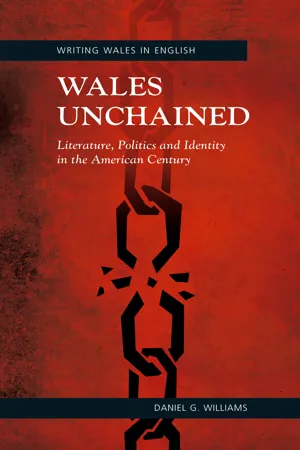
Wales Unchained
Literature, Politics and Identity in the American Century
- 272 pages
- English
- ePUB (mobile friendly)
- Available on iOS & Android
eBook - ePub
Wales Unchained
Literature, Politics and Identity in the American Century
About this book
In Wales Unchained Daniel G. Williams explores how Welsh writers, politicians and intellectuals have defined themselves – and have been defined by others – since the early twentieth century. Whether by exploring ideas of race in the 1930s or reflecting on the metaphoric uses of boxing, asking what it means to inhabit the 'American century' or probing the linguistic bases of cultural identity, Williams writes with a rare blend of theoretical sophistication and accessible clarity. This book discusses Rhys Davies in relation to D. H. Lawrence, explores the simultaneous impact that Dylan Thomas and saxophonist Charlie Parker had on the Beat Generation in 1950s America, and juxtaposes the uses made of class and ethnicity in the thought of Aneurin Bevan and Paul Robeson. Transatlantic in scope and comparative in method, this book will engage readers interested in literature, politics, history and contemporary cultural debate.
Information
Publisher
University of Wales PressYear
2015Print ISBN
9781783162123
9781783162116
eBook ISBN
9781783162147
The Lure of Race: Rhys Davies and D. H. Lawrence
I
In reviewing Rhys Davies’s ‘new style guidebook’ My Wales in 1937 George Ewart Evans was struck by the fact that the author’s analysis of industrial unrest was based on ideas of race:
Rhys Davies attempts to take a detached view of the conflict between miners and owners since the beginning of the last century. He sees the struggle isolated in South Wales, not a world-wide phenomenon. As a result he has startling theories of its cause. The strife in South Wales is a natural outcome of the presence of mixed breeds in the coalfield. What a notion! Comic of Bill Bristol, Mike and Dai working together in the same seam [sic]. But is fascist-fodder comic?1
By 1937 a view of society based upon racial differences was increasingly being connected with the rise of fascism but, as several critics have argued, the values that informed fascist ideas of society and culture played a significant part within European intellectual thought throughout the first half of the twentieth century.2 Indeed, one of the most striking, and disturbing, characteristics of novelist and short-story writer Rhys Davies’s writings is the way in which, throughout his career, he understood and described the world in racial terms. Individual characteristics, especially abnormalities, are given racial explanations throughout Davies’s writings. In the early short story ‘Arfon’ (1931), for instance, Mrs Edwards blames her husband’s racial background for their son’s ‘idiotic tendencies’: ‘Gipsy blood is in you.’3 Davies was still depicting the world in racial terms in his autobiography of 1969, Print of a Hare’s Foot, where the Rhondda Valley is depicted as a ‘mongrel place’ that nevertheless managed to nurture the ‘perfection of dark Iberian features’ that Davies perceives in his friend Caerphilly whom he decides must be ‘a throwback to some more splendid ancestry, a reminder of an old racial sumptuousness’.4
While this racial view of the world could, with some justification, be dismissed as ‘fascist fodder’, an account of Davies’s ideas of race is necessary if we are to achieve a full understanding of the social and political values informing his fictions. Furthermore, his racial conception of the world is indicative of a significant strain within Welsh writing in the first half of the twentieth century. The issue of race also throws an illuminating light on Rhys Davies’s, by now well-known, relationship with D. H. Lawrence. Society in the fictions of Davies and Lawrence is made up of distinctive racial groups, and their writings are indicative of a significant shift that occurred in the discourse on race between the late nineteenth and early twentieth centuries. This shift has been described as the replacement of a nineteenth-century universal concept of ‘Culture’ with a modernist, pluralist, definition of lower case ‘cultures’. The characteristic nineteenth-century commitment to a universal culture to which all people should aspire is seen to give way to the twentieth-century’s anthropologically informed awareness of cultural difference and pluralism.5 This shift in ideas of race can be traced by comparing the commitment to plural racial cultures that we encounter in the writings of Davies and Lawrence, with the desire to forge a single homogeneous common culture that we encounter in the writings of the leading Victorian social critic, Matthew Arnold. The argument that follows is informed by the writings of the critic Werner Sollors, who bases his analyses of ethnicity on a distinction between consent (the bonds of culture) and descent (the bonds of heredity and blood).6 Consent and descent are not mutually incompatible terms, but adopting these terms will allow me to isolate, within a varied and complex field, two divergent strains that are characteristic of racial thought in the late nineteenth and early twentieth centuries. My goal in what follows is to trace some of the roots of Davies’s and Lawrence’s racial ideas, and to explore the impact that their ideas of race had on their writings. Their racial understanding of the world has far-reaching consequences for their depictions of Wales and the Welsh.
II
The Welsh in Rhys Davies’s writings are represented in racial, primitivist, terms. Welshness is not defined by a consensual engagement in an historically developing culture, but rather is pre-programmed ‘into the blood’ of characters.7 The Welsh are thus defined according to a set of eternal, immutable and primitivist characteristics that are passed down through the generations; they ‘at heart are still bucolic and simple’ notes Davies in My Wales, ‘they still have their priceless Celtic sense of wonder, they are still beautifully child-like’.8 The ‘individual Welsh spirit’ is ‘poetic’ and ‘imaginative’, and the Welsh ‘seldom worry themselves with the weighty problems of modern civilisation’.9 ‘There is still a primitive shine on Wales’ he notes later, ‘one can smell the old world there still’.10 In Davies’s first novel The Withered Root (1927) the Welsh are described as ‘a race of mystical poets who have gone awry in some way’, and it is the fact that Reuben Daniels’s mother is of ‘the old pure Welsh blood’ that gives the preacher his poetic imagination, for ‘he of her descent would in other days have sung poems and carried his harp from village to village, a bard bred of the rough hills and wild people’.11 Reuben and his mother inhabit a valley described in the novel’s opening as ‘a community to itself’ in which ‘its rock-crowned hills imprisoned hardly any but the native Welsh, and in their bleak isolation the people lived with all the primitive force of the Welsh’.12
Davies’s primitivist depiction of the Welsh is most pronounced in the novel The Black Venus (1944) in which the ‘black Venus’ of the title is a statue owned by the ‘fiercely independent’ Lizzie Pugh. It stands as an incarnation of an uninhibited sexuality and a primitive resistance to industrialized society. The story is set in the rural village of Ayron, a place where ‘streams ran pellucid as in the dawn of time’, that feels ‘a thousand miles from the railway station’ and where, beyond the machinery of surveillance developed in industrial settlements, old Welsh customs such as ‘courting in bed’ – where, in cold houses with few rooms, couples would get to know each other in bed with a bolster laid between them – continue unabated.13 The racial difference represented by the black Venus mirrors the difference that Davies constructs between the native Welsh and the English who dismiss the indigenous population as ‘savages’ who go ‘prowling about in the night’.14 The black Venus of Rhys Davies’s novel is thus a symbol of both the Welsh self and the Other, of the Welsh people’s complicity in colonialism and their subjugation as colonized subjects, and of a primitivized rural past that the author – a native of the industrialized Rhondda – simultaneously longs for and disowns. These ambivalences constitute a key tension in much of Davies’s work. In My Wales, he tells his reader that a visitor to south Wales ‘will come across a distinct species of short and sturdy people with long, dark, curly heads and black eyes’.15
These ‘are probably descendants of those Silures of Iberian aspect whom Tacitus describes as being in possession of South-West Britain’. The Silurian is significant for Davies because he ‘is the oldest Welshman known to us by characteristic and feature’. These ‘characteristics’ are brought into focus on a train ride where the narrator witnesses an encounter between a Silurian and an American who ‘was bright as the morning, sharp as an arrow, and as full of swift lean strength’. But
when the Silurian entered at Brecon, and sat beside him, his brightness thinned, his movements appeared jerky, squirmy, controlled by nerves damaged in a civilisation that could not really touch the Silurian’s core. The Silurian’s vitality was warm, deep and shrewd; the mobility of his expression had a soothing beauty, he was perceptive of the earth and the things around him, from a source deep within him; he would know how to touch things. The American was living outside himself; I could see now that he was scarcely ever a part of his body; he jumped and careered about and jerked out questions about the land, brightly using his mind and storing information away in it, like a card-index.16
The American represents modernity, and is a man whose ‘nerves’ have been ‘damaged’ by modern civilization and whose mind works ‘like a card index’. The Silurian, in stark contrast, represents the ‘warmth, depth and shrewdness’ of a previous, and in some ways superior, civilization. The very presence of the Silurian forces the narrator to revise his views of the American, and results in a change both in the behaviour and consciousness of those present: the American’s ‘brightness thinned’ and the narrator becomes aware that the American ‘was living outside himself’ in a rationalized world where the functions of the mind are wholly disconnected from the experiences of the body. The collision between America and Wales is depicted as the collision of two racial types with fundamentally different instincts.
Tony Brown has noted that Davies, in developing his racial conception of Welshness, was drawing on the ideas of H. J. Fleure, professor of geography and anthropology at the University College of Wales, Aberystwyth.17 From the 1910s onwards Fleure dedicated himself to the exploration of racial types in Wales. Though Fleure was an outspoken critic of racism, he nevertheless based his analyses of British racial types on a distinction between ‘Nordic’, ‘Alpine’ and ‘Mediterranean’ stocks. While explicitly noting the dangers of applying the linguistic designation ‘Celtic’ to physical anthropology, he nevertheless believed that the ‘little dark people’ – the fundamental ‘Mediterranean’ type found in mid Wales – were ill disposed to industrialism and had cultivated religion, music and poetry while leaving commercial enterprises to the Nordic types. Born in Guernsey and concerned about the alienation bred by urban industrial societies, Fleure argued for the retention of those rural values that he believed persisted among the racial remnants in the more remote western areas of Wales. He viewed Wales as the ‘ultimate refuge’ of ‘old thoughts and visions that had been lost to the world’ and hoped that once the ‘fever of industrialism’ had subsided, the riches of the Celtic tradition would be rediscovered.18
In addition to Fleure’s influence, Davies was also indebted to his major literary influence and friend D. H. Lawrence for his conceptualization of the Welsh as a primitivist, anti-materialist and poetic people. In Print of a Hare’s Foot, Davies recalls that he ‘listened carefully’ to Lawrence’s argument that
What the Celts have to learn and cherish in themselves is that sense of mysterious magic that is born with them, the sense of mystery, the dark magic that comes with the night, especially when the moon is due, so that they start and quiver, seeing her rise over their hills, and get their magic into their blood. They want to keep that sense of the magic mystery of the world, a moony magic. That will shove all their chapel Nonconformity out of them.19
This ‘mysterious … moony magic’ that is associated with the Celts is embodied fictionally in the character of Morgan Lewis in Lawrence’s novella of 1924, St Mawr. Lewis, the groom from Merioneth, occupies a position in the novel ‘half-way’ between the coldly rational world of humans and the warm, instinctive world of animals.20 Lou notes that when she speaks to Lewis ‘I’m not sure whether I’m speaking to a man or to a horse’, and this animalistic primitivism is reflected in the fact that Lewis is made the spokesman for a mystical and magical view of life:21
If you didn’t go near the fire all day, and if you didn’t eat any cooked food nor anything that had been in the sun, but only things like turnips or radishes or pig-nuts, and then went without any clothes on, in the full moon, then you could see the people in the moon, and go with them.22
The emphasis on the moon and on primitive beliefs reinforce the image of the Celts that informed Lawrence’s advice to Rhys Davies. For both Davies and Lawrence the Welsh are perceived in racial terms as embodying a number of unchanging and eternal characteristics – imagination, a belief in the supernatural, a poetic temperament – and both authors thus continue a tradition of thought that extends back to the late eighteenth century. Walter Scott popularized such ideas in the contrast between the Gaelic culture of a feudal Highland society and the hard-headed commercial ethos of Lowland life in his novel Waverley (1814), a contrast which itself derived from the visions and fabrications of early romantics such as Thomas Gray and James Macpherson.23 However, the idea of the Celt received its most influential formulation, especially with regards to Wales, in Matthew Arnold’s lectures of 1866 On the Study of Celtic Literature.
Arnold begins his study of Celtic literature with a somewhat melancholy description of attending an eisteddfod in Llandudno, where, on an ‘unfortunate’ day of ‘storms of wind, clouds of dust and an angry, dirty sea’, he listens to the last representatives of a once proud tradition reciting verse in a language that Arnold admits he does not understand.24 Upon leaving the festival pavilion he meets
an acquaintance fresh from London and the parliamentary session. In a moment, the spell of the Celtic genius was forgotten, the Philistinism of our Anglo-Saxon nature made itself felt, and my friend and I walked up and down by the roaring waves, talking not of ovates and bards, and triads and englyns, but of the sewage question, and the glories of our local self government, and the mysterious perfections of the Metropolitan Board of Works.25
The English philistine’s world of material affairs, of instrumental activity, of the ‘machinery’ of industrial society, is juxtaposed to the creative, imaginative, poetic world of the Celt. As the contrast between English philistinism and Celtic creativity suggests, Arnold’s lectures were not primarily directed at the Celts themselves, but were concerned with exposing certain deficiencies within the emerging culture of England. Wales is thus pre...
Table of contents
- Cover
- Half Title
- Title
- Copyright
- Dedication
- Contents
- General Editor’s Preface
- Acknowledgements
- Introduction
- 1. The Lure of Race: Rhys Davies and D. H. Lawrence
- 2. Black and White: Boxing, Race and Modernity
- 3. Blood Jumps: Dylan Thomas, Charlie Parker and 1950s America
- 4. Class and Identity: Aneurin Bevan and Paul Robeson
- 5. To Know the Divisions: The Identity of Raymond Williams
- 6. ‘American Freaks’: Welsh Poets and the United States
- 7. Singing Unchained: Language, Nation and Multiculturalism
- Notes
- Bibliography
Trusted by 375,005 students
Access to over 1.5 million titles for a fair monthly price.
Study more efficiently using our study tools.
Frequently asked questions
Yes, you can cancel anytime from the Subscription tab in your account settings on the Perlego website. Your subscription will stay active until the end of your current billing period. Learn how to cancel your subscription
No, books cannot be downloaded as external files, such as PDFs, for use outside of Perlego. However, you can download books within the Perlego app for offline reading on mobile or tablet. Learn how to download books offline
Perlego offers two plans: Essential and Complete
- Essential is ideal for learners and professionals who enjoy exploring a wide range of subjects. Access the Essential Library with 800,000+ trusted titles and best-sellers across business, personal growth, and the humanities. Includes unlimited reading time and Standard Read Aloud voice.
- Complete: Perfect for advanced learners and researchers needing full, unrestricted access. Unlock 1.5M+ books across hundreds of subjects, including academic and specialized titles. The Complete Plan also includes advanced features like Premium Read Aloud and Research Assistant.
We are an online textbook subscription service, where you can get access to an entire online library for less than the price of a single book per month. With over 1.5 million books across 990+ topics, we’ve got you covered! Learn about our mission
Look out for the read-aloud symbol on your next book to see if you can listen to it. The read-aloud tool reads text aloud for you, highlighting the text as it is being read. You can pause it, speed it up and slow it down. Learn more about Read Aloud
Yes! You can use the Perlego app on both iOS and Android devices to read anytime, anywhere — even offline. Perfect for commutes or when you’re on the go.
Please note we cannot support devices running on iOS 13 and Android 7 or earlier. Learn more about using the app
Please note we cannot support devices running on iOS 13 and Android 7 or earlier. Learn more about using the app
Yes, you can access Wales Unchained by Daniel G Williams,Daniel Williams in PDF and/or ePUB format, as well as other popular books in History & Historical Biographies. We have over 1.5 million books available in our catalogue for you to explore.